


At a halfway point during the Great War (Aug. 12, 1916), the President of France, Raymond Poincare, a key figure in the July Crisis that led to the war, walked by leaps and bounds to Chateau, on home soil, to meet King George V, his main ally in the global conflict.
The king was on a one-week inspection tour of his country’s forces, which were deployed, at Poincare’s request, to northern France in a bid to lock the German into place. However, while both visits were ostensibly meant to instill into soldiers the spirit of military pride and glory, a totally different reality lay behind the scene.
One-to-one, the nationalist president confides to the traditionalist king that France must grind the war to a halt as soon as opportunity presents itself. One week after this terse conference, the German Chancellor Theobald Bethmann Hollweg — also a key figure in the July Crisis — pens a decoded telegram for a negotiated peace to ambassador Johann von Bernstorff to communicate it to the idealist American President, Woodrow Wilson.
Up to then, the United States was still a neutral country. Wilson had developed a wholly new vision founded on the notion that the war was as bloody as useless a stalemate, and that the most useful role for Washington to play was to promote mediation without crushing victory for either side of the conflict.
With that in mind, the peace-loving president had sent his most trusted advisor, Colonel Edward House, to Europe. House had been Wilson’s conduit into the great saloons of Europe, yet House kept his cards close to his chest.
However, Poincare’s opinion on peace was not shared by the French people. The waste of human life in Verdun and Somme was by all means heart-shaking. It was apparent that the French more than the British were feeling the edges of the Teutonic swords. In London, House claims to have found a certain inclination to entertain peace. Quite understandably, to allay British concerns, Foreign Secretary, Sir Edward Grey, extracted a debatable pledge from House to the effect that if Germany rejects peace, the U.S. may enter the war on the side of the Allies.
The British cabinet thereupon was scheduled to approve the peace in late May meeting. However, Arthur Balfour, then First Lord of Admiralty, wanted guarantees from Wilson regarding territorial concessions so far as Germany was concerned. On the surface, a speech made by Wilson days before the meeting apparently upsets the apple cart, yet the story reveals its self.
The Allies to all intents and purposes had no keen earnest in peace. Their arrangements and secret agreements could only be carried out in the case of complete German (and Ottoman) defeat. That very same month (May), Winston Churchill, Vice- Admiral of the Navy, assigns Mark Sykes, an advisor on Middle Eastern affairs and a character of charming traits, to enter into furtive talks with Francois Georges-Picot, France’s most imperialist diplomat, to set pen to a share- out of the Caliphate.
During the war, London and Paris developed a strategy for a joint offensive astride of the Somme. However, the Teutons hammered hard upon the anvil of Anglo- French force and prestige. This seems to have casted palls over particularly France.
After two years of hostilities, not a single shot was fired on German soil, not an enemy soldier has crossed its borders. It was against this backdrop that Berlin garnered an interest in a negotiated peace. This was a reversal of the German military tradition of ‘seek battle.’
Contrastingly, the War Office decides at this moment to roll the dice into the summer offensive of Somme. Massive military operations were undertaken, throwing millions of soldiers into the cogwheels of ruthless machinery. Yet, the British Army, “the flower of the nation,” in the words of Churchill, was mowed down by the German machine- guns. During Somme David Lloyd George takes the reins of Secretary of State for War consequent on the sudden death at sea of Field-Marshal, Horatio Kitchener.
Daunted, the King (Aug. 17) briefed Francis Bertie, his Ambassador to Paris, on the details of his meeting with Poincare. Four days later, Bertie meets Secretary General to Foreign Affairs, Jules Cambon, and Prime Minister, Aristide Briand. In the meeting, Paris and London lay stress on the necessity to continue the war until Germany is thoroughly defeated.
In the same vein, on August 25, Asquith met Briand at an inter-Allied financial conference in Calais. Oddly enough, returning home, Asquith, burns all his bridges when he untimely requests members of the cabinet to present their peace terms. Lloyd George seizes the opportunity and taps into the public mind as the natural national hero who would lead the nation to victory.
Not in the cards, a couple of days later, startling news seized the Reichstag. Romania, that small country anxious to find the winning side who might butter its unleavened bread, made common cause with the Allies. The loss of Bucharest would have been a great event, which would have changed the course of the war.
Pincers were closing fast upon Kaiser Wilhelm II, who on October 9, personally wrote a special memorandum which he directly transmitted to Bernstorff. In the memo, Wilhelm requests Wilson to call for a peace conference with the hope to bring together all states of the world. However, in a reference to Alsace-Lorraine and probably Belgium, Wilson is requested not to interfere in territorial problems. London, via Room 40, had the full knowledge of the peace proposal.
Undeterred, in November President Wilson secretly orders the Federal Reserve to instruct American bankers and investors (notably J.P. Morgan) to discontinue foreign currency loans to the Allies. This order comes days after the plan for the 1917 war efforts was almost approved.
At the outbreak of the war in 1914, Britain was the creditor nation of the world. However, as 1916 drew to a close, the British Empire was on the verge of total economic collapse. It was a financial catastrophe the war had inflicted on London. Quite mistakenly, the war was expected to be won before leaves come off trees. Yet it turned to be a rabbit hole.
In December, out of the blue, a pulpable political crisis grips London with the ultimate aim to bring down the government of Herbert Asquith, who had governed Britian since 1908. Asquith had recently declined a proposal by Lloyd George for the formation of an executive small war cabinet for the day-to-day running of the war. To Asquith, it was a coup in everything but name.
On December 7, Lloyd Geroge was appointed Prime Minister. Bertie flatly says “I suppose that Lloyd George and his fellow conspirators were resolved to get rid of Asquith or die in the attempt.” Days later, Grey goes to the Buckingham Palace to give up the seals of the office he held since 1905. Arthur Balfour succeeds him.
On December 12, Hollweg presented to the Reichstag the German proposal for peace. The Allies construe the proposal a sign of weakness. They were catastrophically wrong. That same day, Briand denounced in the French Chamber the proposal as “a trap.” Rome and Petrograd also rose in defiance.
However, though the terms on territorial annexations were vague, yet Berlin is said to have offered to evacuate Belgium (London’s pretension for declaring the war on Germany) and to retrocede Alsace-Lorraine (the hotly contested territories Berlin had occupied in 1871). Yet the proposal for compulsory service, which had meanwhile been passed into law may have given the appearance of a determination to continue fighting in case the offer was rejected.
Grey admits that the terms were not regarded those of victory for the Allies, but for Germany, many were the terms of positive defeat. Kaiser declared, the next day, that Germany was victorious in all theatres.
Six days after that date, Wilson, to adjudicate the world’s greatest dispute, addressed identical notes to all the belligerent powers, inviting them to state their war aims, and express their terms for mediated peace. The proposal left the way open for further discussions. The President apparently desired to compare the demands of both sides and arrive at a compromise. Berlin replied they would be happy to send delegates to a neutral town to discuss with Allied delegates the terms of peace.
The next day, and in his first ever speech made to Parliament (Dec. 19), Lloyd Goerge heaped scorn on Wilson’s offer of peace, and flamboyantly stated that Britain and its allies would fight until they carry the day. He went further reaffirming the British and French were settled on the fact that an acceptable peace could only come with the outright defeat of Germany. The speech caused anger and consternation, yet the truth was slowly dawning on the Central Powers.
Nevertheless, the governments of Central Powers proposed (Dec. 26) an early conference of representatives of the belligerents on neutral soil. Four days later, (Dec. 30) the Allies officially put the final nail in the coffin of Wilson’s peace note with their enunciated intention of destroying Germany. Their answer was partly the voice of Lloyd George. This gave ground to militarists.
The fear that Germany would have then the upper hand in Europe, and that Belgium would have been under its heel, made the peace note a very bitter pill to swallow. That, according to the British, would have cemented the opinion that London was always taking a hand and never taking a side. That said, Britian would have been discredited, isolated and left alone with no friends in the world.
It is upon such considerations of national pride that all endeavors aimed at peace came to naught and the war went on more ferociously. When all prospects of peace failed to the ground, the Kaiser early in January, laid the blame for the continuation of the war on the Allies.
Berlin, to end the war either way, would renew its submarine warfare in February, a move that consigns peace to grave once and for all. The love of peace, the Germans stated, can only be maintained when it is met by similar sentiments.
Choked off, the British Government was seeking every available sort of avenues to grease the wheels of war. Instigating Romania against Germany was a masterstroke, yet Bucharest was too a weak an anvil to endure the hammer. Great Britain was running out of options until opportunity presented itself in the boldest way. Chaim Weizmann, a notable Jewish figure and scientist from the Pale of Russia, who had made the acquaintance of British ruling elite.
Having a passion for chemistry, he had settled in Manchester in 1904, upon taking up a science appointment at its university. He met Churchill first in 1905, Balfour in 1906, and Loyd George in 1914. Weizmann was a persuader extraordinaire. Between 1914-16, he is said to have organized more than 2000 personal interviews, and wrote 1000 letters to British politicians and diplomats advocating his cause.
Suffice to say, he had to his name the acetone brand, a smokeless propellent used virtually in every British shell and bullet fired during the war. Without acetone, the guns fell silent. The patent caught the eye of Churchill, who was desperately in the pursuit of acetone. Weizmann gave London the right to his discovery without charge.
In the years preceding the war, Weizmann had tried hard to put the dream of Theodor Herzel into performance. He had induced chief British politicians to the restorationist Jewish cause. However, he came to realize that Jewish culture and tradition could never be restored while Palestine was in Ottoman hands.
With conferences dating back to the Pre- war era, the first-ever formal meeting between the British Government and Jews took place on February 7, 1917, when Mark Sykes held a historic meeting with Weizmann and Nahum Sokolow, a key Jewish-Polish diplomat, and six other prominent Jewish and Zionist figures in London.
In March, London leaked to the press the Zimmermann Telegram, a last straw in order to bring the U.S. to the war. Days later, the Russian embassy in London informed the Whitehall they had lost contact with Petrograd. For the Allies, the events which were said to have been repressed, drew the curtain on a very grim tale. Russia was out of the war.
By the time, France had incurred a considerable loss of prestige owing particularly to the rout at Neville Offensive, which was supposed to by an all- time victory, but ironically resulted to mutinies and desertion. Like Russia, France was crumbling from within.
Additionally, when Wilson declared war on Germany, his idea was to bring Berlin by detaching the Ottoman Empire from the Central Powers. For this very reason, Wilson did not declare war on Turkey. At this grim moment of the Great War, British and Jewish interests converge.
Furtively, on June 19, Balfour requested Walter Rothschild, head of the British Zionist Organization, and Weizmann draft a declaration of support for a Jewish homeland in Palestine. The Rothschilds carried out enormous weight in the financial as well political circles across the world. Weizmann was not slow to pick up the obvious key and fit it in the all- important lock.
Militarily, on June 21, Lloyd George tasked General Edmund Allenby with one plain mission, deliver Jerusalem as a “Christmas Present” to the British people. No more, no less. Allenby was initially reluctant to accept his transfer from France to the Middle East.
Now, since the Western Front was frozen into a stalemate, a diversion was needed to be made somewhere else. Palestine was increasingly becoming a sort of an all-time fight, as the advance seemed to be hanging fire. In a meeting in Aleppo (Jun. 24), the crux of which is disagreement, recapturing Baghdad and reinforcing Palestine loom large. Elsewhere, General Frederick Moberly, anticipated a new (third) Gaza offensive to be mounted in mid- November. Yet the British had to race against the clock.
To put the pedal to metal, Paris was promised a considerable share of spoils in the decrepit empire in case of an Allied victory. On June 4, Cambon had sent a letter to Sokolow, declaring his country’s unflinching support to the Jewish cause.
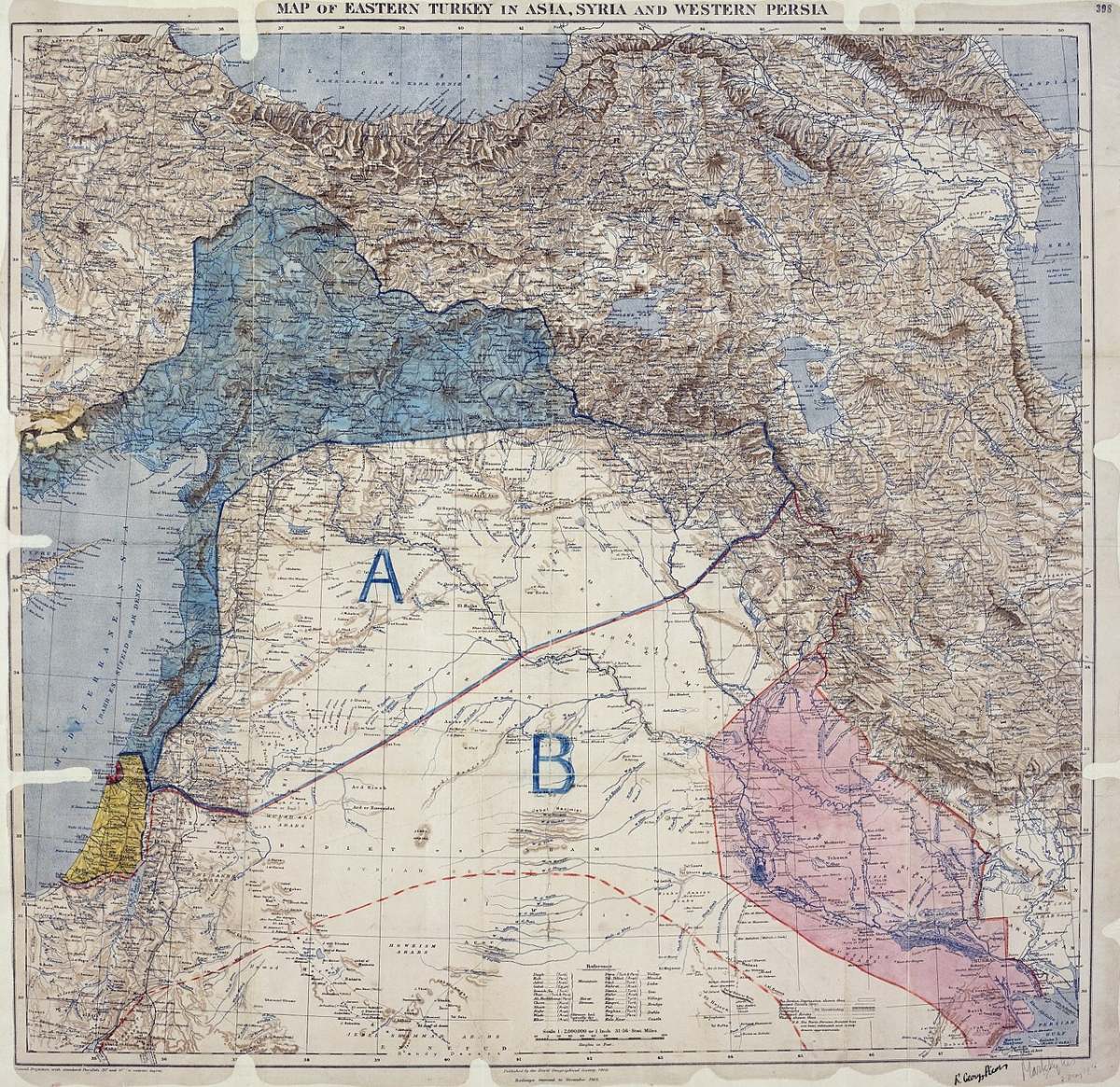
The Cambon declaration precedes Balfour’s not only in timing. It is the very first official statement and pledge of support given to the Jews in the Holy Lands. In the 1916 Sykes-Picot Agreement which designates Palestine as an international protectorate, France tacitly renounces its historical and cultural hegemonic claims to Palestine, which dates back to the Crusades, and which all the powers of Europe and the sultan himself recognized.
Politically, it became well known to Foreign Office that to uphold the prestige of the empire in the West, a strong hand was to be shown somewhere in the East. The Allies were vehemently in pursuit of any symbolic victory to offset the stagnated western front, come what way. Nothing more than a gleam of light that came up out of the Levant, telling a story of biblical restorationist connotations, seemed more appealing. The strong hand of Kaiser’s diplomats, economists, and advisors fanned the fumes of such an orientation within British decision-making circles.
Strange it may seem yet in 1915, the War Office had brushed off an offer by Zion Mule Corps, an all- Jewish unit unknown in the annals of the world since the days of Judas Maccabeus, who volunteered to assist the British in driving the Ottomans out of Palestine. At the time, Sir John Maxwell of British Army casted dire clouds over the Jewish aspirations in Palestine. “I doubt whether such an offensive will be launched at all.” Many things have changed, and there was a knock at the door.
At daybreak on August 4, 1916, German and Ottoman forces twisted the lion’s tail by daringly attacking the railhead at Sinai’s Romani, but they were given a bloody nose. Having been repelled, the attack triggered a chain of events. Romani turned into a black swan event. In December al-Arish was captured. Shortly thereafter, further pushes to the interior of Palestine were to be made. But from al-Arish to the southern approaches of Palestine lay vast and barren expanses of desert.
Romani riveted the attention on Desert Mounted Corps, made up primarily of young officers, NCO’s and men (farmers, peasants and shepherds) who traversed the vast tracts of the desert with nothing more than an ancient map and a compass to work on.
With two attempts to break the line in Gaza bearing no fruit, which painted a grim picture of reality, and produced enormous consequences on moral, Gaza turned into a graveyard for the British. It was increasingly becoming apparent this was a vain and useless engagement.
One of the first things to be attended to was to find a suitable means to cross the desert. General Harry Chauvel, who was given the command of Desert Mounted Corps, was looking for the best way point via which he might cut his teeth on the Turk.
In the meantime, not far afar, Thomas Lawrence who had been seconded by the Arab Bureau to liaise with Faisal ibn Hussein, had turned into a protagonist, adopting a war of detachment (hit-and-run operations) against thinly deployed Ottoman forces, across the vastness of Arabia of which his superiors in Cairo were in ignorance.
Lawrence and Chauvel have ground Arabs and Australians into a really efficient fighting force, co-opting them into a sort of medieval chivalry ready to beat themselves to death, which they did. Chauvel’s men in particular were of variety of different backgrounds who learned to shoot before they learned to shave. It is a rare episode largely ignored in the annals of the Great War.
In July 1917, to the shock of Turkish garrison, and disbelief of his superiors in Cairo, Lawrence galloped his ebullient nomads to the small yet strategically important town of Akaba, on the eastern horn of the Red Sea. The capture of Akaba made headlines. Akaba earned the British a toe fold (modern day FOB) deep in the enemy’s land.
In the vast expanse between al-Arish and the southern approaches of Palestine, with desert sandstorms and unforgiving dunes, made it impossible for conventional warfare to make a breakthrough. Seasoned cavalry units uniquely adapted to the environment were recalled.
With a practically continuous line of roughly 48 km distance, from the sea to a point south of Sharia, the Turkish position was strong. The light horse were some 22 km southwest of Sharia, and 28 km west of Beersheba, at the southern edge. The Ottomans have recently destroyed all wells in the no- man areas. Vitally, ‘the aces in the air,’ gave a tremendous advantage in terms of being able to see what the enemy was actually doing. Connectedly, there was an ace in the sleeve. Aaron and Sarah Aaronsohn had mapped all wells across the desert, and passed them to the British in Cairo.
Against the backdrop of clues shared by Aaronsohn, Beersheba posed itself as the best of options. It became the pivot of a new strategy. Its ancient wells added more weight to its strategic significance. Chauvel had clear instructions to capture the wells in the town before sunset. Otherwise, cavalry and horse would cripple to death. The extrication of the forces if they were defeated, would be impossible.
With extra bottles of water strapped to their packs, before daybreak of October 31, Chauvel galloped Australian and New Zealand cavalry to Beersheba, the biblical abode of Abraham, Sarah, and their son Isaac. Turkish forces were making desperate efforts to grasp the shock. However, nothing was impossible when determined men dashed to trenches which they carried at the point of the bayonet.
The confirmed news of the capture of Beersheba at 18:00, with 1700 Turkish prisoners of war, relieved diplomats in London. Strategically, the takeover rendered the Ottoman Empire impotent to avert the catastrophe. The way to the heart of Palestine lay open.
At last, Weizmann was to be granted the long- sought and the much- awaited reward on behalf of the nation. That same day, the War Cabinet put the last touches on a paper that would be known to posterity as the Balfour Declaration. It was the fifth version of a letter drafted by Weizmann and Rothschild some time back in June, hitching British fortunes to the Jewish.
No less than acetone, British sympathy and imperial policy, the Balfour Declaration was but the product of the convergence of interest that all crammed the Allies war effort into this historically debated, culturally contested and religiously diverse tract of land. It was the Magna Carta of the kicking out of the Holy Land of Ottoman Turks.
It could arguably be said that the British may have hoodwinked the Arabs, French, and Russians into lavish war-time promises merely to tie down the Ottomans in Hijaz, Syria, Palestine, and Mesopotamia and to relieve pressure from the Western Front, but the Balfour commitment is the rare combination of historical, cultural, religious, economic, social, and above all, imperial factors which played into Jewish aspirations.
While it is the biggest political event in the creation of the Middle East as a result of the Great War, yet the idea in itself was not a novelty. To rewind backward, on August 1, 1840, and having dined with Foreign Secretary, Henry John Temple, aka Lord Palmerston, Lord Ashley, a formidable Tory, requested the ‘God’s- chosen instrument’ to restore His ancient people to the Land of Promise, and cherish likewise the idea of ameliorating the condition of Christians there.
That said, the Church of England had since 1820s doing a good job in Jerusalem. Consequentially, on February 10, 1840, the foundation stone for the erection of a church on Mount Zion was laid.
More recently, since the Russian Pogroms of 1881, the Rothschilds have given firm support to establish communities for Jewish families migrating to Palestine. The Aaronsohns is fair example of Jewish migrants who came from Eastern Europe (Romania) and settled in Palestine in late 19th century and who were funded by the Rothschilds in the village of Zichron Yaacov. During the recent war, over claims of harboring enemy sympathies, the Ottomans had deported thousands of Jews from Palestine to Alexandria. They made the bulk of Zion Mule Corps, who fought in Gallipoli.
Six weeks after the capture of Beersheba, Allenby strode into Jerusalem with no fighting. The road to the rest of Palestine lay open. Yet it became very hard to traverse a land of bare, rocky hills, intersected by innumerable dry river beds, some of which rises at times to 100 feet or more in height. Heavily trudged through rain and mud, the upshot was that a pause to be made to the campaign until spring. Bu the happy occasion would soon be marred.
The publication by The Times of the Balfour Declaration (Nov. 9), and still more the revelation by Bolsheviks of Sykes- Picot’s (Nov. 24), caused consternation among Hashemites. To quench the vortex of Arab agitation, the Turks entered into secret talks to induce the ‘stabbed’ Arabs to the Turkish fold. By conferring Syria to the Hashemites, they were not mouthing empty phrases.
Early in 1918, Faisal received signals from Jamal Pasha to come to terms. Wilson jumped at the chance. To this end, he sent Henry Morgenthau to mediate peace. The Foreign Office detailed Weizmann to put a lid on Morgenthau, who instead of proceeding to Turkey went to communicate with General John Pershing in Biarritz, northern France.
The Treaty of Brest- Litovsk in March 1918 had restored to Turkey the provinces of Erzurum, Batlis, Kars, Ardahan, and Batum. The new situation, though it seemed dark at first, contained all the elements of promise for the Allies. In July and August, Turkish troops were recalled from Palestine to fortify the Caucasus front.
In September, Bulgarian soldiers left their position and left for home to “pick-up harvest.” What Bucharest had failed to do in 1916, Sofia did now in one week. Thanks to Allies propaganda and money. The battle of Megiddo in September 1918, brought the Palestine campaign to an end. It was too late for German Asiatic Corps who were deployed to Palestine to hold the front. The loss of Palestine was blamed on Anwar Pasha who held his ground. The empire that had for centuries straddled the region became past.
In October, Germany sued for peace. The position was different from that of 1916. Britian set the terms to end the war. When Damascus fell, Lawrence visited the tomb of Saladin, where the Kaiser back on November 7, 1898, had placed a satin flag and a bronze laurel wreath. This had irritated Lawrence on his pre-war visits to Damascus.
He was now to pick-up the wreath. Lowell Thomas, an American young man who had been sent to bolster public opinion about the war, took the Kaiser’s flag to America. He would then launch the legend of Lawrence of Arabia. Chauvel faded from public knowledge. Similarly, people’s sacrifices were folded into British communiques, and hard-fought achievements were credited to the wider imperial effort. The British wrote them out of the story.
In May 1919, six months after the war hand ended, a French train carrying German delegation to the peace conference in Paris, slowed to a deliberate crawl. The Teuton was made to view the scope and scale of unbelievable tragedy of human souls, for which he was saddled with bone- breaking IOU for plunging the world into unhinged mayhem. Was he?
The singular fact that British intelligence did not give John French earlier information while he was commanding the front at Mons of the fact that large German forces were marching upon him from the direction of Tournai in 1914, dissipates such an argument.
The Great War was the most political event in the history of the Middle East. Not less than the Bolshevik Revolution, the Battle of Beersheba is the most important event in the war so far as the Middle East is concerned.
In 1921, the term ‘Middle East’ was coined in Cairo. The next year, Britain was given a trusteeship over Palestine. The largely chaotic and basically unstable British rule abruptly came to an end, when in the midst of a hard winter (1947), London referred the case to the United Nations.
One year after that, the man who had picked- up the pieces of an ancient nation, went down to history as the first President of the State of Israel; Herzel’s Der Judenstaat. The achievement was the greatest, the happiest, and the grandest of his life. The wandering of the Children of Israel was presumably over. The rest – it is said – is history.