


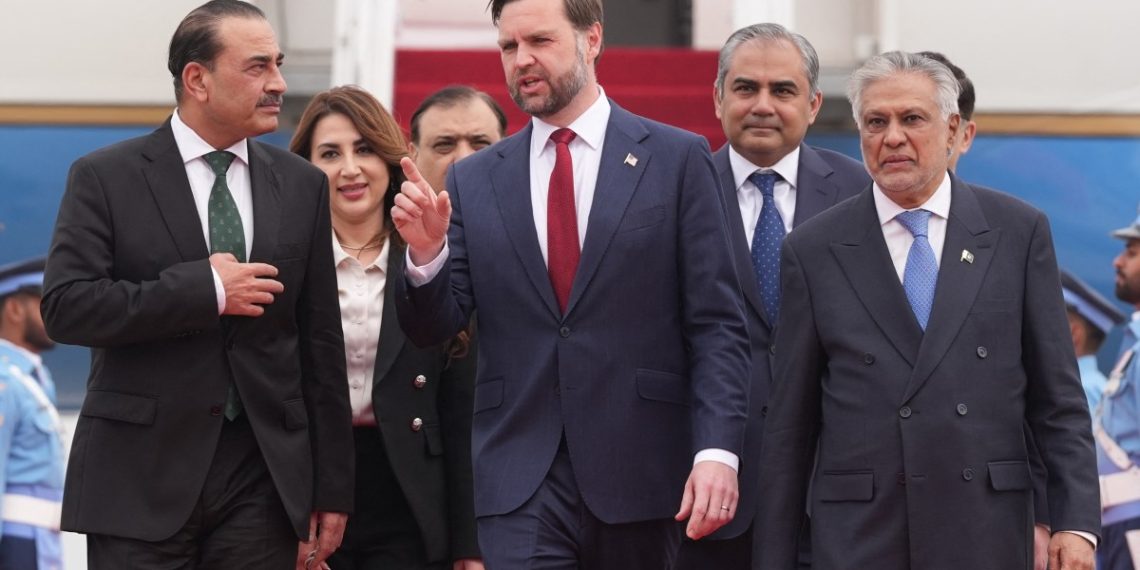
One of the striking phenomena highlighted by the war of February 28, 2026, and its truce on April 8, is the role played by Pakistan between the United States and Iran, as a venue for negotiations, a mediator, a messenger of ideas, and at times, a proposer of amendments. This is in addition to the visits conducted by Pakistani officials, such as the Chief of the Pakistani Army, who made several visits to Iran following a single visit to Washington after the truce was concluded. These visits closely resemble the shuttle diplomacy conducted by Henry Kissinger in 1974 between Israel, Egypt, and Syria following the 1973 war, which led to the two disengagement agreements between them and Israel. This phenomenon stood in stark contrast to Washington’s treatment of Islamabad in the post-September 11, 2001 era. Weeks after those attacks, the Americans overthrew Pakistan’s ally, proxy, and protégé in Afghanistan—the Taliban movement, which possesses a social base among the Pashtun ethnicity. In their place, they brought the anti-Pakistan “Northern Alliance,” dominated by Tajiks, Uzbeks, and Shia Hazaras, albeit with a Pashtun facade represented by Hamid Karzai, who was brought from his residence in the United States to govern Kabul. Numerous American hints emerged regarding Pakistan’s relationship with Al-Qaeda, which was practically founded in 1989 in the Pakistani city of Peshawar before being officially declared in 1998 from within Afghan territory by Osama bin Laden and Ayman al-Zawahiri. These hints turned into overt accusations by some officials in the administration of Barack Obama, who did not conceal his desire to utilize Pakistan’s chronic enemy, India, against China. This culminated when Bin Laden was killed in May 2011 by a special American unit, which reportedly carried out its mission without consulting or informing the Pakistanis, inside a house where the Al-Qaeda leader was hiding in the city of Abbottabad, no more than a few hundred meters from the Pakistan Military Academy.
But did this phenomenon, epitomized by Pakistan in this war and its truce, emerge without prior introductions?
Following the four-day war of May 7–10, 2025 between India and Pakistan, US President Donald Trump stated that he had “stopped the war between the two sides,” a claim praised by Pakistani Prime Minister Shehbaz Sharif, who also nominated Trump for the Nobel Peace Prize. Conversely, the Indian Foreign Minister denied Trump’s role in stopping the war before the parliament. The following month, the Chief of the Pakistani Army, General Asim Munir, was hosted for a dinner at the White House, an unprecedented occurrence for a foreign military official arriving alone in Washington without being part of a delegation led by civilian officials. This was followed by notable developments in August, such as the US State Department placing the “Balochistan Liberation Army”—an organization active in executing military operations against the central government in Islamabad—on the terrorism list. Subsequently, Trump imposed a 50% tariff on Indian goods exported to the United States, while the tariff on Pakistani goods was 19%. The most prominent event occurred in September, when a Pakistani-American agreement was signed for American investments aimed at exploring and extracting rare earth minerals such as lithium, cobalt, and tungsten (the latter being essential for steel hardening), alongside copper and gold. Remarkably, most estimates based on geological research indicate that the primary geographical arena for this agreement is the Pakistani province of Balochistan.
On September 17, 2025, a landmark event took place: the signing of the “Mutual or Joint Strategic Defense Agreement” between Saudi Arabia and Pakistan, which stipulates that “any aggression against one party is an aggression against both.” This came eight days after the Israeli raid on the Qatari capital, which sparked panic in Gulf capitals and prompted a search for a new protection umbrella alongside (or in addition to, or in tandem with) the existing American umbrella established for Saudi Arabia since the “security-for-oil equation” concluded by US President Franklin Roosevelt with King Abdulaziz Al Saud during their meeting aboard the ship anchored in the Suez Canal in March 1945. Notably, the aforementioned agreement meant breaking the Israeli nuclear monopoly in the Middle East, which had existed since the 1970s with the approval of the Richard Nixon administration in Washington, and bringing the weight of a nuclear-armed state into the region through that pact. It was also striking that the American-European West did not consider Pakistan’s acquisition of nuclear weapons in 1998 as a breach of this monopoly, given that Pakistan is geopolitically classified within the South Asia region. All the international efforts exerted by Washington against Iran’s acquisition of nuclear weapons are aimed at preserving this monopoly, which has been a tacit agreement since the 1970s between Washington and Tel Aviv. The assessment is that Iran turning into a nuclear state would drive numerous countries in the region to seek nuclear weapons, leading to a troubling state for the system of international relations since Stalin achieved nuclear duality in 1949, and since international relations were organized on the basis of mutual deterrence, which precludes resorting to the use of nuclear weapons after their acquisition by specific states. It is worth noting that the nuclear duality between New Delhi and Islamabad has been contained within this framework since 1998.
With the signing of that Saudi-Pakistani agreement, much analysis was stirred—tainted by political wishful thinking—suggesting that the agreement indicated Riyadh’s search for a military-security umbrella away from Washington, and that this constituted a shift toward a “Chinese axis,” driven by Saudi disappointment over a Gulf capital being bombed by Iran just a few kilometers away from where the US Central Command (CENTCOM) is headquartered. These analyses harbored and carried the conviction that Pakistan “exists within that Chinese axis,” repeating similar analyses launched by proponents of similar wishful thinking following the Beijing agreement on March 10, 2023, to normalize relations between Riyadh and Tehran, claiming that “China is advancing globally while the United States is retreating.”
One must admit that the Saudi-Pakistani agreement was not merely a striking phenomenon that defies easy interpretation; rather, it approaches a riddle that requires explanation and deconstruction (and perhaps the Pakistani role in this war, its truce, and their talks also approaches being a riddle). However, is it not highly probable that the American satisfaction with the Pakistani role in the war and its truce implies a tacit American approval that was present when that Saudi-Pakistani agreement was signed? Especially since this rapprochement, which reflects a strategic dimension between the United States and Pakistan, began in the summer of 2025, and consequently, Pakistan would not provoke Washington’s anger through a step representing a qualitative shift that disrupts regional equations established for half a century with American consent.
The American silence regarding what transpired between Riyadh and Islamabad last September 17 was noteworthy. This silence, which signifies Washington’s satisfaction, was contradicted by the adverse and hostile Israeli reaction to the agreement. Following it, Israelis began speaking of a “Sunni axis being formed,” as stated by Israeli Prime Minister Benjamin Netanyahu on the Sunday preceding the start of the war on Iran, which was launched on February 28, 2026. This war, in which this Pakistani-American harmony manifested, served as evidence that there is American approval of that agreement, which carried the desire to establish a Pakistani nuclear (and conventional weapon) umbrella for Saudi Arabia (and perhaps for other Gulf states) in the coming days. This implies a new vision for the region that transcends Saudi relations with both Tel Aviv and Tehran, hinting at something far beyond.
Most likely, this points to an American bet on a Pakistani role that Washington desires to link the security of South Asia with the Middle East, in order to use this connection against China (and most likely against Iran in the post-war and post-truce phase). This mirrors what Washington has been doing since 2021, when it began using the term “Indo-Pacific region,” also against China—a term introduced and declared by the Joe Biden administration that year to establish a security system under Washington’s leadership encompassing India, Vietnam, Indonesia, the Philippines, Japan, and Australia. The launching of this new security term—resembling the term “Atlantic shores” used with the creation of the North Atlantic Treaty Organization (NATO) in 1949—was striking when the “AUKUS” trilateral security partnership was signed on September 15, 2021 between the United States, the United Kingdom, and Australia. The American plans, which gained momentum with the outbreak of the Ukrainian war five months after that signing and the Chinese support for Putin, excluded Pakistan and placed India in an advanced position in the US strategy to contain China, much like George Kennan’s 1946 plan to contain the Soviet threat.
Hence, it is a venture to claim that the American rapprochement with Pakistan, which now resembles a honeymoon, represents an American abandonment of India or an American resignation to New Delhi’s swimming in the Russian orbit, and what might follow of a similar shift toward China after resolving the Sino-Indian border disputes dating back to the 1962 war. It appears that Washington is using its rapprochement with Pakistan to pressure India to force it away from Russia, which, despite American warnings, has since 2022 become the largest buyer of Russian oil sold at prices cheaper than those traded on the global oil market. It is also used to foil signs initiated by New Delhi since 2025 to resolve its disputes with China, which coincided with India crossing a major American red line when it announced its support for the plans of the Shanghai Cooperation Organisation’s Development Bank to trade in currencies other than the US dollar in international commercial exchanges.
Furthermore, this American-Pakistani rapprochement deeply unsettles China, which has invested sixty-five billion dollars in the economic corridor extending between it and the Pakistani coast. This corridor is deemed vital for bypassing China’s major strategic vulnerability, wherein the majority of its imports of oil, liquefied gas, and commodities, as well as Chinese exports, pass through the Strait of Malacca connecting the Indian and Pacific Oceans, where an American military base is located. Most likely, Pakistan swimming away from China and into the American orbit would constitute a major strategic American blow against Beijing. In recent years, Beijing had devised plans to use Pakistan as a land corridor for a gas pipeline transporting gas from Iran’s Pars field to China—a project that was obstructed due to the fear of international companies interested in the project, as well as the Pakistani government’s fear, of American sanctions.
In summary: When the government of Pakistani Prime Minister Imran Khan faced a vote of no confidence on April 10, 2022, he accused the United States of being behind it. He was succeeded by Shehbaz Sharif as Prime Minister. In the autumn of that year, Asim Munir was appointed Chief of the Pakistani Army, the highest military position in the country. In this regard, it must be recalled that Imran Khan was pursuing a policy of distancing from Washington and moving closer to both Beijing and Moscow during his premiership since 2018, amid an atmosphere of significant rapprochement between Washington and New Delhi. It was Imran Khan’s misfortune that his visit to Moscow came just a few hours after the start of the Russian invasion of Ukraine in the dawn of February 24, 2022.