


Many people were greatly surprised by the revelations made by Miles Copeland, the CIA’s Middle East intelligence officer, who was stationed under cover as a cultural attaché at the embassy in Damascus. In his book The Game of Nations (translated into Arabic in 1970, a year after its original publication), Copeland discussed Washington’s involvement in Husni al-Za’im’s coup in 1949. At the time, the focus of attention was primarily on Egyptian President Gamal Abdel Nasser, especially after Copeland revealed the CIA’s involvement in the 1952 Egyptian revolution.
However, those thick American veils began to lift somewhat with the publication of Ropes of Sand in 1980 by Wilbur Crane Eveland, a another CIA officer. Eveland disclosed the agency’s involvement, along with the British, in planning between the spring and fall of 1956 an attempted Syrian coup, called Operation Straggle. He also revealed the US’s unilateral planning for a second coup attempt, called Operation Wappen, which, like the first, was uncovered before it could take place in August 1957 by Colonel Abdul Hamid al-Sarraj, head of the Second Bureau.
Further details became clear with the declassification of US documents concerning the Middle East in 1988, covering the period from 1945 to 1958. Douglas Little analyzed these documents in a study titled Cold War and Covert Operations: The United States and Syria 1945–1958. (published in the Middle East Journal, Vol. 44, No. 1, Winter 1990, pp. 51–75).
According to the documents Little discusses, in addition to the failed plans for Operations Straggle and Wappen, the US was behind Husni al-Za’im’s coup on March 30, 1949, and Adib al-Shishakli’s second coup, which took place during the night of November 28–29, 1951.
Little states that Washington’s motivation for supporting al-Za’im was to find a new authority that would approve the Tapline oil pipeline project from Saudi Arabia. This was after the Syrian parliament blocked ratification of the agreement, with deputies demanding that the pipeline run through the Syrian coast rather than Lebanon. Shishakli—who, a week before his second coup, had supported plans to establish the Middle East Command (MEC), proposed by the US, Britain, France, and Turkey, in a conversation with Copeland at the US embassy in Damascus—led the coup against a government formed by his opponent, Marouf al-Dawalibi.
A review of US policy toward Damascus in the 1940s reveals the importance of the oil pipeline factor. During the 1950s, the focus shifted toward transforming the Middle East into a regional arena linked to NATO via the Turkish bridge through the MEC project, and later through the Baghdad Pact of 1955. This period also saw the rise of local communist influence and Syria’s shift to the left and eastward toward the Soviets between 1955 and 1957. This shift caused concern among US Secretary of State John Foster Dulles and his brother, CIA Director Allen Dulles, for whom the communist threat was the primary factor shaping their worldview.
According to Little, Washington was the driving force behind Ankara’s deployment of Turkish military forces toward the Syrian border in September 1957—just a month after Afif al-Bizri’s appointment as Chief of Staff of the Syrian Army, a figure known for his pro-communist leanings.
During this two-month Syrian crisis, the first confrontation between the White House and the Kremlin occurred when Soviet leader Nikita Khrushchev threatened Turkey, a NATO member, warning that “any aggressive action against Syria would lead to very serious consequences, including those for Turkey.” This crisis was followed, five years later, by the Cuban Missile Crisis, with all Cold War confrontations being fought indirectly through proxy conflicts on behalf of the two superpowers, the United States and the Soviet Union.
Here, the growing power of the communists in Syria may explain Washington’s rapprochement with Abdel Nasser, which was evident or reflected in the Lebanon crisis of summer 1958, and then in the shared hostility between Washington and Cairo toward the rule of Abdul Karim Qasim, who was allied with the Iraqi communists.
The key likely lies in a cable sent by the US Ambassador to Cairo, Raymond Hare, to the State Department on December 11, 1957. This cable may explain the sudden rush toward Syrian-Egyptian unity, which was born on February 22, 1958:
“An Egyptian journalist told me that Nasser had become convinced, based on information provided to him by the United States, that Afif al-Bizri was indeed a communist, and that something needed to be done to address this. Nasser is asking us Americans to keep our hands off Syria for the next three months and not to do anything that would make al-Bizri, Khaled Bakdash, and Defense Minister Khaled al-Azm appear as heroes.” (James Barr, Masters of the Desert, Basic Books, New York 2018, Chapter 22, p. 284).
Additionally, in Patrick Seale’s book The Struggle for Syria (Dar Al-Anwar, Beirut 1968), we find Fares al-Khoury’s testimony regarding his reasons for approval of the union project:
“Although I did not agree with the establishment of unity, I did not publicly oppose it. At that time, I believed it was the only way to prevent the spread of communism into the country.” (p. 423).
This, along with Hare’s telegram, provides an explanation for a pivotal event in Syrian and regional history—one whose causes Syrians still dispute, more than sixty years later.
Apart from the question of the reasons behind the union, the creation and establishment of the United Arab Republic led to the rupture of the rapprochement that had started in 1955 between Cairo and Moscow. It also led to closer ties between Cairo and Washington in Beirut, culminating in the joint inauguration of President Fouad Chehab’s era, and then in their united hostility toward Iraq under Abdul Karim Qasim, which was allied with the communists.
In this context, regarding Iraq, a 2006 thesis based on declassified American documents, authored by William Ziman and titled The Secret American Intervention in Iraq 1958–1963, was submitted for a Master’s degree in History at California State University. (PDF version – 53 pages). It reveals cooperation between Cairo and Washington in the 1959 assassination attempt against Qasim carried out by the Ba’ath Party (p. 21). It also uncovers the CIA’s role in the Ba’athist coup against Qasim on February 8, 1963, including the recruitment of the military leader Colonel Saleh Mahdi Amash (p. 26).
On page 25, it cites a testimony by Dr. Jamal al-Atassi concerning “the confirmation by Ba’ath Party leaders in Iraq of their cooperation with the CIA to overthrow Qasim’s rule, and how they compared themselves to Lenin, who cooperated with the Germans during World War I, in the story of the train passing through Switzerland to reach Russia and lead the revolution.”
Dr. al-Atassi also discusses Syria and the March 8, 1963 coup:
“In reality, there was a push from the West, especially from the United States, for the Syrian Ba’ath Party in Damascus to seize power, monopolize it, and exclude all other forces, including communists and Nasserists.” (p. 25).
This suggests that the Ba’athists’ rise to power within thirty days in both Baghdad and Damascus was a turning point, and that these two coups—carried out by Washington against Nasser—were part of a broader US strategy to undermine Arab nationalist and Pan-Arab forces.
It also appears that, just as the secessionist coup dealt a blow to Nasser, causing him to falter, the emergence of two Ba’athist centers in Baghdad and Damascus—what Nasser called in one of his speeches the “Arab Fertile Crescent”—was aimed at splitting the Arab nationalist movement. The Ba’athists largely succeeded in this, which eventually led to their entanglement in the 1967 war—a near-fatal blow to Nasser’s leadership.
Here, it is important to note that the leadership of the Iraqi Ba’ath Party, whose ties to Washington are documented by Ziman, was tasked after the Fifth Ba’ath Congress held in Homs in May 1962 with rebuilding the Syrian branch of the party, which had been dissolved during the era of union.
It should also be noted that Abdel Nasser, after his split with the Ba’athists in the summer of 1963—a split coinciding with Washington’s distancing from him—returned to reconciliation with Moscow in 1964. This period also saw a rapprochement between Washington and Tel Aviv after tensions that marred their relations during the tenure of Israeli Prime Minister David Ben-Gurion (who resigned in 1963). Following the 1956 war, Ben-Gurion focused on strengthening relations with the Paris-Bonn axis “and sought to link Israel to it in order to acquire nuclear weapons, which was at odds with the position of American Jews and Israelis loyal to the United States…and this aroused the anger of a large segment of Mapai leaders with pro-American tendencies.” (Tahani Halsa, Ben-Gurion, The Research Center of the Palestine Liberation Organization, Beirut 1968, p. 156–158).
In this context, there was an ambiguous period in Syrian-American relations, extending from March 8, 1963, until Hafez al-Assad came to power on November 16, 1970. During this time, the Syrian government—controlled by Ba’athist leftists since February 23, 1966—rejected international Resolution 242, which was the result of a US-Soviet understanding after the June 1967 war.
In the summer of 1970, Damascus and Cairo clashed over President Abdel Nasser’s acceptance of US Secretary of State William Rogers’s initiative for a ceasefire in the Egyptian-Israeli War of Attrition, and to set a path for implementing Resolution 242, which stipulated the principle of “land for peace” to resolve the Arab-Israeli conflict.
When Jordanian authorities clashed with Palestinian resistance forces, and Damascus sent Syrian troops to support the Palestinians in September 1970, Hafez al-Assad, then Minister of Defense, rejected the resolution and refused to provide air cover for the Syrian forces.
Hafez al-Assad’s rise to power and his coup against the Shabatists may have been a direct consequence of the events in Jordan, and the international and regional approval of his conduct—especially after Israel threatened to intervene in Jordan to counter Syrian military intervention.
However, the deeper explanation for the 1970 coup lies in Assad’s acceptance of Resolution 242, which outlined the contours of the post-1967 Middle East. Even the 1973 war was more a movement toward a settlement than a “war of liberation.” While Egypt moved toward negotiations with Israel, Hafez al-Assad (father and son) moved toward “coexistence” with Israel, and understanding the reasons behind this shift warrants further investigation.
It appears that Bashar al-Assad’s fall accelerated the process of Syrian settlement with Israel. Although Syrian coexistence with Israel officially began with the 1974 Disengagement of Forces Agreement, this was followed by a US-Syrian agreement for Syrian forces to enter Lebanon in June 1976. Coinciding with this, Tel Aviv sponsored a security belt in southern Lebanon with the forces of Major Saad Haddad in the same month.
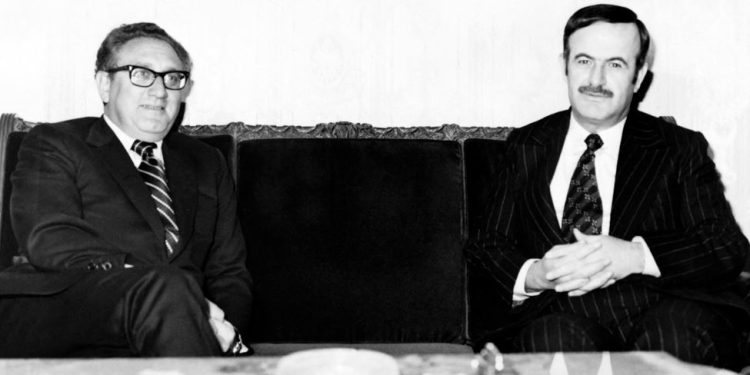
In January 1976, US Secretary of State Henry Kissinger asked US Ambassador to Damascus Richard Murphy to “inform Syrian Chief of Staff Hikmat Shihabi of our hope that the Syrians will do what they can to bring about a ceasefire in Lebanon and lay the groundwork for an agreed-upon political settlement” (1). In his memoir Years of Renewal, which covers the Ford administration (August 1974 – January 1977), Kissinger describes a new turning point in US-Syrian relations, marked by an American green light for Damascus to act as a mediator to extinguish the Lebanese conflict and broker a settlement.
This green light from Kissinger not only signified the beginning of Syria’s regional role—after decades of being “a playground for others”—but also implied a US exclusion of Cairo and Baghdad, which had been actively supporting Kamal Jumblatt and Yasser Arafat against the Lebanese Christian right-wing camp.
This cannot be separated from the traditional rivalry between the Ba’athist regimes in Damascus and Baghdad, and from the dispute between Damascus and Cairo since the September 1975 Sinai Agreement, which Egyptian President Anwar Sadat concluded with Israel.
Certainly, Kissinger was aware that Damascus’s move toward a Lebanese settlement would clash with the Palestinians and the Lebanese left, and that it would also put Damascus in conflict with Moscow, which supported Arafat and Jumblatt, as well as with Baghdad and Cairo.
Kissinger remarked: “In Lebanon, Assad aligns with our interests in his distrust of solutions sought by the radical leftists.” (2) Damascus, along with Washington, Tel Aviv, and Riyadh, did not want Lebanon to fall under the control of a leftist like Jumblatt, while the de facto ruler of Lebanon would be Yasser Arafat. Assad was also aware that the defeat of the Lebanese Christians—if Damascus did not intervene—could lead to Israel’s unilateral military intervention, which Kissinger sought to prevent. His primary goal, perhaps, was to distract Damascus from Lebanon to prevent it from obstructing Washington’s efforts with Egypt toward unilateral solutions with Israel:
“The more Assad is engaged in conflict with the Soviets and preoccupied with Lebanon, the less likely it is he will oppose our initiatives.” (3)
In June 1976, Syrian forces clashed with Palestinians and Lebanese leftist forces, tensions with Moscow increased, and the US provided cover for the Syrian military presence in Lebanon.
This marked the beginning of Syria’s regional role, starting from Lebanon, for the first time since Syria’s independence in 1946.
The US-Syrian understanding over Lebanon reached a crisis with Washington’s support for Israel’s invasion in 1982. Relations did not return to a similar level of understanding until 1990, after Iraq’s invasion of Kuwait. Syria’s participation in the international-Arab coalition against Iraq paved the way for the removal of military Prime Minister Michel Aoun from Baabda Palace by Syrian forces on October 13, 1990, and the start of implementing the Taif Agreement under Syrian control of Lebanon, with US-Saudi backing. This arrangement lasted until September 2, 2004, with the adoption of UN Security Council Resolution 1559, which coincided with Damascus’s dispute with Lebanese Prime Minister Rafik Hariri and with Riyadh.
The 1990 understanding was a prelude for Damascus to adapt its regime—whose relations with the defeated Soviet Union in the Cold War were close—to an international system increasingly dominated by a unipolar US world order. Through the “Damascus Declaration” of March 1991, which included Egypt, Syria, and the six Gulf Cooperation Council states, Damascus sought, along with Cairo, to assume a regional military role in the Gulf as a reward for participating in the 1991 war against Iraq. However, this effort was met with American rejection, which prevented Saudi Arabia and the Gulf countries from seeking protection under an Arab umbrella outside the US-led framework (4).
Just as Iraq served as a bridge in 1990 for restoring the US-Syrian understanding, this understanding was shattered in 2003 by Damascus’s rejection of the US invasion of Iraq.
In the first scenario, Damascus paid a price for its understanding with Washington in Beirut, and in the second, Washington made the Syrians pay in Lebanon by ending their military presence there in 2005.
The US-Syrian confrontation began with US Secretary of State Colin Powell’s visit to Damascus on May 2, 2003, three weeks after the fall of Baghdad. There were three US demands related to Iraq, Lebanon, and Palestine (5): Moving toward Syrian accommodation,Not obstructing the US position in Iraq, Stopping arms supplies to Hezbollah, and Severing Damascus’s relations with Hamas and Islamic Jihad in Palestine.
It can be said that May 2, 2003, marked the beginning of the crisis in Syria’s regional role, just as June 1, 1976, marked its start. In both cases, the other party was the United States.
However, in 2005, Juliet War, the Director of Public Relations at the US Embassy in Beirut, stated:
“The United States is not seeking regime change in Syria, but rather a change in its behavior” (specifically regarding three areas: Iraq, Palestine—in terms of its relations with Hamas and Islamic Jihad—and Lebanon) (6).
After the 2006 war, Western engagement with Damascus resumed via Paris in spring 2007. The US then entered the scene following the events of May 7, 2008, when Hezbollah invaded Beirut. Washington actively participated in the Doha Conference on Lebanon, which was followed by indirect Israeli-Syrian talks in Istanbul.
There were suspicions in Washington, amid the resumption of Syrian negotiations with Israel in Turkey, that the Syrians sought more than just an agreement with Israel. This suspicion stemmed from the American reading of the negotiations since the Madrid Conference of October 1991, which suggested that the Syrian regime aimed only at restoring relations with Washington, without a genuine desire for a comprehensive agreement with Tel Aviv.
Following the attack on a security building in Damascus in September 2008 by jihadists linked to Fatah al-Islam, which has ties to the Abdullah Azzam Brigades and al-Qaeda, about 800 jihadists were arrested. The Syrian outlet that Bashar al-Assad had opened for Islamists to travel to Iraq and fight against the Americans since his fallout with them in 2003 was closed.
Subsequently, the International Tribunal investigating the assassination of Rafik Hariri began indicting Hezbollah, replacing the earlier accusations by investigator Detlev Mehlis, who had pointed to the Syrian regime since 2005.
With Damascus’s shift following the Doha Agreement in May 2008, relations with Saudi Arabia warmed again. This was quickly reflected in Lebanon with the formation of Saad Hariri’s government in November. Then, during the Iraqi parliamentary elections of March 2010, a Syrian-Saudi-Turkish alliance emerged supporting the Iraqiya list led by Iyad Allawi, while Iran backed the State of Law list led by Nouri al-Maliki.
Most likely, Iraq’s former Prime Minister Iyad Allawi was the US’s strategic bet for a country far from Tehran’s influence, especially in the post-US withdrawal phase scheduled for the end of 2011.
Ultimately, after two and a half years of US and regional efforts—by Washington’s allies such as Saudi Arabia and Turkey—to distance Syria from the Tehran-Hezbollah-Hamas axis, Damascus chose not to break its alliance with Iran.
In fact, Baghdad, which had been the source of friction between Washington and Tehran in 2003, became the platform to declare its continued alliance with Iran by supporting Nouri al-Maliki’s nomination for Prime Minister on November 25, 2010.
By abandoning its joint support with Riyadh, Ankara, and Washington for Iyad Allawi, who had emerged as the leading candidate in the months preceding the Iraqi elections—where the Iraqiya list secured the most seats—Damascus positioned itself at odds with Riyadh and Ankara, both obsessed with Iranian expansion in the region. This shift aimed to undermine Iranian influence in Iraq, starting from Baghdad on April 9, 2003, through restoring Allawi to the premiership.
This Syrian decision also signaled to Washington that Damascus was unwilling to reorient its policies.
Then, on January 12, 2011, when ministers from Hezbollah, the Amal Movement, and the Free Patriotic Movement announced their resignation from the Lebanese government during Saad Hariri’s meeting with Obama at the White House, the overthrow of Hariri’s government—supported by Tehran and Damascus—became a second, stronger message of Syrian estrangement from Ankara, Riyadh, Paris, and Washington, surpassing the earlier Baghdad-related signals.
This Iranian-Syrian movement in Beirut occurred two days before the fall of the first Arab ruler in what was called the “Arab Spring.”
The fall of President Zine El Abidine Ben Ali, due to internal unrest in Tunisia, was the first chapter in the upheavals across Egypt, Libya, and Yemen. Then, on March 18, 2011, the wave of unrest reached Syria.
Footnotes
(1) Henry Kissinger: Years of Renewal, a Touchstone Book, published by Simon & Schuster, New York, 2000, p. 1026.
(2) Ibid., p. 1027.
(3) Ibid., p. 1050.
(4) Farouk al-Sharaa: The Lost Narrative, Arab Center for Research and Political Studies, Doha, 2015, pp. 229–230.
(5) Al-Hayat Newspaper, May 4, 2003.
(6) AL-Safir Newspaper, October 14, 2005.