


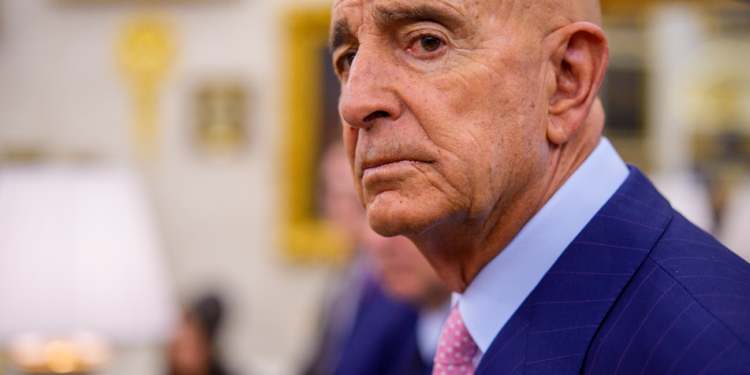
The U.S. special envoy to Syria, Tom Barrack, in a condescending and arrogant tone of Orientalist perspective, described the Middle East as a region devoid of the state, asserting that it is in reality nothing more than a collection of “villages, tribes, and nation-states created by Sykes-Picot.” He claimed that it is “illusions to see 27 different states with 110 ethnic groups that agree on a political concept.” This clear and explicit statement is perhaps the “crown jewel” of Barrack’s insights, which he arrived at after his “long” experience in the dark corridors of Middle Eastern politics! As a representative of the American establishment in the Middle East (at least in Turkey, Syria, and Lebanon), Barrack has been exhausted by the complex makeup of societies resistant to democracy, decision-making mechanisms, governance, participation, and consensus. He has finally understood the core problem, which led him to deliver this shockingly harsh, yet deeply analytical, statement about the history, heritage, mentality, and diverse peoples/tribes of the Middle East.
His reliance on the authority of “Hay’at Tahrir al-Sham” in Syria, which emerged from a military operation whose circumstances and details remain unknown and unspoken, reveals what he truly thinks and believes about the peoples and components of the Middle East. Tribes and sects that are far from the modern understanding of the state should only be governed through appointment and guardianship. This is Barrack’s ideological and orientalist understanding and conviction, rooted in his ancestral background from the “Jabal Lebanon” region of Ottoman Syria, who emigrated to America—this “new land”—to escape Ottoman tyranny, internal wars, sectarian conflicts, and religious strife. The man, who accuses the region’s peoples of tribalism and of being distant from the spirit of the state, is still imprisoned by that historical era. Accordingly, his understanding and “management” of these peoples is based on tribal and sectarian foundations that can only be controlled through the authority of an intervening power, which in this case is the United States. This is achieved through an alliance with a central “partner”: in Turkey, the Justice and Development Party (AKP), and in Syria, the faction of “Hay’at Tahrir al-Sham”—which Barrack recognizes as the state and has entrusted with the task of “uniting” the Syrian tribes and villages into a centralized state capable of presenting a unified front. Thus, Barrack has a direct line to contact Damascus whenever he wishes.
Meanwhile, the Damascus regime appears pleased with this comprehensive and “inclusive” American understanding of the situation. Barrack supports their rejection of recognizing Syria’s internal diversities within a decentralized framework. Despite all the bloody history of “Hay’at Tahrir al-Sham” over the past ten months—including massacres against the Alawite component in the coast, the bombing of the Mar Elias Church in Damascus, massacres in Rif Damascus and Sweida targeting the Druze, and ongoing threats of massacres against the Kurdish communities in Aleppo’s Sheikh Maqsood and Ashrafieh—he continues to rely on them. They are seen as the most capable of maintaining Syria’s unity (with or without regions occupied by Turkey or southern provinces under Israeli control), and of controlling internal affairs and negotiating with the U.S. and its allies. Consequently, “Hay’at Tahrir al-Sham,” with its well-known history, is kept under control, made to serve U.S. interests, and accepted as a “serviceable” authority that executes orders without threat of removal or being ousted with the threat of exposing its old leadership files.
For the sake of fulfilling a functional role here, or what the regime considers “serving,” which in reality is a one-sided obligatory service, the faction of “Hayat Tahrir al-Sham” continues, amidst its formation and its transformation into a “state,” to relinquish most of the fundamental “theoretical principles” of the jihadist thought from which it emerged and around which it coalesced, attracting passionate youth over the past years. This is done in order to strengthen its rule and continue seizing state institutions and agencies, consolidating its influence within them. What is currently happening, with “Hayat Tahrir al-Sham” dominating the Syrian state apparatus and “replacing” it, is carried out through a broad range of practical procedures, supported and legitimized legally by fatwas and directives from the group’s religious scholars. There is a clear understanding among the group’s legislating mind that what is happening now in terms of “appearances” and “policies” outside the framework of the Salafi jihadi understanding is, in reality and in essence, taqiyya (dissimulation) and part of the process of empowerment that is necessary. This does not threaten the fundamental principles, as it falls within branches of jurisprudence that can be debated and interpreted according to time and place, within a legitimate scholarly effort supported by Islamic jurisprudence heritage and historical Islamic events. From this perspective, priority is given to jihad against the “near enemy” rather than against the “far enemy,” which, in the understanding of jihadi groups, is a sequential order: the United States of America, the West, and Israel.
According to the regime, the “near enemy” has been subdued in the coastal region and Sweida, leaving only one enemy: northeastern Syria, the Syrian Democratic Forces, and the Kurdish factions. Their image, manipulated by the regime’s media machine—backed by a network of Arab media directed by the regime—continues to flood Arab audiences with fake news, slander, and lies. This propaganda aims to rally support and justify potential crimes, including a possible new act of genocide and ethnic cleansing similar to what happened in Sweida, only halted by the humiliating Israeli bombing of the Republican Palace and the General Staff, and, of course, the resistance of the people of Sweida who defended their land and dignity.
The regime is aware that jihad against the “near enemy” requires a reservoir of obedient jihadists, warlords capable of inciting panic, and sectarian clerics issuing calls for “general mobilization.” This can only happen if the regime effectively controls the Sunni Arab majority—what is happening now with the help of Arab media and the tools and power centers operated by Turkey. However, this clashes with the rejection of the regime among the majority of Syrian Sunni Arabs, especially in urban centers, who oppose the doctrine and policies of “Hay’at Tahrir al-Sham,” which has created major rifts and imposed its Salafist interpretation on city dwellers who are predominantly Ash’aris and Sufis. Furthermore, there has been a significant ruralization of major cities, altering their social fabric, seizing economic and commercial sectors from the Sunni urban class, and placing them under rural groups loyal solely to the regime.
This is a civilizational and class struggle, with its future effects the authorities seek to minimize by banning political parties and excluding them from the scene—since they could represent the broader Sunni movement—and through sectarian incitement and media hysteria, which aim to lump all Sunni Arabs into one “block,” calling them the “incubator of the government,” and claiming they lead the country. They are also targeted by other Syrian components and by the “alliance of minorities,” which the jihadist-leaning authority uses to strip them of their Syrian national identity, portraying them as “remnants,” “separatists,” and later, “Crusaders.”
The regime interprets the concept of the “near enemy” according to its new vision as being based on the displacement of its opponents within the Syrian landscape. Using this understanding, it has brutalized the Syrian Alawite community in the coastal massacres, and continues to oppress them through targeted liquidation, killing, kidnapping, and enslavement here and there—especially in the Hama and Homs countryside—what appears to be a silent yet systematic ethnic cleansing. Meanwhile, it confiscates Alawite homes and properties in Damascus, dismisses thousands from their jobs under various pretexts, and harasses others by relocating them far from their original areas. It also continues to besiege Sweida after the large-scale attack there, which resulted in the deaths of thousands of Syrian Druze, the enslavement and rape of dozens, in addition to acts of looting, burning guesthouses and shrines, desecrating mausoleums and cemeteries, and humiliating the elderly by shaving their mustaches and beards.
The regime interprets the concept of the “near enemy” according to its new perspective as targeting its opponents within the Syrian landscape. Based on this understanding, it has carried out massacres against the Alawites in the coastal region, and continues to oppress them through acts of liquidation, killing, kidnapping, and enslaving here and there (especially in the countryside of Hama and Homs, which appears to be a silent, yet systematic, ethnic cleansing process). Meanwhile, it seizes the roles and properties of Alawites in Damascus, dismisses thousands from their jobs for various reasons, and restricts others by relocating them to distant places away from their homes. It also continues to besiege Sweida after the major attack that resulted in the death of thousands of Syrian Druze, as well as the kidnapping and rape of dozens, along with looting, arson of guesthouses and shrines, desecration of graves, and insults to elders by shaving their beards and moustaches. In the regime’s view, punishing the “near enemy” has been carried out in the coastal region and Sweida, and only another enemy remains: northeastern Syria, the Syrian Democratic Forces, and the Kurdish component. The regime’s media machine, supported by a directed Arab media arsenal, continues to distort their image, flooding the Arab audience with vast amounts of fake news, false accusations, and lies, in order to mobilize the ranks and rally morale against them, and thus justify any crimes that might occur—such as a new process of genocide and ethnic cleansing similar to the attack on Sweida, which was only halted by humiliating Israeli bombardment of the presidential palace and the general staff, and, of course, the resistance of the people of Sweida, who defended their land and honor with great bravery.
The regime recognizes that jihad against the “near enemy” requires a human reservoir of jihadists who obey and listen, criminal warlords capable of mobilizing “panic groups,” and sectarian religious scholars issuing calls for “general mobilization.” This will only happen if the regime succeeds in controlling the Syrian Sunni Arab component, which is currently underway with the help of Arab media and tools and “power centers” manipulated by the Turkish state. However, this faces rejection from the majority of Syrian Sunni Arabs, especially from urban centers and large towns, due to the ideology and policies of “Hayat Tahrir al-Sham,” which have contributed to creating significant fractures within Syrian society. The group has imposed its Salafi interpretation on city residents, who are primarily Asharites and Sufis, along with the significant ruralization of major cities, which has altered the nature of life there. It has also taken the economic and business sectors out of the hands of the urban Sunni class and placed them in the hands of rural groups, whose loyalty is solely to the regime. This time, it is an underlying class and civilizational struggle that the regime is trying to downplay by maintaining the ban on political parties and excluding them from the scene, as they represent the broadest framework for Sunni presence and activism. Additionally, there is increased sectarian incitement and media pumping aimed at forcing all Sunni Arabs into a single “block,” portraying them as the “ruling support base,” the “leaders of the country,” and collectively targeted by other Syrian components or by the “minority alliance.” The regime disqualifies these groups from the Syrian national role, branding them with labels like “remnants,” “separatists,” and later “Crusaders,”.