

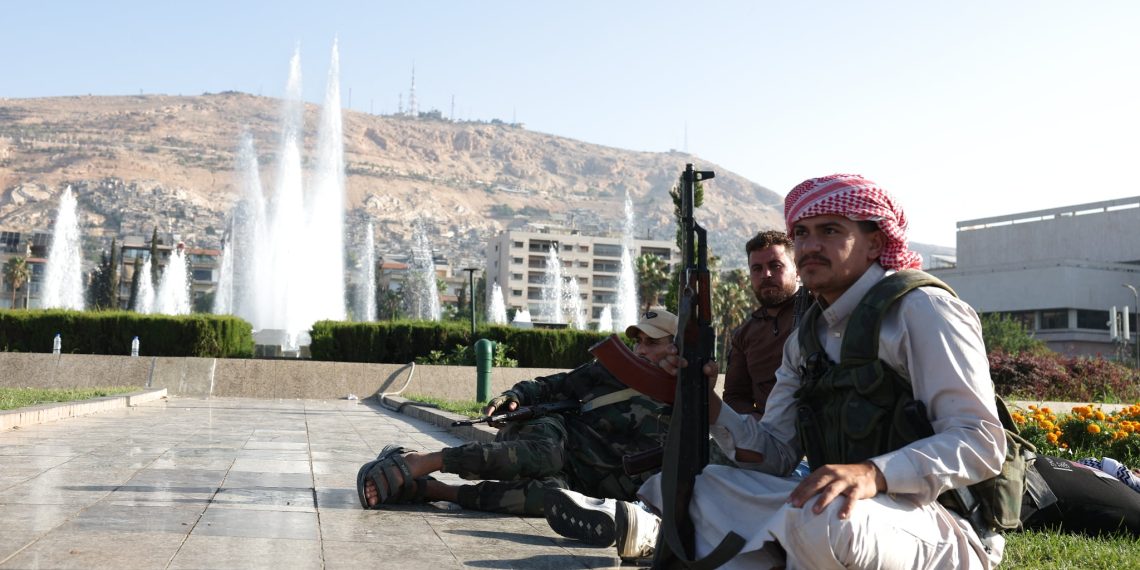
Suwaida appeared on the verge of being annexed into the possessions of the government, in defiance of the wishes of its residents, without understanding their concerns or reaching an understanding with its prominent figures. It seemed that the weary inhabitants of the mountain were left alone to confront “government forces,” which included public security forces, undisciplined forces affiliated with the Ministry of Defense, tribal fighters, Bedouins, and foreign fighters on the battlefield.
Last Tuesday morning, Sheikh Hikmat al-Hijri approved the deployment of the public security forces throughout Suwaida province. However, his quick reversal of this decision came after government forces brutalized civilians and humiliated the local population. Some of these atrocities were broadcast indiscriminately through video recordings, exposing a visual dimension of the process of imposing hegemony and the new formation of a sectarian superiority doctrine, manifested in tampering with the symbols and beliefs of the Druze monotheists.
Another reason for al-Hijri’s reversal of the agreement, which he described as “humiliating,” was the influence of the Ma’roufi group’s stance in Israel. This influenced the decision to refuse the initial agreement with Damascus, relying instead on the strength of the Israeli Air Force and the promises from the Netanyahu-Katz duo to preserve the lives of Syria’s Druze. This aligns with the project of keeping southern Syria free of heavy weapons.
The war did not erupt due to the dispute between the Druze and the Bedouins. Such issues recur periodically and are, in essence, echoes of traditional pasture and neighborhood conflicts. Moreover, the “state” does not resolve such problems by declaring open war but rather through social guidance—a sub-legal solution adopted by states and governments in the Middle East.
Therefore, it can be concluded that the military operation in the mountains, along with its scale and combat readiness, reveals another dimension of the reasons behind the attack on Suwaida. The broad external openness to the al-Sharaa government, the successive supportive statements from Washington’s representative Thomas Barrack, the direct communication with Israel, and the selection of international mediators to oversee this, gave Damascus a sense of possessing surplus power that it could deploy quickly before the local governance structures in Suwaida could solidify.
To this end, the regime perceived that embarking on a war of submission was easy, without fully understanding the situation, taking advantage of the rifts within the Druze spiritual and military establishment. Furthermore, inaccurate intelligence suggested to Damascus that the community in the mountain region did not support the equal approach promoted by Sheikh al-Hijri. Consequently, the regime fell into a trap, convincing itself that it was closer to a negotiation round that would divert Israel’s attention from ongoing developments, that it would be welcomed by the Druze opposition to al-Hijri, and that tacit American approval of Thomas Barak’s statements rejecting the establishment of a “Druze state” would be in place, and that Washington could stop Netanyahu’s government at the level of verbal interventions without resorting to military responses.
These misjudgments—almost fatal—pushed Damascus toward an unnecessary war, both in timing and in reasons. Damascus believed that promises from Washington, along with Arab and Turkish alignment behind it and the overwhelming desire for peace with Tel Aviv, would tip the balance in its favor, and that Tel Aviv would not oppose the formal process of extending control over Suwaida.
However, the arrival of heavy weapons to the Suwaida front prompted Israel to destroy some of them and halt their flow. According to Israeli perspectives, southern Syria must remain demilitarized under all circumstances, even if the presence of heavy weapons is temporary or for intimidation purposes. Furthermore, keeping Suwaida under the control of armed Druze groups provides an additional layer of security for the border region, even if a peace or truce agreement is reached.
Thus, it appears that Damascus’s assessments were more reckless than realistic. While her miscalculations were based on the belief that the United States would not allow Israel to carry out devastating strikes, this interpretation—founded on American “coddling” of Damascus—seems more like a mirage than reality. The nature of control and the regime in Syria are ultimately subject to Israeli moods and the demands of Israeli national security.
The decision to withdraw was cloaked in an agreement between Druze sheikhs and representatives of the regime. This deal aimed to save the Syrian regime’s face and strengthen the position of al-Hijri’s opponents within the province. However, the withdrawal, which exposed horrific massacres and violations, pushed most moderate voices in Suwaida to reverse their stance toward the government. This shift unified the Druze community behind a state of fear and distrust of Damascus, and canonized Sheikh al-Hijri as an uncontested authority, a reference point no other voices or forces on the ground could challenge. As a result, al-Hijri became the sole interlocutor across the entire mountain region. This “nightmare,” which Damascus had long struggled to eliminate, is now turning into an established reality.
If we consider the war’s outcomes alongside the heavy toll in civilian and military lives, and the near-absolute consolidation of al-Hijri’s leadership, we can see Israel’s readiness to resume its policy of protecting the Druze, even if peace efforts intensify or a cooperative framework with Damascus that aligns with Israeli interests is reached. It is useful here to review some opinions within Israel. Cautious voices in their dealings with al-Sharaa, as well as more extreme figures like Israeli Diaspora Affairs Minister Amichai Chikli and National Security Minister Itamar Ben-Gvir, have called for the elimination of Sharaa, equating him and his forces with Hamas. Such harsh positions may reflect a mood that is uncomfortable with the peace rhetoric Washington promotes, and perhaps the haste Damascus shows in reaching out to Tel Aviv will be met with indifference or apathy from the other side—even if one of the costs involves promises to intervene in Lebanese affairs against Hezbollah.
Among the most evident consequences of the war is the deepening sectarian and identity polarization among Syrians. Loyalists to the regime feel wounded in a narcissistic sense, some of which has been partly healed through waves of hatred and violence—manifested in the mobilization of widespread tribal revenge “frenzies” and in confrontations where Druze students have been beaten and persecuted by their “fellow students” at the universities of Damascus and Aleppo—scenes reminiscent of the militarization of universities during the Assad era. Meanwhile, “civilian” voices have called for imposing a siege on Suwaida, ignoring the fact that, even if carried out by individuals as some regime preachers and supporters claim, such a siege constitutes a clear war crime. It is barbaric and no less heinous than the field executions, massacres, and pogroms that occurred when government forces entered villages and the city center. Symptoms of the war include marches and sit-ins tinged with fascist and sectarian rhetoric calling for the genocide of the Druze, alongside an increase in accusations of treason and both religious and political excommunication, all orchestrated by the regime’s command centers.
Needless to say, the regime is wasting—if it hasn’t already—its opportunity to demonstrate to Syrians and the world that it has moved beyond its bloody past. Instead of learning from the painful lessons of the Mountain War and engaging in a comprehensive review of its mistakes, it appears poised to repeat those mistakes through different means and in other regions. This means that the old regime’s slogan—“Me or chaos, and you must choose”—has been modified to “I am chaos,” forcing others to either adapt or confront the regime and its agents, including tribes, angry protesters, students, and a sectarian community that has been rehabilitated within a few months.
Most likely, the regime, which has begun to forge its own sectarian-tribal structure akin to the military-security apparatus of the Assad regime, will not learn any lessons from the absurdity of al Baath Mountain War—particularly the lessons of accepting national partnership and a decentralized system as horizons for reuniting a fragmented Syria.