


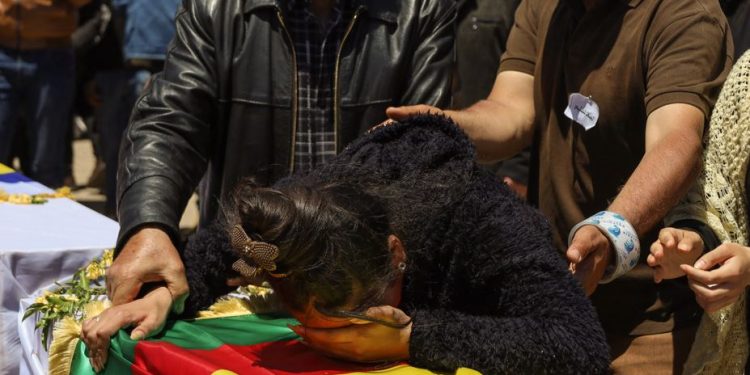
Talking about “hope” is no longer possible or meaningful in this beautiful Levant, drowned in violence and death. Any discussion of it is nothing more than an illusion, an ideology, or a failure to understand what we are truly experiencing. “Hope” — for change in circumstances without transforming the underlying conditions, capabilities, and dispositions — is a form of perpetuating what we are trying to escape. While this may sound negative, it is also a rational perspective.
“Despair” is not merely a temporary absence of “hope,” nor is “sadness” simply a fleeting lack of happiness. Rather, they are profound value structures—symbolic fabrics woven into our collective psychological complexes. Nations do not need a superficial awareness of sadness but rather a stark confrontation with its essential truth. It is not a “problem” that can be solved with doses of artificial optimism or with dreamy (and often delusional or false) narratives and discourses. Instead, it is an integral part of our makeup, engraved in our collective memory like an indelible tattoo.
So far, the horrors unfolding in this beautiful Levant are far less than what the forces and systems driven by imaginary, desire-driven values—brimming with hopes and aspirations for violence, death, and genocide—actually carry or contain. Fortunately, there are circumstances that prevent those murderous imaginary and desire-driven impulses—between groups and nations, toward one another, within each of them, and toward their components and representations—from becoming reality. Imagine what could happen if all parties were able to achieve what they wish for and aspire to, each toward the other!
Reproducing Life
This is a tragic reality in every sense of the word—a heavy history, and more importantly, a mindset and aspirations that seem to leave little room for hope or opportunities for overcoming. Here, and this is the main theme of the paper, emerges the concept of the “Right to Despair.” At first glance, this may seem contradictory, but at its core, it is a call to “liberate consciousness.” It is not an appeal to surrender to nothingness, but rather an acknowledgment of the necessity of confronting harsh reality without sugarcoating or numbing.
This “Right to Despair” is a rejection of illusions and artificial hope—goods sold to anesthetize populations. It recognizes that life, in itself, carries within it a measure of suffering and contradictions. Attempts to expel this dark side are nothing but “self-denial” and “a erosion of consciousness.” Illusions and false hope are a “reproduction” of what we suffer from, not a way to contain or transform it.
Schopenhauer’s Call
Arthur Schopenhauer, with his pessimistic philosophy, offered profound insight into the meaning of pain and suffering as an inseparable part of the universal Will that drives existence. For him, suffering is not an exception but an eternal rule that imposes itself on every living being. From this perspective, life itself is a manifestation of a blind, insatiable Will. Every momentary gratification leads to boredom, then to new desires and new pains.[1] In this context, despair becomes not weakness or passive impotence, but a higher state of awareness of reality as it truly is—a penetrating vision that removes the veils of illusion and superficial optimism.
Acknowledging this existential despair is the first step toward genuine liberation and toward reshaping our relationship with the world. From the heart of this acknowledged, rather than repressed, despair can emerge the capacity to “reproduce” life with a more authentic and profound meaning. This is not a call to surrender, but rather a starting point—stripping away illusions and seeking a new, deeper meaning of life that transcends imposed limitations.
Embracing the Shadow
In this context, the ideas of thinkers like Jacques Le Goff loom large. He explored the “history of mentalities” and the depths of societal morale, recognizing that grief or the “tragic sense of life” is not an emptiness, but a fully formed cultural entity.[2] Ulrich Beck, in his discussion of the “risk society”[3] and how Germans have dealt with their burdened past, offered an unforgettable lesson: they did not “overcome” their grief, but rather “embraced” it, understanding that defeat could serve as a springboard to avoid greater catastrophes.
Perhaps salvation does not lie in trying to “expel” grief from our societies, but in “embracing” it. Learning to live with our contradictions, our existential despair, and the truth that we may never be “happy” in the prevailing ideological sense. Maybe—and only maybe—within this acknowledged grief, we find some measure of freedom: the freedom to detach from illusions and to see the world as it truly is. Ultimately, this may be the only path to genuine happiness: the happiness of a conscious, miserable, and acerbic awareness that emerges from a stark confrontation with reality.
Rebellion and the Opium of Sadness
Societies forced to swallow their sadness, and afflicted by a “phobia of joy” due to repression, become ticking time bombs. The jokes, stories, and exuberant art seen at weddings and festivals are not merely outlets; they are both illusions of happiness and calls to invoke that happiness simultaneously. Conversely, authorities of various types seek to create official occasions to contain and manage this pressure, claiming to care about the well-being and happiness of the populace.
When we speak of “happy societies being less prone to violence,” we must ask: what kind of happiness? Not the superficial happiness offered by systems of power as a false compensation. In this context, entertainment, consumption, and fashion are nothing but forms of repression.[4] We seek genuine happiness—happiness that springs from self-realization, justice, and freedom.
People in this East did not take to the streets in protests and revolutions merely because they sought “happiness” in its glittering form, but because they were fed up with the alienating sadness, exhausted by falsehoods and oppression that had turned their lives into nightmares filled with “joy phobia.” They took to the streets because they rejected this imposed sadness and demanded the right to define their own sadness and happiness. Revolutions are not just a quest for abstract happiness; they are a refusal of a state of chronic, alienating sorrow that no longer bearsable. Here, we are not judging events by their outcomes, though that is often a common approach. Instead, we are focusing on the active, imaginative moment at the start of the regional upheaval (2011). Yet, what initially embodied vitality, freedom, optimism, and joy ultimately resulted—across many societies and countries—in sadness, destruction, and horrific disasters.
For example, Albert Camus’s voice echoes in “The Rebel”: “The rebel is he who says: No.” This “No” is not merely a rejection but a declaration of limits: “Things have gone on too long,” “It is acceptable up to this point, and unacceptable beyond,” and “There is a boundary that must not be crossed.” At this moment, sadness and resignation transform from passive states into a revolutionary moral force. They cease to be constraints and become an existential question: Why do I accept this? Why do I live like this? Why don’t I demand something else?[5]
But hold on! There is a deeper level of tragedy—one that some may reject: sadness itself has become an opiate, a collective drug justifying powerlessness. Even our “right to be sad” has been taken away. This sadness is not authentic but manufactured, programmed, and tamed—presented to us as a “false alternative” to confronting terrifying realities. As Theodor Adorno pointed out, we do not mourn [or rejoice] because we want to, but because authorities and systems of meaning and power want us to do so in their way.[6] This is the ultimate alienation: to be forced even to feel the emotion that is supposedly our last refuge.
At the Heart of This Acknowledged Sadness—Authentic, Not Alienated—we Find Freedom
Freedom to detach from illusions; freedom to see the world as it truly is. This might be the only path to genuine happiness: the happiness of a conscious, miserable, and searing awareness! Collective sadness is easier to control than individual joy. It’s simple to mobilize people for funerals, mourning, or grief over the past (or the present). But gathering them for genuine laughter is much harder, because laughter demands something alive—something that cannot be faked. Authorities manipulate sadness to say, “There’s no time for joy now; you’re under threat.” Then they organize official festivals of happiness, as if joy should be granted from above, not emanate from within.
Echoes of Sadness
The echoes of these ideas resonate powerfully through the works of literary icons who shaped the consciousness of an entire generation in the Middle East. The Iraqi poet Muzaffar al-Nawab, in his poem “Not sadness, But Sad!”, does not merely describe fleeting romantic sorrow; he captures the essence of the great tragedy afflicting our societies. His words: “Not sadness, but sad… like a jasmine seedling torn apart by rain! Not sadness… but sad… like a wedding box sold as scrap love as the years pass!” go beyond simple description to paint a portrait of sadness that has become a permanent destiny—dry, withering sadness that invades souls and emotions alike.
Al-Nawab skillfully distinguishes between “the sadness we experience as individuals” and “the sadness we are obliged to endure as a collective,” a sadness that is not free but “a moral duty, a symbol of loyalty.” Even his invitation, “Oh sadness, I wish I knew you / I’d turn you into a jasmine garden / and a walkway of wedding tiles / in front of your house,” is not an endorsement of sadness but an attempt to understand it more intimately—to break its shackles and transform it from an imposed fate into a conscious choice, perhaps.
The Damascene writer Zakaria Tamer treats sadness as raw material for his stories—not a gentle emotion, but a cynical despair, a black humor that slaps the face of absurdity. In his story “The Call for Help” [7], we see how the statue of Youssef al-Azma morphs from solid copper into a screaming, furious figure, then is cast into prison. He describes Damascus as “a sleeping child with her head and hands severed, a burning dust, and birds whose wings are leaving the sky, and trees.” This painful symbolic image of a statue moving to express buried grief and repressed despair, only to be suppressed again and returned to inertness, serves as a powerful metaphor for our societies—ones that do not permit their grief to turn into action or rebellion.
The grief of Tamer’s characters isn’t rooted in the loss of something, but in the realization of the emptiness of everything: the emptiness of existence itself. It’s a “weariness”—a fatigue from waiting and false hopes. In his story “Tigers on the Tenth Day” [8], the tiger becomes a “citizen,” and the cage a “city,” after a brutal taming. This terrifying embodiment of grief portrays the deep sorrow of losing freedom and dignity—the symbolic death of the soul under systematic repression. Tamer shows us how maintaining grief—“neutral, frozen, devoid of any possibility of ‘action’”—becomes the condition that sustains power.
We must not forget the cry of poet and playwright Muhammad al-Maghut: “Joy is not my profession.” This is not a rejection of joy per se, but a denunciation of its illusory fabrication—those manufactured “joys” that hide more brutal oppression. His grief isn’t defeatist; it’s the grief of a rebel who sees through the falsehood and exposes it. In his poem “Sadness in the Moonlight” [9], he addresses Damascus: “O pink chariot of captives,” describing how “for twenty years we’ve been knocking on your sturdy doors / And rain falls on our clothes and children / And our faces, choked with a painful cough, / look sad like a farewell, yellow as tuberculosis.” When he declares, “I will betray my homeland” [10], he’s not speaking of the geographic homeland but about “the homeland of violence, terror, hypocrisy, and murderous thuggery.” It’s a bold cry that shatters the myth of glory and happiness, revealing that what is promoted as joy is merely an illusion forced upon consciousness.
The grief of “Al-Nawab,” “Al-Maghut,” and “Tamer” is not simply defeatist despair but a “sad rebellion”—an absolute rejection of false patriotism and ideologies that drive people to dance in pain. These literary voices, with their mournful yet rebellious tones, affirm that true, unalienated grief is the key to consciousness—and perhaps the spark that drives nations to seek freedom and dignity, even if that means embracing the “right to despair.”
The Courage of Despair
In the midst of this scene of acknowledged despair, a question may arise: Is there hope? Here, the insights of thinkers like Slavoj Žižek come into play. Žižek challenges the conventional notion of the “light at the end of the tunnel” in a provocative way, emphasizing that the real danger does not lie in failing to see the light, but in the possibility that the “light at the end of the tunnel” might actually be a train heading straight toward us. This is despair of illusions—despair of easy solutions and false promises. It compels us to abandon naive hope that justifies stagnation and to confront reality in its harsh, unvarnished truth. Here, despair is not an end but a necessary turning point.[11]
Societies deprived of even their “right to mourn” are societies headed toward moral and spiritual death, regardless of how loud or flag-waving their displays may be. When people are denied the right to honestly express their bitterness and despair, or are forced to wear masks of artificial joy, they lose their capacity for self-awareness and reconciliation with their reality. Repressed sorrow becomes a slow poison that extinguishes the flame of the collective spirit, depriving it of the ability to renew, innovate, or even think critically. This enforced “happiness” kills the genuine potential for change.
Herein lies the paradox: hope, in its naive or manufactured form, can itself become the greatest obstacle to contemplating radical alternatives and driving meaningful change. As long as false hope is promoted, protest is delayed, and the impulse to alter patterns and realities is suppressed. Conversely, true despair—arising from a clear, cold comprehension of the depth of the crisis—is what motivates nations to craft new paths. Not because they love or desire despair, but because they “dislike what they are in and fear what is to come.” It’s not merely about losing traditional hope; it’s about realizing that continuing in the current pattern will inevitably lead to catastrophe. This awareness becomes the catalyst for forging unprecedented routes forward. This kind of hope, paradoxically, can be aligned with Žižek’s concept of the “courage of despair.”[12] By openly acknowledging the bitterness of reality and the alienation of emotions, we open doors to moments that can lead to the rebirth of life itself.
Ultimately, the “right to despair” appears as a right to self-recovery—an act of seeing the world with a conscious eye that transcends illusions. It is a call to free oneself from the shackles of alienating grief, toward an authentic sorrow that awakens consciousness. Perhaps, in this embrace of shadows, lies the only path to genuine happiness—one that only those willing to confront their despair can dare to attain. It is a despair that does not lead to nihilism or defeat but to a deliberate, relentless effort to redefine the meaning of existence and to rebuild life on the ruins of old illusions and false promises. Perhaps, honest despair is the seed of true freedom and the first step toward a more authentic, dignified future.
Footnotes:
[1] Arthur Schopenhauer, The Charge of Despair, translated by Al-Tayeb Al-Hasni, (Riyadh: Dar Safha, 2019).
[2] Jacques Le Goff, Memory and History, translated by Jamal Shahid, (Beirut: Arab Center for Research and Policy Studies, 2017).
[3] Ulrich Beck, Risk Society, translated by George Kattoura and Ilham Al-Shaarani, (Beirut: Al-Makkah Al-Sharqiya, 2009).
[4] Byung-Chul Han, Topologies of Violence, translated by Badr Al-Din Mustafa, (Riyadh: Dar/Manassa Ma’na, 2021).
[5] Albert Camus, The Rebel, translated by Nihad Rida, 3rd ed., (Beirut-Paris: Awidat Publications, 1983), pp. 17-18.
[6] Theodor Adorno and Max Horkheimer, Dialectic of Enlightenment: Philosophical Fragments, translated by George Kattoura, (Beirut: United Book House, 2006).
[7] Zakaria Tamer, Damascus Fires, Stories, 3rd ed., (Beirut: Dar al-Rayyes for Books and Publishing, 1994), pp. 143-150.
[8] Zakaria Tamer, Tigers on the Tenth Day, Stories, 2nd ed., (Beirut: Dar al-Adab, 1981), pp. 54-58.
[9] Muhammad al-Maghut, Sadness in the Moonlight, (Beirut: Shi’r Magazine, 1959).
[10] Muhammad al-Maghut, I Will Betray My Country: Delirium in Terror and Freedom, 4th ed., (Damascus: Dar al-Mada, 2004).
[11] Slavoj Žižek, “He Will Come Like a Thief in the Night,” translated by Hassan Al-Hajili, Hikma website, (April 24, 2018).
[12] Slavoj Žižek, The Courage of Hopelessness, New York: Penguin Random House, 2017.
References:
- Adorno, T. & Horkheimer, M. Dialectic of Enlightenment: Philosophical Fragments. Translated by George Kattoura. Beirut: United Book House, 2006.
- Beck, U. Risk Society. Translated by George Kattoura and Ilham Al-Shaarani. Beirut: Al-Makkah Al-Sharqiya, 2009.
- Tamer, Z. Tigers on the Tenth Day. Beirut: Dar al-Adab, 1981.
- Tamer, Z. Damascus Fires. Beirut: Dar al-Rayyes, 1994.
- Žižek, S. “He Will Come Like a Thief in the Night.” Translated by Hassan Al-Hajili. Hikma website, April 24, 2018.
- Schopenhauer, A. The Charge of Despair. Translated by Al-Tayeb Al-Hasni. Riyadh: Dar Safha, 2019.
- Camus, A. The Rebel. Translated by Nihad Rida. 3rd edition. Beirut-Paris: Awidat Publications, 1983.
- Le Goff, J. Memory and History. Translated by Jamal Shahid. Beirut: Arab Center for Research and Policy Studies, 2017.
- Al-Maghut, M. Sadness in the Moonlight. Beirut: Shi’r Magazine, 1959.
- Al-Maghut, M. I Will Betray My Country: Delirium of Terror and Freedom. Damascus: Dar al-Mada, 2004.
- Han, B.-C. Topologies of Violence. Translated by Badr al-Din Mustafa. Riyadh: Dar/Manassa Ma’na, 2021.
- Žižek, S. The Courage of Hopelessness. New York: Penguin Random House, 2017.