

Before reaching the stage of organizing elections for the People’s Council, the “National Dialogue” conference and then the Constitutional Declaration ended what was called the political transition phase and emptied it of any political substance, placing Syrians before the reality that they are facing a regime unwilling to be a mere transitional authority. Practically, the Constitutional Declaration empowered Ahmet al-Sharaa with all authorities—executive, legislative, and judicial—and placed them all under its personal control. The ultimate meaning that the declaration tried to convey was a project to “perpetuate” this authority, which was defined as “temporary” or “transitional.” The formula of consolidating hidden authorities was sufficient to manipulate the foundations of the transitional phase; it is based on pillars such as rejecting partnership and inclusion, controlling the country’s resources through the power to approve laws and contracts, presenting personal visions of transitional justice, and granting factions participating in the “Victory” conference the monopoly on violence. The sum of these issues represents the theoretical prelude to a second eternity completing the eternity of Assad’s rule, to the extent that describing the “president” as transitional has become closer to an insult or an attempt to undermine the regime’s prestige according to supporters of Ahmet al-Sharaa.
At the moment of issuing the declaration, the general Syrian surrender appeared in its clearest form, except in rare cases; the emerging authority was not confronted with any wave of civil or political pressure to limit its growing powers, while Syrian society was divided into different groups: one group exhausted by years of war and its heavy toll, no longer caring who rules; their priorities are safe return, improving living conditions and services, and restoring security. Another group happily pursued the overthrow of Assad’s regime and seemed captivated by romantic rhetoric full of illusions about past glories and the restoration of a mythical Umayyad past, bolstered by the rapid Arab and international openings and promises of financial flows and investments from every country visited by regime representatives. Meanwhile, a third group was cautious not to be held accountable for supporting Assad’s regime or for being judged by others who look at them with the same eye, remaining silent and withdrawn during the 14 years of the Syrian war under the label “Where were you for 14 years?” The sum of these groups’ conditions helps explain why the declaration was accepted without significant opposition to its contents, which entrench a sectarian religious dictatorship mimicking the powers of the Assads.
Ahmet al-Sharaa’s authority has always preceded the national and international public opinion by a step that helps kill politics and subsequently establish a deaf sectarian system. This authority has plans to brutally and confusingly obstruct the transition and political change.
Let’s observe the actions and steps of the authority and its desire to move from a temporary and contentious authority to a constructed sectarian regime:
First, launching a hastily prepared National Dialogue Conference before Syrians could catch their breath and prepare to demand a broad, representative national conference.
Second, announcing the “Victory Conference” that crowned Ahmet al-Sharaa as president before Syrians demanded a civilian transitional ruling council.
Third, forming the (Arab) Syrian army before absorbing Druze armed groups or the Syrian Democratic Forces (SDF) into this ambiguous military entity.
Fourth, announcing the formation of a transitional government after the collapse of the experienced interim government in Idlib, before Syrians could organize into new political frameworks.
Fifth, issuing the constitutional declaration by unilateral will instead of issuing it through a national body derived from the general conference that commissions an agreed-upon committee to draft a concise constitutional declaration defining the limits of authority, reorganizing political life, and returning politics to society.
Finally, Ahmet al-Sharaa preempted the implementation of Resolution 2254 as a demand advocated by a Syrian majority seeing ongoing governmental failure and continuous violations by the authority. It is important to recall that the resolution called for “free and fair elections under UN supervision within 18 months.”
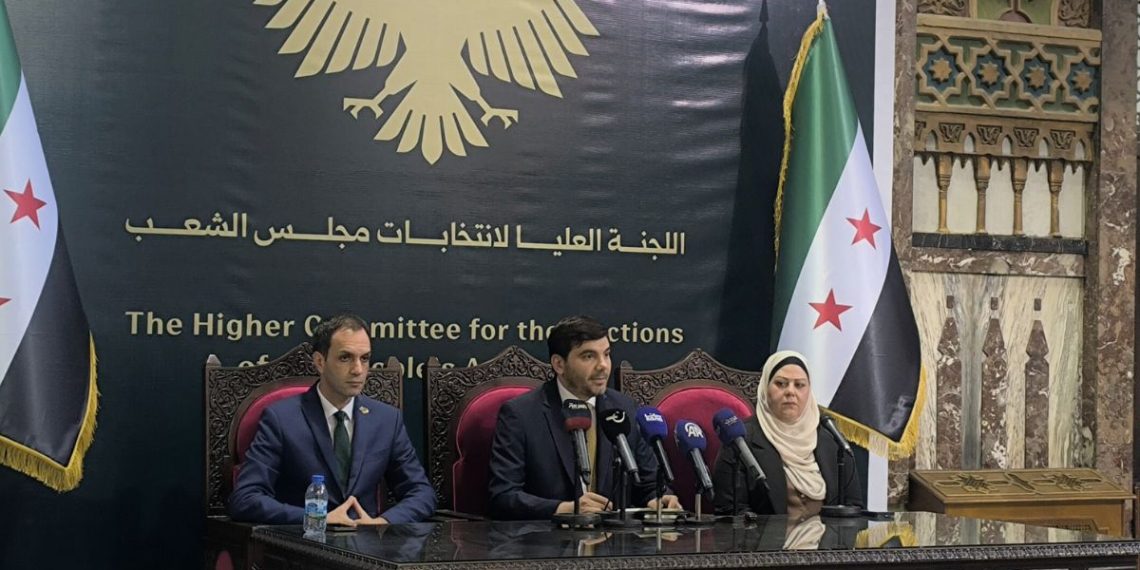
Meanwhile, the “Supreme Electoral Commission” appointed by al-Sharaa is carrying out its work. The name itself raises suspicion of an election process in a country whose new rulers do not recognize democracy, popular partnership, or the people’s rightful equality. Indeed, the commission submitted a copy of its vision for the electoral process mentioned in the constitutional declaration. Accordingly, al-Sharaa issued Decree 143 of 2025 approving the temporary electoral system for the People’s Assembly, with the assembly’s seats numbering 210, a third appointed by al-Sharaa, and the remaining seats distributed according to the population of the provinces, excluding Hasakah, Raqqa, and Suwayda provinces.
The electoral pattern designed by the regime’s tailors does not carry any representative form expressing any level of inclusion of Syrians in the last remaining authority of the three powers fully controlled by al-Sharaa. It also reflects the brazenness of appointments, making those appointed feel that they would not occupy their new positions if the president had not granted them this opportunity. In this sense, the appointee does not feel indebted to their constituency or the electoral process that brought them to office. In other words, the vacant seat in the People’s Assembly no longer represents a “proxy” representing a bloc of citizens but a proxy for the “president” within the legislative authority, meaning the enrichment of al-Sharaa’s patronage network and supplementing it with a new class of beneficiaries.
The exclusion of the three provinces from the electoral process cannot be understood as a mere retaliation against political and social forces that refused to submit to the project of converting absolute authority into an established tyranny. The Supreme Electoral Commission justified the exclusion by the security conditions in the excluded provinces, implying that conditions in areas under al-Sharaa’s control are safer. This is contradicted by daily facts, including violations against minorities in Damascus, and the entire southern provinces (Quneitra, Suwayda, most of Daraa’s territories) falling outside the regime’s security control and under Israeli dominance. Moreover, the regime’s claim that the problem is limited to the excluded provinces is a farcical deception. Parts of Aleppo province (Afrin, Kobani, and Kurdish neighborhoods in Aleppo), as well as most of Deir ez-Zor province, are under SDF control, making it impossible for the Supreme Electoral Commission to hold “elections” there. Not to mention the undeclared state of emergency in the Alawite areas of the coast subjected to inhumane conditions that make electoral activity impossible. Naturally, none of these facts concern the regime; the purpose of all this is to establish a nominal People’s Assembly, at any cost and in the shortest possible time, whose role is to pass some legislation and ratify international treaties that al-Sharaa is reluctant to approve. This means the “transitional” president needs gloves to hide his fingerprints on some issues affecting all Syrians, while we are facing a fabricated assembly that falsifies the will of the governed by means that appear legitimate on the surface.
It is likely that the elections will proceed without any significant popular rejection of their course or the way the assembly is formed, which means closing one of the most important public spheres for Syrians wishing to correct some of the madness driven by the regime. But the most important part of the seizure of the last remaining authorities, after Ahmet al-Sharaa gained control over the executive and judicial powers, is that this paves the practical way for the transformation of al-Sharaa’s authority into a system even worse than the Assads’ system.