


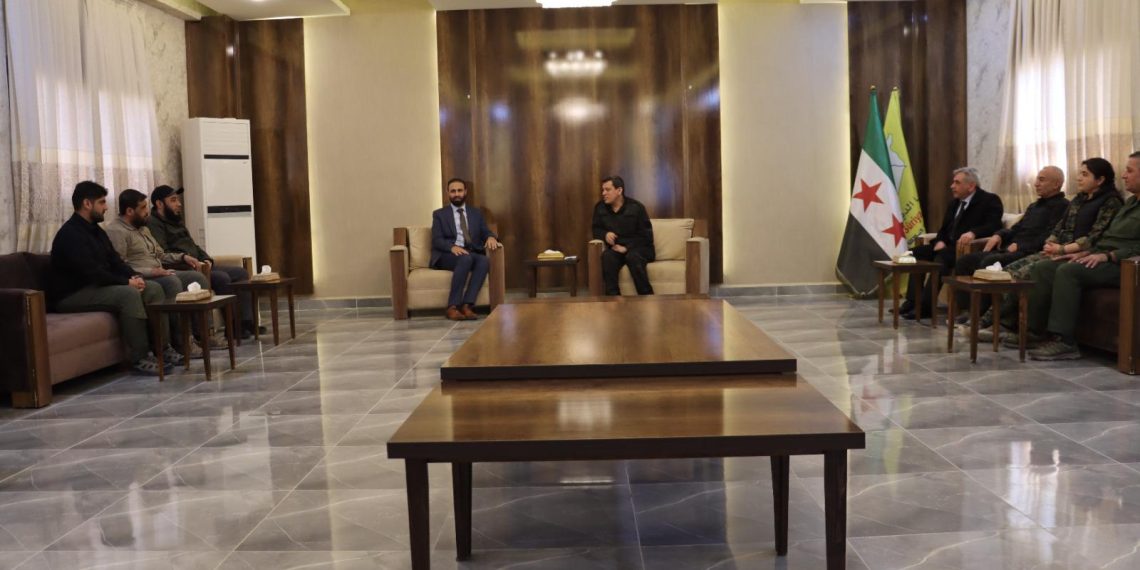
The interim government in Damascus and the Syrian Democratic Forces (SDF) are proceeding with the implementation of the terms of the January 29 agreement, which mandates a ceasefire between the two sides, the normalization of conditions, and the achievement of military and administrative integration for both the SDF and the Autonomous Administration within the structures and institutions of the Syrian state. Despite numerous observations here and there, the emergence of obstacles, and a state of slowdown—perhaps even intentional stalling aimed at exerting pressure and restriction—the agreement, in its general and overall sense, is progressing well. Many points and clauses have already been realized and practically applied on the ground, notwithstanding the continued imposition of a sort of siege on Kobani, which appears to be a premeditated measure by the authorities to achieve certain gains or perhaps to evade some responsibilities and obligations stipulated in the agreement concluded between the two parties.
The agreement came after comprehensive confrontations and a state of “breaking of wills” between the interim government and the SDF. Through this, the authorities attempted to mobilize the public against the SDF and its social base—the Kurdish component—using local groups, segments, and militias as “soft gloves” to commit dirty acts that the state would later disown. In fact, after the horror and magnitude of what occurred were revealed, the state would present itself as the “entity” capable of controlling these groups and restraining them from committing further crimes, violence, and mass killings, thereby marketing itself as a guarantor for the protection of the Kurdish component outside the three densely populated Kurdish areas where the SDF and “Asayish” forces maintain a strong presence.
Despite the SDF’s acceptance of withdrawal from Deir Hafer and Maskana (areas west of the Euphrates) following a series of regional and internal developments that strengthened the position of the Damascus authorities, the Government decided to continue the offensive. This occurred in light of the government forces’ success in storming the civilian neighborhoods of Sheikh Maqsoud and Ashrafieh in Aleppo, reveling in the “victory” achieved over a few dozen lightly armed Asayish members who refused to leave the two neighborhoods, preferring to fight in defense of the residents who were subjected to indiscriminate shelling and the use of heavy weapons, leading to widespread destruction and the displacement of tens of thousands of Kurdish citizens. It was clear that the Damascus authorities were gambling on force, withdrawing from the March 10 agreement and, prior to that, the April 1 agreement in Aleppo, preferring fire over dialogue following the meeting held with the Israeli side in the French capital, Paris, on January 5.
The stabbing in the back of the SDF forces withdrawing from areas west of the Euphrates, the activation of sleeper cells in Raqqa and the Deir ez-Zor countryside, the instigation of defections within the Arab element of the SDF there, and the call for Arab tribes to revolt, resulted in massacres and mass killings against withdrawing SDF fighters as well as Kurdish civilians who fled Tabqa and Raqqa toward Kobani, Hasakah, and Qamishli. Dozens of Kurdish families were liquidated on the roads and at the entrances of towns and cities. All of this took place under the cover and complicity of the authorities and after a groundwork laid by official media and allied Arabic media, which pumped out a massive volume of lies and fabrications targeting the SDF and the Kurds. As usual, tricks and ruses were employed to hide and cover up the authorities’ crimes, with a deliberate exclusion and blackout of the Kurdish narrative—even challenging the credibility of photos and video clips showing the liquidation of Kurds based on ethnic identity—while focusing the forged media output on other details such as “tunnels” and “innocent civilian prisoners” in SDF jails.
Damascus government forces advanced to the outskirts of Hasakah and Qamishli after Arab fighters from Raqqa and Deir ez-Zor left the ranks of the SDF to return to their homes upon witnessing the withdrawal to the administrative borders of Hasakah province, alongside other defections coordinated via intelligence at a later stage. Government forces stationed themselves in Shaddadi, Tel Brak, Tel Hamis, and Tel Kocher—towns with an Arab majority in Hasakah province. Additionally, government forces launched attacks on the countryside of the Kobani region, occupying a total of 70 villages. The offensive was accompanied by looting, pillaging, murder, displacement, and other shameful violations and acts of indignity that have become synonymous with the Damascus government factions and part of their history during their few months of governing and managing Syria. Official and directed incitement from Damascus and its media, as well as from Arabic (exclusively Gulf) channels and platforms against the Kurds, reached its peak. The next target was Hasakah province, where the greatest danger lay in the occurrence of bloody confrontations and massacres between the Arab and Kurdish ethnicities.
The SDF had preferred withdrawing from Raqqa and Deir ez-Zor over staying and entrenching themselves in a fight there, to avoid deepening the Arab-Kurdish confrontations that the authorities desired—confrontations that might have expanded to other areas, potentially encompassing all Arab-Kurdish mixed regions in both Syria and Iraq, from Afrin through Shengal to Khanaqin. Consequently, the SDF retreated to Hasakah province, where the Kurdish presence and social base reside, and where the Arab tribes share a long history of neighborliness, intermarriage, and distinguished social relations with the Kurds, thereby providing a foundation for calm, reason, and consensus that complicates the authorities’ efforts to use these tribes against the Kurds. As for Raqqa and Deir ez-Zor, they were, in truth, a heavy “iron shirt” that the SDF and the Autonomous Administration shed. They had never intended to keep them and were always searching for formulas to hand them over to their people via military councils and administrative structures and withdraw to Hasakah. This was intended to be within an understanding with the Damascus authorities that would guarantee the people of Raqqa and Deir ez-Zor a form of decentralization respecting their sacrifices in liberating their areas from ISIS and acknowledging their efforts in establishing administrative structures and maintaining civil peace and state institutions (dams, factories, oil, and gas fields). However, the Damascus authorities’ gamble on military action after storming Sheikh Maqsoud and Ashrafieh, and their adherence to a factional approach of ethnic and sectarian sorting—believing this would destroy the collective national sentiment based on citizenship and push Syrian ethnic and sectarian components into entrenchment and isolation, thus weakening them and confining them to specific geographic areas while consolidating the state’s hold over the entire Sunni Arab component—is what contributed to the failure of dialogue and the emergence of a clear state of civil war based on the “state” inciting one part of its people against others.
There was a clear certainty within the Damascus authorities that the international community would not interfere in its war against the SDF and the Kurds, and that silence would prevail after the concessions made in the Paris meeting to the Israeli side under American and Turkish sponsorship. The Damascus authorities felt assured of Washington’s approval and received a promise from Israel not to intervene militarily in any operation targeting the SDF and the Kurds, similar to what happened in Suwayda. At the height of the Syrian government forces’ offensive and advance in Raqqa and Deir ez-Zor, Tom Brak, the US Ambassador to Turkey and Special Envoy to Syria, appeared to demand that the SDF withdraw from Arab areas. He then announced in a lengthy statement on his “X” platform page that his country would withdraw from Syria, evacuate its bases, and end its “functional” cooperation with the SDF. Prior to that, Interim President Ahmed al-Shara issued Decree No. 13 regarding Syrian Kurds, considering the Kurdish issue in Syria resolved and stating that there was no longer a need for the SDF or the Autonomous Administration. Here, things began to “connect,” and a clear pattern of intentional and planned behavior emerged: the authorities “sabotaged” the meeting between the SDF leadership (General Mazloum Abdi) and the Syrian Army (Minister of Defense Murhaf Abu Qasra) held in Damascus on January 4, which discussed a mechanism for integration into divisions and brigades. They then sent Foreign Minister Asaad al-Shaibani to Paris on January 5 and made concessions to Israel. From there, they reneged on the understandings with the SDF and effectively canceled the March 10 and April 1 agreements. Consequently, the authorities activated the military option, attacking the neighborhoods of Sheikh Maqsoud and Ashrafieh and occupying themselves with preparing for the “East of the Euphrates” battle. All of this proceeded along two parallel lines: first, political—obtaining American and Israeli green lights, along with promises of Turkish military supervision and support, and Gulf media coverage; and second, military—removing Arab regions (Raqqa and Deir ez-Zor) from SDF control, dismantling the Autonomous Administration there, and handing over the affairs of the (Sunni Arab!) citizens to Damascus and officials appointed from there, who are, naturally, the “inner circle” of Hay’at Tahrir al-Sham. Meaning, according to the authorities’ vision, Raqqa and Deir ez-Zor would not have any legal personality enjoying a type of decentralization or expanded local administration similar to Hasakah province after the January 29 agreement; instead, the two provinces would be managed with extreme centralization directly from Damascus, under the guardianship and supervision of leaders and officials appointed from the capital and by the Interim President directly.
In the face of the Damascus authorities’ attack on both Hasakah and Kobani, the SDF, the Autonomous Administration, and the Kurds found no choice but to declare “general mobilization” and prepare to fight to the end. This declaration galvanized the Kurdish sentiment in other parts of Kurdistan and around the world. The Kurdish leader Abdullah Öcalan intervened and communicated with the Turkish state, making it clear that the peace and settlement process between the PKK and Turkey would end if Ankara persisted in encouraging the Sharaa government and pushing it to continue the attack on the Kurds in Syria and abuse them. He stated it was unacceptable for the Turkish government to claim it wants peace and the consolidation of “historic brotherhood between Turks and Kurds” in Turkey while openly inciting and participating in the killing of Kurds in Syria. Additionally, the Equality and Peoples’ Democracy Party bloc (the third-largest bloc in the Turkish parliament) moved to pressure the Justice and Development Party government to bring about a de-escalation in Syria and open channels for dialogue and a political solution. Furthermore, significant diplomatic and political activity took place by the Kurdistan Regional Government; a meeting was held between Kurdish leader Masoud Barzani, SDF commander General Mazloum Abdi, and Ambassador Tom Brak in Erbil to discuss stopping the Damascus government’s offensive and finding a political way out. Thousands of Kurdish youth also headed to Hasakah to join the SDF resistance and repel the attack that the Syrian government forces were preparing to launch on the densely populated Kurdish areas in Hasakah and Qamishli. Hundreds of Kurdish demonstrations broke out globally to denounce the massacres and crimes committed by Syrian regime forces against Kurdish civilians and fighters, following the publication of photos and videos showing members of Syrian Army factions mutilating the bodies of Kurdish male and female fighters, running over them with armored vehicles, desecrating shrines and graves, and killing fleeing civilians on the roads. Accompanying these massive demonstrations was a Kurdish diplomatic and media movement that significantly influenced international public opinion. Great pressure was placed on the Syrian government to stop its attacks on Hasakah and Kobani and launch a new dialogue with the SDF and the Autonomous Administration. Prominent US Senator Lindsey Graham announced work, in cooperation with other members of Congress, on drafting a “Protecting Kurds in Syria” law, pointing to the role of the Kurds and the SDF in fighting terrorism and the necessity for the United States to protect its allies and not allow extremist forces to isolate and brutalize them.
The Kurdish cohesion in the region with the Kurds of Syria, the influx of thousands of Kurdish youth to join the resistance forces, the massive demonstrations of the Kurdish diaspora worldwide, the movement of the US Congress and the European Parliament to punish the Damascus authorities for crimes committed against Kurds in Aleppo, Raqqa, and Kobani, and the political and diplomatic roles of the Kurdistan Region and the Equality and Peoples’ Democracy Party bloc in the Turkish parliament, along with Kurdish and international media pressure, forced the Damascus authorities to retreat and freeze their military march on Hasakah and Qamishli. They offered a four-day ceasefire, then extended the deadline to two weeks. Subsequently, the Interim President issued Decree No. 13, and finally, the January 29 agreement emerged. Its clauses included the integration of the SDF, the appointment of a Kurdish governor for Hasakah, the settlement of conditions in Kobani, Sheikh Maqsoud, and Ashrafieh, and the return of displaced Kurds to Afrin, Ras al-Ayn, and Raqqa.
As for Deir ez-Zor and Raqqa—the areas the Damascus authorities recently “liberated” from the SDF—they are currently witnessing a state of unrest and chaos due to popular discontent and resentment. Those who came to manage the two provinces know nothing of the nature of their people; their sole concern is controlling oil wells and production sources that generate money. They have begun issuing decisions and acting in an arbitrary manner that has deeply affected citizens’ lives. Living conditions have deteriorated, and services have declined. People have started hinting at armed rebellion against the state. In light of this poor reality, security laxity, and the loss of control, the ISIS organization has begun to re-emerge and reorganize its ranks, benefiting from the release of hundreds of its members with combat experience from the “Al-Aqtan” and “Al-Shaddadi” prisons. ISIS had published a lengthy statement by its spokesperson, “Abu Hudhayfa al-Ansari,” calling on Syrians to revolt against the government of Ahmed al-Shara, whom he described as the “guard of the global coalition,” stating that Syria had “moved from Iranian occupation to Turkish-American occupation.” Accompanying this statement were qualitative attacks, some of them “inghimasi” (suicide commando) operations, carried out by organization fighters against headquarters and military points belonging to the Damascus authorities in both Raqqa and Deir ez-Zor, resulting in the death and injury of dozens of Syrian soldiers.
The implementation of the January 29 agreement between the government in Damascus and the SDF is proceeding slowly but steadily. Among the positives is that it broke the ice between Damascus and the SDF after recent confrontations and the state of polarization and tension. General Mazloum Abdi, who moved politically and diplomatically, contributed to the success of the agreement. His participation in the Munich Security Conference alongside politician Ilham Ahmed, and his joining the official Syrian delegation, had a profound impact on “de-escalation” and the restoration of trust between the two sides. Likewise, meetings with American and international officials, led by Lindsey Graham, played a role in the calm and pushed the government in Damascus to adhere to the agreement’s terms to avoid American sanctions, the reactivation of the “Caesar Act,” and the imposition of a political and economic siege on Damascus—thereby averting the abortion of the previous phase that saw American and international sponsorship of the Syrian regime to grant it time and opportunity, in hopes of achieving internal reconciliation, reconstruction, and the enhancement of civil peace.
The biggest obstacle to the implementation of the January 29 agreement remains the existence of groups that reject the ongoing national reconciliation and threaten to resort to arms. These are the groups that the authorities long incited and used in their military campaigns (the “Nafir” and “Faz’a”) in the Coast, Suwayda, Raqqa, and Kobani. These outlaw groups are spread in some rural areas of Hasakah province and refuse to submit to the local authorities now managed by Governor Nour al-Din Ahmed. Similarly, some families settled in Afrin still refuse to vacate the homes of Kurdish citizens they seized following the 2018 Turkish occupation, and they refuse to return farms and fields to their owners, with some demanding large sums of money in exchange for their return. The campaign of incitement, provocation, and agitation practiced by the authorities and their official and allied Arabic media against the Kurds has contributed to entrenching feelings of hostility toward the Syrian Kurdish component among lower segments of Syrian society. These segments now reject the agreement and even threaten to take up arms against the state openly, hinting at joining ISIS if the authorities do not allow them to dominate the Kurds and seize their areas. The authorities must now find a solution for these segments: to disarm them and subject them to the law. It is also important to launch a rehabilitation program targeting these segments and groups to achieve their successful integration into a Syrian society that is hoped to transform into one where the values of citizenship and full equality are respected, and where all forms of sectarian and ethnic incitement are simultaneously criminalized.