


The phrase that the Assad regime has turned Syria into a “farm” has often been repeated. This expression is striking because it encapsulates the image and essence of the rule that has dominated the country for more than five decades. The “farm” is an ideal setting to depict the relationship between the master (in reality, the ruling elites) and the slaves or subjects.
It is uncertain whether those who coined this description were aware of the relationship between the words “farm” and “colonization.” The term “colonization” derived from the Latin word “colonus,” meaning farmer or settler. Ancient colonies were initially farms serving the city-state and its ruling elites. In this sense, colonialism—both external and internal—can be seen as parallel in their use of force to control and exploit territories. However, they differ in the outcome of the exploitation process: external colonialism aims to exploit the resources of colonies for the benefit of the colonizing state and the welfare of its population, while internal colonialism seeks to exploit national resources for the benefit of the ruling central elites, not for the benefit of the state as an abstract entity.
But can the term “internal colonialism” be applied to the policies of the Assad regime in specific Syrian regions? Is there a parallel approach followed by the current Damascus government, which considers annexing areas through brute force and launching “internal conquest” campaigns that could ultimately lead to a form of internal colonialism?
From a historical perspective, the term “internal colonialism” seems ill-defined, although it is not new. Russian populists previously used the term to describe the exploitation of peasants by urban classes. Lenin used the term in 1896 to describe the forced annexation of regions within the empire by Tsarist despotism, transforming them into an internal market for capital centered in St. Petersburg and Moscow. The adoption of the term by Lenin and Gramsci played a role in defining its scope, highlighting the idea of internal colonialism and the economic backwardness of certain regions of Russia and Italy as a consequence of “the economic policies of a centralized state” (Özkirimli, 2013: P 150). In the 1960s, the term was revived and used mainly to describe “economically deprived and culturally distinct regions” separate from the central areas. It was widely employed in Latin America to describe the policies of military rulers and oligarchies against peripheral regions and the plundering of national resources.
Within Syria, there is ample evidence of internal colonialism during the Ba’ath regime. The Kurdish region, in particular, and the three provinces of al-Jazira, served as the ideal setting for implementing the central state’s colonial-oriented policies. The underground resources, agricultural land, and even livestock were considered part of the central wealth, transformed into private property controlled by the ruling elite. Instead of viewing these resources as part of a common, public wealth, a process began that aligned with colonial ideas of resource management for the benefit of the center and the elite. For example, in the Syrian case, Peter Calvert’s observations about the damaging effects of exploiting shared resources—often cloaked in slogans like “nation-building” and “development”—highlight how these justifications were used to legitimize state actions (Third World Quarterly, Vol. 22, No. 1, pp. 51–63, 2001).
The Ba’athist nation-building process involved dispossessing thousands of Kurdish farmers from their land, reorganizing agricultural areas, and impoverishing the Kurdish population. It also included establishing “agricultural settlements” under the guise of “Arab Belt,” which reshaped the Kurdish geography of the Hasakah Governorate, and adopting a “state farms” model inspired by East Germany to achieve agricultural development. The term “settlements” was used literally in the recommendations of Ba’athist officer Mohammad Talab Hilal, reflecting an unconscious application of the idea that the regime could operate as a colonial power within its own country.
What distinguishes the elites of this type of colonialism is their ability to inflate the population numbers of major urban centers at the expense of migration from rural and impoverished areas, based on legislation that serves the central policies. Decree 49 of 2008, which regulates ownership and investment in border areas, provides a clear example of the state/center’s ability to push tens of thousands of residents from Hasakah governorate toward the shantytowns and informal settlements surrounding Damascus and other interior cities. Other governorates were treated similarly for various reasons.
Dictator Bashar al-Assad even acknowledged that the uprising of Syrians against his rule originated from the rural heartland—that is, from the settlements drained by the regime and by Syria’s delay in implementing “balanced development” projects. Although this acknowledgment came late, nearly seven years after the start of the protests against Assad’s corrupt and repressive regime, it implicitly answers the question of the nature of the regime, which sought to confine politics, economy, and development within the borders of central cities governed by the ruling elite.
While colonial wisdom relies on a “divide and conquer” policy, much of this played out in Assad’s Syria. For example, consider the bloody events at Qamishli stadium in 2004 and the resulting massive Kurdish uprising, and how the regime sought to incite Arab tribes against the Kurds, creating a national rift and mutual Kurdish-Arab distrust. Similarly, recurring conflicts between the Bedouins and Druze have always been resolved through government intervention, rather than by efforts to eliminate the root causes of these civil conflicts. Government intervention after such conflicts creates networks of clients and cronies who seek to ally with or gain favor from the regime. These networks typically emerge from various civil groups trying to balance their power against rival groups. In this sense, clientelism is another hallmark of the colonial system.
The colonial nature of the Assad regime became clear with the escalation of brutality, violence, military campaigns to impose hegemony, the siege of cities, and the subsequent seizure of property and looting after 2011. These brutal measures were preceded by limited military operations in Hama (1982) and Beirut shortly after Syria’s intervention in Lebanon began (1976). This brutality can be described as the “Syrian” version of the favored “scorched earth” policies used by foreign colonial powers when imposing hegemony and controlling rebellions and unrest.
It may be useful to highlight the phenomenon of coup generals in the post-foreign-colonial era, who carried forward traits of the earlier colonial system, maintaining a “catalog” of governance based on wars to discipline “rebellious” groups, perpetuating divisions among communities, and relying on military, urban, sectarian, and regional loyalties to secure rule. These traditions, passed down among coup regimes, became deeply rooted during the Assad’s, the father and the son era. Signs now suggest these traditions are transferring to the current Syrian transitional authority, which aims to “discipline minorities,” discriminate between “white” and “black” Syrians, and organize internal invasions under any pretext.
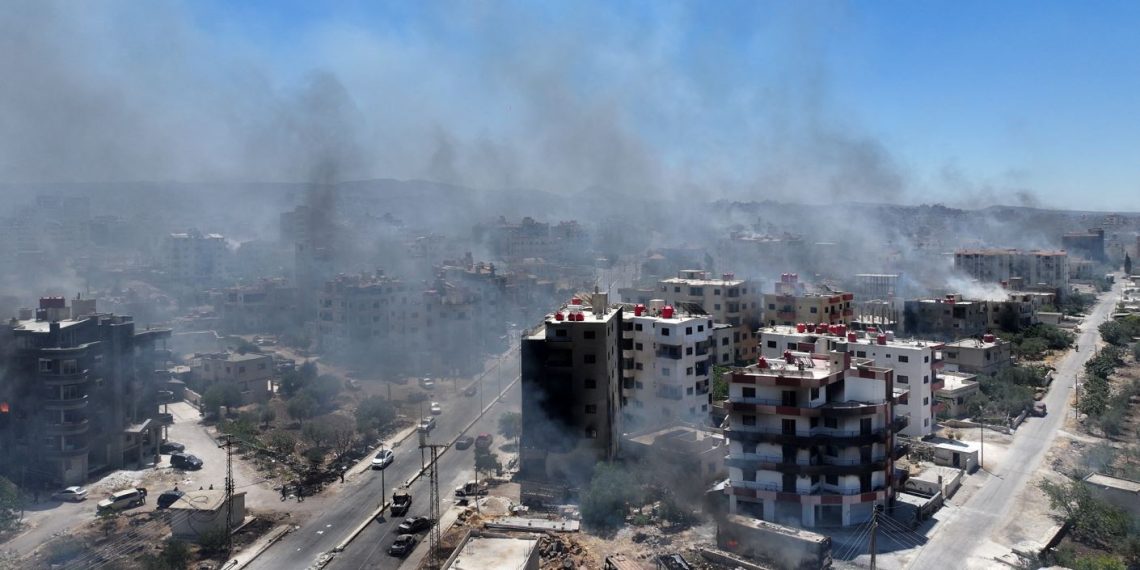
Since early March of last year, the new authority has pursued a scorched-earth policy, first against the Alawites, followed by an unjustifiable wave of violence targeting the Druze in Ashrafieh Sahnaya and Jaramana. More than a month later, the offensive moved toward the main Druze stronghold in Sweida. Following these two internal invasions, Syrians’ dignity was humiliated in both audio and video, with field executions, the killing of entire families, and cameras documenting scenes of looting, plundering, burning, destruction of property, and devastation of local livelihoods.
The goal of expelling thousands of employees from the bureaucracy—under the pretext of purging the state apparatus of sectarian “contamination” that supposedly hindered proper nation-building, replacing one minority’s dominance with that of an “imagined majority,” then imposing dominance over local populations and keeping them under constant threat by the regime and its supporters—signifies that this internal invasion is a practical prelude to enforcing a form of internal colonialism surpassing even that pursued by the Assad regime.
Meanwhile, the effort to transform the regions of “components” into “punishment colonies” or new plantations stems from the sick desire to remake the submissive nation, which in turn is subject to the authority of the dominant group.. This imagined nation thus claims the right to direct the future of the remaining regions economically, socially, and politically, in a way that provides the ruling elite with all the tools to transition from a purely centralized authoritarian regime to a totalitarian one embodying the spirit of a theocratic system hostile to the principle of equal citizenship.
No amount of optimism can be expressed about liberation from forms of internal colonialism, the cessation of conquest ideologies, and disciplinary campaigns while a highly centralized system remains. Establishing a balanced, decentralized system has become necessary to restrain any absolute authority seeking to turn Syria into a farm belonging to a new dominant group.