


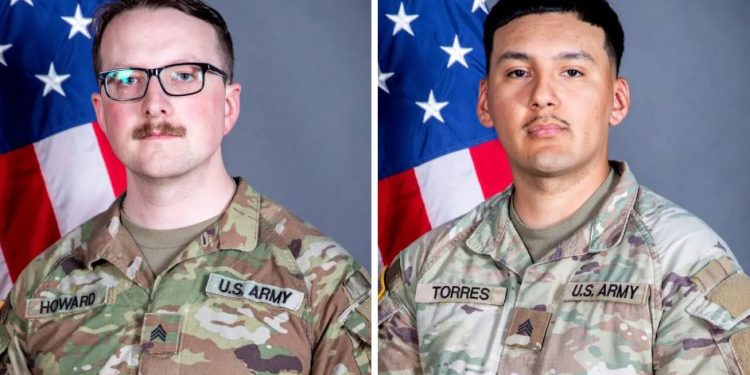
Approximately one month after the Syrian government signed a political cooperation agreement with the U.S.-led International Coalition to Defeat ISIS, Washington announced the killing of three U.S. Army service members in an ambush carried out by a member of the Syrian security forces on Saturday, December 13, in the city of Palmyra, which is under the control of Ministry of Defense forces.
In a hurried and somewhat turbulent manner, Damascus and Washington exchanged conflicting narratives regarding the perpetrator and the location of the incident before statements settled on holding ISIS directly responsible. Washington immediately determined the identity of the perpetrator by asserting his affiliation with ISIS, thereby ending the conflicting initial statements of Damascus officials, who found it difficult to acknowledge a security breach and the infiltration of ISIS elements into the nascent security establishment. However, the attack raised questions regarding the lack of a unified narrative between Washington and Damascus, revealing a weakness in information and security coordination. Furthermore, what occurred necessitates new assessments for dealing with the group’s cells and purging military and security institutions of extremist and infiltrating elements. Criticisms of how U.S. President Donald Trump and his special envoy, Tom Barrack, deal with the new Syrian authority may begin to emerge if attacks on service members in Damascus-controlled areas are repeated.
Contradictions in the Initial Statements of the Damascus Authority
In a rapid statement, the official spokesperson for the Syrian Ministry of Interior, Noureddine al-Baba, stated that “the perpetrator of the attack against Syrian security forces and American forces near the city of Palmyra during a joint field tour has no command link within the Internal Security and is not considered an escort to the leadership” (1). During this statement, which came hours after the attack, the spokesperson placed the blame on the operating American forces, saying: “The Internal Security Command had issued prior warnings to partner forces in the International Coalition regarding preliminary information indicating the possibility of a breach or attacks by ISIS, but these warnings were not taken into consideration.” It is not possible to verify whether the Internal Security Command informed the American side of this information, nor what steps Damascus should have taken to attempt to nullify or confront what it described as a breach occurring within its own ranks. The breach happened within its own forces, and the issue could have been addressed before it took its bloody turn. Moreover, al-Baba spoke of a decision to dismiss the perpetrator “were it not for the fact that the explosion occurred on Saturday, which is an administrative holiday.”
From an operational perspective, and regardless of the “negligent responsibility” of the Damascus security forces, shifting responsibility onto the American side may be considered a sign of the turmoil that hit the Ministry of Interior in the first hours following the attack. If the Syrian spokesperson’s claims are true, accountability within the American forces operating on Syrian territory and the subsequent reassessment phase will attempt to provide a report clarifying the existence—or lack thereof—of a Syrian “warning.”
During the first hours, Damascus did not specify the attacker’s affiliation—whether he was a member of ISIS, or merely a person “carrying extremist thought,” as Noureddine al-Baba stated, or a former member of Hay’at Tahrir al-Sham (HTS) who maintained his previous hardline ideas that the group worked on before reaching power. This weakens the credibility of the Syrian authority’s narrative regarding a prior “warning” to American forces. However, the following day, Damascus modified its narrative. The Ministry of Interior reported, according to Reuters (2), that the perpetrator belonged to ISIS and that, based on this, it had arrested five suspects in the shooting of American and Syrian forces in Palmyra. It stated that the operation “came in full coordination with the General Intelligence Service and the International Coalition forces, based on accurate intelligence information.” Notably, the Syrian Interior Ministry’s statement lacked any mention of the prior warning mentioned by the ministry’s spokesperson.
Did Washington Contribute to Modifying the Syrian Narrative?
U.S. President Donald Trump extended a lifeline to the Damascus government, stating to reporters at the White House in response to the killing of three U.S. Army members in Palmyra that “the United States will respond to the Islamic State if its forces are attacked again” (3). He added that the incident resulted from an “ambush.” Perhaps the term “ambush” was sufficient to deflect suspicion away from the fatal flaw within the security system of the Damascus authority—the same term adopted by the U.S. Central Command (CENTCOM). Especially since the U.S. President added to his comment on the Truth Social platform that Syrian President Ahmed al-Sharaa “feels great anger and deep resentment over this attack.”
Statements from the U.S. Department of Defense (Pentagon) and the U.S. President’s representative in Syria, Tom Barrack, also leaned toward considering ISIS as the party behind the attack, thereby exonerating the Syrian security authorities. It is noticeable that the Trump administration, as a result of its significant embrace of al-Sharaa, cannot rush to direct blame at the Syrian leadership, as criticisms would rebound toward it after opening the doors of the White House to the transitional Syrian President on November 10 and pushing toward the conditional lifting of Caesar sanctions. Particularly since the conditions for lifting sanctions include Damascus taking “concrete steps in combating terrorist organizations.” Perhaps the Palmyra attack may lead to a review of Damascus’s merit in combating terrorist organizations that appeared within its own ranks, posing a threat to the safety of American forces operating in Syria after the announcement of Syria joining the International Coalition to Defeat ISIS.
Post-Attack Questions
Observers of Syrian affairs await the assessments the Pentagon leadership will conduct regarding the situation in Syria, comparing what happened in Palmyra—one month after the announcement of Damascus’s cooperation with the International Coalition—with the results of its older and ongoing alliance with the Syrian Democratic Forces (SDF). This is particularly relevant as the perpetrator was a member of the Syrian security forces, according to what the Wall Street Journal quoted from American and Syrian officials. According to the newspaper, “Despite the pledge of American officials to continue cooperation with Syrian forces, some analysts see that the attack may complicate efforts to deepen security relations until al-Sharaa succeeds in imposing better control over his forces” (4). It is clear that the multiplicity of factions making up the Ministry of Defense requires realignment, restructuring, and scrutiny of the identity of those joining its ranks. The possibility of extremists or ISIS members joining the Syrian army has become easier due to the difficulty of differentiating individuals, given the similarity of ideological curricula in the nascent military and security establishment. Furthermore, Damascus has hurried the process of forming a factional army with a larger force size, which allows for the inclusion of new fighters without scrutiny or security screening. Additionally, Damascus ignores the issue of resolving the file of foreign fighters and officers within the ranks of the Ministry of Defense and the possibility that they may pose a constant risk factor in the most sensitive institutions.
It seems that the attack incident will leave behind questions about Damascus’s merit in managing the file of fighting ISIS, Al-Qaeda, and foreign jihadists, and its ability to “purify” security and military institutions of extremist elements. Likewise, its ability to work independently across all Syrian territories, separate from the support of the Syrian Democratic Forces SDF, especially in the Badia (desert), the Deir ez-Zor countryside, and the eastern border regions. Naturally, the Pentagon and decision-makers in Washington will keep in mind the importance of implementing the March 10 agreement to reach an optimal security framework for dealing with the risks of ISIS’s growing capabilities and the breaches it may achieve within the new security institutions. The primary question remains: What if the Palmyra attack is repeated in other areas, or if the targeting of American forces during joint operations with Syrian security forces recurs? Furthermore, will the Trump administration bear the cost of excessive trust in al-Sharaa’s ability to manage the transitional phase without the presence of other Syrian partners, especially since the nature of the Sharaa authority’s mistakes may become costly for the United States and its forces in Syria?