

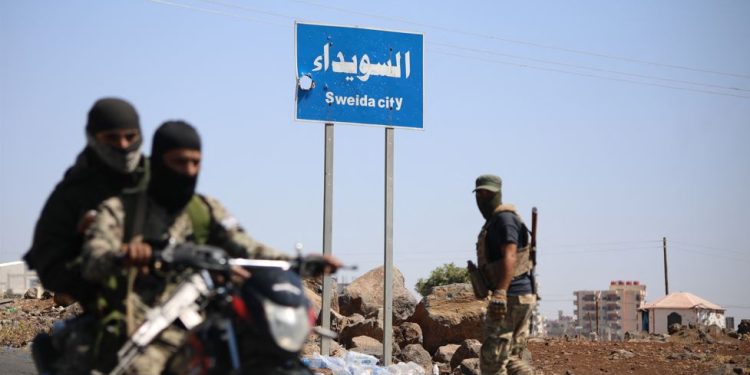
Another example of the transitional authority in Damascus (run by Hay’at Tahrir al-Sham, as must always be emphasized) interpreting how to “control” Syrian spaces and subjugate their inhabitants within the “central state” emerged in the recent attacks targeting the Druze community in the southern Syrian province of Suwaida (Sweida). The horror and brutality of the violations, crimes, and massacres committed against the people of Suwaida provide new and additional evidence of the totalitarian, exclusionary mindset of the central authority regarding its relationship with the various components and parties. This relationship, which the regime does not want outside the logic of spoils and dominance, and the narrative of “whoever liberates decides,” is becoming a method of governing the state and a fixed “truth,” reinforced by the efforts of local and Arab media loyal to the Damascus regime.
The regime has not abandoned its favored approach of exploiting Arab and international acceptance, and the marketing it has received—and continues to receive—as the “new Syrian state,” despite its transitional nature (local factional, and also based on a false quota system), to impose its authority and vision on the Syrian people and nation. It has also repeatedly sought to translate external acceptance into “power cards” and an expansion of influence over all parties and components. Following its meeting with Israeli officials in the Azerbaijani capital, Baku, and its presentation of its vision for peace and a “security agreement” with Israel, the regime assumed it had received the green light and that the path was paved for its push toward the Sweida governorate, which has enjoyed a special administrative status for many years. This was to control and “replace” it, thus imposing “state sovereignty” by integrating it into the rest of the country—territories the regime considers “spoils” in the name of “deterring aggression.” The regime sought to seize what it perceived as an opportunity after the Baku meeting: suppressing local will, crushing the Syrian Druze identity, and eliminating emerging decentralization efforts there, outside the will, mentality, and ideology of the regime.
The massive attack launched by the regime on Sweida, using hundreds of jihadists and heavy military vehicles—believing that the Israeli “veto” in place since the fall of Bashar al-Assad’s regime had diminished, and that the regime’s entry into Sweida would be part of the price Israel would pay for accepting “peace” and the task of “securing” the southern regions—resulted in horrific crimes and violations against Druze civilians, causing a major upheaval within Israel, where the Druze community holds significant influence. This led Benjamin Netanyahu’s government to “retract” from its understandings with the legitimate government and to decide to strike Syrian government forces, in addition to bombing the presidential palace and the General Staff headquarters in Damascus. These Israeli strikes, carried out under internal Druze pressure, brought the regime back to its senses. They demonstrated that the idea of “operating as a functional group” with international actors does not always grant immunity or a “certificate of innocence” to settle scores with those it considers domestic enemies. This military approach, as we have seen in the coast, Sahnaya, and recently in Sweida, remains a constant.
U.S. Secretary of State Marco Rubio stated that a “serious misunderstanding” occurred in Baku, which prompted the Damascus regime to launch an attack on Sweida using heavy military equipment. Reuters published an extensive report, based on multiple sources, indicating that the regime misinterpreted the positions of the U.S. and Israel following the Baku meetings, believing there was a “green light” allowing it to deploy its forces in Sweida. Here, the regime’s unrestrained desire to continue exploiting all understandings with foreign powers—regardless of the impact on Syrian sovereignty and territory—is evident, in order to consolidate its rule and control over Syrian parties and components through force and coercion, integrating them into a unilateral, totalitarian “state” that continues to strengthen its pillars and institutions.
Tom Barrack, the U.S. envoy to Syria, plays a negative role by boosting the morale of the temporary transitional authority and energizing its resolve. He consistently covers up violations committed by this authority, defends its positions and policies, and aligns with it in every dialogue and negotiation with Syrian parties and components. Barrack’s not-so-innocent focus on the suffix “strong, centralized, unified state” and his persistent rejection of what he calls “division and separation” when discussing issues related to northern and eastern Syria, Sweida, and the coast, strengthen the regime’s resolve and contribute to its rigidity, increasing accusations of treason and exclusion in its rhetoric regarding the demands of Syrian factions and components.
In the last meeting that brought together a delegation from the Autonomous Administration and the Syrian Democratic Forces with officials from the central government on July 9, Barrack sided with the regime’s interpretations. This contributed to further hardening of the regime’s stance, culminating in the issuance of a strongly worded statement against the Autonomous Administration and the Syrian Democratic Forces, laden with accusations of treason. The statement also quoted some of the phrases Barrack frequently repeats when speaking about the form and nature of the political system in the new Syria, such as “one Syria, one army, one government.”
After the failure of its attack on Sweida, which did not conclude as planned with the regime’s control over the province and the confiscation of its people’s will, and with the exposure of the extent of the crimes, massacres, and horrific violations committed, coupled with the humiliating Israeli bombardment of sovereign landmarks in Damascus, the Syrian authorities began employing a different method of revenge and breaking the will of the Druze. The regime turned to incitement and sectarian and social/tribal mobilization against the Syrian Druze. Similar to the “general mobilization” that took place against the Alawites on the coast, the regime and its “social and media activists” launched calls for a “tribal uprising” to mobilize unruly groups claiming to belong to major Syrian tribes, reinforced by jihadist fighters and others affiliated with Turkish-backed factions. These groups are used as dirty tools to commit crimes—such as mass killings, executions from high places, rape, slavery, as well as looting and pillaging—in their name and under their banner.
This is a tactic by the regime to officially distance itself from the crimes of mass murder, ethnic cleansing, and sectarian persecution, instead blaming “groups that emerged from underground,” claiming they have no control over them and are outside its authority. Such accusations serve as a weapon to target its opponents among the Syrian people. Currently, the regime is forming a “reserve army,” overseen by its foreign and Syrian cadres. This process involves extensive fabrications and the infusion of as many takfiri narratives and fatwas as possible, along with accusations drawn from the Ba’athist lexicon—such as collusion with Israel and foreign powers, and “attempts to carve out parts of Syrian territory and annex them to foreign states.”
There is a reliance on force, brutality, and the involvement of new actors—particularly tribes—in the Syrian conflict. A deliberate policy aims to implicate the Syrian Sunni component in the war the regime wages against Syria’s ethnic, religious, and sectarian groups. A significant amount of Sunni blood is shed at their own hands, in an effort to make Syrian patriotism fade and to replace it with a blind, sectarian vengeance that follows the regime’s lead, without consideration or planning. Currently, incitement, mobilization, and propaganda against Syrian communities are ongoing in the media, with the participation and supervision of the regime, and with coverage and distortion by most Arab media outlets.
It is clear that the legitimate authority—Hay’at Tahrir al-Sham—has plunged Syria into a “war of all against all,” despite all warnings and advice. Amid this chaos, resulting from horrific acts of mass killing, this authority now appears more committed to relying on what it believes is its “popular support” to complete its control over Syria, discipline those who have escaped its grip, and turn the country into a dark emirate. Under this grim reality, the words directed at the suffering Syrian communities, calling for “laying down weapons” and “joining the state” unconditionally, have become a foolish joke deserving of condemnation—and raise serious doubts about the mental fitness of the speaker!