
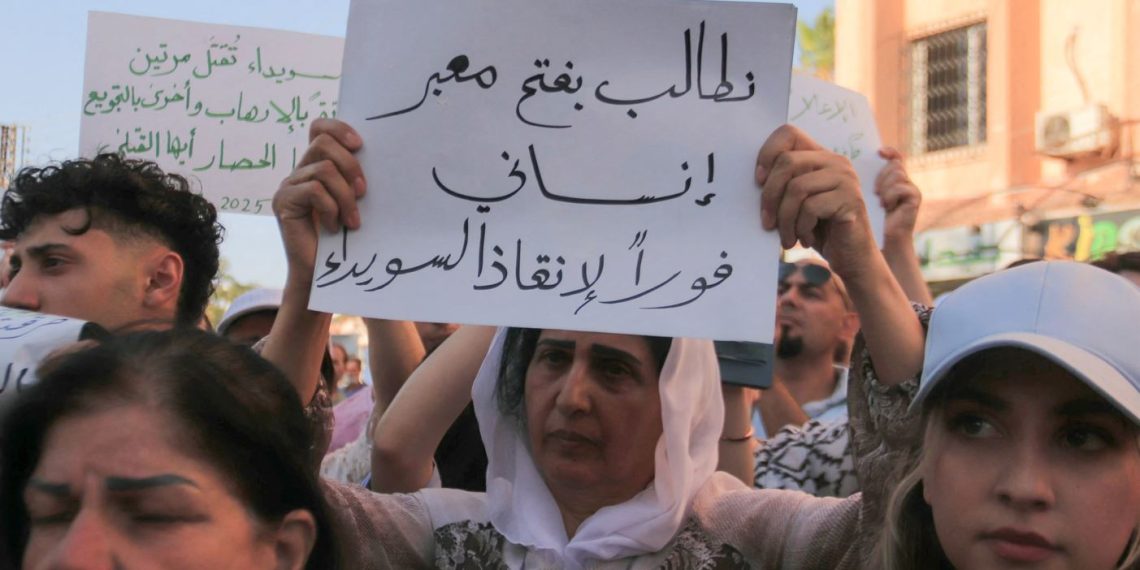
The bloody developments that have taken place in Sweida Governorate since the middle of last month have once again brought the Syrian issue to the attention of the UN Security Council. On August 10, 2025, the Council unanimously issued a presidential statement condemning “the acts of violence committed against civilians in Sweida, including mass killings and loss of life, which led to the displacement of approximately 192,000 people.” As indicated in a previous similar statement issued by the Security Council on March 14, concerning events in the Syrian coast—including massacres and violations—the Council reiterated the need to return to the fundamental principles of its Resolution 2254 of 2015, which serves as the UN’s reference for a comprehensive political solution in Syria.
The repeated reference to Resolution 2254 does not appear to be routine or formal. Rather, it carries a symbolic political significance. On one hand, it transcends the internal aspect of the Syrian Case; on the other hand, it indirectly highlights the political and security failures accumulated by the transitional authority led by Ahmed al-Sharaa over the past months.
The aforementioned resolution stipulates a political transition based on phased steps with clear timelines. This transition aims to establish a democratic political life, including the formation of a representative government that reflects the diverse segments of the Syrian population, drafting a new constitution, and holding elections under international supervision. These measures are intended as a prelude to restoring Syria as a state with full legal and political sovereignty. Therefore, the inclusion in the Security Council statement of phrases such as “the implementation of an inclusive political process based on the core principles of Resolution 2254, including the protection of the rights of all Syrians,” and “the necessity for this political process to meet the legitimate aspirations of all Syrians, protect them all, and enable them to determine their future peacefully, independently, and democratically,” as well as reaffirming “the importance of the United Nations’ role in supporting the political transition process in Syria in accordance with the principles outlined in the resolution,” and expressing “support for the efforts of the UN Special Envoy in this regard,” can be understood as a form of skepticism by Security Council members regarding the unilateral political measures undertaken by the transitional authority—such as the “Victory Conference,” the appointment of Sharaa as head of the transitional phase, the fragile National Dialogue Conference, the Constitutional Declaration granting Sharaa sweeping powers, the formation of a government dominated by Hayat Tahrir al-Sham and its affiliates, and the upcoming appointment of the People’s Assembly.
This international insistence on a comprehensive political process under Resolution 2254 is likely to exert political pressure on the transitional authority, which the Security Council statement refers to as the “Syrian Interim Authorities.” It exposes the ineffectiveness of their efforts in addressing the various complex internal issues, as evidenced by the continued massacres and violations, the involvement of regime agencies and loyalist factions, and their failure to reach an agreement with the Autonomous Administration and the Syrian Democratic Forces SDF in the northeast. The March 10 agreement remains merely ink on paper, with ongoing disagreements and escalating rhetoric from regime mouthpieces inciting and threatening the Kurds. All of this reveals the inability of the current transitional authority, with its exclusionary and factional approach, to overcome divisions that hinder political stability, security, and sustainable peace in Syria.
On another note, the Security Council’s statement called on “the Syrian Interim Authorities to ensure accountability for all perpetrators of violence and to bring them to justice, regardless of their affiliations,” emphasizing “the importance of inclusiveness and transparency in justice and reconciliation processes and their urgent necessity for peace.” This reflects concerns about ongoing impunity for war crimes. It is worth noting that these international calls for justice for the victims of the massacres in Sweida and the coast—many of which were documented on mobile phones by the perpetrators themselves, including members of the Ministries of Defense and Interior, as well as what the regime calls “unruly factions”—and the mention of “full, safe, rapid, and unhindered delivery of humanitarian aid to all affected communities in Sweida and across Syria,” will all remain futile unless accompanied by serious international pressure mechanisms. This is especially true given that local and international human rights organizations have questioned the regime’s procedures and the independence of its committees tasked with these issues. Further eroding trust is the regime’s already fragile track record on human rights, as evidenced by the profiles of its leaders and core figures, many of whom come from a Salafi-jihadist movement previously linked to Al-Qaeda.
In summary, the Security Council’s position essentially reminds the Damascus regime and its supporters of what must be done to save Syria and its people, while also implicitly expressing reservations about the current situation. The key question remains: will there be a genuine will among international, regional, and domestic actors to translate these direct and implicit signals into tangible political action? Or will Syria continue to be hostage to a factional, ineffective regime that seems unaware of the scale of the catastrophe?