

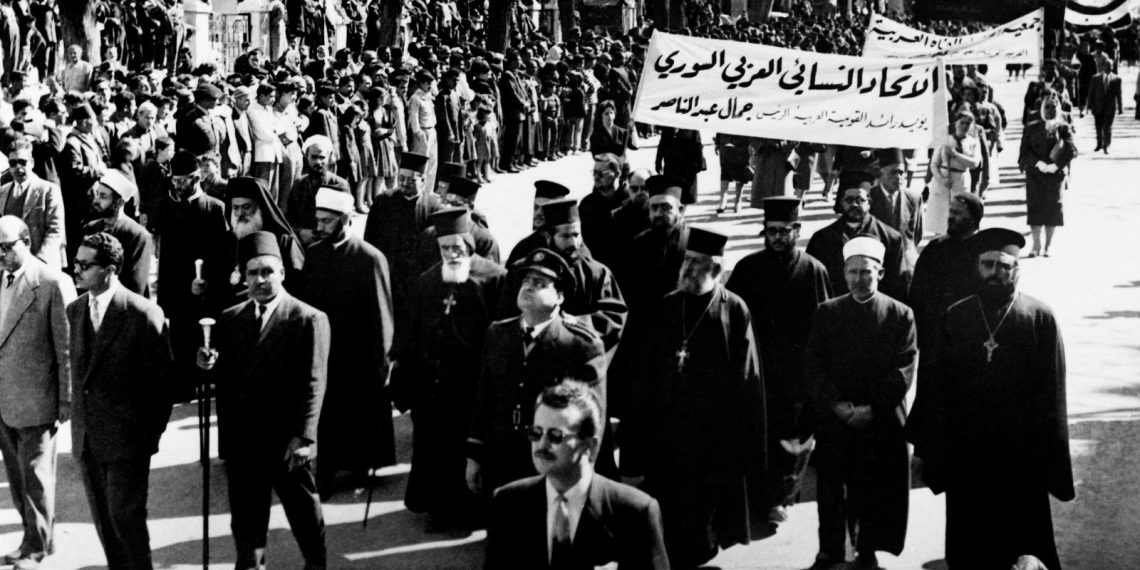
The Syrian writer Muhammad Amir Nashir al-Naam’s article, titled “The Attribute ‘Arab’ in the Name of the Syrian State between History and Current Debate,” [1] opens a wide window for an intellectual discussion that transcends the traditional, superficial political polemics surrounding the identity of the Syrian state. The true value of the article lies in its sober attempt to approach the issue from a calm historical and epistemological angle; it seeks to separate Arabism as a foundational narrative of the modern Syrian state from its authoritarian and tyrannical exploitation in later stages. This reading appears essential for deconstructing the emergence of the Syrian state away from the flawed reductionism that confines its structural crises solely to the “Ba’ath” era or to the mere insertion of the word “Arab” into the state’s name.
However, I believe that the real dilemma does not stop at the boundaries of the historical facts recounted in the article, but rather lies in their theoretical trajectories and the conclusions to which they lead. The obsession with proving the political and cultural roots of the Arab narrative in founding the Syrian entity ends up leading the author—perhaps unintentionally—to the opposite result: exposing the exclusionary nature inherent in the core of the Syrian social contract itself. Tracing the rise of Arabism in the nascent state reveals that the Syrian political sphere was never founded on a purely inclusive, national neutrality; rather, it was formulated within a nationalist vision that monopolized the definition of the state, the nation, and the public sphere, viewing itself as the natural and sole expression thereof.
Here, this reading must distance itself from the trap of retrospective moral condemnation. The critique of the foundational Arab narrative does not aim to negate the cultural or historical heritage of the Arab majority, nor does it seek to reduce Arabism to its subsequent authoritarian trajectories and distortions. We are facing an analytical approach that attempts to question the validity of this narrative today, and its capacity to persist as an inclusive framework for producing equal citizenship within a highly diverse and complex Syrian society.
First: Foundational Arabism and the Limits of National Neutrality
Historically, Arabism played a unifying and modernizing role at the beginning of the twentieth century; it succeeded in formulating a political bond that transcended sectarian, tribal, and narrow local sensitivities, forming a bulwark against colonial fragmentation and Turkification policies. However, the structural dilemma began when this spontaneous cultural and historical presence of the majority turned into a “top-down foundational reference” that predefined the state, imposing implicit identity conditions on the remaining components as a passport for integration within it. The epistemological objection here does not concern the existence of the Arab identity as a social given within the Syrian sphere, but rather its transformation into a supreme constitutional and political dogma that monopolized the public space and the political arena.
When the state starts from a single nationalist identity as its supreme reference, it does not merely reflect an existing social reality, but contributes to reproducing it through its institutions, laws, and mechanisms of political representation.[2] Consequently, the state ceased to be a neutral space that all groups participate in shaping on an equal footing, mutating gradually into a ready-made, pre-defined political and cultural vessel; a vessel that demands other groups to melt and dissolve inside it, instead of granting them an equal opportunity to participate in its foundation.
This dilemma becomes clearly evident when putting the foundational Arab experience to the test of comparison with the concept of secularism in modern Western experiences. Although the latter was not completely untainted by bias toward the cultural and historical heritage of the majority, it succeeded—to varying degrees—in developing a relative institutional neutrality, allowing the state to stand at a more balanced distance from individuals, groups, and their cultural distinctions.
In contrast, the secularism woven by the founding Arab narrative in the Levant [3] — in a manner close to what critical secularism literature explains—appears to be a form of “incomplete or conditional neutrality.” Here, identifying with the Arab cultural space became the mandatory entry point to citizenship and political legitimacy for the groups not naturally belonging to it. While this model partially succeeded in domesticating and containing religious and sectarian diversity within the Arab space, it collided with the barrier of the national and ethnic question, specifically in the Kurdish case. At this crossroads, integration shifted from partnership in an interactive political space to forced assimilation and absolute subordination to a dominant nationalist narrative.
Second: From Founding Identity to Unequal Citizenship
The crucial distinction between the existence of a cultural majority within society and the transformation of this majority into a foundational and monopolistic reference for the state represents the cornerstone for understanding the roots of the Syrian crisis. The presence of an Arab majority does not, in itself, constitute a political dilemma, nor is the recognition of the historical role of Arab culture in shaping the modern Levantine space a subject of denial or ingratitude. However, the problem explodes when this sociological fact turns into a monopolistic basis for defining the state and the social contract. At that exact moment, identity shifts from being a societal cultural expression to an institutional mechanism for redistributing legitimacy and belonging within the national sphere.
The state here does not confine itself to distributing material rights, but extends its hand to redistribute recognition, status, and symbolic proximity to the definition of the “homeland” itself among different groups.[4] As a result of this political construct, some groups seem naturally and by birth closer to the definition of the nation and the homeland, while other groups are pushed into the corner of continuous, exhausting defense of their belonging and patriotism. Here precisely, citizenship loses its assumed neutrality between the individual and the state, transforming gradually into a disparate and distorted relationship with legitimacy and national belonging. This disparity does not remain imprisoned at the level of legal rights or top-down political representation, but permeates the depth of the sense of status and security within the national sphere itself.
In this context, the Kurdish question manifests as an illuminating and glaring example of a deeper crisis related to the structure of the national Syrian state itself, rather than merely concerning the isolated rights of a specific ethnic group. The Kurds, like other non-dominant groups in the traditional nationalist narrative, did not face only flagrant forms of political or administrative discrimination; they faced a deeper dilemma represented in their inability to see themselves and their features within the official definition of the state.
Accordingly, milestones such as: the exceptional census of 1962, the Arab Belt settlement project, the ban on education in the Kurdish language, and the criminalization of Kurdish political and cultural expressions[5], cannot be read as fleeting or isolated authoritarian policies; rather, they are an institutional and executive extension of a deeper foundational structure that rendered the national sphere itself non-neutral and designed against segments of its citizens.
Third: The Kurdish Question as a Crisis of Recognition, Not a Crisis of Secession
This confrontation acquires its current importance from the fact that Syria today no longer faces a mere crisis of authority or a conflict over the form of the ruling regime, but is living a existential crisis of trust regarding the nature of belonging to the state entity itself. The extended years of war, collapse, and mutual violence have not only exposed the fragility and flimsiness of the state’s institutional structure, but have also revealed the ultimate limits and historical dead-end of the old national vision upon which it was established.
Nevertheless, a paralyzed segment of the Syrian debate still approaches Kurdish demands through a narrow security or geopolitical lens, placing them in the category of a potential threat to the country’s unity or as a prelude to secessionist projects. The ultimate paradox here is that this logic reverses the causal relationship entirely; localized identity retreat or acute nationalist sensitivities do not represent the starting point, but are rather the inevitable result of a long path of structural imbalance in the distribution of recognition and legitimacy within the state. Groups that are deprived of equal representation in the definition of the state and the national sphere tend instinctively over time to close themselves within “defensive identities” to protect their existence.
This is not a Kurdish particularity or a Syrian syndrome, but a well-known sociological phenomenon in divided societies, where the absence of equal recognition generates what can be termed a “societal security dilemma.” By this, we mean the transformation of groups’ fears of exclusion or assimilation into a permanent, sustainable source of mutual suspicion and political tension.[6]
What the Syrian experience confirms repeatedly is that policies of denial or security containment have never produced stable national integration; rather, they have contributed to fueling souls with suspicion and deepening defensive identities. Whenever a segment of society feels that its passage into the state is conditioned upon dissolving into a dominant identity—even if that was not always the result of deliberate or conscious policies—trust in the shared national sphere recedes, and citizenship shifts from an equal political bond to an unequal relationship with legitimacy.
Fourth: From Symbolic Hegemony to a Pluralistic Social Contract
Rethinking the Syrian social contract should not be understood as a call to dismantle national identity, or to replace an ancient hegemony with an opposing one; it is a serious attempt to transition the state from the “logic of exclusive ownership” to “equal political partnership.” Here emerges a fundamental truth: the foundational narrative’s possession of historical legitimacy in the past does not grant it eternal immunity that places it above revision and critique in the present. Historical heritage is not an eternal shackle imposed on the future of societies, but rather a political and functional experience whose validity is measured by its capacity to produce stability, legitimacy, and actual national integration.
Therefore, the Syrian dilemma does not lie in the presence of pluralism within society, but in the absence of the political and institutional formula capable of managing this pluralism in a just and balanced manner. Modern experiences prove that stable states in pluralistic societies rarely succeed by imposing rigid, centralized narratives that attempt to melt everyone down; rather, they succeed by building a flexible political space that allows multiple narratives to coexist within an inclusive national framework.
In this theoretical context, the “Agonistic Peace” approach acquires its utmost legitimacy as an analytical framework suitable for divided societies like Syria. This approach does not assume that stability is achieved by erasing differences or reaching a forced compliance with a definitive, rigid, and inclusive identity; rather, it establishes the building of political and institutional rules that accept difference and manage it as a project and a vital, peaceful element, transforming zero-sum conflict into healthy political competition.[7]
Conclusion
In conclusion, the real challenge and the wager placed upon Syrians today is not the impossible consensus on a definitive, past narrative of the state, but rather the invention of a neutral political and institutional space that accommodates everyone without exception. The opportunity for re-foundation is still viable and possible, provided that a new and courageous social contract is formulated—one that emerges from the complexity and lived reality of the present, not from the obsessions and shadows of the past.
It is, in its essence, a call for the birth of a state that derives its legitimacy and stability from its capacity to produce equal representation for all its citizens; a state that guarantees that every component can see its image and read its name within the shared national space, without prior conditions or historically established marginalization. The Syrian crisis did not merely announce the failure of a specific political regime, but exposed the ultimate limits of the foundational formula upon which the modern Syrian state was built, confirming the existential need to rebuild national legitimacy on more comprehensive, balanced foundations of equal and unconditional citizenship.
Footnotes
[1] – Muhammad Amir Nashir al-Naam (2026) “The Attribute ‘Arab’ in the Name of Syria between History and Debate” | Euphrates Magazine.
[2] – See: Brubaker, R. (1996). Nationalism reframed: Nationhood and the national question in the new Europe. Cambridge University Press.
[3] – See: Asad, T. (2003). Formations of the secular: Christianity, Islam, modernity. Stanford University Press.
[4] – On the relationship of recognition to citizenship and political identity, see: Kymlicka, W. (1995). Multicultural citizenship: A liberal theory of minority rights. Clarendon Press. Taylor, C. (1994). Multiculturalism: Examining the politics of recognition. Princeton University Press, 41 William St., Princeton, NJ 08540..
[5] – See for example:
Tejel, J. (2008). Syria’s Kurds: History, politics and society. Routledge.
[6] – The concept of the societal security dilemma is used here to refer to the situation in which groups’ fears of exclusion or threat turn into a permanent source of mutual suspicion and tension within divided societies. See: Posen, B. R. (1993). The security dilemma and ethnic conflict. Survival, 35(1), 27–47. https://doi.org/10.1080/00396339308442672 Roe, P. (2004). Ethnic violence and the societal security dilemma. Routledge.
[7] – The concept of agonistic peace here is based on the literature of agonistic pluralism by Chantal Mouffe, who posits that stability in divided societies is not achieved by removing differences, but by organizing them within a political framework that recognizes the legitimacy of competition and conflict. See:
Mouffe, C. (2013). Agonistics: Thinking the world politically. Verso Books.