


The transitional authority in Damascus is racing against time to tighten its grip on the Sunni Arab component through a series of mobilization policies and measures. These policies begin with incitement against non-Arab Syrian components (the Kurds) and non-Sunni Arab components (the Alawites and Druze), portraying them as outside the “authority/state” and rebellious against it. They then move to reframe the state, imposing it as a unit based on a narrow, highly centralized identity that refuses any identities or particularities outside the umbrella of “Sunni Arabs.”
These efforts culminate in official, public calls for participation in ethnic and sectarian cleansing campaigns such as “general mobilization” and “tribal mobilization.” All this “implication” of Syria’s largest nationalist and sectarian component is based on the hope of legitimizing this authority (Hay’at Tahrir al-Sham) to rule and to eliminate the isolation it currently feels, as it did previously when it governed Idlib. This isolation stems from its being an ideologically driven faction created across borders, refusing to recognize nationalism or popular sovereignty. It is rooted in a Salafi-jihadist interpretation, whose visions are unpopular among Syrians and lack any support base that believes in and defends its ideas.
The goal is to shape Syria as a majority and minority society. The majority should be a single, cohesive group united behind the authority, obedient and submissive to its commands, while the “minorities” appear scattered, besieged, exhausted, and out of balance. To achieve this, the regime seeks to intensify sectarian nationalist rhetoric and amplify media propaganda in one direction, always relying on multiple narratives that it presents as unquestionable facts. All this aims to radicalize the Sunni Arab segment and entrench it behind the “state.” Concurrently, the regime continues to bury the legacy of the Syrian political opposition by excluding historic national parties and forces from the scene and erasing them from official political and media discourse. It also works to prevent the rise of civil society, to marginalize women, and to hinder their emergence within inclusive Syrian frameworks that transcend regional, sectarian, and national boundaries—thus thwarting efforts to establish a genuine national civil political life. The regime’s goal is to forge an “incubator” by engaging with the most basic social relationships and descending to the lowest societal levels, where it re-establishes clans and sheikhdoms as its structures and bases—both as a foundation—and as tools of repression and intimidation against its political opponents.
What the regime currently lacks, however, is a stable base of support. It recognizes its own isolation and lack of roots within Syrian society. That is why they turn to marginalized peripheries—sectarian audiences with poor backgrounds, whose circumstances of war and life in refugee camps have deprived them of education, exposure to the values of citizenship, coexistence, and acceptance of difference and diversity.
Besides the ideological burden of media hype, mobilization, and incitement aimed at subjugating and radicalizing the Sunni Arab component, the regime resorts to practical measures to bolster its political and media narrative. An example of this is what happened in Suwayda, where attacks targeted Druze citizens, along with the use of the “tribal card” by mobilizing lawless groups outside the bounds of Arab tribal custom and law (some led by local warlords who, only months earlier, were commanders of militias formed by the Iranian Revolutionary Guard) to attack Jabal al-Druze and abuse the Syrian Druze community. It was by no means innocent for the authorities to agree to expel Sunni Bedouin families from Sweida, in full view of the Syrian people and Arab public opinion.
The approval of the displacement of the Bedouins from Sweida serves the regime’s narrative of a “ethnic minority conspiracy” against the “Sunni majority.” It is part of the sectarian and ethnic segregation narrative/plan pursued by the authorities, aimed at creating homogeneous and “pure” areas in which the regime can “replace” its loyalist base in place of minorities it considers disloyal to the centralized, single-colored state that it is working—along with external actors—to shape and firmly establish.
There is no doubt the regime struggles to recruit the Sunni Arab community, especially in major cities and urban centers (Damascus, Aleppo, Homs, and Hama), within the frameworks it has outlined. These plans seem strikingly influenced by the “management of savagery” methodology developed by jihadist theorist Abu Bakr Naji. The regime appears to be operating in the first phase of this approach: the phase of “vexation and exhaustion,” where crises are deliberately created to destabilize local communities and push them toward a state of “lawlessness,” with the aim of intervening forcefully to manage the ensuing chaos in line with the rules outlined in that infamous jihadist manifesto.
The regime’s plans also clash with a series of heinous violations committed against Sunni Arab citizens—ranging from arrests and extrajudicial killings, to storming mosques to “correct” worship, prayer rituals, and Qur’an recitation, and extending to the disruption of wedding celebrations, assaults on attendees, and abuse of singers and members of musical groups. These violations are casting a shadow over Sunni Arab communities, fueling unrest and resentment toward an authority that seeks to impose its extremist vision and dark ideology on people who have practiced a moderate, locally rooted religious practice all their lives.
Indeed, the minimal—even microscopic—popular participation in regime-led demonstrations intended to showcase public support highlights the extent of anger toward the regime’s policies and actions. This regime barely exits conflict with one Syrian community before entering into confrontation with another, not to mention the continuous repression of Sunni Syrians in major cities and urban centers.
As usual, the regime evades reality and distorts facts (e.g., the Fact-Finding Committee report on the coastal events, the official narrative on Sweida, etc.), resorting to external diplomatic contacts and visits as supposed achievements for Syrians engulfed in internal conflicts, ongoing confrontations, and insecurity.
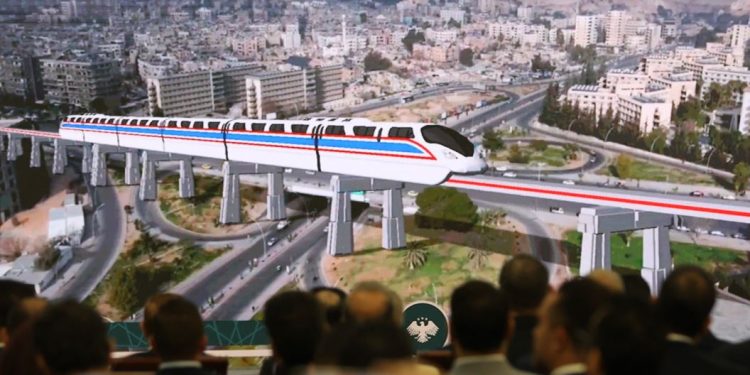
The regime also resorts to ceremonies and occasions—now almost daily—for signing multi-billion-dollar construction contracts (a metro system, expansion of Damascus International Airport, the construction of towering skyscrapers in the capital, etc.) in order to project an image of having resolved all internal problems, established a state of law and institutions that respect local specificities, and achieved smooth, transparent decentralization, with nothing left but grand, luxurious projects of towers and airports—following the so-called “great achievement” of establishing the state’s “prestigious visual identity.”
In reality, the regime’s show of being absorbed in reconstruction is nothing more than an escape from the major obligations it faces: ending the systematic abuse of Syrians and the massacres committed against them, moving out of the transitional phase, and accepting a national consensus conference to define the features of the existing state—away from the “empowerment” methodology it enforces, and which it seeks to drag the Syrian Sunni Arab component into, turning it into a tool for achieving and solidifying that empowerment.
It seems that the rhetoric of mobilizing and inciting the Sunni Arab component—following the “general mobilization” and “tribal uprising”—and the transitional president’s gratitude toward the “supporting” groups that attacked the Druze in Sweida, killing and humiliating civilians, has become an explicit and covert policy of the authorities.
As a result of this rethoric, ISIS cells have begun to openly appear with their symbols and slogans within the waves of raids launched and ongoing by the regime in the coastal areas, Damascus countryside, and Sweida. Additionally, more extremist groups are also emerging, openly calling for ethnic cleansing and liquidation. An example is the “Ansar al-Sunna” group, a splinter faction from Hay’at Tahrir al-Sham, which claimed responsibility for the bombing of Mar Elias Church in Damascus and began spreading propaganda on jihadist channels inciting fighters against religious and sectarian groups, accusing the regime of “apostasy and submission to the tyrant.”
Amidst all this, and to achieve its ultimate goal of remaining in power, the regime continues—and desperately clings—to its favorite policy: operating as a functional apparatus that skillfully, or so it believes, manages relations with countries and alliances whose interests and agendas conflict with the Syrian nation and people’s well-being.