
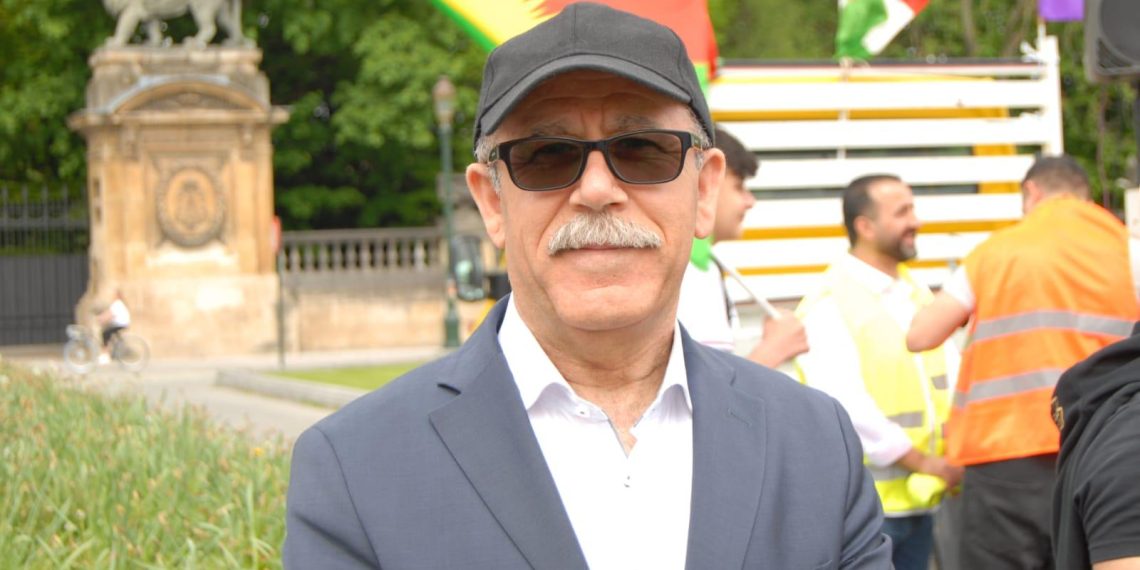
The Kurdish Center for Studies conducted an interview with Kurdish politician and leader of Free Life Party of Kurdistan (PJAK), Siamand Moini, regarding a number of issues concerning Iran and Eastern Kurdistan, particularly in light of the recent exchange of attacks between Israel and Iran.
The interview examined the Kurdish position in general, and PJAK’s stance in particular, as one of the most important Kurdish parties in Eastern Kurdistan, with regard to the recent confrontations and efforts to pressure the Iranian government to engage in dialogue and negotiations with Kurdish political forces. It also addressed efforts to unify Kurdish political discourse and the language of all Iranian national democratic opposition factions. Additionally, the interview explored PJAK’s stance on the “Peace and Democratic Society” initiative launched by Kurdistan Workers’ Party (PKK) leader Abdullah Ocalan in early February, aimed at resolving the Kurdish issue in Northern Kurdistan and Turkey.
Kurds in other parts of Kurdistan do not have sufficient information about the demographics and geography of Eastern Kurdistan. Can you briefly discuss the demographics and geography?
Siamand Moini: Eastern Kurdistan is a vast region within Iran’s borders, comprising four provinces according to the Iranian administrative division: Kermanshah Province, Ilam Province, Kurdistan Province (with its center in Sanandaj), and West Azerbaijan Province (or Urmia). A significant portion of Lorestan Province is Kurdish as well, and the region extends into parts of Khorasan, with an estimated Kurdish population of around two million people. The area is characterized by its beautiful and rich natural landscapes, situated on the slopes of the Zagros Mountains. Mountain villages and major rivers such as the Sirwan River, the Kalu River, and many others flow throughout Kurdistan. The region is rich in mineral resources, with a large portion of Iran’s gold deposits located on Kurdish soil. This land is considered blessed and sacred. There is also abundant water in Kurdistan, although the Iranian regime has transferred some of this water to other regions via dams.
Eastern Kurdistan borders southern Kurdistan in Iraq and northern Kurdistan in Turkey. The Kurdish population in Eastern Kurdistan is estimated to be between 10 and 15 million. When including Kurds from Khorasan and Lorestan, the total number is significantly higher. The Kurdish people in this region generally speak various dialects of the Kurdish language, including Sorani, Kurmanji, Kalhori, Hawarami, and Lori. Culturally, they are closely linked to the Zagros cultural sphere, and the richness of Kurdish culture within Iran’s geography also shares connections with other ethnic groups. Politically, the people of Eastern Kurdistan are politically conscious, highly educated, possess a culture of civil activism, and have a strong awareness of environmental protection.
How do you describe the Iranian state? What is its nature, and does its policy toward the Kurds and other peoples differ from the policies of countries such as Turkey, Syria, and Iraq? How do you interpret the 12-day war between Israel and Iran?
When it comes to the Iranian government, we must understand that Iran pursues a dictatorial and repressive policy. This regime has played a significant role in the Middle East, and its policies toward the Kurds and other peoples have made it insecure and hostile. Iran is an Islamic state that imposed itself on its people after the Iranian Revolution of 1979. The political system in Iran is governed by the concept of Velayat-e Faqih (Guardianship of the Jurist), with Khamenei serving as the Supreme Leader, who considers himself the Imam of the Age. All major decisions are made under his supervision and orders.
At the start of Khomeini’s rule, systematic internal executions and the suppression of revolutionaries, socialists, and dissidents were carried out. The Iran-Iraq war, under Saddam Hussein, lasted eight years, during which thousands of revolutionaries were executed. Simultaneously, Iran’s foreign policy focused on exporting the Islamic Revolution, and its relations with neighboring countries have always been hostile. This policy has contributed to regional crises.
Iran has consistently supported the Assad regime in Syria and has strengthened its armed forces to fight through proxy outside its borders. It also supports Shiite militias and is largely indifferent to party politics in southern Kurdistan. Iran has a president, a parliament, and various institutions, but all operate strictly within the framework authorized by Khamenei.
Officially, no political party is permitted to operate independently; all political, civil, and environmental movements are under the regime’s control.
The main force of the state is the Revolutionary Guard (IRGC), which operates in a mafia-like manner, aiming to control the state, institutions, and society. The IRGC controls over 80% of Iran’s economy and functions as a cartel. Therefore, Iran can be classified as a theocratic and dictatorial state.
What is the current political situation in Iran? Is the regime considering resolving its problems after this war? How do you view the regime’s orientation at this time?
Iran has never prioritized solving the problems of its people, nor does it have any genuine intention to do so. As we mentioned, the regime is an authoritarian and dictatorial authority, primarily focused on maintaining and expanding its power and advancing its military and technological capabilities. It is developing nuclear weapons and ballistic missiles. This policy serves to strengthen its proxies and export political Islam beyond its borders.
During the recent 12-day conflict, Israel targeted and killed many senior Iranian military commanders, which was a significant blow to Iran’s military structure, and Israel achieved many of its objectives.
Despite this, Iran shows no intention of resolving its internal issues; or in other words, it is unable to do so. We have seen that after the twelve-day war, hundreds of political and civil activists in Kurdistan were arrested, many were executed, and there is a group of young people awaiting execution. Iran’s excuse is that they are spies for Israel; however, this is merely a pretext to intimidate the people domestically, especially Kurds, Baloch, and Arabs, so they do not think or act against the dictatorship and injustice.
How close are the Kurdish forces in Eastern Kurdistan, and how can they form a Kurdish unity or front?
The parties in Eastern Kurdistan have opportunities to reach an agreement. They have repeatedly attempted to establish a common mechanism for cooperation, but due to external interventions, they have been unable to unite under one umbrella. In 2016, we, as Free Life Party of Kurdistan (PJAK), visited all the parties in Eastern Kurdistan. Later, in 2018, we proposed a project outlining ten key points. Although all parties agreed on the content of this project, its implementation has been hampered by various obstacles. A faction within the Kurdistan Democratic Party of Iraq (KDP) has also obstructed these efforts multiple times, resulting in no tangible results. Many people in Eastern Kurdistan are seeking solutions. At PJAK, we do not set any conditions for rapprochement between parties. We only emphasize that if the Iranian government changes, no party should have the right to possess armed forces independently. The military component must be unified, and its primary duty should be to safeguard the gains of freedom in Eastern Kurdistan.
What does PJAK currently rely on in its political work, and what are its relationships with Kurdish and Iranian forces?
PJAK operates based on self-organization and aims to strengthen political and cultural awareness among its members. Simultaneously, it remains active within the political landscape of Kurdistan and Eastern Kurdistan. Our political activity is founded on close relations with other peoples in Iran, including the Balochis, Arabs, Azeris, Gilaks, Talysh, and Turkmen. We believe it is essential to enhance our relationships with democratic and freedom-loving forces and to cooperate politically to build a democratic society in Iran.
What is the vision PJAK seeks for Eastern Kurdistan and Iran?
PJAK works toward establishing democratic self-governance in Eastern Kurdistan, considering democratic federalism a suitable model for Iran’s governance system. Within this framework, we aim to foster cooperation and solidarity with the Iranian people and collaborate with political parties in Eastern Kurdistan based on political pluralism. Our goal is to form a united front against centralization, chauvinism, and reactionary forces, and to engage in a common struggle.
Currently, PJAK is the only party in Eastern Kurdistan that has managed to protect its existence from the regime’s conspiracies. We have organized and trained thousands of people inside Iran to play a leading role in the political future of Iran and Eastern Kurdistan. Our aim is to establish democratic self-rule within a democratic and confederal Iran, working toward a democratic Iran for a democratic nation. This is our vision for the future of Iran and East Kurdistan, and we are committed to implementing our strategies and tactics to realize it.
What impact will the peace process in Northern Kurdistan and the end of armed conflict have on Eastern Kurdistan and Free Life Party of Kurdistan(PJAK)?
It is too early to make a comprehensive assessment of this issue. However, if such a process takes place in Turkey and the need for war and armed conflict diminishes, it will have a highly positive effect on our struggle and will strengthen the role of the freedom movement in Eastern Kurdistan. The dialogue and peace initiative could elevate the Kurdish struggle to a new political stage, and through this process, the problems faced by the Kurds and other peoples in Turkey and Iran could be addressed via democracy and dialogue.
Iran will no longer be able to sustain its oppressive political approach, as the regime has exhausted its justifications for its current policies. If this approach persists, considering Iran’s worsening economic, social, and political conditions, the country is likely to face a crisis and may lose its grip on power.
In either case, PJAK will adapt its policies according to the evolving situation in Iran. PJAK will not compromise on the legitimate rights of its people and will continue its struggle by all means necessary to achieve its goals.
Free Life Party of Kurdistan
PJAK was founded on April 4, 2004, and held its second congress in January 2006. It is a party engaged in both political and military struggle to secure the rights of the Kurdish people in East Kurdistan (Iranian Kurdistan). The party (which has held a total of 7 congresses so far) is considered one of the strongest and most influential Kurdish parties in Iran, with significant popularity among the Kurdish youth. It also enjoys widespread support across all regions of East Kurdistan and among various segments of Kurdish society of different sects and beliefs. Kurdish politician Siamand Moini, born in Mahabad city and the son of well-known Kurdish politician Suleiman Moini, served as a co-chair of the party alongside leader Zilan Vejin from 2016 to 2024. He is currently a member of the party’s leadership committee.