

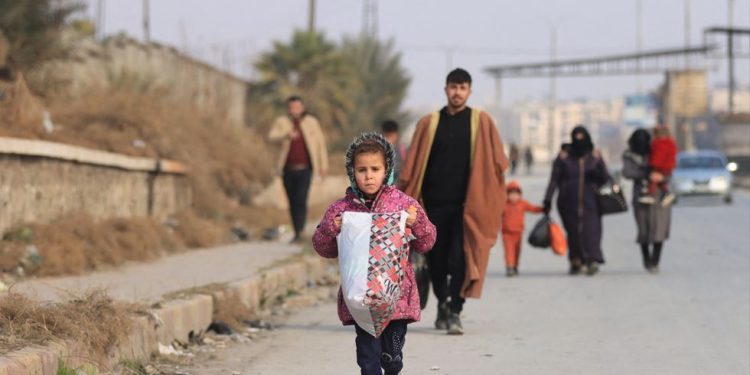
Over the last two weeks, the two densely populated Kurdish neighborhoods of Sheikh Maqsoud and Ashrafiya in the city of Aleppo in northern Syria became scene to horrendous war crimes and crimes against humanity, resulting in consequence in displacement of thousands of civilians.
While atrocities were with intent ignored by Arab and Western media outlets, giving place to the “rightful” long-sought and much-awaited takeover by the Syrian interim government of both adjoining neighborhoods, the Kurd was on purpose demonized.
Aleppo’s pyrrhic victory which reduced Sheikh Maqsoud in particular to rubble, as it witnessed intense battles between the Janissary- styled invading Syrian Army, and defending Asayish forces, could – in the long term – curtail the millennia-old Kurdish presence in Aleppo.
In conjunction with fierce battles unfolding on the ground, the history of Sheikh Maqsoud and the Kurdish occupation of it was called into question. This could justify the widespread damage caused by intense and constant shelling and bombardment.
While the unquestioned Kurdish presence in the city of Aleppo itself is unknown as it goes beyond record, historic evidence of the Kurdish occupation in Aleppo’s periphery tells a similar story.
By way of illustration, Afrin to the northwest, knows in antiquity as Ufrenus, had been purely a Kurdish locality with a history dating back to the Hurrian Era, 2300- 1200 BCE.
This reality went unchallenged until the whole locality was taken by Turkish Armed Forces and their Syrian hotchpotch militias as a result of Operation Olive Branch, symbolically in 2018.
In the Middle East, a region which has never been stranger to ironic twists, it should come as no surprise to know that Aleppo’s Kurdish twin neighborhoods, more or less, are associated with the waning years of the Ottoman Empire, which, like the recent Syrian crisis, has left indelible marks as one of the bloodiest scenes in recent history.
In historic perspective, murky information is available about Sheikh Maqsoud. Yet if we go back into history an exact century, we have historic evidence of both Sheikh Maqsoud and Ashrafiya.
The most available record of both localities could be traced as far to the closing days of World War I, 1914- 1918, with Ashrafiya been associated with the Armenian Genocide, which saw the total destruction of the Christian minority. At the time, Ashrafiya was known as Dawudiye.
In 1915, Ottoman authorities established a halting place nearby for detaining Armenians, who were brought from other distant parts of the empire, in order to be transferred (deported) to other areas via Ras al-Ain (Serekaniye) further east, or as far as Deir Ezzor, further in the southeast.
As the war drew to a halt, Bedouins and tribesmen of Sharif Nasir, son of Hussein of Hijaz, with British bayonets, converged on Aleppo. In the night of October 25, 1918, they swept into the city, which they set to fire. Echoing Damascus, Ottoman forces and civil employees were put to the sword.
Befuddled, that same night, Mustafa Kamal Pasha, evacuated his office at Baron Hotel to a nearby hill, about two kilometers north of the Baghdad railroad station. With River Qweik wriggling the hill in the west, and with Baghdad Railway passing at a close range, this gave the hill a unique commanding position in the military terms of the word, which was best materialized in the recent war.
When the sun of the next day rose over Aleppo, a new chapter was written in history. British Commander Henry MacAndrew entered the city in a champion reception. It was a total collapse. Elsewhere, Mustafa Kamal descended the hill he had occupied during the night on the forlorn hope that the situation might – at the eleventh hour – change. To no purpose.
That was the last of Mustafa Kamal Pasha’s short-lived acquaintance with Aleppo, an acquaintance (betrayal) that would leave indelible impacts not only on him personally, rather on the nation as a whole.
MacAndrew pursued the Turkish Pasha to Haritan further north, where the last engagement of WWI took place. The 402-year-long Ottoman rule was flicked to precipice. The place would be marked by a memorial, which still stands in place known ironically as Qabir Inglizi.
On July 16, 1919, MacAndrew, the conqueror of Aleppo, would die of burns he had incurred a week earlier. In fine details, his tunic had been cleaned with petrol and was hanging in a room to dry when he entered smoking a cigarette. The petrol vapours exploded, burning the British general so severely that he died in hospital a week later.
Four months later, British forces would withdraw from Syria. The country was essentially a French sphere of influence in line with the Sazonov-Sykes-Picot Agreement, 1916. The British by the urgency of war conquered Syria.
Arab “Nationalists” were now to lay prostrated at the feet of Turkish “Nationalists” (Mustafa Kamal Pasha) to help them mount a revolt against the French occupiers. The future father of the Turks, who was busy elsewhere, and with the Arab stab in the back still vivid in his memory, was not of the type to let the chance slip. He was not of the kind to let others see his cards.
Turkey quite cunningly funneled help to the Syrian rebels. Yet it was a well-studied gamble whose fruits were to be picked by Mustafa Kamal, not Arab Nationalists.
The short-lived act of cooperation curtailed Turkish- Syrian relations, ushered in an era of tense ties. The thaw finally broke in 1998 with the signing of the all-security Adana Agreement, which came, not unsurprisingly, at the expense of the Kurds.
In short, evidence suggests that George Beldi and Sabri Kurdi are the first two people to have (1938) occupied the place that would be known as Sheikh Maqsoud – the very same hill on which Mustafa Kamal had, 20 years ago, spent his stomach-churning and heart-wrenching night.
Yet it is of quite certainty that the appellation is attributed to a certain Kurdish sheikh, who lived in died in the locality in 1952. Prior to that, nothing is certain about the place.
Economic restrictions imposed on Kurdish rural areas by successive exclusionist Syrian governments, and with lack of job opportunities, non-availability of schools, among others, Kurdish workers, students, intellectuals from rural localities found their way to the quarter.
With the passage of time, Sheikh Maqsoud eventually expanded to the size of a modern town. In this diverse and rich environment, Kurdish spirit was not absent.
Being at the northern outskirt of Aleppo, and with residents coming basically from Kurdish areas adjacent to Turkish border, who came on successive waves, Sheikh Maqsoud became, more or less, deeply immersed in politics.
During the Syrian civil strife, Islamist opposition from the get-go found sanctuary in the warm lap of Islamist- leaning regime of Justice and Development Party (AKP) with Recep Tayyip Erdogan at its post. In the spring of 2013, Sheikh Maqsoud was taken by Kurdish People Protection Units (YPG) and the all-female Women Protection Units (YPJ).
As both neighborhoods isolated islands in a sea of piracy, they became the scene for constant attacks and shelling by different Syrian opposition (mostly Islamist) forces in the main quite ironically by Jabhat al-Nusra, led then by Abu Mohamed al-Jolani, Syria’s now interim president Ahmed al-Sharaa.
It was in 2016 when YPG/YPJ ditched all Islamist leaning groups from its periphery. Yet since then, it became a target for the notorious Fourth Armored Division, under the infamous command of Maher Assad. Use of siege, shelling, and starvation to subjugate YPG/ YPJ failed to the ground.
Structurally aligned with the Autonomous Administration of North and Est Syria (AANES), militarily, it as the Asayish that run security and policing duties. Syrian Democratic Forces (SDF) had earlier withdrew from both quarters. Yet, from bad to worse.
With the fall of the regime of Bashar Assad in 2024, Aleppo fell de facto to the caliphate of Hay’at Tahrir al-Sham (HTS), a newly adopted appellation for the very same Jabhat al-Nusra, that had, a decade ago, rattled the Kurds’ cage.
Yet Sheikh Maqsoud and Ashrafiya retained their limited yet symbolic self-rule. This reality proceeded, not without disturbances, until it became scene to one of the most of the grotesque cruelties.
On January 6, 2026, tribal militias trained by Turkish intelligence services rabbled into Aleppo. Contrary to 1918, when tribal mercenaries betrayed the Ottomans, and aligned with the British cause, time was ripe now the Neo- Ottomans to employ mercenary tribesmen to their cause.
It was now the turn of the Kurd to receive a tribal (al-Baqir Brigade) blow, the head of which had, by war urgencies, sought sanctuary among the Kurds. In the military perspective, Sheikh Maqsoud could have withstood the invading hordes had its impregnable defense line not been pierced by an act of betrayal. That could have set another scenario.
The often attacked but never defeated Sheikh Maqsoud became associated with medieval-styled atrocities against Kurdish people by Islamist extremists, curtailing an era and setting the stage for a new one.
The battle of Sheikh Maqsoud has transcended its military connotations with rising reactionary voices replacing the appellation with a new one. Quite sarcastically, few kilometers further north “Qabir Inglizi” – the place which commemorates a century-long betrayal – still strides the area, as if it appeals to the public mood.
Selected references
1-Desert Mounted Corps, an account of the cavalry operations in Palestine and Syria 1917- 1918, by Lieutenant- Colonel R. M. P. Preston, D.S.O. 19121.
2-Five Years in Turkey, by Liman von Sanders, General of Cavalry, 1920.
3-Seven Pillars of Wisdom, a Triumph, by Thomas Edward Lawrence 1926.