

The term “issue” (mas’ala) usually refers to a complex of problems, questions, propositions, discourses, and even theories surrounding a specific phenomenon that appears akin to a chronic knot, perpetually seeking solutions. This can act as a catalyst for thought and politics in a given era, expressing social vitality despite the tragedies that may accompany it. It is notable that contemporary Arabic lacks many “issues”; instead, it is dominated by “causes” (qadaya)—that is, integrated discursive constructs that have already reached their answers, defined their demands, and fully distinguished friend from foe. Perhaps the “Eastern Question”—the Western struggle over the region following the erosion of Ottoman power—was the last major political issue we knew. Within it, the questions of populations, nationalisms, minorities, territories, identities, and the political self of the region’s peoples were raised, sparking diverse viewpoints, debates, and, of course, bloody civil strifes. Following this, the era of “causes” began, accompanying liberation movements from colonialism and the rise of nation-states.
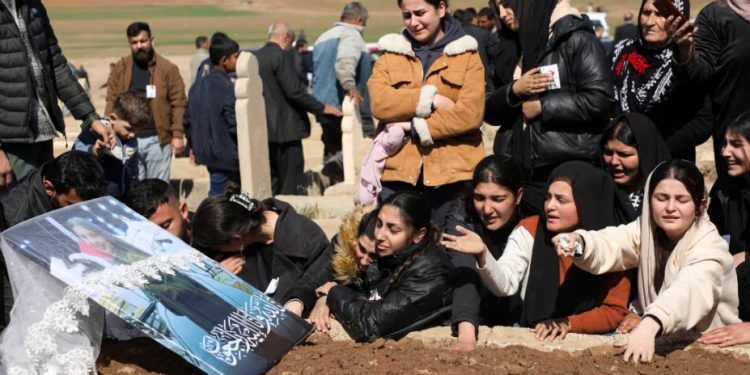
These states reached their limits some time ago; some collapsed, while others withered away, yet this did not trigger the revival of “issues” in the region. The occupation of Iraq was a milestone in that collapse, but what followed was the “cause” of “Iraqi resistance,” a violently bloody sectarian war, and the rise of Al-Qaeda and ISIS. The region’s inhabitants witnessed the Yazidi genocide in sound, image, names, and faces, yet it did not stir a need to formulate an “issue” regarding Daeshism, genocide, and the nation. As for the “Syrian Revolution,” it was a self-contained “cause” that was not driven by tragedies—such as the civil war, the rise of Daeshism, and ethnic cleansing in Afrin—to turn inward and question itself.
However, the collapse of the Syrian regime and the dismantling of the Syrian state largely brought the “cause” to an end, especially after the “Revolution” transformed into a discourse justifying and legitimizing the authority of the ruling coalition of militias. “Issues” began to emerge, even in defiance of those who refuse to contemplate them. One could say that Syria today is a vast field of issues; there is no “resistance” here, no “state” that can be taken seriously (even the authority’s so-called Minister of Information said it is “almost a state”), and no actual project beyond sectarian incitement and mobilization under derelict narratives like the “New Umayyadism” and “Majority Rule.” Instead, there are only many questions regarding the Syrian entity and its brutality—capable of perpetually reproducing itself—and its peoples and factions, who are embroiled in conflict to the point of extermination. It is perhaps exactly here that one must propose thinking about what might be termed the “Alawite Issue,” as it sits at the heart of all Syrian issues, and not only for the Alawites themselves.
Although the Syrian civil war, in its multiple stages, affected all groups; and though critical issues regarding national formations in the region escalated (such as the Kurdish Issue); and despite economic, living, and environmental crises that threaten the very continuity of life in the country, the Alawite Issue remains a fundamental link between all these matters. It is akin to a “Nodal Point,” as described by the Argentine thinker Ernesto Laclau—a signifier of a special kind in which multiple meanings condense, such as the issues of nation, state, people, violence, sect, and class, and through which they are reformulated. This manifests on several levels:
First, at the level of the Syrian entity itself: The matter of integrating Alawites into that entity as an Arab and Muslim group was a foundational necessity and a challenge to all propositions of Syrian nationalism built on the foundations of inclusive Arab nationalism. How can a large group—viewed from the perspective of normative religion as a heretical sect at best, or infidels warranting war at worst—be transformed into a “fundamental component” of the desired Syrian state, which itself never accepted its own borders? The challenge continues to this day, and answers to it have varied for over a century.
Second, at the class level: Alawites, despite the presence of well-known feudal and bourgeois families among them, remained a name synonymous with destitute peasants and the poorest segments of the country, placing them at the heart of the Syrian “Peasant Issue.” Their social mobility—whether through state institutions, the army, or various political movements—was fundamental to Syrian history. It seems the Peasant Issue in Syria has never become obsolete, despite radical changes in production patterns and class relations.
Third, at the level of the foundational narrative for the post-Assad era: This was previously the foundation for the largest uprisings of a Muslim Brotherhood character during the era of Hafez al-Assad—the narrative of “Alawite Rule.” This later became the core of the “Syrian Revolution” and subsequently the rule of Islamic militias. It was central to the violence that founded the new authority, as it claimed to establish “majority rule” following its “victimization.” Therefore, the “remnants” (fulul) and their “coup attempts to restore the Assad regime”—which broke out hundreds of kilometers from the capital—had to be crushed.
Thus, the circle of the “Alawite Issue” closes: from integration for the sake of establishing the central Arab/Islamic state, to the necessity of crushing the Alawites for the sake of its rebirth and realization. They were always at the heart of nationalism and its problem simultaneously; therefore, their issue condenses the Syrian issue in its entirety.
This complexity in the Alawite Issue has rendered the answer to the question “Who are the Alawites?” politicized and problematic to the extreme, both inside and outside the group, with answers varying according to the position and stance of the respondent. It can be said, with bitter irony, that the definition of Alawites in the Syrian imagination combined being “nothing” and “everything” at once. On one hand, they are nothing but a sect on the margins of Shiism and Islam, less than an ethnicity, merely Arabs and Syrians, assimilationist to the utmost, with no cultural, religious, or political demands of their own, and no special cause. On the other hand, they are the ones who controlled the state for five decades, conspired before that against majority rule, and dominated the security and military apparatus from the French “Levant Army” until the dissolution of the “Syrian Arab Army” at the hands of “majority” militias. This duality between “nothing” and “everything” also emerged in the responses of a large segment of the Alawite elites themselves. The mainstream rejected an Alawite state under the French Mandate and a personal status law independent of Sunni Muslims; they rejected “ethnicization” and did not seek to highlight any cultural distinction from other Syrians, or even show Alawite particularity within the Peasant Issue as an intersection of class and religious oppression. To such an extent, the “Alawiteness” of these elites seemed like “nothing” compared to the “everything” they aspired to: to be at the heart of the homeland, the nation and its battles—perhaps even at the heart of global battles. Thus, Alawites fought extensively, but always within an entity broader than themselves, one that contained and negated them simultaneously, and they showed no significant resentment toward that.
However, the “nothing and everything” equation is no longer sustainable after Alawites became a subject of a special kind—a subject of extermination, both biological and cultural, under the rule of Islamic militias. They must now become something determinate and answer the identity question clearly before it is too late. This adds new complexities and energy to the Alawite Issue, giving it a special kind of vitality, explosive potential, and centrality within the Syrian framework.
Can we truly speak about the Alawites? And can they speak about themselves? Any such talk will carry much pretension and arbitrariness. No one today, from inside or outside the group, can speak of “the Alawites” as a singular Subject, but only of the Alawite Issue. From that issue, an Alawite Subject might emerge, or even a new post-Syrian Subject on the level of the entire country. Therefore, the Alawite question returns, as is its habit, to become larger than the “sect” itself.
But why is the Alawite Issue not discussed openly and systematically, instead being left to mostly vulgar debates? Why does it occupy a position closer to the Syrian unconscious? Perhaps the question is redundant in a culture and language not accustomed to “Issues.”
Integration and Taqiya
It seems that the erasure of the self was a conscious cultural and political choice for many Alawite elites in recent decades, to the point that this erasure became the “self” itself—a way to gain power and presence, rather than necessarily a sign of weakness. We see the same phenomenon among writers, artists, and intellectuals who spoke about everything—from heritage and modernity and “Westernization” in theater, to the “Asiatic mode of production” and the critique of Orientalism—without clearly raising the Alawite Issue, as if it were merely a trivial matter to be transcended. This extends to politicians and military officers, who were always “greater than Alawites.” However, the matter was not limited to rising above sectarian reductionism; it reached the point of actual self-abnegation and “annihilation in the other,” in the Sufi sense. Campaigns of Shiization and Sunnization among Alawites never ceased, sometimes led by Alawites themselves, such as Jamil al-Assad, brother of President Hafez al-Assad and founder of the “Al-Murtada” Shiite association. Despite this, Alawites remained Alawites.
Many speak of the roots of this in the Alawite doctrine itself, as being capable of absorption, transformation, integration, and pluralism without losing its internal cohesion; or even as a spiritual space capable of all incarnations (again: nothing and everything). However, any doctrinal talk lacks great reliability in the shadow of a non-institutionalized religion with weak documentation, making most discussions closer to personal interpretations and ijtihad related to the inclinations and culture of the speaker, or even their desires and interests. Furthermore, doctrine alone does not explain political and social choices; one must look at the broader history surrounding the doctrine and its structures.
Was the self-erasure a type of taqiya (dissimulation) resulting from fear? Or a choice in transcendence and integration? Or perhaps both? And why did Alawites not declare they were Alawites even in the Assad state, which its opponents describe as the “Alawite State”?
Thinking about the Syrian entity may be more useful in navigating these questions. Full integration into the central Syrian state had a price, which was paid by Alawites with open arms; meanwhile, the Syrian peasant movement, in its various stages, provided the minimum of solutions for Alawites. Thus, the Ba’ath state was a mixture of Arab nationalist identity and a change in rural relations that brought the sons of peasants into state institutions and services, making them officers, professionals, and Syrian Arabs. When the Muslim Brotherhood rebelled, they were aware of that change and exerted their efforts to reverse it. They reminded the Alawites that they were “merely” Alawites and that the state would not be the state of the Ummah—truly Arab and Islamic—in their presence. They targeted their officers and professionals; thus, the doctor, engineer, and lawyer were killed solely because they were Alawite. An updated and integrated ideology of anti-Alawitism was established, merging traditional roots with modern ideology. According to this, Alawites were considered the lowest (sons of peasants, infidels, of doubted honor) and the highest (conspirators since before colonialism, leaders of the state and controllers of the regime) at the same time, endowed with supernatural qualities and insulting traits. These traits later leaked into general culture and became “mainstream,” implicitly and explicitly, even in television comedies produced in the Assad era, where it became normal to see the Alawite as a crude, ridiculous peasant with supernatural authority. Meanwhile, studies that can only be described as methodologically poor—such as the works of the Dutchman Nikolaos van Dam and the Frenchman Michel Seurat—reinforced perceptions of the supernatural “Alawite Power” among what is called the “elite culture” in the Syrian condition.
The Alawite response to all this leaned toward more self-erasure and full integration into the state. The sectarian targeting in the seventies and eighties was considered a battle of colonialism, imperialism, and reactionism against the progressive Syrian state, and the same applied to the Syrian war in the second decade of this century. Clear Alawite sectarian tendencies and discourses were always pushed to the background, and it is difficult to say they ever came to the fore, unlike the Syrian opposition, which highlighted its sectarian self with heavy emphasis.
Perhaps this was more than a voluntary choice. Alawites, like other Syrian peasants, were linked to the bloated state apparatus and entered into new relations of loyalty and dependency within a broad process of “peasantization” (taflih) of Syrian societies—the reproduction of peasant relations through the state apparatus as a new master, distributing support, rent, and returns through a mix of official social policies and undeclared clientelist networks.
Dependency on the state was general among Syrians, but it was deeper in the case of Alawites, whose “self” was founded on erasure and integration. When Assadism collapsed upon itself with the outbreak of the Syrian war, many Syrians could return to “selves” that transcended and opposed authority, while Alawites had nothing but further adherence to and “annihilation” in the state.
Beyond the “Assad Sect”
The expression “Assad Sect” became common in the Western press to refer to the Alawites, especially during the massacres of March 2025. There may be practical reasons for this (condensing the Syrian conflict for the Western reader), but it remains a reductionism far from journalistic professionalism and methodological accuracy.
In any case, Assad fled Syria more than a year ago and will not return; the Syrian state, in which the Alawites integrated to the point of annihilation, has been dismantled. The massacre occurred and was committed under an Islamic ideology whose roots can be traced back to the 1940s—that is, before Alawites became the “Assad Sect”—with clear statements of intent for extermination, which may qualify it as genocide. Generally, there seems to be a tendency among the ruling political Islam forces to find a “Final Solution” to the Alawite Issue, the signs of which appear in practices such as biological targeting (especially of women), cultural genocide, changing the natural and social environment, and narrowing the means of livelihood through dismissal from public institutions—or rather, “purging” them, as if the Islamic militias were intentionally forcing an involuntary weaning of the Alawites from the state.
We have certainly entered the era of the post-“Assad Sect,” and Alawites are forced to reproduce and define their own self. They have limited options: among them is the attempt to survive through taqiya and submission to the Islamic authority—an option that may accelerate the “Final Solution” according to current indicators, to the point where it has become possible to imagine a Syria without Alawites in a few years. There is the option of “ethnicization”—the trend toward transforming Alawites into an ethno-religious group with clear features and demands, which may reach the degree of calling for the right to self-determination, as happened with the Druze of Syria. And there is the option of waiting—dreaming of a new, larger entity in which Alawites integrate and realize their self by erasing it within it, an option based on expecting a change in regional power balances and finding a patron against the ruling militias.
The Alawite debate over these options does not stop and can only be biting and fierce; it revolves, in the end, around a question of existence in the absence of a unified self-reference. However, this debate is centrally influential on the Syrian issue as a whole. Whether the Alawites disappear, distinguish themselves by their ethnic identity, or find a patron who changes the balance of power, it will mean irreversible changes in the Syrian entity and the fate of its multiple peoples and groups.
Everything we know about “Syria” is linked in one way or another to the Alawites; they are the peasant, the ruler, the demonized enemy, and the familiar stranger. Everything they know about themselves is linked to that “Syria,” as it is the existential threat, the historical opportunity, the painful history, and the entity tempting integration. We have reached the peak of this complex relationship’s escalation, and Syria will likely change after this critical point—and the Alawites will change.