


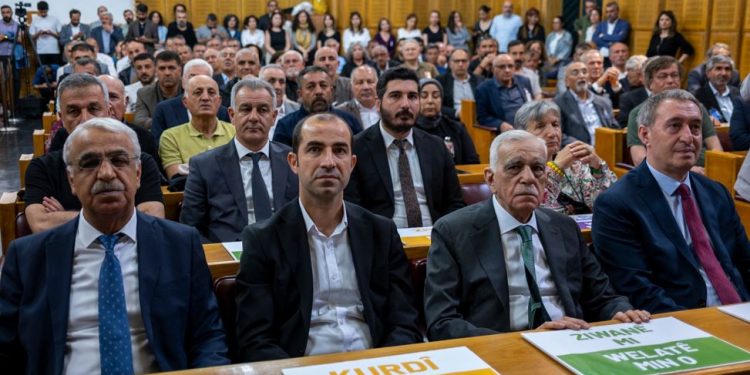
In a scene that blends political absurdity with irony, Peace and Democracy Party MP Cengiz Çandar described the Turkish Ministry of Justice’s last-minute objection to the European Court of Human Rights’ ruling on the release of political prisoner Selahattin Demirtaş as a deep stab in the heart of the peace process, which has not yet completed its second year. At the same time, Turkish Foreign Minister Hakan Fidan appeared alongside his Syrian counterpart following the events in the Sheikh Maqsoud and Ashrafieh neighborhoods of Aleppo, speaking in language that suggested escalation against the Syrian Democratic Forces (SDF). He emphasized the need to implement the March 10 agreement, according to a narrow Turkish vision in which the mechanisms of subjugation are transformed into politics, and integration into a disguised surrender under a diplomatic guise.
For his part, Nationalist Movement leader Devlet Bahçeli, in his speech to his parliamentary bloc a few days ago, called for the parliamentary committee overseeing the peace process to be able to visit PKK leader Abdullah Öcalan in his prison on Imrali Island, as he is the main negotiator for the Kurds. Meanwhile, the Turkish President opened the legislative session with a warm greeting to the representatives of the Peace and Democracy Party, speaking of brotherhood and equality, and the necessity of continuing the path of the Kurdish-Turkish-Arab alliance.
Through these statements, the deep gap between the positions of the various parties in the Turkish state since the launch of the peace process becomes clear. The scene appears to be afflicted with a pathological attachment to the same threshold, unable to make a decision, as the state experiences an internal division between its desire to move beyond the war and its pleasure in its continuation.
Despite the parliamentary peace committee holding more than fourteen meetings with various segments of society, the state remains reluctant to take practical steps that would strengthen the climate of trust, such as recognizing Öcalan’s right to hope and releasing political prisoners, especially the sick. Furthermore, the state continues to adopt a hostile rhetoric toward the Syrian Democratic Forces and insists on exploiting the remnants of Al-Qaeda through the authority of Ahmad al-Sharaa and the Syrian version of the Grey Wolves, called the “National Army.”
A Confusing Peace
Thus, the Turkish scene appears to be celebrating peace as a new form of conflict management: a peace that is spoken but not practiced, presented as a noble goal but used as a means to keep tensions alive. The state, in its current perspective, thrives on contradiction. The issue, therefore, lies in an “in-between” zone, between a declared desire for a new peace and a structural inability to break with a past rooted in denial, assimilation, and genocide. When the state utters the word “peace,” it unconsciously speaks of “national security,” not “reconciliation.” Meanwhile, the Kurds see peace as a recognition of their existence and rights. From this, two processes have emerged: peace for national security (“Turkey without terrorism”) and peace for recognition (“democratic integration”).
This contradiction produces a state of confusion on both sides—Kurds and Turks alike. There are hopes pinned on a sustainable reconciliation, countered by structural hesitation within the state in confronting itself and its historical memory. Even when some of its leaders, such as Erdoğan and Bahçeli, acknowledge the oppression and marginalization suffered by the Kurds, the system remains far from unified. This internal division threatens to return the conflict to square one.
The process is still taking shape, amidst an environment still dominated by a culture of war—especially after the Turkish state’s slide toward an authoritarian model that disregards the law since the faltering peace process a decade ago. From this perspective, peace is not a ready-made formula conjured up by a political decision or a symbolic gesture, but rather a complex process that requires building bridges of trust and a courageous will to overcome the past. As Bahçeli says, peace cannot fly without wings, and here precisely the responsibility falls on the state, now that the Kurdish side has fulfilled its commitments to disarmament.
Proponents of peace believe that the state must take concrete steps as quickly as possible to restore confidence in the peace process. However, it remains trapped in repeated promises without translating them into action, allowing the war system to raise its voice once again—both within Turkey and in the Syrian arena. The March 10 agreement is the clearest example of this confused path: While its original text was clear in its provisions and principles, Damascus and Ankara quickly reinterpreted it, transforming it into a form of disguised surrender presented under the banner of “forced integration.” This integration essentially means melting the Kurdish self into the model of a monolithic ruling nation—a model that today, in the Syrian case, manifests as a fundamentalist Sunni nation seeking to monopolize nationalism and exclude diversity.
If this is the case, why did Turkey choose to knock on the door of “peace” this time through Devlet Bahçeli, and why is it hesitant to pursue it further now?
The answer does not seem to stem from a sudden moral awakening but rather from strategic awareness driven by concerns. Ankara, through its intelligence agencies, was aware that any potential collapse of the Assad regime—alongside the decline of Russian and Iranian influence—could open the door to an expansion of Israeli presence and perhaps a rapprochement with the Syrian Democratic Forces. This translates, in the Turkish imagination, into a geopolitical nightmare: the encirclement of Turkey within the borders of Anatolia, as Bahçeli describes. It is a revival of the “phobia of contraction after expansion” that has haunted the Turkish subconscious since the Treaty of Sèvres. Thus, in this discourse, “peace” becomes more a manifestation of strategic panic than an expression of a political vision.
All this confusion and ambiguity raises a pivotal question: Is there a conflict between the wings of the Turkish state—those advocating for peace and those supporting war? The answer may lie in two basic hypotheses, given the absence of confirmed data.
The first is that the state apparatus may be operating as a single unit in a dual game of words and deeds—without any real distinction between Erdoğan, Bahçeli, Hakan Fidan, Ibrahim Kalın, and Yaşar Güler. It raises slogans of peace but imposes submission, favoring forced integration over genuine participation. This makes “peace” synonymous with “surrender” and a symbolic cover for its security and political objectives.
The second hypothesis points to an internal conflict between opposing factions within the state—more surprisingly, between two models of the “old deep state.” The first is the normative state that seeks to preserve Turkey’s unity through peace, while the second is the “new deep state” that transgresses the law, relying on monopolistic networks, militias, gangs, and mafias—extending from the remnants of the Gladio network to jihadist groups and the Syrian versions of the Grey Wolves. These networks turn the conflict into a permanent tool for managing tension and fueling hatred, leaving the state hostage to this antagonism between the factions of the deep state.
Integration and the Game of Interpretation
According to the above, the second hypothesis appears closer to logic, considering recent historical events. Accordingly, the path may develop in light of these contradictions, and the core of the issue lies in how the concept of “integration” is interpreted, as this serves as the primary criterion for determining the stance of various currents toward it. The traditional Turkish security narrative views integration as monolithic: submission instead of participation, and assimilation instead of diversity. This is known as “forced integration,” where representatives of the Kurdish cause are required to deny themselves and conform to the ruling national identity. The state exploits all its diplomatic, intelligence, and military resources to transfer this model to the Syrian reality after Assad, thereby undermining the effectiveness of negotiation rounds between Damascus and Qamishli.
In contrast, Öcalan presents a completely different vision based on the concept of “positive integration,” where individuals and groups participate in the political space with legal awareness as free and equal citizens, not as demographic appendages or decorative tools for a monolithic national scene. This form of integration recognizes difference as an added value, not a threat. Öcalan seeks to leverage all voices and currents supporting this approach within the state structure, while pressuring his bloc to expand social and political support for this idea of integration. Meanwhile, the movement that considers peace a threat continues its symbolic resistance to this new consciousness, relying on the legacy of the nation-state, which recognizes the other only as subordinate or adversary. This was exemplified in the silencing of Kurdish mothers when using the Kurdish language.
With the absence of a green light from the West and NATO for a new military adventure in northern Syria, “peace” in the eyes of war advocates has become a tool for political investment. Negotiations are replaced by daily diplomatic bombardment, and postponement becomes a policy of managing time rather than pursuing a solution. Here, the disparity within the currents of the state becomes evident: some voices speak of peace, while others ignite the fuse of war; some call for integration but practice policies of assimilation. In this context, peace is nothing more than a temporary management of contradictions, hiding fears of losing control and influence, and often linked to groups that violate the law and rely on an imagined enemy to perpetuate the state of war.
Turkey’s intentions will undoubtedly be tested on Syrian soil and through concrete legal steps expected within it. The field reveals the difference between words and actions. If Ankara is serious about the idea of “Kurdish-Turkish brotherhood,” it could, for example, adopt the spirit of the National Pact, which recognizes decentralized Kurdish rights and strengthens the historical friendship between the Kurds and the Turkish nation. However, the security mindset, for now, prefers to recycle old tools—from the Syrian “Grey Wolves” rabble to fundamentalist Islamist movements in Damascus.
The road ahead may be fraught with mines, but developments on the ground in Syria, the inability of the interim government of al-Sharaa to manage diversity, and the shrinking scope of war may create opportunities to retreat from threats and intimidation. This could open broader horizons for peace advocates within the country. Chances for peace still exist, and if they are properly exploited according to the historical necessity, it might be possible to defuse the time bombs before they explode and cross the threshold with determination and enthusiasm toward lasting peace.