

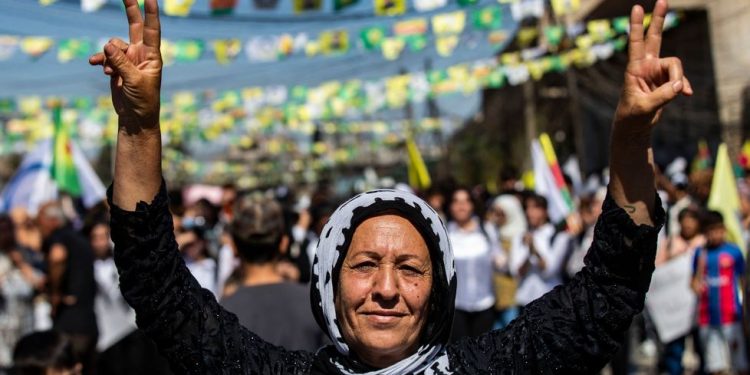
In parallel with the ongoing artillery and rocket attacks on the Deir Hafer area, which resulted in the death of eight civilians on September 20—most of whom were women and children—due to indiscriminate shelling by factions officially affiliated with the Syrian Ministry of Defense, these factions launched an attack on the predominantly Kurdish neighborhoods of Sheikh Maqsoud and Ashrafieh in Aleppo. This occurred after a period of siege imposed on the two neighborhoods, during which roads leading to them were blocked, medical supplies and relief materials were withheld, residents were kidnapped, daily provocations were carried out at checkpoints, earthen barriers were erected, and a military encirclement was visibly established through the deployment of armored vehicles and heavy weapons. Drones were also flown over the neighborhoods to terrorize and oppress the residents.
The attack on these neighborhoods, which resulted in the killing and injury of several Kurdish civilians, came after the authorities promoted claims such as “the Syrian Democratic Forces digging tunnels and preparing for combat.” It coincided with the presence of a high-level US delegation in northeastern Syria, including US Special Envoy to Syria Tom Barrack and US Central Command Commander Admiral Brad Cooper. They met with General Mazloum Abdi, Commander of the Syrian Democratic Forces, and other leaders. The stated goal of the visit was to foster rapprochement between the interim central government and the Syrian Democratic Forces, to achieve breakthroughs on several unresolved issues, and to advance the implementation of the March 10 agreement. Following this visit, the US delegation, accompanied by General Mazloum Abdi and a delegation from the Autonomous Administration, traveled to Damascus to meet with the interim President, Ahmed al-Sharaa. Discussions took place, and the two sides agreed on a ceasefire across all fronts between factions loyal to Damascus and the Syrian Democratic Forces.
Abdi – Al-Sharaa Meeting in Damascus
The visit of General Mazloum Abdi and his accompanying delegation to Damascus, attended by the American delegation, has sparked a new wave of optimism. A ceasefire has been established, and agreements have been made to activate joint committees and hold numerous meetings to make progress on contentious issues. It appears that the American role will be more prominent, particularly in overseeing the implementation of the March 10 agreement. Meanwhile, the US Senate has approved the allocation of $130 million to the Syrian Democratic Forces (SDF) and the Free Syrian Army (FSA). This indicates that the Pentagon will continue its military cooperation with the SDF as part of the fight against ISIS—to prevent its resurgence or control of territory in Syria, to target its cells, and to carry out operations against its leaders and influential military and organizational figures.
In an interview with Ronahi TV on the tenth anniversary of the founding of the Syrian Democratic Forces (SDF), General Mazloum Abdi confirmed that the meetings in Damascus resulted in “verbal coordination” regarding the process of integrating the SDF into the Syrian army. He added that a military delegation will be heading to Damascus to discuss the details, and that internal security forces in the regions of North and East Syria will also be integrated according to mechanisms agreed upon by the Ministry of Interior. Abdi stated that the residents of Raqqa and Deir ez-Zor are the ones who will determine the nature of their administration. He also emphasized that the form of governance in Syria is crucial, and that a delegation from the Autonomous Administration of North and East Syria will tour Syrian provinces. Furthermore, he noted that discussions with the American side during the recent meeting held in Hasakah, attended by Tom Barrack and Cooper, focused on cooperation between the SDF and the Syrian army in the fight against ISIS, and on the mechanisms for Damascus to join the war against the organization. He added that the American side proposed the formation of a joint force between the interim central government in Damascus and the SDF to combat ISIS and contain its threat. Abdi also explained that discussions are ongoing to amend the Constitutional Declaration in line with the March 10 agreement. He mentioned that upcoming meetings will focus on these amendments, particularly on incorporating Kurdish rights into the Syrian constitution. A Kurdish delegation will soon visit the capital to discuss this issue.
Regarding internal issues, General Mazloum Abdi indicated that the Sheikh Maqsoud and Ashrafieh neighborhoods in Aleppo are a priority for the SDF, and that there is interest from the US and the international coalition in fighting ISIS. He also emphasized the importance of implementing the April 1 agreement between the SDF and the central government in Aleppo, praising the residents’ resistance amidst all circumstances and challenges. Abdi affirmed that their priority is the return of displaced persons to their homes, mentioning refugees from Afrin, Ras al-Ain/Sere Kaniye, and Tal Abyad/Gire Spi, stating that these people will return to their areas.
In a new statement to AFP, the commander of the Syrian Democratic Forces said they had reached a “preliminary agreement” with the transitional authorities in Damascus on the mechanism for integrating their forces into the Ministries of Defense and Interior. He noted that discussions are ongoing between the two parties in Damascus to explore how to accomplish this. He explained that “what is new in our recent discussions in Damascus is the shared determination and strong will to expedite the implementation of the agreement’s provisions,” and that the most important point is “reaching a preliminary understanding regarding the mechanism for integrating the Syrian Democratic Forces and the Internal Security Forces into the framework of the Ministries of Defense and Interior.”
Ankara Obstructs, Damascus Confused
Regarding the Turkish stance, Ankara is closely monitoring the situation and continues its interference in Syrian affairs. Its position on many Syrian issues remains negative, and it intervenes directly in all policies and positions—particularly those related to the relationship between the Damascus government and the Syrian Democratic Forces (SDF), the integration of these forces into the Syrian army, constitutional recognition of the Kurds, and acceptance of a decentralization formula in Syria. Ankara summoned Syrian Foreign Minister Asaad al-Sheibani to Ankara following the recent meeting between a delegation from northeast Syria and the SDF, led by General Mazloum Abdi, and a delegation from the central government, headed by interim President Ahmed al-Sharaa, with a prominent American presence.
Meanwhile, the Damascus authorities have resorted to appointing other “figures” from factions affiliated with the so-called “Syrian National Army,” loyal to Ankara, into military positions. Most notably, Major General Salim Idris, Minister of Defense in the so-called Syrian Interim Government loyal to Turkey, and Brigadier General Hassan al-Hamada, who is close to Turkey and served as Deputy Minister of Defense in the government established by Turkey after its direct intervention and occupation of Syrian territories starting in 2016. Turkey remains firm on its demands regarding northeastern Syria, rejecting Damascus’s constitutional recognition of Kurdish identity, the decentralization proposal, or the integration of the Syrian Democratic Forces into the Syrian army as a unified bloc or in the form of multiple military structures/divisions—similar to the 18 major factions that currently comprise the Syrian army. Many of these divisions are affiliated with the so-called “Syrian National Army,” loyal to Turkey. Only their names have changed, and they remain under leadership loyal to Ankara, including individuals involved in war crimes and pursued by international bodies for violations and massacres committed before and after the fall of Bashar al-Assad’s regime—such as Muhammad al-Jassem (Abu Amsha), Abu Bakr (Saif) Bulad, and Hatem Abu Shakra, the perpetrator of the killing of Kurdish politician Hevrin Khalaf in 2019.
On Sunday, October 12, talks took place in Ankara between officials from the Syrian Interim Government and Turkish officials. Participants from the Syrian side included Foreign Minister Asaad al-Sheibani, Defense Minister Marhaf Abu Qasra, and Intelligence Chief Hussein al-Salama. From the Turkish side, Foreign Minister Hakan Fidan, Defense Minister Yasar Guler, and Intelligence Chief Ibrahim Kalin took part. According to the Syrian Arab News Agency (SANA), the Syrian delegation arrived in Ankara “to hold discussions with the Turkish side on issues of mutual concern, particularly in combating terrorism, border control, enhancing stability, cooperation, and joint training.” Hakan Fidan stated on his social media platform, “The meeting provided a comprehensive assessment of security cooperation, and we do not see Syria’s security as separate from our own.”
On October 15, Turkish President Recep Tayyip Erdoğan, during his return flight from the Sharm el-Sheikh Peace Summit in Egypt, declared that integrating the Syrian Democratic Forces into Syrian state institutions is “an important strategic step that will help accelerate development and strengthen national unity in Syria,” emphasizing that this integration should be implemented as soon as possible.
Meeting of Military and Security Committees
Meanwhile, in Damascus, two meetings concluded between delegations—one military and the other security—from northern and eastern Syria and their counterparts in the transitional government, held at Tishreen Palace in Damascus. Hawar News Agency reported that the military delegation included Sozdar Haji and Sipan Hamo, members of the General Command of the Syrian Democratic Forces (SDF), SDF spokesman Abjar Daoud, and Commander Shaker Arab. They met with the Minister of Defense in the Interim Government, Marhaf Abu Qasra. The security delegation from northern and eastern Syria included Major General Diler Hussein Tammo, Major General Ali Khader al-Hassan, Major General Mustafa Mahmoud Deli, Major General Ahu Elio Lahdo, and the Deputy Co-Chair of the Interior Authority in the Democratic Autonomous Administration, Arin Mustafa. This delegation met with the Minister of Interior in the Interim Government, Anas Khattab.
In an interview with the Syrian Democratic Forces’ media center, Sipan Hamo stated that their forces are ready to join the newly formed Syrian army, but on the condition that the integration is based on principles that respect the identity, struggle, and sacrifices of the Syrian Democratic Forces, and that safeguard the rights of all components of the Syrian people without exception. He emphasized that the next steps required by the interim government will determine whether the integration process will accelerate, slow down, or possibly be frozen.
These military and security meetings in Damascus demonstrate the seriousness of the Autonomous Administration of North and East Syria and its insistence on taking clear, practical steps toward integrating the Syrian Democratic Forces and the Internal Security Forces into the Syrian Army and Ministry of Interior, based on the March 10 agreement. The composition of the delegations from North and East Syria reflects the regional, as well as the component and gender diversity of the administration. It also highlights the pluralism and participatory nature of the dialogue and negotiations with Damascus, ensuring the rights of all components and involving them in the negotiation process, while clarifying the nature of the relationship between North and East Syria and the central government in Damascus. The Autonomous Administration rejects closed-door meetings between only two parties without transparency or informing Syrians of the developments. Therefore, it relies on media statements from its highest levels to explain points of disagreement and, at the same time, to express commonalities and points of agreement between the Administration of northeastern Syria and the interim central government.
Summary
First: The interim authority was unable to impose its will on the predominantly Kurdish neighborhoods of Sheikh Maqsoud and Ashrafieh in Aleppo, despite tightening the siege, blocking roads, preventing relief supplies, and arresting Kurdish citizens at checkpoints. This represents a clear retreat from the April 1 agreement, under which the Syrian Democratic Forces (SDF) withdrew their fighters and heavy weapons, while the Internal Security Forces (ISF) remained alongside the local administrative structures formed by residents. Additionally, no significant progress was made on the Deir Hafer front.
Second: The visit of a high-level US delegation, including Tom Barrack and Admiral Brad Cooper, to northeastern Syria, where they met with General Mazloum Abdi, and later traveled to Damascus to meet with interim President Ahmed al-Sharaa, created pressure on Damascus. It also dismantled the narratives promoted by the regime and its media, which claimed that the United States was abandoning the SDF, withdrawing its military forces from the region, and limiting its agreements solely to Damascus and the central government. This visit, followed by the trip to Damascus, compelled the government to resume dialogue and negotiations within the framework of the March 10 agreement. As a result, Defense Minister Muhraf Abu Qasra announced a halt to hostilities against the SDF across all fronts.
Third: Recent statements by General Mazloum Abdi confirm that the position of the SDF and the Autonomous Administration in northeast Syria remains strong, and there will be no concessions or deviation from the spirit of the March 10 agreement. The interim central government is required to amend the constitutional declaration to align with this agreement. The withdrawal from Deir ez-Zor and Raqqa will not occur; their fate will be decided by their local populations. Meanwhile, delegations from the Autonomous Administration will visit Syrian provinces to clarify their perspective. A cooperation framework will also be established between government forces and the SDF to jointly combat ISIS, based on a proposal from the US side.
Fourth: The status quo in Sheikh Maqsoud and Ashrafieh neighborhoods of Aleppo will be maintained, with government forces removing earthen barriers and lifting the siege, while refraining from harassment of Kurdish citizens. Administrative and security structures will remain operational in these neighborhoods. Conditions will also be normalized in Afrin, Ras al-Ain/Serê Kaniyê, and Tal Abyad/Gire Spi, with the return of all displaced persons, under full cooperation from the Interim Authority.
Fifth: The United States will continue to pressure Turkey to cease its interference in Syrian affairs and to stop obstructing ongoing dialogue between Damascus, the Autonomous Administration, and the SDF. It will also insist that Damascus reject decentralization, constitutional recognition of the Kurds, or acceptance of the SDF as a unified bloc within the new Syrian army.
Sixth: Turkey, which has requested an urgent meeting with civilian and military officials of the interim authority in Ankara, has issued several recommendations and conditions. It insists on being the primary actor in Syria, aiming to exceed Iran’s role under the previous regime. Turkey seeks to direct the interim government, control economic, trade, and development sectors, establish military bases, form the army, and determine the political system—all to serve its own interests and restrict Syria accordingly. After every breakthrough or meeting between the interim authority and northeast Syria, Turkey emphasizes its well-known red lines: no to decentralization, no to constitutional recognition of the Kurds, and no to integrating the SDF as a cohesive and unified structure within the Syrian army, similar to factions affiliated with the so-called “National Army,” loyal to Ankara.
Seventh: The military and security committees of northeast Syria, which met with defense and interior committees of the interim government in Damascus, are experienced and knowledgeable, representing all components of the region, including women. This underscores that northeastern Syria is a region that embodies all its components, respects ethnic and religious diversity, and is willing to integrate within a pluralistic political system that involves all Syrians, provided that specificities are acknowledged.
Eighth: International oversight, especially from the United States, is essential to monitor the ongoing dialogue and the implementation of all steps, aiming to guide Syria out of its current phase. This includes ensuring a healthy political process, respecting the rights and particularities of all components, governing through participation and consensus, restoring political life, investigating recent violations the happened in the last few months, and accepting the decentralization model and the distribution of powers.