

I first met Salih Muslim on June 25, 2011, during the founding session of the National Coordination Body. His aptitude for consensus-building immediately caught my attention; while certain members of Kurdish parties insisted on including strictly nationalist Kurdish demands in the founding document, he proposed the conciliatory formula that was ultimately adopted. By emphasizing and strengthening the broader Syrian national dimension of the Kurdish cause, he secured a unanimous consensus from all attendees..
I was with him in every meeting of the NCB Executive Bureau, which took place every Saturday from early July 2011 until the final meeting held on the last Saturday of June 2012, before he departed for Cairo to attend the Syrian Opposition conference meetings. Subsequently, he developed precautions regarding the possibility of his arrest should he return to Damascus; thus, he began attending Executive Bureau meetings intermittently via Skype, while other delegates from the Democratic Union Party (PYD) were appointed, in coordination with him, to attend the Bureau meetings in person. This state of affairs continued until the PYD froze its membership in the Body in January 2016. On many occasions, he and I—and sometimes joined by Abdulaziz al-Khayer or Rajaa al-Nasser—would have a meal at a restaurant and then head to Al-Kamal Cafe for tea after the conclusion of the Executive Bureau meetings, which often lasted for long hours.
What struck me most about Comrade Salih Muslim, after these meetings spanning hundreds of hours, if not more, was that he possessed a broad, open nationalist project. He envisioned a Syrian state where citizens are constitutionally and legally equal in the rights and duties of citizenship, alongside the right of all to practice their political and cultural freedoms. He pointed out to me that the name and program of the Democratic Union Party, founded in 2003, is based on this orientation. I remember in the third week of November 2011—one day before his departure to Cairo—he astonished me with this answer when I asked him about the goals of the PYD: “We do not only want Qamishli or Ayn al-Arab/Kobane; we want Damascus as well.”
The Coordination Body passed through difficult tests, perhaps the most arduous of which occurred in the second week of September 2011. The Body’s delegation had returned from talks in Doha with representatives of the “Damascus Declaration” and the Muslim Brotherhood, carrying a draft declaration for the birth of a coalition political body encompassing the three parties under the name: “The Syrian National Coalition.” Marathons of meetings by the Executive Bureau took place over two days. The feeling among several members of the Bureau—including Abdulaziz al-Khayer, Salih Muslim, Hassan Abdul Azim, Rajaa al-Nasser, and the author of these lines—was that this body, should it be born, would be akin to the Libyan National Council led by Mustafa Abdul Jalil, which served as a local cover for external military intervention (carried out by NATO led by France in that case, and here by Turkey, but led by the United States from behind in both instances). Therefore, the five of us sought to thwart it by proposing the addition of the “Three No’s”: (No to foreign military intervention, no to sectarian and denominational conflict and mobilization, no to violence by the regime or any other party) to the text, along with the demand for the “recognition of the Kurdish national existence in Syria and working for its constitutional codification.” When Rajaa al-Nasser carried these four additions to Riad al-Turk at his secret home in Damascus, we knew he would refuse, as would Riad al-Shaqfa, the Comptroller General of the Muslim Brotherhood based in Istanbul. (The text brought from Doha is found within the documents of the Coordination Body, pp. 19-20, and the amended text by the Body, dated and published on September 14, is found on pp. 21-22). Ultimately, the “Two Riads” moved to form the Syrian National Council on October 2. When the American Ambassador came to the office of Mr. Hassan Abdul Azim (Abu Mamdouh) in Al-Hejaz days before the announcement of the “Council” in Istanbul, his goal was to entice the Body to join by offering it a third of the seats. Abu Mamdouh refused, as did Abdulaziz al-Khayer who was present at the meeting. Paradoxically, the regime’s Shabiha attacked and trashed the office that day under the pretext of the “meeting with the American Ambassador.”
The Body’s view had crystallized by then: overthrowing the regime was not possible in the style of what occurred in Egypt due to the composition of the Syrian army—unlike the Egyptian army, which remained neutral during the Tahrir Square revolution against Mubarak. Furthermore, the Libyan experience contained the catastrophes of fragmentation in the post-Qaddafi era, whose fall was not achieved by internal forces but by NATO forces. Therefore, at the Body’s conference in Halboun (September 17, 2011), the idea of a transitional settlement began to take shape—one formed through a transitional governing body leading Syria toward a new democratic system, with the participation of existing regime forces, opposition forces, and various social forces. This idea was the result of consultations between the Coordination Body and the Secretary-General of the Arab League, Dr. Nabil Elaraby. In his home in Cairo during a Ramadan Iftar (August 2011), a member of the Body wrote the text of the “Arab Initiative” adopted by the Council of the League of Arab States on November 2, 2011—which Bashar al-Assad, Riad al-Turk, Riad al-Shaqfa, and the founder of the Free Syrian Army, Colonel Riad al-Asaad, all met in rejecting.
The Body’s position on a transitional settlement was reinforced when the Russians entered the line of confrontation with the Americans in the Security Council by exercising their veto power on October 4, 2011, against a draft resolution concerning the Syrian issue. This was after they had abstained from voting seven months earlier, which had allowed NATO forces to intervene in Libya under a United Nations cover. It was clear that there was an internationalization of the Syrian crisis, along with regionalization, as Iran stood by the regime while the Turks and Gulf states stood by the armed opposition that had emerged since the autumn of 2011. This suggested a Syrian deadlock that left the crisis without a solution, turning the country into an arena for conflict in Syria and conflict over Syria—which would drag on a sea of blood and a stagnation without solution for a long time.
Salih Muslim was part of the Body’s delegation that went to Cairo and remained there for five weeks, along with Abdulaziz al-Khayer, Rajaa al-Nasser, and Haytham Manna, to negotiate with the “National Council” to produce a Syrian opposition conference. The goal was the emergence of an opposition delegation to negotiate with the Syrian government to implement the terms of the Arab Initiative regarding the transitional settlement. Those negotiations resulted in the document of December 30, 2011, signed by Haytham Manna (Deputy General Coordinator of the Body) and the Council President Burhan Ghalioun; however, the Council’s Executive Bureau revoked its signature the following day.
The Body’s delegation was the subject of praise from Arab League Secretary-General Nabil Elaraby for the flexibility and conciliatory spirit it displayed, and Salih, along with Abdulaziz, received the greatest share of that praise. Salih demonstrated this again at the Syrian Opposition Conference in Cairo (July 2012), in which both the Body and the Council participated, and then at the second conference held by the opposition (but without the Coalition, which succeeded the Council in the autumn of 2012) in Cairo in June 2015.
I was also struck by Salih’s early awareness of the danger of ISIS in September 2014—something many Syrian opposition members failed to grasp—and his belief in the vital importance of the Syrian armed opposition among Arabs participating in the international effort to fight ISIS. All these factions refused, which led the Americans to turn toward an alliance with the People’s Protection Units (YPG), and then, since 2015, an alliance with the Syrian Democratic Forces (SDF). It is highly probable that the retreats and defeats of the Arab Syrian armed opposition against the Syrian regime—supported by the Russians and Iranians—which occurred in the 2016-2020 period, would not have happened had they engaged in the international effort against ISIS. Most likely, their withdrawal and refusal led to the withdrawal of international cover from them, and to the American-European silence regarding what the Russians and Iranians did to the armed opposition.
Salih paid the price for the American-Turkish convergence by being excluded from the Syrian Opposition Conference in Riyadh (December 2015), as the Turks insisted on his absence while the Americans and Saudis remained silent. This was likely the reason that prompted the Democratic Union Party, in the following month, to freeze its membership in the National Coordination Body.
In general, the author of these lines can say, after half a century of political work, that Salih Muslim was one of the distinguished personalities he has known, and one of those who left major marks on Syrian political life.
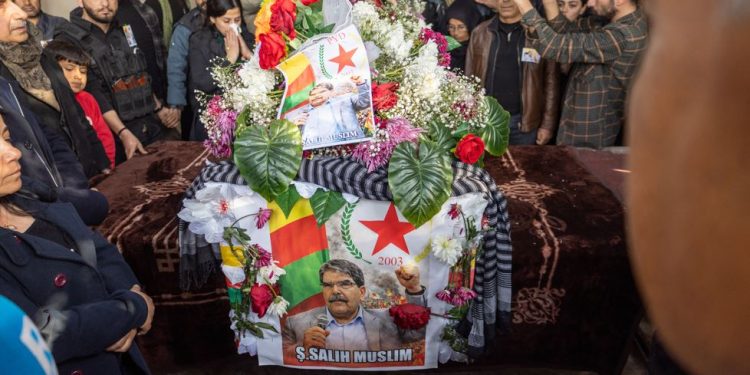
His memory will endure for a long time.