


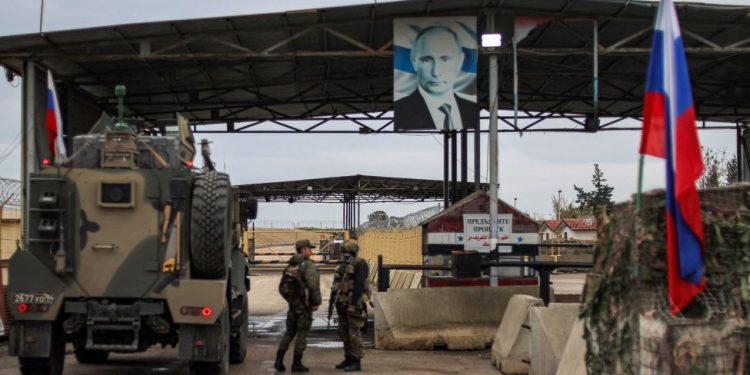
A few days after the Russian military intervention in Syria (September 30, 2015), Dmitry Rogozin, Russia’s Deputy Prime Minister for Defense Industries and the architect of the 2014 Crimea invasion, said, “Our boys are extinguishing a war against Russia in distant plains in Syria”(1). This statement recalled what Russian Foreign Minister Sergey Lavrov told a delegation from the Syrian opposition’s Coordination Body that visited Moscow in April 2012 (including Hassan Abdel Azim, Saleh Muslim, Haytham Manaa, and Abdulaziz Al-Khair) when justifying Russia’s support for the Syrian authority: “We are defending Moscow in Damascus.”
This Russian thinking might stem from Moscow’s calculation that a victory for Islamists in Syria, in the post-2011 period that saw Islamists come to power in Tunisia and Egypt, could have repercussions for the Russian Federation (where Muslims make up 10% of the population, with two million Muslims living in Moscow) and for neighboring Muslim-majority countries in Central Asia, all of whom are Sunnis except for Azerbaijan. Lavrov expressed this concern, or something close to it, during a May 7, 2013, meeting in Moscow with U.S. Secretary of State John Kerry, when he stated: “Moscow is concerned about the spreading instability in the Middle East and the rise of Islamic radicalism… [and expressed] Moscow’s concern about Syria turning into an extremist Islamic state” (2). Bashar al-Assad, in a meeting with Lebanese forces and parties, also touched upon the Russian concern in Syria when he said: “Russian support is not out of love for us or our people, nor is it for my eyes; rather, it is because Russia considers the battle to defend Damascus to be the battle to defend Moscow and its interests”(3).
From this perspective, the Russian war in Syria alongside the Syrian regime can be seen as a preemptive war from the Kremlin’s viewpoint, fought in a distant location to defend Russia. On the day of the Russian military intervention, the Syrian regime was at a political moment where it was prone to collapse. The Russian military intervention, which had implicit American backing—as President Barack Obama, after the fall of Mosul to ISIS on June 10, 2014, and its expansion in Iraq and Syria, had united with the Iranians and Russians in confronting the threat of Sunni radical Islamists—prevented this collapse. Obama did not want Damascus to fall into their hands at that time, as Homs was threatened after the armed Islamist opposition seized control of the entire Idlib governorate and most of the Al-Ghab region. The faction Jaysh al-Islam (Army of Islam), based in Douma, had managed to control parts of the Damascus–Homs international highway between Adra and Harasta in September 2015. On the day of the Russian military intervention, Bashar al-Assad had lost control of 70% of Syrian territory.
There were other considerations for the Russians as well. They sought to exploit the Syrian platform to affirm for the first time since the collapse of the Soviet Union in 1991 that Russia is a global power with a presence in regions further afield than its immediate neighborhood, and that it is not merely a force operating in its region like in Georgia (2008) and Ukraine (2014), or a power preoccupied internally (Chechnya in 1999 and 2000). Furthermore, Vladimir Putin, who was intimidated by the waves of change that had overthrown Arab rulers in Tunisia, Egypt, and Libya through street protests, feared the extension of that phenomenon to Moscow (4. Trenin also asserted that “Moscow’s stance in Syria was drawn… by strong suspicions regarding the composition of the Syrian opposition, and doubts about the motivations of the United States in Syria” (p.1). He added that “strategists in Moscow see the conflict in Syria, the sectarian violence in Iraq, and the aborted revolution in Bahrain as merely proxy war arenas fought over who will be the strongest in the region” (p.2), and the Russians believe that “the United States wants to overthrow Assad to strip Iran of its only ally in the Arab world” (p.2).
This likely explains Lavrov’s statement to the Russian radio station Kommersant FM on March 21, 2012, that “the conflict is raging throughout the entire region, and if the current regime falls in Syria, a strong desire and enormous pressure will emerge from some countries in the region to establish a Sunni regime in Syria, and I have no doubt about that” (Anba’a and Al-Sharq Al-Awsat newspapers, 22-23/3/2012).
Jihad al-Zein in Al-Nahar newspaper (12/7/2012) detected this in an article titled: “Why the Russian Alliance with Shiite Islam?” in which he said: “Today we are facing the following equation: a Russian defensive alliance with Shiite Islam versus an American offensive alliance with Sunni Islam… There is a Russian trend led by Putin and the security establishment he represents… toward dealing with the fundamentalist threat as a Sunni one.” It appears that Putin saw himself at that time in a unified stance with Khamenei in defending Bashar al-Assad, but for different reasons: for Tehran, to defend the “Axis” for which Syria forms the communication bridge between its parts; and for Moscow, for the reasons mentioned above.
To these Russian motivations for getting involved in the Syrian conflict (2011–2024), we can add what the British newspaper The Guardian reported on August 30, 2013: that the Syrian authority had rejected a Qatari offer in 2009 for a project to transport Qatari gas to Europe via a pipeline running from Qatar through Saudi Arabia, Jordan, and Syria to Turkey, and from there to Europe. This would have served as an alternative to the Russian gas line, which was then the main supplier to Europeans, representing a strategic gain for the European-American West and a major blow to Moscow. Moscow feared an American trend, since Obama arrived at the White House in 2009, towards weaning Europe off Russian energy, where “the Obama administration’s view was that the level of Europe’s dependence on Russian energy is unacceptable… and that this would lead Moscow to exploit the increasing energy link to consolidate its relationship with the European West, which, from Washington’s perspective, would weaken the European-Atlantic spirit and ultimately lead to the end of trans-Atlantic American leadership” (5). In another article in Asia Times (28/2/2013), titled: “Moscow Weaves Wide Relations in the Mediterranean Basin,” Bhadrak umar stated that “U.S. geological research estimates that the Eastern Mediterranean basin, stretching from Syria to Egypt, contains 122 trillion cubic feet of gas and 1.7 billion barrels of oil.” Most likely, one of Putin’s motives for getting involved in the Syrian conflict was to establish a geographical foothold that would prevent Syria from being turned into a corridor for Middle Eastern energy to Europe via the Syrian-Turkish crossing, whether that energy came from the Eastern Mediterranean basin or from the Gulf states.
However, the change in Washington’s stance toward the Islamists since the spring of 2013, compared to 2011 and 2012, brought the Americans closer to the Russians in Syria. Since the Moscow meeting between Kerry and Lavrov on May 7, 2013, the Americans moved towards cooperation with the Russians in Syria. The following month, we saw the Emir of Qatar step down, followed by the fall of the Muslim Brotherhood government in Egypt the month after. The spring and summer of 2013 witnessed the beginning of Washington’s separation from the Turks, not only in Syria but also regarding the stance on Islamists in Egypt, despite the Islamist Recep Tayyip Erdoğan, who, during the period of Washington’s convergence with the Islamists of Egypt and Tunisia in 2011 and 2012, was seen as the primary American agent across the region, including Syria. Indeed, since the spring of 2013, Washington was no longer insisting on “Assad’s departure,” which coincided with its distance from Ankara and its move toward cooperation with the Russians in the Syrian chemical weapons agreement (9/14/2013) and at the Geneva II Conference (January–February 2014), which collapsed due to the American-Russian dispute over Ukraine after demonstrations in Kyiv led to the pro-Moscow Ukrainian president fleeing to Moscow. Putin responded to this by occupying the Crimean peninsula. American-Russian cooperation in Syria then resumed with the Russian military intervention to halt the advance of armed Islamists, which was politically translated two and a half months after the intervention by the issuance of Resolution 2254 (18/12/2015) and at the Geneva III Conference. Geneva III was intended to impose an American-Russian solution over the heads of the authority and the opposition, but Riad Hijab thwarted it by halting negotiations with the regime at the behest of Erdoğan in April 2016, at a moment when Ankara was at odds with Washington and Moscow in Syria.
The preceding points can explain Russian behavior in Syria in the period after the eruption of the Syrian crisis since Daraa on March 18, 2011. The Syrian arena was the first confrontation for the Russians with the Americans in the post-Cold War era since 1989. The Russians did not merely use the veto in the Security Council on October 4, 2011 (which they had not done in March 2011 regarding the Libyan issue), but also sent Russian warships to Tartus port in November 2011. During the regime forces’ storming of the Baba Amr neighborhood in Homs in February and March 2012, the Russians were in a position supporting Bashar al-Assad. On the fifth anniversary of the Russian military intervention in Syria, Russian Defense Minister Sergey Shoygu said that “Russian forces carried out 44,000 combat sorties and killed 133,000 militants, including 4,500 from Russia and the Commonwealth of Independent States” (Al-Sharq Al-Awsat, 10/11/2020). It is notable in the battle for Eastern Aleppo during the period from October to December 2016 that Russian aviation was the paving and aerial support for the attack by Syrian regime forces, Iranian forces, and forces loyal to Tehran. Most of the destruction in the eastern neighborhoods of Aleppo was due to Russian air strikes. Similarly, for years, since the autumn of 2015, Russian aviation in Idlib province carried out incessant raids, often hitting civilian areas. This is a Russian combat doctrine applied in 1999 and 2000 in the Chechen capital, Grozny, which is based on the theory of inflicting a huge cost in lives and infrastructure on the civilian incubator of the armed opposition by striking it and demonstrating the heavy price of militants’ presence there, thus pushing that incubator to abandon the militants or stir up unrest against them.
It is true that Moscow agreed with Washington on the Geneva Communiqué (June 30, 2012), which includes forming a transitional governing body agreed upon by the opposition and the authority with full executive power, but there were no mechanisms to implement the Communiqué. Even when Geneva II (2014) and Geneva III (2016) conferences were held, whose announced goal according to Resolutions 2118 (2013) and 2254 (2015) was to implement the Geneva Communiqué through an agreed-upon mechanism, the Russians and Americans did not bridge the differences between the opposition and the authority, nor did they make a joint effort to present an American-Russian vision. It was as if the game was one of waiting for them, or that they were using the Syrian arena as leverage for other issues, despite rumors circulating in the corridors of the Geneva III conference that the Americans and Russians would impose a settlement on the Syrians at the end of July 2016, after the six-month negotiation period between the authority and the opposition expired. This was preemptively ended by Riad Hijab when he unilaterally announced the suspension of negotiations after three months, with Turkish support.
There was one political moment when the Russians hinted at a willingness to sacrifice Bashar al-Assad, in December 2012, at the peak of an offensive launched by opposition forces since the end of the previous month on the outskirts of Damascus city, starting from the airport and then extending to the eastern outskirts of Damascus from the Ghouta side. That offensive lasted for two months and one week, with the opposition gaining control of Jobar, Harasta, Zamalka, Arbin, and Yarmouk camp, but failing to penetrate the heart of Damascus or reach sensitive locations like Abbasiyyin Square through Jobar or otherwise.
During that offensive, and two weeks after its start, statements were issued suggesting an unprecedented Russian readiness to concede or move away from sticking to Bashar al-Assad. During a roundtable in Moscow titled “Russia and the Changing World,” Foreign Minister Sergey Lavrov declared: “We are not sticking to Assad or any other person”(Al-Hayat newspaper, 9/12/2012). This trajectory was followed by his deputy, Mikhail Bogdanov, in a speech delivered at the Russian Public Chamber: “Regarding the readiness for the opposition’s victory, that cannot be excluded, of course. We must look at the facts. There is a trend toward this path. The regime and the government are losing control over the country more and more” (Al-Hayat newspaper, 13/12/2012).
With the failure of the Syrian armed opposition’s attack on Damascus, the Russians did not return to those statements but reverted to their position of sticking to Bashar al-Assad. This coincided with Washington’s move since the spring of 2013—most likely because of or along with the failure of the armed opposition’s attack on Damascus—to begin openly abandoning Obama’s August 18, 2011, statement calling for Bashar al-Assad to step down. This began with a statement by U.S. Secretary of State John Kerry on March 13, 2013. The declared interpretation of the Geneva 1 Communiqué by the Americans, concerning the transitional governing body that includes the authority and the opposition, was that (Bashar al-Assad should not be part of it or that its formation should coincide with his departure). On that day (March 13, 2013), Minister Kerry issued a statement saying: “What is required is for Syrian President Bashar al-Assad and the Syrian opposition to sit at the negotiating table to establish a transitional government according to the framework reached in Geneva” (UPI, March 13, 2013). Then, Kerry and Lavrov concluded the May 7, 2013, agreement, which involved an American move to bring the Russians into the management of the Syrian file in cooperation with Washington, which from that month began to feud with Erdoğan. It is no coincidence that June 25, 2013, witnessed the stepping down of the Emir of Qatar and his Foreign Minister, followed eight days later by the fall of the Muslim Brotherhood’s rule in Egypt. These three signals from Turkey, Qatar, and Egypt gave indications of Washington’s divorce from the Muslim Brotherhood’s Islamic fundamentalism after a two-year marriage. This American-Russian cooperation in Syria continued on September 14, 2013, with the Syrian chemical agreement, which produced Resolution 2118 calling for the implementation of the Geneva Communiqué and the convening of Geneva II. The Russian military entry into Syria was then followed by an American-Russian consensus seen in Resolution 2254 and subsequently in the Geneva III conference.
With the failure of Geneva III (April 2016), American-Russian relations moved toward crisis management in Syria, which was characterized by a division of influence: Hmeimim–al-Tanf, east and west of the Euphrates. Most likely, and this happened simultaneously, the strong spread of ISIS in Syria during 2014, 2015, and 2016 was one of the major factors (though not the only factors) that led, during the period after the Russian military entry into Syria (September 30, 2015), to mapping out the division of influence in Syria between an American sphere of influence east of the Euphrates (and the al-Tanf area) and a Russian sphere of influence west of the Euphrates. This was followed by cooperation between the Russians and the Turks to establish a Turkish zone in the north (the Jarabulus–Al-Bab–Azaz line in 2016–2017, then Afrin in 2018, and then the Tell Abyad–Ras al-Ayn line in 2019). This came after the start of rapprochement between Erdoğan and Putin in the month following the failed July 15, 2016, coup attempt against the Turkish president, following which Turkish officials accused Washington of involvement. Meanwhile, the Russians, Americans, and Turks remained silent about Iranian influence west of the Euphrates, between Al-Bukamal and Deir ez-Zor, and in the Lebanese-Syrian border area extending from Al-Qusayr to Zabadani. The “DW” website revealed an American-Russian understanding on October 21, 2015, to avoid collisions between the two countries’ planes over Syria. It seems that the establishment of the Russian Hmeimim base in 2015 was agreed upon to be followed the next year by an American base in Al-Tanf and later by American bases east of the Euphrates, in addition to the silence of the Russians and the Syrian regime regarding hundreds of Israeli raids on the positions of Iranian forces or those loyal to Iran in Syria during the 2015–2024 period. It is likely that the Americans and Russians had agreed that the Euphrates River would be the dividing line for their influence in Syria, with the exception of al-Tanf.
U.S. Special Representative for Syria James Jeffrey (2018–2020) made a statement on May 12, 2019, saying: “My mission is to make Syria a swamp for the Russians by taking a set of measures to prevent the return of the normal situation to the regime-controlled areas and to stir up renewed crises, thus making Syria turn from a card into a burden for Moscow and Tehran” (Jonathan Spyer, Foreign Policy, 1/7/2020). It is probable that this was a new policy from Washington involving a confrontational tendency with Moscow in Syria, unlike the bilateral cooperation that existed since the May 7, 2013, agreement, and unlike the crisis management policy implemented by the Americans and Russians since 2016 and the failure of Geneva III.
In a comment by Vitaly Naumkin, head of the Institute of Oriental Studies of the Russian Academy of Sciences, on what Jeffrey said, we find the following: “Perhaps it would be right to call this experienced diplomat, who does not speak in vain, the Special Envoy not for Syria and counterterrorism, but for the war against Russia” (Al-Sharq Al-Awsat, 5/20/2020, titled: “What Is Russia Waiting for from Syria?”). It really seems that Jeffrey’s statement was a declaration of the beginning of the American war on Russia and the creation of a “Russian swamp,” but through economic tools, the first and most fundamental of which was the Caesar Act, which entered into force on June 17, 2020, after Congress issued it on December 18, 2019.
The reason for this American shift in position towards Russia in Syria must be sought, transitioning from cooperation (2013–2016) to crisis management (since mid-2016) up until Jeffrey’s statement on May 12, 2019, which Naumkin, the greatest Russian expert on the region’s affairs, considered to be a declaration of war on Russia.
Is the reason Russia’s cooperation with Iran in Syria and its attempt to draw Turkey eastward and away from the Atlantic orbit, through what Putin offered Erdoğan of the Syrian cake, and Trump’s anger at this—as he adopted a confrontational policy with Iran by abandoning the U.S. signature on the nuclear deal in 2018, and then punishing Ankara by excluding it from the F-35 fighter jet development program after it purchased Russian S-400 missiles? Or did the Pentagon, which was and still is in charge of the Syrian file, want to implement its global confrontation policy with Russia in Syria, as announced in the last month of 2017 with the issuance of the “National Security Strategy of the United States” This text shows a shift (within the military-security complex—the Department of Defense and intelligence agencies—which determines or is the strongest in determining U.S. national security policies) from a consistent American policy that lasted until the end of the Obama administration (2009–2017) and had begun in 1971 with Henry Kissinger: to separate the Russians and Chinese and prevent their alliance, as happened between Stalin and Mao Zedong in the Korean War (1950–1953). The 2017 text places China and Russia together as powers threatening U.S. national security, even while considering China the main threat.
Indeed, the American war on Russia in Syria began with the shot of the Caesar Act in 2020, intended to “create a Russian swamp” for Putin to sink into by leaving his ally in Damascus in a state of economic paralysis and the resulting social and political translations in the areas controlled by the regime. The criticisms directed at the regime by Russians in the spring and summer of 2020, voiced by people close to decision-making circles in Moscow, such as the former ambassador to several countries in the Middle East, Alexander Aksenyuk, and reports by the Russian Council on Foreign Affairs (headed by former Foreign Minister Igor Ivanov)—including a report warning that “Assad is working to drag Moscow into an Afghan scenario” (Al-Sharq Al-Awsat: “Protecting Assad Has Become a Burden,” 6/5/2020)—suggested that the Kremlin was beginning to sense the danger of Syria turning into a second Afghanistan, a quagmire the Soviet Union sank into between 1979 and 1989, which was also a quagmire of American making.
But the question posed by Robert Fisk in the title of his article in The Independent on 4/16/2020: “Will Russia rescue Syria’s economy as it rescued the regime militarily?” was answered in the negative by the subsequent four years. This is not only because Russia lacks the economic capacity to save a dilapidated, corrupt, and structurally worn-out regime, but also because Russia sank into the Ukrainian quagmire starting February 24, 2022. That former Soviet republic has become and remains an arena for an Atlantic war against Putin’s Russia, in whose mire the Kremlin master is stuck, unable to advance or retreat, losing in either case.
To escape this Syrian predicament, Putin tried to encourage an Arab opening towards the Syrian regime, initiated by the UAE and then Jordan, with the “step-by-step” initiative in 2021. The first steps were to address refugee return, halt Captagon trade, release detainees, and reveal the fate of the missing, in exchange for Arab diplomatic and economic opening steps. Despite the Syrian regime reclaiming Syria’s seat in the Arab League at the Jeddah Summit in May 2023, the regime’s lack of response to the steps outlined for it rendered the Arab initiative zero-sum. Putin also attempted between 2022 and 2024 to find a rapprochement between Bashar al-Assad and Erdoğan, but Bashar al-Assad’s stubbornness and lack of response caused the Russian president to hit a wall.
The Syrian quagmire intensified with the Gaza and Lebanon wars of 2023–2024 in the period following the October 7, 2023, attack by Hamas on the Gaza envelope. The combination of Putin’s Ukrainian weakness with Iran’s regional weakness, added to the defeat of Hezbollah in the war from September 17, 2024, to November 27, 2024, led the Syrian regime to become a soft target that was easily and readily consumed in the “Deterrence of Aggression” operation, which began on the morning after the end of the Lebanon war in the period from November 27 to December 8, 2024. The Syrian regime fell in twelve days. Just as Moscow, Iran, and Hezbollah had prevented its fall in the 2011–2015 period, the weakness of the three in the 2022–2024 period made it prone to falling easily, because it lacked self-immunity throughout the period from March 18, 2011, to December 8, 2024. The strength of foreign powers protected it for a period, and the weakness of foreign powers opened the door wide for its easy fall.
The name “Deterrence of Aggression” suggested that the military operation, led by Hay’at Tahrir al-Sham (HTS) from Idlib toward Aleppo, had limited objectives, but the revelation of the regime’s weakness and the collapse of its forces from the first day opened the way.
The factor that leaves open questions is Russian behavior during those twelve Syrian days. After limited air support for the regime in Aleppo on the first day, the Russians stood aside and did not repeat the aerial support they had provided to the regime, the Iranians, and Hezbollah in previous years.
The puzzling thing that remains unexplained is the statement from the Doha meeting on the afternoon of Saturday, December 7, 2024, for the Astana process countries (Russia, Iran, and Turkey), with the attendance of Qatar, Saudi Arabia, Egypt, Jordan, and Iraq, which included “the necessity of stopping military operations in preparation for launching a comprehensive political process based on Security Council Resolution 2254” (Qatar Media Center).
The questions that are being asked and remain: Could Sergey Lavrov be naive enough to agree to such a statement if he knew, was complicit in, or approved of the entry of armed opposition forces into Damascus just a few hours after that statement was issued? Doesn’t this coincide with rumors that circulated that evening, and were confirmed by insiders in the regime circles, that Bashar al-Assad had asked Bouthaina Shaaban that evening to prepare a speech to be delivered the following morning in line with the Doha statement? Furthermore, is it plausible (according to an investigation published by The New York Times on October 16, 2025, about the Syrian regime’s last night) that Major General Ali Mamlouk was sleeping in his home as usual and was then woken up at 4 AM to flee to the Russian Embassy after the entry of armed opposition forces into Damascus, and that Major General Hussam Louka, head of the General Intelligence Directorate, viewed the situation as normal until midnight, only to hastily flee his office at 2 AM? Doesn’t this indicate unexpected developments for them—not unexpected by those outside the regime—which made them feel safe? And doesn’t Bashar al-Assad’s escape from the palace without informing anyone at midnight with Russian assistance indicate developments that were unexpected for them and for him, more than it suggests Russian complicity with the newcomers to Damascus?
Does the statement of Alexander Dugin, the intellectual mind of the Russian regime, provide the answer when he said three days after the fall of the Syrian regime: “Erdoğan betrayed both Russia and Iran in Syria and turned against them” (Al Arabiya Net, 11/12/2024)? And doesn’t Dugin’s statement align with Trump’s praise for the Turkish President: “Erdoğan solved the problem in Syria, this is a great victory for Turkey, and I want to give him credit for it.”
Footnotes
1 – (NYR daily, 8/10/2015, “Why Does Russia Need Syria?”, 5 pages, p.3).
2 – (Peter Eltsov: “How Do Russia’s Domestic Muslims Affect Moscow’s Syria Policy?”, Washington Institute, 14/6/2013, 3 pages, p.2).
3 – (Al-Safir newspaper, 22/4/2013).
4 – (Dmitri Trenin: “Russia’s Red Line in Syria,” SCIS Center for Strategic and International Studies, 10/2/2012, 3 pages).
5 – (M. K. Bhadrak umar: “The US Breathes Life into a New Cold War,” Asia Times newspaper, 7/6/2011).