


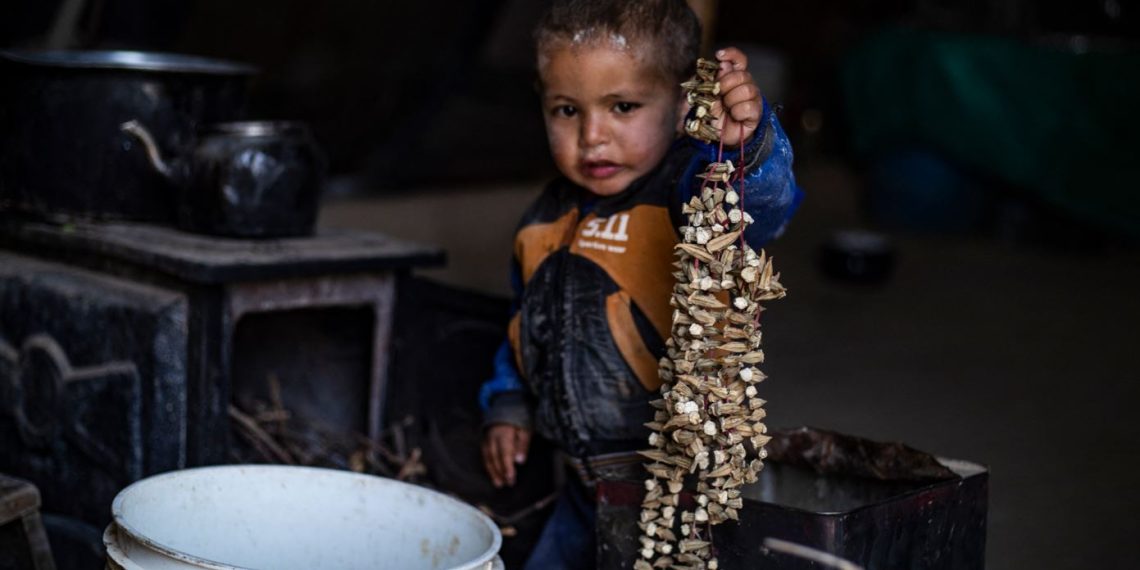
In a striking paradox, a Swedish politician who met with Iraqi refugees fleeing Saddam Hussein’s regime noted that, despite their radical differences in almost everything—politics, religion, lifestyles, and more—they all agreed on one nearly constant theme: the presence of okra on their tables! This remarkable consensus prompted the Swedish politician, as noted by Iraqi sociologist Faleh Abdul Jabbar[1], to propose placing an image of okra on the Iraqi flag! The same suggestion could apply to “Mulukhiyah” for Egyptians, “qat” for Yemenis, and “couscous” for Moroccans. As for the Syrians, their differences seem to extend even to food colors, just as they differ in almost everything else! They are no exception, as it is not easy for the societies of this beautiful Levant to agree on anything, even food[2].
Food: Identity, Memory, and Peace?
If Iraqis or others were to take such a step, each according to their favorite dish, they wouldn’t be the first to make a plant a national symbol. Other societies and countries have long adorned their flags and currencies with well-established botanical symbols: the cedar tree on Lebanon’s flag, the red maple leaf on Canada’s flag, and the chrysanthemum in Japan’s national emblem. Let’s not forget the oak branches and acorns in Bulgaria’s national insignia, or the laurel leaf that adorns the coats of arms of countries like Argentina, Greece, El Salvador, and others.
The Swedish proposal opens a broad question: can food serve as a tool for social peace? Just as pizza embodies Italian spirit, and kimchi reflects Korean identity in ways that transcend mere cuisine, for Iraqis, okra carries more than just a taste. It is linked to collective memory, childhood recollections, and family gatherings—those warm bonds that remain alive despite deep political divisions. Could an “Okra Festival,” “Mulukhiyah Day,” or “Sheikh Mahshi” bring people together around one table despite their differing loyalties? What role might food play as a bridge of unity in countries affected by profound conflicts, such as post-apartheid South Africa, where shared cultural symbols have contributed to healing division?
The Exhausted State: The Failure of Grand Projects and the Persistence of Simple Symbols
However, for Iraq, Syria, Libya, Yemen, Tunisia, Lebanon, and all societies in the Levant, the issue extends beyond shared dietary patterns to encompass deeper commonalities in values, lifestyles, and a broad cultural and historical landscape. Yet, all these commonalities have been under immense strain and are in ongoing confrontation for decades, making it difficult to speak of a cohesive society or a clear societal future—especially during moments of conflict and devastating war. Syria, in particular, exemplifies this, due to its deadly sectarianism.
Today, Syrians, Iraqis, Libyans, Sudanese, and others appear as mere facts, labels, colors, maps, and flags that do not justify their existence in and of themselves, nor as united peoples or societies in the sense understood by social sciences and democratic nations. Instead, they are arenas of conflict and black death—fighting over the sacred, religion, and spoils! They are peoples and societies subjected to permissiveness from both internal and external forces, living in a perpetual tragedy whose chapters unfold continuously, with only violence and death on the horizon—and, of course, migration and asylum for those able to escape.
But does resorting to simple symbols like okra indicate the failure of political elites to build a unifying national identity? Or is it an implicit admission of despair regarding grand projects—whether national or religious—that once underpinned identity? Does this situation reflect how historical factors such as colonialism, hatred, fanaticism, and tyranny have contributed to dismantling once-cohesive identities, leaving food as one of the few remaining bonds?
This reality points us toward a deeper issue in the sociology of symbols: the transformation of okra or other food colors into symbolic refuges reflects—according to an analysis based on the ideas of Ernest Gellner[3]—an elite crisis in producing modern, unifying symbols. It also signals a profound crisis in the value systems of societies (or what are considered societies), where religion (sect or faith), society (tribe, clan), politics (power), and economy (rent) are intertwined in a “quasi-essential” manner, from which there is no escape. Conversely, and as a corrective to what has just been said, Michel de Certeau speaks of “the tactics of everyday life,” which can form relative possibilities for “alternative identities” that transcend the superstructures imposed by official and semi-official discourses[4]. This is also reflected in Pierre Bourdieu’s concept of “habitus,” where identity is not an essential given but a relational outcome of interactions between structures and practices[5].
Okra: A Point of Convergence or Mere Paradox?
Returning to okra—indeed, it truly deserves to be a national symbol, perhaps a nationalist and Eastern emblem par excellence. It is consumed (and loved) by Arabs, Turks, Persians, Kurds, Muslims, Christians, and non-religious individuals, across various sects, denominations, tribes, groups, and individuals. You find it on tables across all social classes and strata, in cities and rural areas, inside and outside urban markets, in luxurious palaces, as well as in belts of poverty and impoverished neighborhoods.
Cervantes once said, “I have never found a love more sincere than the love of food.”[6] Does the convergence of people over a love for something—even okra!—lead to an implicit agreement that they like or prefer something, or that they do not differ on everything? And consequently, can what they love—whether food, drink, or otherwise—be considered a genuine “point of convergence” at the national level?
In fact, considering okra or anything similar as a national symbol involves a profound rhetorical and symbolic paradox, especially for proponents of grand narratives and overarching ideologies who view the region’s conditions through imperial, religious, or nationalist lenses. These are peoples who glorify violence, war, killing, and death under grand pretenses. Yet, in reality, they live amid divisions, fragmentation, corruption, underdevelopment, tyranny, human rights violations, and the rush toward sectarian violence—or the silence or justification of it. Is it reasonable, from this perspective, to think of a plant or a beverage as a symbol of nations, societies, and countries—leaving aside heroic battles, wars, and great historical epics? Or are we merely decorating collapse, hysteria, killing, death, and violation with collective cooking?
Symbols: Comparisons and Bitterness
Let us make a comparison—one that many might find unconvincing—between okra and other symbols: Why has the Lebanese cedar tree succeeded as a symbol of Lebanon despite its deep divisions? Is it because it is linked to nature, geography, and ancient mythological heritage (such as Phoenician myths), rather than to the ever-changing, digestible daily life of a meal? Is the cedar tree a unifying symbol for Lebanon, or does each person have their own tree and cedar?
This reveals the difference—and I hope the reader’s mind doesn’t wander too far—between “natural” symbols that transcend time and “culinary” symbols that are fleeting. Is it justified to reduce ancient peoples to dishes like okra, mulukhiyah, or stuffed vegetables, while other nations are represented by awe-inspiring symbols such as the Russian bear, the American eagle, the Indian tiger, or the Chinese dragon? Who determines the “seriousness” of a symbol? Why is food disparaged while animals or trees are revered as national symbols? This reductive view provokes biting irony and raises questions: Is it naive to believe that food can unite what centuries of history and culture have failed to unify? The Lebanese cedar, despite its grandeur, did not prevent a bloody civil war, nor may it prevent future conflicts among Lebanese. Similarly, “okra” and “stuffed vegetables” have not prevented Syrians from the horrors of war, killing, and displacement they face today.
Food and Migration: Longing and a Bridge
We are confronted with phenomena driven by various imaginative, emotional, and value-based motives, centered around tribe, sect, region, ethnicity, clan, or group—rather than society, homeland, or the modern state. These motives are what fuel disputes and conflicts—struggles between lovers and passionate supporters of themselves and their interests, and between those who resent anything that poses a threat or mere difference. Power becomes the prize, and the homeland the victim!
In the context of migration and asylum, food acquires an additional dimension. Why does a plate of food become an integral part of migrants’ identities? It’s not just a meal; it’s a longing for the land they fled, the people they left behind or were cut off from, and memories that require much forgetting to heal their dark images and pains. Food—or “food memory,” or “culinary commonality,” if I may use the term—may be the final bridge connecting generations of migrants to their homeland, transmitting oral and sensory heritage across oceans.
In Conclusion,
Is food enough to build a nation? Can the “okra horn,” the “cedar tree,” “qat,” “mulukhiyah,” “stuffed vegetables,” or “Damascus mulberry,” if Syrians agree to consider it a shared symbol, achieve—and here we seem to repeat ourselves—what centuries of shared history, culture, geography, and civilization have failed to realize among the peoples of the region, and within each of them?
It is true that the taste of okra is good, as is “SDamascus mulberry” and others; these things are subjective and there is no compulsion in that. However, the task entrusted to it seems somewhat heavy! Perhaps what makes okra suitable to represent our homelands is not its taste or flavor, but its fragility—tender, quickly disintegrating if boiled excessively—yet it remains on everyone’s table. The most important lesson from okra might be that shared values are not only built through dishes, but also through the recognition that a single table can hold more than one dish, and that the true homeland is the one that allows its citizens the freedom to choose how they prepare their okra.
Footnotes:
[1] Faleh Abdul Jabbar, “The Construction or Disintegration of Iraq within the Framework of Sociological Theories of Nationalism and Nations,” a lecture at the General Union of Writers and Authors Club in Iraq (March 17, 2017). See Rifaat Chadirji’s discussion of okra in: Rifaat Chadirji, Dialogue on the Structuralism of Art and Architecture (Beirut: Dar al-Rayyes for Books and Publishing, 1995).
[2] The book published an initial version of this text several years ago, and it seemed appropriate to revisit, deepen, and reintroduce it to the reader with a new “flavor” and “taste.”
[3] Gellner, Ernest. Nations and Nationalism. Cornell University Press, 1983.
[4] de Certeau, Michel. The Practice of Everyday Life. University of California Press, 1984.
Arabic translation: Michel de Certeau, The Invention of Everyday Life, translated, annotated, and introduced by Muhammad Shawqi al-Zayn (Algiers: Publications of Ikhtilaf, 2011).
[5] Pierre Bourdieu and Jean-Claude Passeron, Reproduction: Toward a General Theory of the Educational System, translated by Maher Trimesh, with a review by Saud al-Mawla (Beirut: Arab Organization for Translation, 2007).
[6] This phrase is often attributed to Cervantes, but it does not appear literally or directly in his works. It is likely a paraphrase or a free quotation that captures the essence of a meaning derived from Don Quixote, where there are numerous references to the characters’ love of food—particularly Sancho Panza, Don Quixote’s companion, known for his gluttony and affection for eating.