

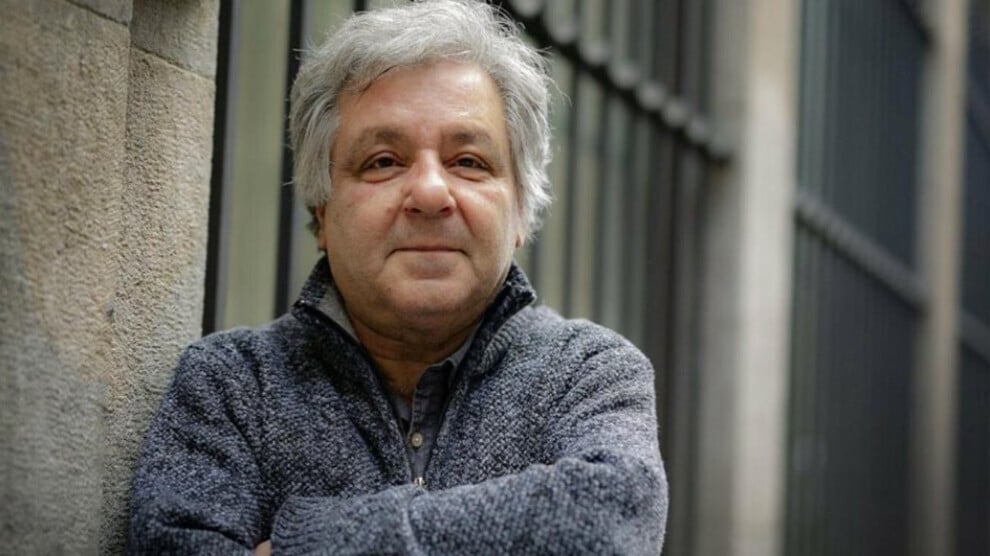
Professor Hamit Bozarslan is an expert in the Middle East, Turkey and the Kurdish question. He has been director of studies at the École des Hautes Études en Sciences Sociales (EHESS) in Paris since 2006. Bozarslan is a regular contributor to French media such as Le Monde and is the author of a long list of works, including the essay Crisis, violence et dé-civilization (2019), Révolution et état de violence. Middle East 2011-2015 (2015), History of Turkey. From the Empire to the Present (2013), A History of Violence in the Middle East. From the End of the Ottoman Empire to al-Qaeda (2008), From Political Struggle to Self-Sacrifice: Violence in the Middle East, (2004), The Kurdish Question: States and Minorities in the Middle East (1997).
Prof. Bozarslan spoke to the Kurdish Center for Studies about the importance of Abdullah Ocalan’s 27 February call, the current political process in Turkey, as well as the developments in Syria and the Middle East.
Let’s begin with your evaluation of the current political process – we cannot call it a peace process yet – in Turkey?
Much has already been written about this. Clearly, a certain dynamic has formed. However, we don’t know how far this dynamic will go. We can see that, in fact, there is both recognition and non-recognition of the Kurdish question. There is recognition, because when you take the PKK as an interlocutor, when you take Abdullah Öcalan as an interlocutor, inevitably in one way or another, you accept that this issue exists.
There was a deadlock for the last 10-15 years, and with the deadlock there was also a very great pressure against the Kurds.
However, despite this pressure, the Kurdish movement has not disappeared, Kurdish society has not dissolved. We witnessed a phenomenon of national consciousness. And because of this, one of these two things happen: either the pressure is increased to a much higher degree, or a solution is sought. Yet, as I said, actual recognition does not fully exist.
Let me be clearer. When you look at the statements of both Devlet Bahçeli and Recep Tayyip Erdoğan, you see that:
One, this issue is still considered a terrorism issue. However, the Kurdish issue is definitely not a terrorism issue. The Kurdish movement emerged as an armed movement as a consequence of a certain situation. The Kurdish question is a phenomenon that encompasses the entire 20th century. The acceptance of the legitimacy of the Kurdish question is at stake. Because when you speak of terrorism, this legitimacy vanishes.
Two, there is a claim that the Kurdish issue is imperialism and Israel’s manipulation. It is not possible to accept this either. Because the Kurdish question is a phenomenon that existed throughout the 20th century as I just said. And if Kurdistan was divided, if it was partitioned, the reason for this also includes, at the same time, an alliance phenomenon in the establishment of Turkey, and in imperialism.
Three, the unity of the Ummah, the Muslim unity. This, of course, is not a phenomenon to accept. That is why sometimes I think of the Spain phenomenon between 1975-78. In Spain, at that time, a dual process occurred. First, during this period, the recognition of democracy as a legitimate issue, perceived as a legitimate system, and the formation of a democratic alliance. Second, despite all its inadequacies, the acceptance of the Basque and the Catalan questions as legitimate questions.
Talking about the Ummah resembles somehow talking about Christian unity in Spain. However, the national issue is not an Ummah issue. And moreover, what are we going to do with the Armenians? Armenians are not part of the Ummah. That is why I believe that a democratic brotherhood needs to be taken into consideration. But for a democratic brotherhood to exist, Turkey itself must democratize, Turkish society must democratize. But unfortunately, we witness a serious deadlock here.
That is why I was talking about a phenomenon of both recognition and non-recognition. Or, put it in another way, the distortion of the Kurdish question, in various ways, which continues not to be seen as a national issue.
Going a bit back in time, do you think the results of the last general elections, presidential elections, and the subsequent local elections (2023 and 2024) had some influence in shaping a new scenario today?
It’s difficult to say, because we do not have precise knowledge of the codes managed in this process. We are talking about a process that started in October 2024. Almost a year has passed since then. Yet, despite this, we still do not have a knowledge of its codes. Whether we talk about the steps taken by the president of the MHP (Milliyetçi Hareket Partisi, Nationalist Movement Party), Devlet Bahçeli, Turkish President Recep Tayyip Erdoğan’s resistance [to this process], then acceptance, in one way or another, the reduction of pressure in Kurdistan, we don’t have full knowledge of the codes. Maybe the elections and their results were a factor.
In addition, however, we need to ask ourselves: is it possible for a non-democratic Turkey to solve the Kurdish question? While this process is happening, at the same time, pressures in Turkey are increasing. Especially against the CHP (Cumhuriyet Halk Partisi, Republican People’s Party). And there is no sign, no indication, that these pressures will decrease. However, it is likely that not everything was linked to the elections. There may be some tactical projects, some tactical calculations. But what is happening is most likely a phenomenon beyond the elections and their results.
Linked to this how would you define the “state of health” of both the CHP and the AKP?
Let’s say this: at least in the CHP there is partial development. Extremely inadequate. Because if you look at CHP’s establishment, if you look at CHP’s history, we are facing a system similar to Mussolini’s Italy of that period. The CHP was founded by genocidists. The CHP’s rule was a period when the Kurdish question was denied, intense violence was applied against Kurds. And the CHP has not been able to reckon with its own history in this regard. But on the other hand, in one way or another, it is a party that can no longer deny the existence of the Kurdish question.
That is why in the CHP there are some developments, albeit insufficient. The CHP’s democratization can play a very important role in the democratization of Turkey. But the CHP is not yet at this stage.
As to the AKP, I do not know. I definitely cannot make even the slightest prediction about its future. I do not think Kurds will rise and vote for AKP. There are different reasons for this, historical reasons. There is a sociology of Kurdish voters.
For example, in Kurdistan there is the Hezbollah phenomenon, Hüdapar. Hüdapar can gather 100,000 people in Diyarbakır. But Hüdapar never exceeds 0-2% nationwide. What I am saying is that a very large part of Kurdish society has a democratic sensitivity and comes from a leftist tradition. So personally, I do not think it will turn to the AKP, or that the AKP’s Ummah-Sharia discourse will have some appeal to most Kurds.
How do you see the role of MHP, and especially the role of Devlet Bahçeli?
The biggest enigma, the biggest mystery, is this. Until now, the MHP was the most radical anti-Kurdish party. I do not know how much progress has been made at the level of discourse. As I said, the Kurdish question has not yet been accepted. But maybe can we talk about a strategic mind? I do not know. Because this process somehow was started by Devlet Bahçeli. And in Devlet Bahçeli’s statements, the following emerged, systematically, Israel and imperialism.
If we cannot solve this issue, Israel or imperialism will in one way or another claim this matter. When Bahçeli brought this discourse, the Lebanon War had not yet started. The Bashar Al-Assad regime had not yet fallen. But this phenomenon, that is, a phenomenon of fear, a phenomenon of conspiracy, the last target of Israel is Turkey—saying all this, of course, probably contributed in some way.
The Kurdish issue had become central in Turkey’s political life. The parties discussing this issue, in some way, as you said, are structurally very old, but in some way, due to the challenges of the Kurdish question, they continue to maintain their actual structure. If the process works, what kind of appearance will political life take, and how do you think these parties should change?
Answering this question is also very difficult because the system itself is exhausted. The system is completely corrupt. The system’s capacity for integration is extremely low. We see this in different ways. For example, the economic issue. Since 2018, we are facing a continuing crisis. Erdoğan said in 2019, “Give authority to this brother of yours; I will solve this issue in three months.” But in 2019, Erdoğan was already in power and had been in power for many years. The economic crisis from 2019 to 2025 is, I suppose, continuing at a very serious level.
Let’s take a look at foreign policy. Turkey has had crises with Israel and continues to have them. But at the same time, there was not a period without crises with Egypt, the UAE, Saudi Arabia, the U.S., or Russia. And ultimately, Turkey had to step back. The government itself is very exhausted.
We are facing a very old administration. 22 years is a very long period. And we see its different signs. Different indicators exist. For example, Erdoğan wants every woman to have three or five children. Fertility rate in Turkey is currently 1.5, with a trend toward 1.3. So, there are very serious gaps between society and the administration.
The CHP has at least some potential to renew itself, because there is a desire for change. Whether this desire for change can turn into a democratic expectation, I do not know. Can the CHP do this? I don’t know. But if the CHP can turn this expectation into a democratic expectation, then it can renew itself.
It is very difficult to say this for the AKP and the MHP. Also, very difficult for the İYİ Party. Likewise, it is very difficult to say that for the Zafer Party. They can increase their voting capacity and potential. They might go from 2% to 6%, 7%. But they cannot have a government-changing dimension. That’s why I think that for the government, at this point, to renew itself and rejuvenate seems extremely difficult to me. But at the same time, the government may continue. That is a separate matter.
Left parties, on the other hand, in Turkey like in the rest of the world seem incapable to find common issues to unite around.
This is the classic problem of the left in Turkey. How many leftist parties exist now? I don’t know, maybe twelve, or fifteen. And their voting potential is about 3–4%. If they can unite and create a new dynamic, maybe they can increase this. For that, they need to ally with the CHP. They need to clearly ally with the Kurdish movement. But these left parties, I think, no longer have a discourse that resonates much with society.
One needs to consider this. For example, the Spain example is very important. But at the same time, it should be considered along with the examples of Greece and Portugal at that time. In all three countries, there was very serious change in the left. Significant renewal occurred. I am thinking for example at the attempt by Nicos Poulantzas. He had a project for renewing Marxism. We do not see any of these in Turkey.
The Call for Peace and a Democratic Society made by Abdullah Öcalan on 27 February 2025 reaffirmed the commitment of the Kurdish Movement to peace. How do you evaluate this call?
As I said, we do not have the codes to properly interpretate this process, including this call. It is very, very difficult for us to see what is happening behind the scenes, behind closed doors. But what is clear, is that Abdullah Öcalan’s call, is not a call for surrender. In that call, there is the reality that the era of armed struggle is over.
The armed struggle occurred under the conditions of the 20th century. We need to remember the 1970s. The 1970s were a period when revolutionary violence was considered legitimate, guerrilla warfare was considered legitimate, and anti-colonial wars continued. The Vietnam War ended in 1975 and was seen as a reference at that time. The Palestinian movement was very important in that period. Armed struggles were also taking place in the Middle East. In Iran, in Lebanon, etc. These conditions no longer exist.
Secondly, there has been a very serious change within the Kurdish society itself. In the 1970s, 75% of Kurdish society was rural. Today, the rural population is below 20%. In the 1970s, there was no middle class among the Kurds. Today, there is a process of middle-class formation. Today, there is a much stronger Kurdish identity, in literature, cinema, theater. So, it is very, very difficult for Kurdish society to continue with the old references.
That is the first reality: the end of armed struggle. Second, I suppose the government was not very pleased with the idea of linking the Kurdish question to democracy. The Kurdish question is also seen as one of the conditions for Turkey’s democratization. And Mr. Öcalan reminded of this. Third, I suppose Turkey had very high expectations there. Mr. Öcalan said nothing about Syria or Rojava. Because Turkey’s ultimate goal, despite everything, is either the destruction or the takeover of Rojava in one way or another.
No peace and negotiation process can be compared to others. However, there are certain issues which are tackled in all processes. For example, in Ireland or Colombia, we saw that one of the most critical issues was political prisoners, and the other was the return of guerrillas into society. Do you think it is too early to address these issues in the current process in Turkey?
I think the difference with other processes is this: we are not facing a classical guerrilla, because the PKK has not been active in Turkey for 10 years. The Kurdish question is not only the issue of one country, but a Middle Eastern issue. The heart of Kurdistan is currently beating in Rojava, and everyone knows this. So, I think it is not possible to compare with other processes. Indeed, at this stage, we cannot even say to be in a peace process.
I think the most important issue right now is guaranteeing Rojava’s future. That is, make sure Rojava status is accepted. Which also means recognizing the Kurdish question as legitimate both in Iraq and Syria. If we elaborate on this, it means that borders, the ability to transcend borders – and I am not saying states should disappear – but the acceptance of the concept of borders, the recognition of Kurds as a collective subject in the Middle East should happened. If this happens and, secondly, if the existence of the Kurdish question in Turkey is recognized, other issues, in my opinion, will follow.
What is your assessment of the situation in Syria then?
The fundamental issue is that: How will Rojava develop? Will Turkey continue its strategy of eliminating Rojava? Because Turkey’s last ten-year strategy has been precisely that. Or will Turkey accept a Rojava phenomenon in one way or another?
As a part of Syria, will it be a special part? Will it be a part of Syria with regional characteristics? We obviously do not know. That is, how developments and negotiations between Damascus and Rojava will be. Some in Turkey currently want the Damascus administration to attack Rojava. This is a very big danger for Rojava.
And at the same time, a very big danger for Turkey. Because the cost of starting a new civil war in Syria is very high. There are some factors that did not exist ten years ago. The U.S. is currently in a very active position. And then there is also the Israeli factor.
The question is what status Northern and Eastern Syria-Rojava will attain. Federation is very unlikely, but perhaps an autonomy. What kind of autonomy though? Rojava emerged as a Kurdish project. But the current autonomous region is a region that far, far exceeds Rojava. 30% of Syria. That is, cities like Deir Ezzor, Raqqa, etc., are not Kurdish cities. Will Kurds continue to stay there? Under what conditions will they continue to stay? So, we cannot answer all these questions at present, but the most important issue right now is ensuring Rojava’s continuation.
Do you think this recently signed eight-point agreement with Al Sharaa and Mazloum Abdi can be implemented? I mean, is it being implemented?
All the conditions exist for it to be implemented. There are some problems though, as I mentioned before. One is Ankara. Will Turkey lift its veto? What will Turkey’s pressures be? Secondly, the Syrian issue. There are currently two serious problems in Syria. First, the Syrian regime does not have public support. It does not have representative power. Al Sharaa is someone accepted by 18 militias. I am not even talking about Syria’s democracy; to reach a legal structure, a rational structure, the militias must be removed. HTS itself is also a militia. The newly formed army also relies on militias. Can we move out of this militia mentality and enter a state-building process?
Secondly, HTS, as we all know, is an organization coming from Al-Qaeda. Even if they wear a tie, I am not very sure that these leaders have abandoned the project of Islamic emirate or Sunni dominance. And this Sunni dominance also means Arab dominance. Syria has paid a very heavy price to Arab nationalism. And Syria has paid a very heavy price to sectarianism. Because low power, successful dominant power did not represent Alevis but came from Alevis. Now if you think the opposite, the sect factor will emerge in one way or another. The Druze massacres and Alevi massacres showed this.
So, I think the fundamental uncertainty lies with Damascus itself. How will the Damascus government develop, and how will Turkey develop? Ahmet al-Sharaa said that a few days ago there was an agreement between the U.S., Turkey, Damascus, and the Syrian Democratic Forces. But at the same time, we also see that a threat rhetoric continues. The interim government keeps saying “we will attack if it continues this way”. The threat rhetoric is still there. So, the question is, how to shift from that? And how this will affect the U.S. strategy, how it will affect Israel’s response, we do not know yet.
The reality is that we are going through a difficult period.
Do you think Turkey will it redefine its alliances over time? Clearly it is struggling to achieve a strategic importance. Do you think it is managing to do so?
I do not think Turkey has very great strategic importance. In the Ukraine issue, Turkey has no maneuvering room. In the Caucasus, Turkey’s influence is actually decreasing. There is very strong opposition against Turkey in Iraq. The Syrian government is somehow dependent on Turkey, but at the same time is a country that does not want to lose its particularities.
Relations with Israel are very, very bad. Turkey has improved its relations with Egypt, Saudi Arabia, and the United Arab Emirates, but this has no real effect, that is, no benefit. For example, currently, Egypt, Greece, and Cyprus are very clearly in alliance with Israel. Both in terms of the sea—that is, the continental, maritime, continental zone—and regarding oil and energy lines. In all of these, we have not seen Turkey achieve great success. Turkey was expecting a significant amount of money from the Gulf, but as far as I can see this did not happen. So, I do not think Turkey is in a very, very important strategic position.
Coming to Israel. Nobody seems able to stop it.
Of course, it is a very bad situation. A very bad situation. I do not think there is any pressure on Israel. And Israel already had a corrupted democracy. It is now very, very difficult to even speak of democracy in Israel. That is, Israel has become a regime, a war regime-let’s not call it even a military regime. It is a war regime. And it has turned into a war society.
I do not know how long this will continue. Of course, this creates some serious questions in Israeli society, as well as very important debates among Jews outside of Israel. Many Jewish intellectuals openly condemn Israel. But I do not think much will change. I do not think much will change because there is a phenomenon. There is the phenomenon of the merger of two types of Zionism. An eschatological Zionism and a Zionism representing 19th-century nationalism. A social Darwinist Zionism. An organic Zionism. The merger of these two has brought Israel to a point where it is unstoppable. From my perspective, the most important issue is, of course, the Palestinian issue. That is, the Gaza issue, and at the same time, of course, the West Bank. Colonization is continuing there. I am not very optimistic.
Can we argue that Misak-ı Milli was a territorial agreement, or a principled agreement? How would you define it?
Actually, Misak-ı Milli is an oath. A pledge adopted by the Istanbul Parliament in 1920. “We will reclaim these lands.” That is, the lands that were under Ottoman administration in November 1918 will rejoin the Ottomans. These include Aleppo, Iraq, and Kurdistan. Some of Rojava is included in these. But as I said, this oath is not an agreement. It is not an international agreement. It is not an agreement among Turks. It is a text adopted by a parliament.
But that parliament was later dissolved, to be precise. The Ankara Parliament was established. The Ankara Parliament proceeded from a very different dynamic. And the Treaty of Lausanne—that is, Turkey’s existence is the Treaty of Lausanne. If conditions arise tomorrow, would Turkey want to conquest these lands? At what cost could it take them?
Which alliances could it form to conquest them? How could the Israel factor come into play here? How could the U.S. factor come into play? How could the Iran factor come into play? We cannot know all of this. So, for me, at the moment, this remains somewhat at the level of rhetoric. It is a kind of revenge-seeking thought kept alive by this idea and rhetoric spreading sentences like ‘We did not lose this war. World War I is still ongoing. We will continue it. We will take our revenge on history,” and sentences like these. That is, of course, a very dangerous rhetoric. But for now, I think it is better to considering just at the level of rhetoric.