

The latest U.S. Department of War Inspector General quarterly report released on May 28 included many details on the conflict between the Syrian Democratic Forces (SDF) and Damascus in January, the escape of ISIS families from al-Hol Camp, and future U.S. policy toward Syria, including a transition to a bilateral relationship.
The Lead Inspector General’s quarterly report to Congress reviews U.S. activities under Operation Inherent Resolve (OIR), the campaign launched in 2014 to defeat ISIS in Iraq and Syria, and often contains updates on the U.S. military campaign against ISIS, as well as political and humanitarian developments in both Iraq and Syria that could affect the anti-ISIS campaign. The Coalition military mission on the ground in Syria and Iraq is now almost to its end; all U.S. troops have officially left Syria, and the remaining Coalition troops in the Kurdistan Region of Iraq are expected to depart in September 2026.
Al-Hol Camp
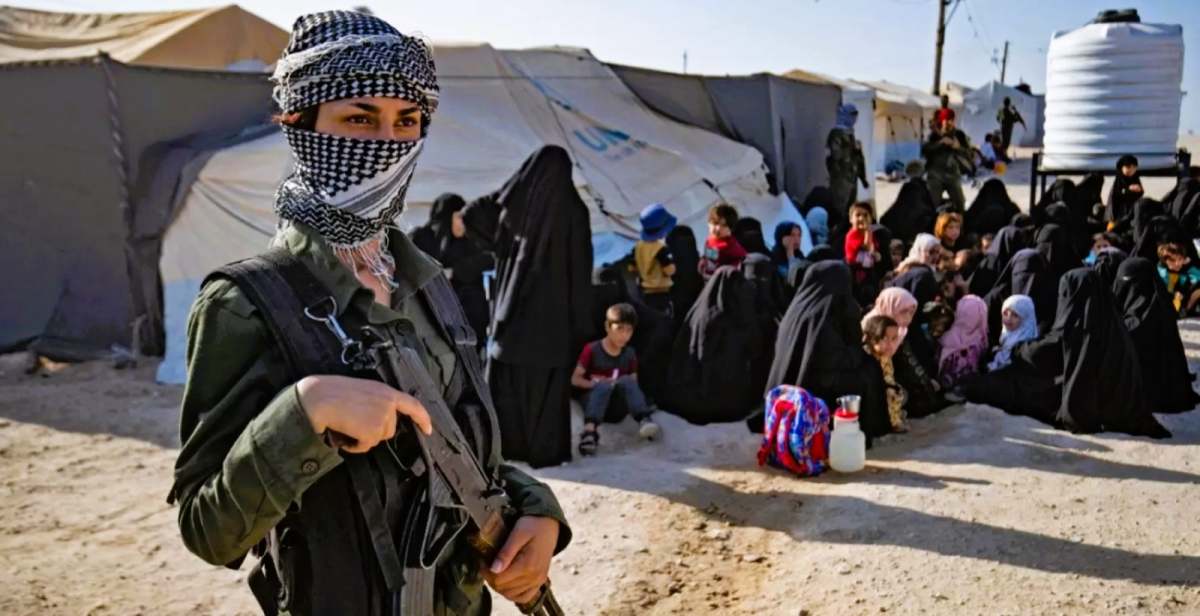
The report confirmed media reports that, in January, as many as 20,000 ISIS family members escaped from Syria’s al-Hol camp—previously under SDF control—under the watch of Syrian government forces. The Syrian government closed the camp on February 22.
On February 25, Syria’s Ministry of Interior said that most individuals who had left al-Hol without authorization had been returned and had their legal status regularized. Furthermore, the Ministry also claimed that, when their forces arrived at al-Hol camp, they found cases of collective escapes “due to the camp having been opened up in a haphazard manner”.
However,the U.S.-led Coalition Mission against ISIS (CJTF-OIR) reported that “government forces neither prevented nor intervened to stop the ISIS smuggling operations from the camp.”
CJTF-OIR noted that the closure of al-Hol and the departures of former al-Hol residents—particularly those with suspected ISIS affiliations—had created an ongoing security concern and signified “broader regional security implications.”
“Over several weeks, women and families related to ISIS fighters received organized assistance to leave the camp, primarily traveling to Idlib in northwestern Syria,” the report said.
The report added that “these activities to smuggle groups of ISIS loyalists from the camp were reportedly facilitated by local networks,” according to the CJTF-OIR.
Risk of ISIS Infiltration
The report also noted that, according to the U.S. Defense Intelligence Agency (DIA), the inclusion of former extremists and the “lack of rigorous vetting have enabled malign actors to infiltrate the Syrian military. These groups undermine stability through abuses against minority groups or attacks on Coalition forces like the attack that killed two U.S. soldiers and an American interpreter in Palmyra in December [2025].”
Most White House officials, including U.S. President Donald Trump, blamed ISIS for the attack at the time, although then-Director of the U.S. National Counterterrorism Center Joe Kent (who left the administration during the recent U.S.-Israeli war with Iran) called the shooting “an insider terrorist attack.”
“The US is intent on remaining engaged with the Sharaa government despite pulling the remaining American troops from Syria and closing its military bases in the northeast,” Joshua Landis, Sandra Mackey Chair and Professor of Middle East Studies at the University of Oklahoma, told The Kurdish Center for Studies.
“The continuing threat of ISIS and anti-Western militants in Syria does not seem to overly concern the White House. When a member of Sharaa’s security forces who was suspected of having ties to the Islamic State, killed two American soldiers in Palmyra, President Trump brushed it off as reiterated that Syrian and American forces were working closely together. Members of the Department of War remain concerned however.”
According to the U.S. Office of the Under Secretary of War for Policy, the extent of ISIS infiltration in the Syrian army is unclear. However, the CJTF-OIR has reported that “many forces now in the Syrian military had ambiguous relationships with ISIS, complicating background assessments, while U.S. investigations and vetting are limited to information the Syrian government provides.”
As a result, the Coalition assessed that U.S. forces face potential insider threats in any future coordination, training, or combined operations with the Syrian government. “U.S. forces therefore must assume potential compromise of any information-sharing, which limits intelligence cooperation that is essential for counterterrorism effectiveness,” the CJTF-OIR added.
Moreover, the report warned that “infiltrated personnel could also steer operations away from ISIS targets” and that ISIS elements “within the government could also provide the group with early warning of operations, allowing ISIS fighters to evade targeted operations and posing risk to U.S. forces.
“Undoubtedly, it is hazardous for American troops to collaborate with Syrian President Ahmed al-Sharaa’s latest incarnation of the Syrian military,” Fabrice Balanche, an associate professor and research director at the University of Lyon 2, told The Kurdish Center for Studies. “The majority of its members are former members of Hayat Tahrir al-Sham (HTS), the former Syrian affiliate of al-Qaeda, as well as former ISIS sympathizers who rallied after the fall of Raqqa in 2017, and assorted jihadist groups whose primary driver is animosity towards the United States and Israel.”
“Considering the past events, how can we be sure of the Syrian soldiers who will be collaborating with American military personnel? The guard who murdered several American soldiers in Palmyra in 2025 was, in fact, a former member of ISIS who had been assimilated into HTS for several years. Al-Sharaa does not have total control over the bloodlust of his fighters, as evidenced by the massacres of the Alawites and then the Druze,” Balanche added.
Furthermore, in March, the Office of the Director of National Intelligence assessed that ISIS in Syria will probably seek to “rebuild its ranks, expand support networks, and solicit funds,” from the thousands of ISIS detainees and ISIS-affiliated individuals who escaped or were released from prisons and displaced persons camps previously run by the SDF.
The UN estimated that approximately 3,000 ISIS fighters remained in Syria and Iraq as of February. The DIA reported that ISIS in Syria is one of the ISIS branches most likely to plot external terrorist attacks.
The Pentagon report assessed that the group is most active in areas formerly controlled by the SDF, likely exploiting security vacuums created by the rapid integration of these areas under Syrian government control. It also noted that ISIS continues to operate from urban areas, focused in Deir ez-Zour, Hasakah, Damascus, and Aleppo.
At the same time, the report quoted UN Secretary General António Guterres, warning that President al-Sharaa was a “priority target” for ISIS, noting five assassination attempts against al-Sharaa and Syria’s Foreign Affairs and Interior ministers in 2025.
The report noted that ISIS in Iraq does not pose a significant threat, and was not able to exploit the instability in the country during the conflict between Israel, the United States and the Islamic Republic of Iran in February.
SDF-Damascus Fighting, Integration
The report also discussed the heavy fighting between the SDF and Damascus in January, which ended with an integration agreement on January 29. “For the SDF, while the deal meant the surrender of autonomy, it was the only viable choice as the United States signaled its intent to shift its partnership from the SDF to the government of [President al-Sharaa] in support of a unified Syrian military,” the report noted.
However, the report also added that “the deal also raised questions about the fate of the Kurdish communities in northeastern Syria. Syria is backed by Türkiye, which has long seen the SDF as an offshoot of the Kurdistan Workers’ Party (PKK), a U.S.-designated foreign terrorist organization, that waged a violent insurgency in Türkiye. Türkiye had long supported militias in northern Syria that engaged in fighting the SDF.”
The DIA also confirmed that the Turkish government “provided Syria with support and assistance during the January offensive against the SDF, while also continuing to provide technical and advisory training to the Syrian military.”
Furthermore, the DIA said that, although the Turkish government had previously claimed it would withdraw from Syria once Damascus establishes full control, a senior Turkish official said in February that conditions did not yet support a Turkish troop withdrawal from the country. The U.S. Department of State also continues to engage with the Turkish government on Syria, including in support of dialogue between Damascus and the SDF on integration.
The report also confirmed that, during the hostilities between the SDF and Damascus, U.S. forces were ordered to stay neutral, despite multiple calls by the SDF for the Coalition to intervene to help safeguard the Shaddadi prison facility, which holds ISIS fighters. The Coalition also took credit for meditation between Damascus and the SDF that allowed a peaceful withdrawal of the SDF from Aleppo in early January, “preventing significant loss of life.”
By January 20, Syrian government forces had advanced across much of SDF-held territory in northeastern Syria and the SDF had retreated to two core Kurdish areas in the northeastern corner of Hasakah Governorate and around the city of Kobani on the Turkish border. The report noted that the Syrian government controls nearly all of northeastern Syria, while the SDF retains control over two Kurdish enclaves near Kobani and Qamishli.
The report also states that the January 29 deal permitted Syrian government forces to enter the cities of Hasakah and Qamishli, while allowing the SDF to retain four military brigades tasked with operating in Kurdish-majority areas, So far, three SDF brigades have been integrated into the Syrian army in northeastern Syria, and a separate SDF unit in Kobani has been integrated into a division of the Syrian government affiliated with the Aleppo governorate. The report also added that SDF leaders have received roles in the provincial administration as integration implementation continued.
The report noted that Damascus took steps such as issuing a decree granting citizenship to Kurds, including stateless individuals, and committing to protect Kurdish language and culture, including allowing Kurdish-language education in schools in Kurdish-majority areas.
However, it also said that uncertainty remains about modalities for key aspects of integration, quoting the UN Deputy Special Envoy of the Secretary-General for Syria Claudio Cordone, who said that these issues include SDF integration into the Syrian army and police; the future role of the Kurdish Women’s Protection Units (YPJ); the incorporation of civil employees into state institutions; and the parameters of Kurdish-language education.
The last U.S. base in Syria closed in mid-April, ending the 10-year CJTF-OIR presence in the country.
The office of the U.S. Under Secretary of War for Policy reported that the United States is continuing to work toward a bilateral U.S.-Syria relationship that supports the mutual objective of suppressing ISIS remnants in Syria. However, it noted that the integration of the SDF challenged the U.S. military’s ability in the near term to partner with current vetted groups in Syria against ISIS and al-Qaeda, and added that the Syrian efforts to integrate security actors, coupled with the accelerated departure of U.S. forces, had disrupted U.S. forces’ ability to vet Syrian actors, leaving future Syrian counter-ISIS partnerships in limbo.
The U.S. administration said “that now the focus for a future U.S. defense partnership with Syria could include improving Syria’s command and control over its forces, securing Syria’s borders to counter terrorist infiltration, narcotics and weapons smuggling, and the movement of displaced persons to and from Syria.”
“The U.S. military will try to support both Damascus and the SDF against ISIS through intelligence support and targeted assistance such as raids against high value ISIS operatives,” Nicholas Heras, Executive Director at the Washington-based Middle East Policy Council, told The Kurdish Center for Studies.
Conclusion
The Pentagon report highlighted a rapidly changing security situation in Syria shaped by the SDF-Damascus integration deal, the full withdrawal of U.S. forces, and ongoing uncertainty over political and military arrangements between Damascus and SDF. While the January 29 agreement marked a major political shift, key issues on governance, rights, and force integration remain unresolved.
At the same time, the escape of 20,000 ISIS-affiliated families from the al-Hol camp and warnings from U.S. intelligence point to continued risks, including ISIS infiltration in the Syrian army, regrouping, and external attack planning. Overall, the report suggests that despite ISIS’s territorial defeat, the terrorist group continues to pose a threat in Syria. The United States will continue to work with Damascus towards a bilateral U.S.-Syria relationship with the goal to suppress ISIS, although this might be more challenging now after the withdrawal of the Coalition forces from Syria and the possibility of ISIS infiltration into the Syrian army.