


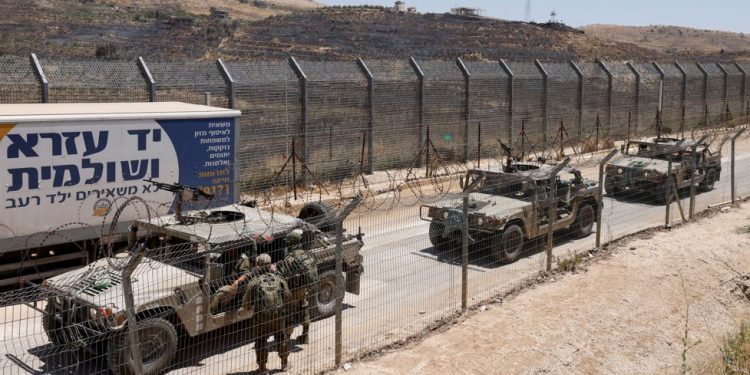
Amid the rapid political developments in the Middle East, a potential peace agreement between Syria and Israel has emerged as one of the most prominent issues shaping the future of the region. However, the bloody events in Suwaida and the subsequent Israeli intervention may currently complicate this process.
If this issue is resolved through effective mediation, media reports and political trends indicate the possibility of an agreement being signed before the end of 2025. This raises questions about its potential impact on the rule of the current Syrian President, Ahmed al-Sharaa.
We will review the legal, historical, and political context of this possible agreement, then discuss the potential risks and repercussions for Sharaa’s regime, while adhering to the facts available from reliable sources. It is worth noting that al-Sharaa, who assumed the presidency in January 2025, faces multiple challenges in establishing a stable government.
Historical and Political Context
Media sources indicate that Israel is seeking to sign an agreement that includes a gradual withdrawal from areas it recently seized in Syria, in exchange for security guarantees preventing the presence of Iranian or allied forces in the border regions. For example, reports suggest that the agreement may include the complete demilitarization of the provinces of Quneitra, Daraa, and Suwayda, as well as a halt to Israeli violations of safe zones in southwestern Syria. If concluded, this agreement would represent a significant shift in relations between the two countries, which have been tense for decades. Such a peace deal could either strengthen or threaten this regime.
Powers and Restrictions
The question of whether an interim president has the authority to sign international peace agreements without the approval of constitutional institutions is a pivotal issue. In stable political systems, such agreements typically require parliamentary approval or a popular referendum to confer constitutional legitimacy. An interim president, as a general rule, does not possess absolute legal authority to sign international peace treaties without the approval of formal state institutions such as the People’s Assembly. Modern constitutions— even in transitional circumstances— impose clear restrictions on the executive branch’s powers over sovereign matters that affect the nation’s future. Any signing by the president without explicit authorization from an elected legislative body or a popular mandate via referendum could be challenged legally and might be considered a violation of the Syrian constitution, if one exists, or of established constitutional principles.
International law tends to approach peace agreements signed by interim governments or those not fully recognized internationally with caution. While such agreements may be binding in principle if the government effectively controls the territory and has the capacity to represent the state, their lack of domestic constitutional legitimacy or international recognition could weaken their enforceability over the long term. Major peace agreements often require ratification by a permanent authority to ensure their durability, and any change in authority could lead to reconsideration or even annulment of the agreement.
Domestic Risks to the Rule of al-Sharaa
One of the most significant internal risks of a peace agreement with Israel is the potential for increased tensions within Syria, as such an agreement could be perceived as a concession that threatens national sovereignty. For example, if the agreement included conditions such as prohibiting the presence of any Syrian forces in specific border areas or establishing them as a “peace zone,” this could provoke protests from armed factions or opposition groups who view it as a betrayal of the Syrian revolution and the Palestinian cause. It is evident that al-Sharaa already faces internal conflict, oscillating between conflicting options for establishing an inclusive governance system that incorporates different sects. Such an agreement could deepen sectarian divides, especially if some groups see it as a surrender to Israeli interests, thereby threatening the stability of his rule.
Moreover, the agreement could pose economic challenges, as Israel’s withdrawal from occupied territories might open the door to reconstruction efforts in those regions. However, this would require substantial financial resources that al-Sharaa may not possess. If the agreement fails to yield immediate benefits—such as increased investment or the lifting of economic sanctions— al-Sharaa could lose popular support, especially since the Syrian public expects tangible results after years of bloody conflict. Reports confirm that the only way for al-Sharaa’s regime to succeed is to build an inclusive system representing all segments of Syrian society, and any perceived imbalance in such an agreement could hinder this goal.
External Risks
At the international level, the peace agreement poses significant risks to Syria’s relations with countries such as Iran and Russia, which were allies of the former regime. Reports indicate that Israel demands the prevention of any Iranian presence in Syria, which could lead to tensions with Tehran and potentially prompt Iran to support factions opposed to al-Sharaa. While the agreement might strengthen Syria’s relations with the West or Arab countries, it could also expose al-Sharaa to regional isolation if countries like Russia perceive it as a move contrary to their interests in the region. For example, if the agreement results in diminishing Russia’s influence in Syria, al-Sharaa could lose vital support needed to confront internal challenges. Furthermore, the repercussions of the agreement on al-Sharaa’s rule include an impact on his image as a “revolutionary” leader among the Syrian people. He may be accused of “normalization” with Israel, which threatens his legitimacy among his supporters. Reports reveal that Israeli decision-makers see Syria’s stability as serving their security interests, but this could portray al-Sharaa as merely a tool for Israeli regional interests, increasing pressure on him to reconcile internal and external commitments.
Security and Economic Implications
On the security front, the agreement could reduce tensions along the border with Israel, but it may also ignite internal conflicts with factions opposed to normalization. Economically, the agreement might lead to the lifting of some international sanctions, opening the door for investment and reconstruction efforts. However, this depends heavily on the international community’s acceptance of the agreement and the transitional government’s legitimacy. Conversely, refusing to sign could prolong economic isolation and sanctions, worsening the ongoing economic crisis and negatively affecting citizens’ living standards.
The future of al-Sharaa’s rule is closely linked to the decisions he makes on such crucial issues:
Political legitimacy risks if he signs:
Moving forward with signing a peace agreement without a clear popular or institutional mandate poses a major threat to his political legitimacy. Many would perceive it as a unilateral act lacking national consensus, which could lead to a loss of popular support and resistance from armed factions or political forces still opposed to normalization with Israel. Such a move could be viewed as a “betrayal” of the Palestinian cause or national principles, destabilizing the regime and undermining efforts to build a new Syrian state.
Impact on his position if he refuses to sign:
On the other hand, refusing to sign could bolster al-Sharaa’s domestic position among nationalist and Arab factions that oppose normalization. Such rejection might be seen as adherence to core national principles, gaining him some popular support. However, it could weaken his international standing, particularly if signing the agreement is a prerequisite for international backing or the lifting of sanctions. Consequently, al-Sharaa faces a difficult dilemma: balancing internal legitimacy with external acceptance.
Public Opinion
The stance of the Syrian people and national institutions is crucial to the fate of any potential peace agreement with Israel:
Reaction of the Syrian people:
The history of the Arab-Israeli conflict is deeply rooted in the collective consciousness of the Syrian people. Additionally, decades of official anti-Israel rhetoric have entrenched the image of Israel as the “enemy.” Therefore, the Syrian people’s reaction to a peace agreement with Israel is expected to be complex and varied. While some may welcome peace and stability to achieve economic gains and reconstruction, a large segment may strongly oppose it, potentially leading to widespread protests and popular rejection.
Role of the People’s Assembly and other institutions:
The People’s Assembly and other constitutional institutions play a pivotal role in either blocking or ratifying such an agreement. In theory, any peace treaty should pass through legislative channels for approval. If these institutions are democratically elected and genuinely reflect the will of the people, their decisions will carry considerable weight. Conversely, if these institutions are weak or lack true representation, any signing could be subject to legal challenge.
Scenarios of popular rejection:
The signing might trigger widespread protests or popular resistance, which could take various forms, from peaceful demonstrations to violent unrest. Possible scenarios include:
-Escalation of protests: Massive demonstrations in major cities expressing rejection.
-Internal divisions: A split within the interim government or even among armed forces.
-Renewed conflict: The possibility of renewed internal armed operations.
Ignoring the stance of the people and national institutions could worsen instability in the country, threatening the future of any transitional government.
Conclusion:
The issue of al-Sharaa signing a peace agreement with Israel places Syria at a historic crossroads. While peace could open new horizons for stability and reconstruction, the political and legal costs of such a step—especially without a clear popular and institutional mandate—could be substantial. Al-Sharaa faces a delicate challenge in balancing the demands of international support with domestic legitimacy, considering the sensitivity of this matter in the collective Syrian consciousness. Any move in this direction must be carefully studied, as Syria’s future depends on wise decisions that reconcile national interests and popular aspirations.
In summary, a potential peace agreement between Syria and Israel could be an opportunity for regional stability, but it also carries significant risks for al-Sharaa’s rule—regarding internal stability, foreign relations, and popular legitimacy.