

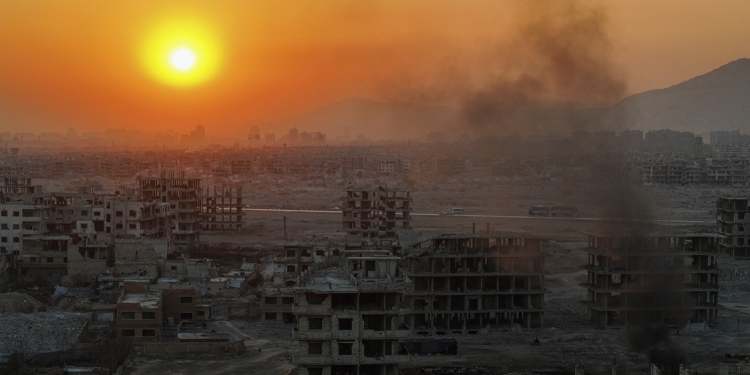
Syrian voices are increasingly calling for the restructuring of the political system around expanded decentralized governance, following the first phase of the civil war under Bashar al-Assad after the popular uprising against his rule. Subsequently, during the second phase, the current Syrian regime has confronted civil society groups in the coastal region, Suwayda, and other scattered areas, with the possibility that factional and closed-minded factions could drag the country into new cycles of violence.
The ongoing debate between establishing an expanded decentralized system or maintaining a highly centralized one is perhaps a reflection of what has transpired and continues to unfold in Syria over the past 15 years. Proponents of decentralization argue for a new system that accounts for the widespread distrust among Syrian communities, as well as issues of social justice, balanced development, and the cultural, linguistic, and religious rights of various Syrian groups. Such a system aims to alleviate fears of “majority tyranny”—especially after authorities have monopolized the right to speak and represent the majority—while preserving Syria’s territorial integrity and reducing fears of de facto partition. Decentralization, in this context, becomes the glue that holds Syrian communities together and safeguards Syria’s unity, countering the dominance of the central authority and the rise of factional and sectarian policies within the state.
On the other side, a coalition of centralists is forming—most of whom support the current regime and some who are obsessed with ambitions of factional and sectarian dominance and internal expansion. This expansion and hegemony are often associated with the use of weapons, reliance on militia factions, and the strength of security apparatuses. Additionally, the emerging oligarchy supported by the People’s Palace (the seat of power) provides the central regime with vast capacities to control the economy and turn Syria into a market open to looting, privatization, and patronage. According to this perspective, economic dominance follows military control. To avoid underestimating the centralists, some advocates seek to reconcile the central system with granting some practical powers to the governorates, aiming to reshape a modernized central system under deceptive pretexts—such as relying on Law No. 107 on local administration or amending it.
The regime’s brutality against minorities has sparked a wave of demands for regional autonomy. Alongside the autonomous administration of North and East Syria, which was the first to call for “self-discrimination,” Suwayda is currently pursuing a vision based on self-rule and the right to self-determination following recent battles and massacres targeting its Druze population. Meanwhile, an Alawite voice is emerging, advocating for a federation in central and western Syria that would include regions with significant Alawite populations. However, differences in perceptions and capabilities among these groups suggest the possibility of combining various levels of decentralized governance across Syria, or granting certain regions expanded decentralization—whether through self-rule, federalism, or a hybrid approach. The remote but possible scenario is that the country could revert to a strict centralized system based on coercion and force, though this remains the weakest and most disastrous option.
The Question of Decentralization
The term “decentralization” appears vague and fluid, and cannot be easily defined. Its meaning varies depending on the contexts and experiences in which decentralized systems have been implemented. Moreover, the scope of decentralization encompasses a broad spectrum of concepts: federalism, autonomy, regional administrative decentralization, local governance… However, comparative studies of federal and decentralized systems often fail to produce the desired results when attempting to replicate or transplant these models from one country to another. Therefore, it is necessary to consider “contextualizing decentralization” so that it aligns with Syria’s unique political, social, ethnic, sectarian, and regional environment—while always maintaining the possibility that Syrians themselves will craft their own experience to reshape their political system outside the frameworks of decentralization applied in other countries and regions worldwide.
Many reasons have motivated countries to adopt expanded decentralization (not merely administrative decentralization in simple states, but broader decentralization within complex nations). Numerous countries have established and developed their governance systems following cycles of sustained violence and civil war, as seen in the United States, Sudan, Iraq, and Spain. Countries may adopt decentralized systems to prevent internal conflicts or the recurrence of civil violence, thereby safeguarding the territorial integrity of the state. Additionally, a decentralized system can serve as a solution to national challenges related to cultural and regional disparities—an approach exemplified by the Swiss model, which was influenced by geographical boundaries, linguistic and cultural differences within each canton, and ethnic diversity among the population. Naturally, countries tend to evolve into composite states through voluntary union with other entities—examples include the autonomy of Turkmenistan and its union with Russia, Tajikistan, and Kyrgyzstan in 1918; the federal system established by Lenin for Bashkortostan and the Tatar Republic in 1920; and the founding of the United Arab Emirates in 1971. There is also the fear of losing parts of national territory; for instance, the Italian Constituent Assembly granted autonomy to the Aosta Valley to prevent its annexation by France, and to South Tyrol (Bolzano) to avoid union with Austria. Additionally, separatist tendencies have emerged in the self-governing island of Sicily.
The motivations behind decentralization or federalism are not solely driven by internal problems and their multiple layers. For example, Germany adopted federalism to promote development, ensure equitable distribution of powers, and establish effective governance structures at the regional level. Similarly, the distinct regions of Spain sought autonomous status to prevent neglect by the central government, leading to the recognition of “self-differentiation” rights that facilitate social and economic development.
In Syria, the reasons are a mixture of all these factors: mutual distrust, persistent uneven development, sectarian and ethnic tensions, border issues, and ongoing fears that parts of the country may be transferred to regional powers under pretexts related to national security. Moreover, the obsession of the current regime with absolute and factional rule—as articulated in the Constitutional Declaration—further marginalizes groups excluded from participation in governance and the formation of new institutions.
The background of the new ruling elites—many of whom originate from Salafist groups or are directly linked to al-Qaeda—also fuels internal unrest and damages the national consensus. Their policies have deepened polarization and created an unprecedented crisis of trust among Syrian factions, especially given their adoption of absurd ideas such as disciplining religious minorities and subjugating ethnic groups. These policies follow their efforts to homogenize the majority population into a single entity, raising doubts about their success in assimilating Sunnis. Additionally, massacres and atrocities committed against at least two sectarian groups have been the proverbial “last straw,” prompting Druze and Alawite voices to call for autonomy or federalism—similar to the autonomous administration in northern and eastern Syria—or even to demand self-determination for their respective regions where they form the majority.
A Look Back
Given the current circumstances, there are ideas that Syria might revisit the project of a decentralized state reminiscent of the era of Faisal I (1919–1920), prior to the Mandate government’s attempt to divide Syria into separate entities with prominent sectarian and regional designations. The radical approach to division adopted by General Gouraud and his advisors distorted the core of Faisal’s original ideas. However, the French guarantor inadvertently contributed to strengthening the position of minorities within the Syrian political landscape, thus paving the way—unintentionally—for long-term solutions to the national question. Apart from the role of the National Bloc, which knew how to expedite the end of the Mandate but failed to establish governance, the Syrian elite did not seek to exclude minorities or Kurds, despite the rise of chauvinist movements that opposed Kurdish autonomy from 1936 onward.
The centralized system can be viewed as an ill-advised response to the policies of creating small states and later the Syrian federation. It also reflects the perspectives of Syrian factions that perceived the country’s limited geographic size and felt the need for broader integration into an imagined Arab entity, driven by imperial ambitions. This tendency was fueled by commercial interests in Aleppo and Damascus with neighboring Arab countries, as well as fears of Syria being absorbed into regional blocs subordinate to colonial interests. This led to the formation of the Syrian-Egyptian Confederation (the United Arab Republic, 1958–1961).
Under the Ba’athist rule and nationalist ideology, strict centralization characterized the functioning of the state for over forty years. Despite the social and political disintegration that engulfed Syria after 2011, the centralized state proved unable to address the core issues. In a desperate attempt, Bashar al-Assad issued Law No. 107 on Local Administration, aiming to reduce the regime’s interventionist policies in the affairs of governorates and to address major deficiencies—particularly the issue of “balanced development.” However, this effort was largely ineffective. Practically speaking, centralization—marked by the concentration of decision-making authority in the capital and within the regime’s inner circles—neglected rural areas and governorates, while informal settlements around major cities expanded, fueling the uprising against central authority.
As a result, Syrians lack deep-rooted traditions of decentralization or significant historical debates on the matter. This absence turns the discussion into a dark maze—an arena filled with mutual skepticism about the future of governance and the shape of political participation for various ethnic, sectarian, and regional groups.
Distinguishing Between Levels of Decentralized Governance
A quick overview can distinguish three levels of decentralized governance that are often confused: self-governance (autonomy), federalism, and administrative decentralization.
The concept of self-governance was originally introduced to address national issues and the concerns of ethnic groups within a single state. While it overlaps with the federal system in that it combines the principles of “autonomy” and “unity,” it remains fundamentally a decentralized system—meaning it is not subject to the authority and clarity of the federal system as outlined in the constitutional document. Self-governance is not necessarily enshrined in constitutional articles, except in rare cases—such as the 1954 Chinese Constitution, which stipulated “autonomy in regions where ethnic minorities are concentrated.” In other cases, self-governance is granted via special laws, as in the case of the 1970 Iraqi Kurdistan Autonomy Agreement (March 11 Declaration). This deprives it of the character of a fixed, constitutional clause that is protected and inviolable. Moreover, even if enshrined in the constitution, it can be subject to modifications in its scope and application, as happened in Sudan during the division of the south into three regions in 1981, which subsequently rekindled conflict between the north and south.
According to the typical model of self-governance, certain conditions must be met: such as the existence of a geographical area with a clear national presence, the autonomy of governing bodies within the region, and oversight by the central authority over their activities. However, the presence of a territorial region with a clear national or sectarian identity is what differentiates self-governance from regional administrative decentralization. This “national” or “sectarian” element in the concept of self-governance is not clearly present in Syria, given the ethnic and sectarian diversity across its regions—except perhaps for the Druze-majority area of Suwayda and the Kurdish-majority region of Afrin (Kurd Dagh). Lenin, in his work “On the Question of Nationalities and Self-Determination,” merged the national question with self-governance, making nationalism the driving force behind self-rule. This approach aligns with international experiences, which have often made the enforcement of national rights a fundamental condition for self-governance.
In contrast, federalism, which is built upon geographical regions or states that are ethnically or sectarianly balanced, with distinct natural terrains or border considerations, presents a more viable opportunity for implementation in Syria. However, it faces outright rejection by the Syrian regime, which describes federalism as “separatism” without discussion—more vociferous than Bashar al-Assad’s rejection of federalism as a principle. Labeling federal demands as mere separatist movements reflects a fundamental ignorance of the noble goals of federal systems, skepticism of pioneering federal experiments, academic research, and legal opinions. It also reveals excessive selfishness disguised as the defense of a “centralized state,” which is just another guise for a one-man, one-party dictatorship.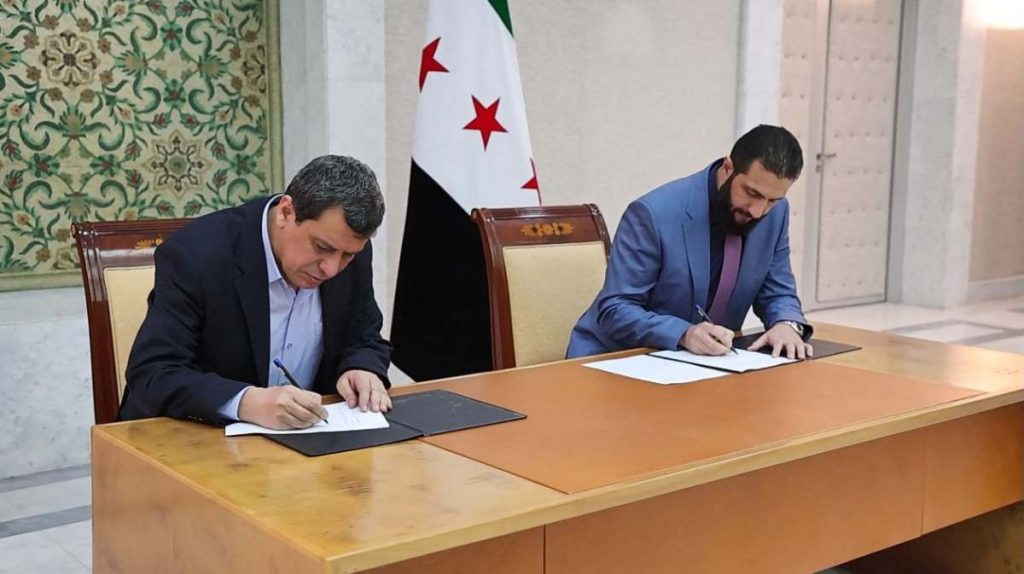 Mazloum Abdi and Ahmad al-Sharaa during the signing of the March Agreement | AFP (photo)
The intersection of federalism and self-governance lies in their shared principles of “autonomy” and “unity,” which transform the state from a unitary to a complex, federated entity through the distribution of powers between the central government and the regions. The common goal of both systems is to end internal conflicts and strengthen national cohesion. However, federalism does not always aim to resolve national issues; for example, the United States, Germany, Switzerland, and India built their federations without internal wars as the foundation. Conversely, self-governance is often based on halting or preventing national conflicts, managing internal ethnic or sectarian tensions, or protecting border regions from annexation to other states.
A key feature of federalism is the requirement for participation in establishing the highest constitutional institutions, forming the supreme administrative body of the state, and participating in drafting and amending the central constitution, as well as in legislative and judicial powers at the regional level. These are more advanced features compared to self-governance, where regions do not participate in the core governance of the state or in decisions by the central government—decisions that can unilaterally amend constitutional provisions, powers, and the scope of self-governance.
In this context, vague signals from authorities suggest they might accept administrative decentralization in the legal and verbal sense outlined by the Assad regime in Legislative Decree 107/2011. However, implementing this decentralization requires a democratic system, which currently does not exist in Syria. The primary benefit of regional administrative decentralization (to governorates) is to promote democracy at the local level and ease the burdens on the central authority, not to ensure equitable power-sharing. In practice, decentralization remains a purely administrative phenomenon; it does not resolve issues related to ethnic or religious minorities, nor does it involve deep political participation or positive discrimination in the constitution. It does not account for the “self-distinction” of regions or governorates based on their ethnic or sectarian composition, nor does it grant them legislative or judicial authority separate from that of the central government. Its role is limited to functioning as a local executive body for the central authority.
Even the most prominent aspect of this administrative model—achieving democracy—appears questionable, especially with a regime rooted in an ideological background that has elevated the slogan “democracy is polytheism.” Its constitutional declaration has never once mentioned democracy, and its parliament is formed solely through appointments and clientelism, not through universal suffrage. Governors and bureaucrats are appointed by the regime, not elected.
In other words, administrative decentralization within a sectarian constitution hostile to equal citizenship offers no practical solution to Syria’s disintegration, nor does it address the core of the Syrian dilemma, which is rooted in the lack of trust among its various components. Without autonomy, the national unity cannot be reconstructed. It might be more beneficial to focus on the “autonomy” aspect of the upcoming decentralized system—an aspect that by no means implies “separation,” contrary to what the Assad regime and the legitimate authorities have repeatedly claimed. Their rhetoric portrays autonomy as a means to fracture those seeking to reduce sectarian dominance, the “tyranny of the majority,” and the central authority’s control, experimental policies, and degree of interference.
Autonomy, in this context, refers to a consensual union between the regions—whose components are sectarian and ethnic—and the central authority. It thus represents an advanced model of unity for a country suffering from evident fragmentation. However, any form of union that is not constitutionally protected by supreme constitutional principles risks relapse into disintegration and the resumption of cycles of violence.
Contextualizing Decentralization
A quick review of the layers of decentralized systems and an overview of some international experiences helps stimulate the Syrian debate on the “taboo” of decentralization—an issue that has been broken by massacres, internal disintegration, ongoing policies of public looting, and the rise to power of Hay’at Tahrir al-Sham. A brief, perhaps routine, examination of international experiences suggests the possibility of localizing and adapting these models to suit Syria. Although the concepts—decentralization and centralization—are fixed in theory, the degree of their implementation varies from country to country. Many centralized nations exhibit a greater degree of decentralization than those systems described as decentralized. Moreover, copying these experiences directly is impossible, which underscores the urgent need to develop local visions and implement Syrian-specific decentralization strategies, despite internal differences across regions.
Environmental considerations require addressing Syria’s chronic issues: the national problem, the current sectarian dilemma, the multiplicity of armed groups and their ideological backgrounds, foreign interventions, and the occupation of parts of Syrian territory.
It is impossible to speak of a Syrian region with “absolute ethnic purity.” This presents a challenge to national autonomy, but it does not negate the possibility for ethnic and sectarian groups to enjoy their cultural and educational rights within a modernized constitutional framework. While Kurds constitute a demographic majority in their border regions, overlapping populations in some areas mean that these pluralistic regions are not purely Kurdish entities—just as they should not be purely Arab, according to the policies of successive Syrian governments and regimes. This necessitates redrawing the governorates or regions. For example, what is the point of considering Kobani part of Aleppo Governorate when the majority of its population is Kurdish, with towns and villages located east of the Euphrates—the Jazira region? The same applies to traditional Alawite areas in the central and western parts of the country. Therefore, it might be feasible, for instance, to redraw administrative borders so as to preserve the cohesive presence and autonomy of Alawites alongside Christians and Sunnis in their respective regions. Conversely, to achieve a more integrated form of decentralization, the inclusion of resource-poor Sweida, a Druze city, along with the Hauran Plain in a southern region could ensure the viability of both mountain and plain areas. However, this integration would not be possible without addressing the long-standing issues among their communities.
Theoretically, larger regional entities extending over two or more governorates—such as those with significant sectarian or Kurdish populations—offer three main benefits: First, they reduce the risks of civil war, mutual population transfers, and demographic manipulation. Second, they reassure Syrians about Syria’s territorial integrity by making clear that such mixed regions are not steps toward secession. Third, they reassure minorities and Kurds that their population proportions in their original areas will be maintained at levels that correct existing imbalances and better reflect their actual demographics within the central system.
The military aspect becomes particularly evident when discussing the future of the defense system. Practically speaking, Syria no longer has a fully integrated army, especially after Israel destroyed the capabilities of the former military. The current “army” is more an extension of Hay’at Tahrir al-Sham, whose final name was settled as the “Syrian Arab Army,” along with factions loyal to Ankara, which were unified through Turkish intervention. These factions maintain their own military fiefdoms, albeit with their previous composition.
It is most probable that the new Syria will not possess a large mechanized army with the extensive capabilities of the past. The idea of building a centralized military force is no longer practical, especially given how easily such armies can be destroyed externally—as Israel demonstrated over the past year. Therefore, the army’s role should be limited to border defense, constitutional adherence, and maintaining public security. To achieve this, a distinction must be made between a factional central army and a multi-layered command structure, where integrating the Syrian Democratic Forces (SDF) and the National Guard in Sweida into the Syrian army becomes both necessary and feasible. This points to the root of the issue: moving toward a decentralized system that regulates their work and defines their relationship with the Ministry of Defense constitutionally, while maintaining the Ministry as the central authority.
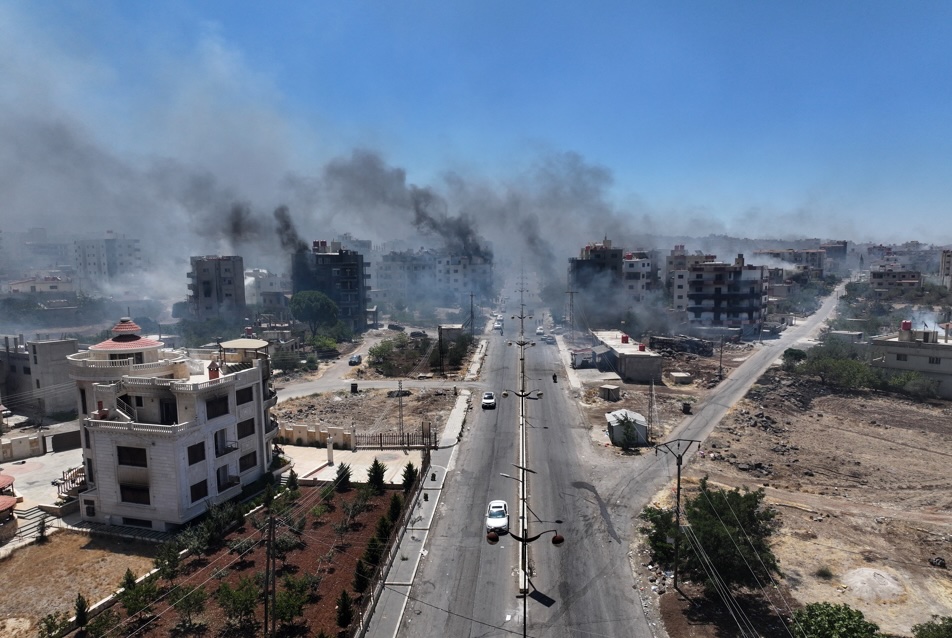 Fires are rising from Sweida during an attack by forces loyal to Damascus in July 2025 | AFP (photo discription)
Furthermore, foreign intervention and territorial occupation further complicate the scene. The risk of losing Sweida and perhaps all of southern Syria increases if Damascus does not compare the situation there with useful international models. In the article, we referred to the Italian autonomous regions of Valle d’Aosta and Bolzano, where local self-governance was established explicitly to prevent their annexation by neighboring states. The Italian Constituent Assembly’s decision preserved territorial integrity through decentralization. Had Italy adopted a purely centralist approach, these regions might have been incorporated into France or Austria, and Italy would have missed opportunities for better border demarcation with Yugoslavia.
Conclusion
Environmentalizing decentralization does not mean neglecting international experiences and comparative studies; rather, it means subjecting the concept of decentralization to a process that aligns with the current Syrian context. In the Syrian case, all international concepts, terminology, and experiences can be adapted to each region or to the issues of each ethnic and sectarian group. Through this adaptation, regional national autonomy could be implemented for the Kurds, but only in some Kurdish areas, not all. Similarly, Sweida could be granted autonomy that reflects its religious and cultural composition. Federalism could also be applied in Aleppo, Deir ez-Zor, and Damascus—assuming these areas do not suffer from ethnic or sectarian conflicts—and provided that the federal system is not solely aimed at resolving ethnic and sectarian problems. Furthermore, administrative decentralization could be extended to many areas within the regions themselves.
Therefore, this mixture of decentralization models calls for the development of new concepts regarding the type of decentralization that should be implemented in Syria. Solutions must be devised that encompass political, cultural, developmental, and ethnic and sectarian dimensions. These solutions should be discussed within a framework that recognizes that a centralized system under factional and authoritarian rule will only lead to further disintegration, massacres, and a renewal of the cycle of civil war.