


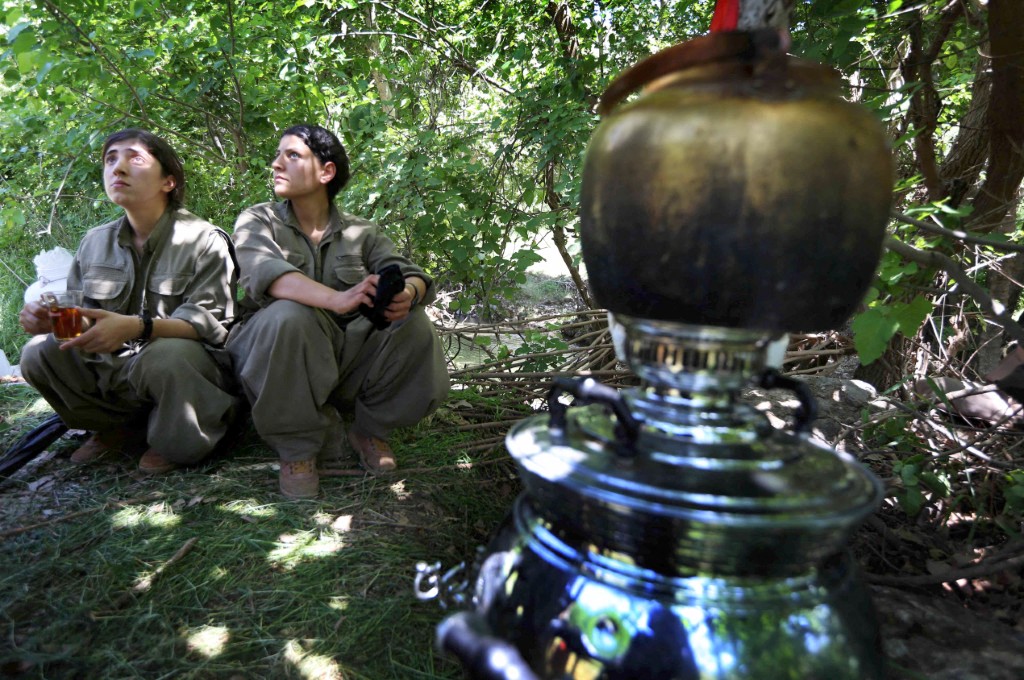
Previously overlooked by the international community, Iran’s 10 million Kurds were suddenly thrust into the spotlight after conflict erupted between the United States, Israel, and Iran on February 28. Earlier in March, U.S. President Donald Trump expressed public support for a possible Kurdish offensive against Iran, but later backtracked, saying he didn’t want them to be killed.
The Washington Post initially reported that President Donald Trump had offered “extensive U.S. aircover” and other backing for anti-regime Iranian Kurds to take over portions of western Iran. Reuters reported that Kurdish sources said their aim was to seize the towns of Oshnavieh and Piranshahr, among others. But the New York Times reported on March 22 that U.S. officials were no longer enthusiastic about the idea — formulated well before the start of the current war — of using the Kurds as a proxy force. However, it will be difficult to topple the Islamic Republic of Iran without a ground force.
On February 22, five Iranian Kurdish parties — the Democratic Party of Iranian Kurdistan (PDKI), Kurdistan Freedom Party (PAK), Kurdistan Free Life Party (PJAK), Organization of Iranian Kurdistan Struggle (Khabat), and Komala of the Toilers of Kurdistan — announced the formation of the Coalition of Political Forces of Iranian Kurdistan. The Komala Party of Iranian Kurdistan joined the Coalition on March 4.
Although the Iranian Kurdish parties do have a limited number of fighters (some estimates suggest 2,500 fighters), their numbers would quickly grow if they were to take over Iranian Kurdish towns with the support of U.S. and Israeli air power. It is unlikely that Iranian security forces could pose a challenge for Iranian Kurdish forces, since Iranian airspace is not currently controlled by Iran.
History offers precedents for such a scenario. When the Kurdish People’s Protection Units (YPG) were formed in Syria in 2011, they initially consisted of a small number of fighters. However, their ranks quickly expanded as the group gained control over territory and as the Syrian army withdrew, preoccupied with the civil war elsewhere in the country.
However, so far there have been no signs of any unrest or armed insurgency in Iran that would force Iranian security forces to withdraw from Western Iran (also known as Iranian Kurdistan). There is also no armed insurgency in Iran, unlike in Syria. On March 22, there were reports that Islamic Revolutionary Guard Corps (IRGC) ground forces commander Mohammad Karami had traveled to Kurdish areas in Western Iran to rally troops. The Iranian Kurds also have no ambitions to march into non-Kurdish areas, as the Syrian Democratic Forces (SDF) once did during the fight against ISIS.
In Iraq, the Kurds have experiences with a safe zone. Following the 1991 uprising of the Iraqi Kurds against Saddam Hussein, a Western no-fly zone was established, after which the Kurds created their own de-facto government and Saddam’s army withdrew from Iraqi Kurdistan. Their region was only recognized after the fall of the Saddam regime in 2003. Between 1991 and 2003, Iraqi Kurdistan became a host for Iraqi opposition groups. Iranian Kurdistan could potentially become a safe zone for the Iranian opposition.
The risk for the Iranian Kurds is that they could be abandoned by potential allies. Again, the recent history of the Kurds in Syria offers a clear example. Though they fought against ISIS with U.S. support following the battle for Kobani in 2014-2015, after the fall of the Assad regime in 2024, the Syrian Kurds were forced to reintegrate into the Syrian state and a new alliance was forged between the new Syrian government led by Syrian Interim President Ahmed al-Sharaa and the United States. However, the Syrian Kurds did receive positions in the new Syrian army and the administration of the Hasakah Governorate.
The Iranian Kurds also have a history of relying on foreign powers in their pursuit of autonomy, as well as a legacy of rebellions against the central state, such as those led by the tribal chieftain Simko Shikak in the 1920s.
On August 25, 1941, Soviet Russian and British troops invaded Iran from the north and the south [1]. On January 22, 1946, Qazi Mohammad declared the Republic of Kurdistan in the city of Mahabad in Iranian Kurdistan with Soviet support. The Soviets also backed the creation of the Azerbaijan People’s Government. U.S. diplomat William Eagleton Jr. wrote in 1963 that the founders of the Kurdistan Republic “could confidently assume that their goal had been attained and that, with the support of the [Soviet Union], their creation would endure.” [2]
Seven months later, both the Kurdistan Republic and the Republic of Azerbaijan collapsed after the withdrawal of Soviet troops in May 1946. General Hassan Arfa, who was Chief of Staff of the Iranian Army in 1944-1946, wrote in his book on the Kurds that the quick collapse was due to the fact that there was no unanimity among Iranian Kurds to fight to the bitter end [3]. Qazi Muhammad was hanged in Chwar Chra Square in the heart of the city of Mahabad on March 30, 1947.
After the collapse of the Pahlavi dynasty in 1979, the PDKI and Komala were able to take control of most of the cities in Iranian Kurdistan. However, they were eventually forced to retreat across the Iraqi border until forced into exile in 1983[4]. The Kurds refused to support a referendum for a new constitution, which eventually led to armed clashes. Iranian Kurdish parties also played a role in the Iran-Iraq War in the 1980s, but this did not result in any movement toward Kurdish autonomy.
After the Iran-Iraq War ended, on July 13, 1989, negotiations between the PDKI and Iran took place at the initiative of the Iranian government in Vienna, Austria to find a peaceful solution to the Kurdish question. However, the talks turned out to be a ruse, and Dr. Abdul Rahman Ghassemlou and the other members of the Kurdish delegation were assassinated by Iran.
“The Iranian Kurdish opposition groups will face a very difficult and dangerous campaign if they take to the field against the regime in Tehran. They therefore need assurances from the United States that it will not all be for nothing, and that Washington will not undercut their demands for decentralization and federalism in Iran when it’s all over, or let Turkey invade their areas to deny them any measure of autonomy, as occurred in Syria,” Professor David Romano, Thomas G. Strong Chair in Middle East Politics at Missouri State University, said.
Thus, Iranian Kurds have the political and military experience to control their areas. However, without political guarantees and a clear U.S. plan to overthrow the Iranian regime — as was done with Saddam Hussein — it could be risky for them to take action. So far, the Trump administration has kept both military and diplomatic options on the table, and U.S. officials have indicated that they want to avoid a “forever war” and aim to conclude the current conflict within a short timeframe.
Sources:
[1] William Eagleton Jr: The Kurdish republic of 1946. (Middle Eastern Monographs, 5.), London, etc.: Oxford University Press for the Royal Institute of International Affairs, 1963, p. 13.
[2] Eagleton, p. 64
[3] Hassan Arfa. The Kurds: An Historical and Political Study (London: Oxford University Press, 1966. Pp. xi, 178. 3.50.) – Volume 61 Issue 3, p. 100
[4] Van Bruinessen, Martin 2023, ‘Allan Hassaniyan, Kurdish Politics in Iran : Crossborder Interactions and Mobilisation since 1947’, Kurdish Studies Journal, vol. 1, no. 1-2, pp. 352-354.
https://dspace.library.uu.nl/server/api/core/bitstreams/2aae60b4-8bad-4959-b9a9-b45f66c56859/content