
Without any justification or shift in the balance of power in favor of Damascus, the interim authority, through its spokespeople, hinted that the Syrian Democratic Forces (SDF) must lay down their weapons, even though the 10 March agreement clearly stipulated “the integration of all civilian and military institutions in northeastern Syria into the administration of the Syrian state.” This reversal of the logic of a political solution and understanding can be described as a deterioration in the discourse of the regime and its media and influencers. It also raises the bar for a demand that even a state like Turkey, with its influence and power, has been unable to achieve. What is going through the regime’s mind as it attempts a coup or evades its signature on a single “national agreement” it previously reached and was later described as having a certain “pragmatism,” despite its apparent contradiction with reality? Is the regime trying to claim that it is not plagued by failures resulting from its mismanagement of issues related to national reconciliation, participation, and political inclusion of various components, and its inability to manage a pluralistic Syrian society outside the confines of sectarian dominance and the logic of force and military supremacy?
Based on the above, the regime’s intransigent positions come after the postponement of the Paris meeting between its representatives and the SDF, and following the joint Syrian-American-French statement issued on 25 July, which emphasized “holding a round of consultations between the Syrian government and the Syrian Democratic Forces in Paris as soon as possible to fully implement the 10 March agreement.” The tripartite statement also included key elements aimed at containing the crises of national and regional fragmentation, such as supporting political transition, achieving national reconciliation, and strengthening social cohesion in northeastern Syria and Sweida.
Theoretically, the regime’s justifications for postponing the Paris meeting and its demands before the next round of negotiations with the SDF can be understood. The postponement and the raising of demands stem from the regime’s failure to address the problems in southern Syria, especially after the bloody events in Sweida, and rumors in Israeli media about accepting the south—its three governorates—as a demilitarized zone, with local fighters armed only with light weapons, tasked with maintaining security. In this sense, the regime seeks to appear as the stronger party after the events in Sweida weakened it and deprived it of its ability to extend control in the south. Therefore, raising the ceiling in its confrontation with the SDF is understandable, as Damascus aims to argue that its wound in Jabal al-Arab cannot affect its negotiating capacity with the SDF. The SDF, however, does not believe this at all. The situation following the disasters in the coast and Sweida indicates that the regime has become weaker and more vulnerable
to external criticism. It could transform from an internationally and Arab-supported authority into an international pariah if it launches a third war on northeastern Syria, relying on dubious tools: sectarian mobilization and tribal panics.
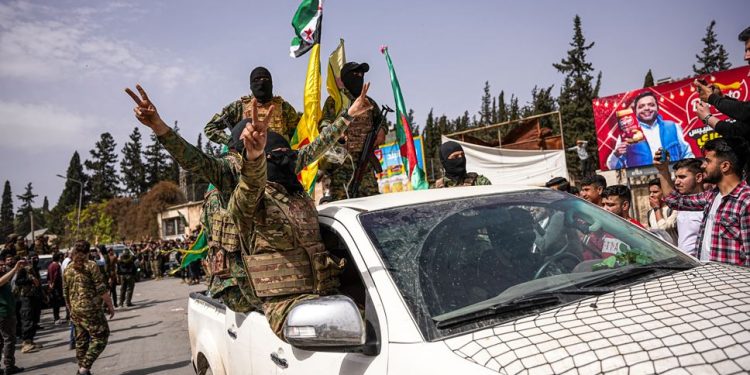
While we understand the difficult circumstances facing the regime, which are ultimately of its own making, the issue of the SDF laying down its weapons cannot be viewed as anything other than an indirect pressure tactic ahead of the next meeting. The core message from the SDF is clear: it will never relinquish its weapons in a manner that contradicts the principle of integration agreed upon. This is especially true given the presence of a regime that retains genocidal capacities, demonstrated through acts of violence and atrocities in the Sahel, Sweida, Jaramana, and Ashrafieh Sahnaya, as well as threats issued by fighters within the “regime army” during the Sweida operation. Additionally, the objective circumstances related to the war on terror prevent the SDF from disarming, along with the regime’s failure to address demands for a new contractual system based on decentralization and the inclusion of Kurdish constitutional, cultural, and linguistic rights in a way that strengthens partnership and preserves their distinguished national status.
Close to the regime’s official discourse, we find to its right the parallel media and the online “fly squads” funded by the regime. They operate in every direction, persistently spreading hashtags and supporting the regime’s positions through virtual intimidation techniques, spreading hate speech, belittling opponents, mimicking primitive instincts, mobilizing clans and tribal panics, and constantly updating the list of enemies—whether sectarian, ethnic, or political—according to the regime’s needs. This includes directing insults and accusations of collaboration at individuals or groups who dare to issue statements or attempt to chart a way out of the national crisis. Sometimes, this even targets a single individual who speaks out against or deviates from the regime’s narrative. The regime’s media machinery, with its parallel face, acts as a tool of psychological intimidation and terror, aimed at opponents or critics of the regime. This reinforces fears among skeptics about the regime’s future intentions toward its various components. Recorded clips of killers reveling in corpses, prisoners, and religious beliefs have played a role in depicting the “new army” as the opposite of Assad’s forces. The executions carried out by this “army” sometimes appear as crude caricatures of ISIS’s brutal acts, relying on “staged” violence—public executions, beheadings, throwing victims from high places, drowning, or burning them—designed to evoke disgust and horror through extreme brutality.
In practice, the regime’s official and parallel media have played a significant role in consolidating the unity of the marginalized components and military forces, encouraging them to cling more tightly to their weapons and refrain from turning away from the regime.
If the demand for disarmament shifts from being a mere pressure tactic to an absolute demand by Damascus, then it risks becoming a nihilistic stance that produces no meaningful political solution and could push the country toward an inevitable war. After the fighters in Sweida refused to disarm and learned lessons from the massacres in the coast, After Damascus’s failure to assert control over the Jabal region, despite resorting to Plan B, which involved sending thousands of fighters under the guise of “Al-Fuz’a” (a call for support), and the impossibility of implementing Plan C, which entailed imposing a strict blockade on Sweida, and following the parallel media’s dissemination of scenes depicting the humiliation of civilians in Sweida and previously in the coastal area, the retention of weapons by the Syrian Democratic Forces (SDF) has become a matter of life and dignity, or death. Beyond that, the violations in the coastal region and Sweida have alleviated any international or regional demands for the SDF to disarm, following all that has transpired in Syria from March of last year up to the present day.
There is little choice left but for Damascus to prepare its own proposals for military and security integration, aligning them with the Kurdish demands for constitutional, cultural, and linguistic rights, in order to reach common ground. Any discussion outside the framework of integration will be a waste of time. Bashar al-Assad has previously relied on the factor of “time,” but this has often been wasted on futile pursuits and on believing that regional and international interests are aligned with his favor.