

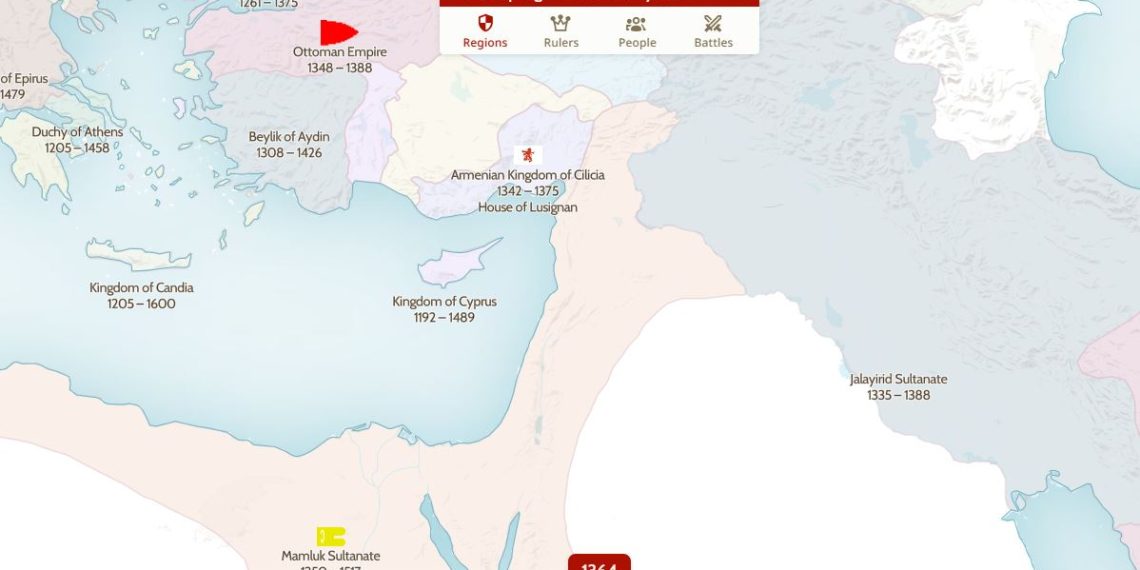
It is clear to any reader of history that the region east of the Euphrates (Al-Jazira—Upper Mesopotamia), from its upper reaches to its proximity to Baghdad, has not been ruled by Damascus since the first Islamic division of the country in the first Hijri century. Damascus never exercised centralized control over the Balikh and Khabur regions throughout its history, even during the brief Umayyad era. Instead, it was a region of equal status, not considered part of historical Syria at all, according to Arab and Muslim geographers or in the administrative divisions of Islamic states and emirates. In detail, Damascus ruled the “Al-Jazira” region for less than 90 years (the period following the French mandate) out of the 1,400 years during which Al-Jazira was fully independent from Damascus (administratively).
However, it is possible for the Al-Jazira region to become part of the Syrian political entity today if the factors for unification are met, and there are many such factors.
Since the signing of the March 10 agreement between the Damascus government and the Syrian Democratic Forces (SDF), the discourse of the “central state” and its virtues has been a constant in Damascus’s rhetoric. Sharaa brought this discourse with him to New York, where he claimed that any formula proposed by the SDF in essence amounts to secession. Before that, he spoke with shocking surrealism—which I briefly thought was a construct of artificial intelligence—about the secession of northeastern Syria, which he claimed would lead the US state of Texas to demand independence, and that it would also impact Iraq (which is fundamentally a federal country).
The current political and security trajectory in the country is moving toward the systematic exclusion of “everyone who has not pledged allegiance.” And what does this pledge entail? Complete surrender and the possibility of “extermination by consent.” This— the “extermination by consent” program—is the security and political framework underlying the disagreement with the new authority.
The authority continues to demonstrate its factional nature, governed by specific preferences in administration and governance, as if it were a continuation of the previous one-party regime, with its structure based on a narrow foundation that it considers the basis of legitimacy. This factionalism is the deep core of power, making every decision and every administrative or security move part of the process of reproducing the rule of factional dominance that has defined the modern Levantine state for decades.
In this context, the approach of “fragmenting the peripheries of Syria” as a method of governance appears as a means to ensure centralization. The East has not yet reached a friendly formula for cooperation between the center and the periphery, with the exception of the Iraqi case, which is also riddled with flaws.
Despite ongoing dialogue between Damascus and the Autonomous Administration, as well as between Damascus and Sweida, every “administrative-constitutional” step taken in Damascus contradicts the idea of bridging understanding gaps with the various parts of Syria. Its aggressive centralist thesis is based on two factors:
First: Numerical superiority and the intent to annihilate have been proven to not guarantee success.
Second: Centralization of Syria’s international representation through Damascus.
The current regime treats the country not as a political and social unit, but as a divisible space whose core legitimacy is held by Damascus, with the peripheries receiving only security crumbs through local loyalties. This aims to establish the center as the sole source of legitimacy, equating Damascus’s rule with Syria’s rule, As one of the tribal leaders in the northeastern part of the country summarized this logic by saying: “Whoever rules Damascus rules Syria.”But this saying — which seems like a mere truism — is nothing but empty political rhetoric. It is presented as if it is based on solid historical experiences, while in reality it bears no real historical substance. Power in Syria has never stabilized solely through centralized authority, but rather through alliances with various parties. Therefore, clinging to this saying is just a form of political deception that conceals the central authority’s inability to produce a unifying national contract. The result is that what remains of this saying today is: “Whoever rules Damascus rules Damascus only.” As for Syria, it remains outside the equation, which will ultimately lead to loss for everyone.
The current regime in Damascus, especially the Muslim Brotherhood faction, believes it can isolate the other parties administratively and legally, allowing them to govern themselves. It may not attack militarily to control northeastern Syria and al-Suwayda, but it seeks to isolate them from the world by monopolizing the representation of the state through university certificates, birth registrations, ID cards, and passports.
Syria’s fundamental problem today is not related to centralization or decentralization, according to each party’s preferences, but rather whether the state exists at all, and whether it will ever be present and in what form. Therefore, it is almost impossible to pose the dilemma of the type of governance as if the state were complete and neutral. The current situation is a biased apparatus, not neutral, that does not hesitate to resort to sectarian violence, of a genocidal nature, with a possessive attitude towards land and populations. It considers itself entitled to determine the fate of any region and to choose the type of punishment it deems a deterrent. This violence is primitive and barbaric, as we have seen in the Syrian coast and al-Suwayda. Before this group took power, it committed acts of genocide and displacement in Afrin and Sere Kaniye/Ras al-Ain, while still being in opposition under the banner of what is called the “National Army,” a militia organization specialized in committing crimes against humanity when it was the main opposition arm in northern Syria
The fundamental divergence reveals a deep gap that is difficult to bridge. On one side, there is the self-administration, which sees the state, or “the Damascus state,” as a hegemonic government that rules with the mentality of the “victorious faction,” coming before the stage of the “saved faction.” On the other side, what Damascus proposes resembles a “trial of the self-administration.” This is Damascus’s concept of integration, and its highest form is “forgiveness before the trial,” and this is a limited-time offer! The end of 2025 is the (time of Death) set by the Damascus government for the self-administration, a date its new supporters talk about with a smug tone as the “dream of meeting in the Syrian Jazira before the end of the year,” in the words of the elites eager to grasp the tail of what they think will win.Thus, under this non-participatory government, the state remains incomplete and non-neutral—a state of collective trials for local communities, prepared for mobilization and panic measures.
In reality, the new authority has almost entirely adopted the concepts of the Arab Socialist Ba’ath Party in its unilateral arrogance in constructing the state, even in its view of Islam as a national pillar that reinforces the unity of Arab Syria. This is when it finds itself compelled to present a nationalist appearance. The “Syrian Arab Republic” still inherits the tools of the previous regime in governance, most notably the factional dominance over the diverse Arab cultures within the country (Druze and Alawites), along with insistence on marginalizing the Kurds, keeping them outside the authority, and restricting them within a centralized state that is biased against roughly half of Syria’s population.
But the problem is deeper than mere attachment to the center; the relationship between authority and society today is based on an inverted foundation: those who want to remain must swear allegiance, and this allegiance is not a traditional political loyalty but complete submission. The pledge of submission is an implicit delegation of the authority’s right to decide the fate of the pledging party: it can abandon or exploit them whenever it wishes. Acceptance of authority is no longer a political contract but a recognition of its right to annul. This can be called “the program of consented extermination.” The authority does not declare its intention to commit genocide but makes submission a condition for survival, and from this submission, an implicit legitimacy to practice violence whenever it deems fit is born.
In other words, when a citizen or group pledges allegiance, they do not receive a “guarantee of life” but grant the authority the right to treat them as spoils at the first political or security test. Therefore, surrender is not protection but prior acceptance of delayed extermination.