


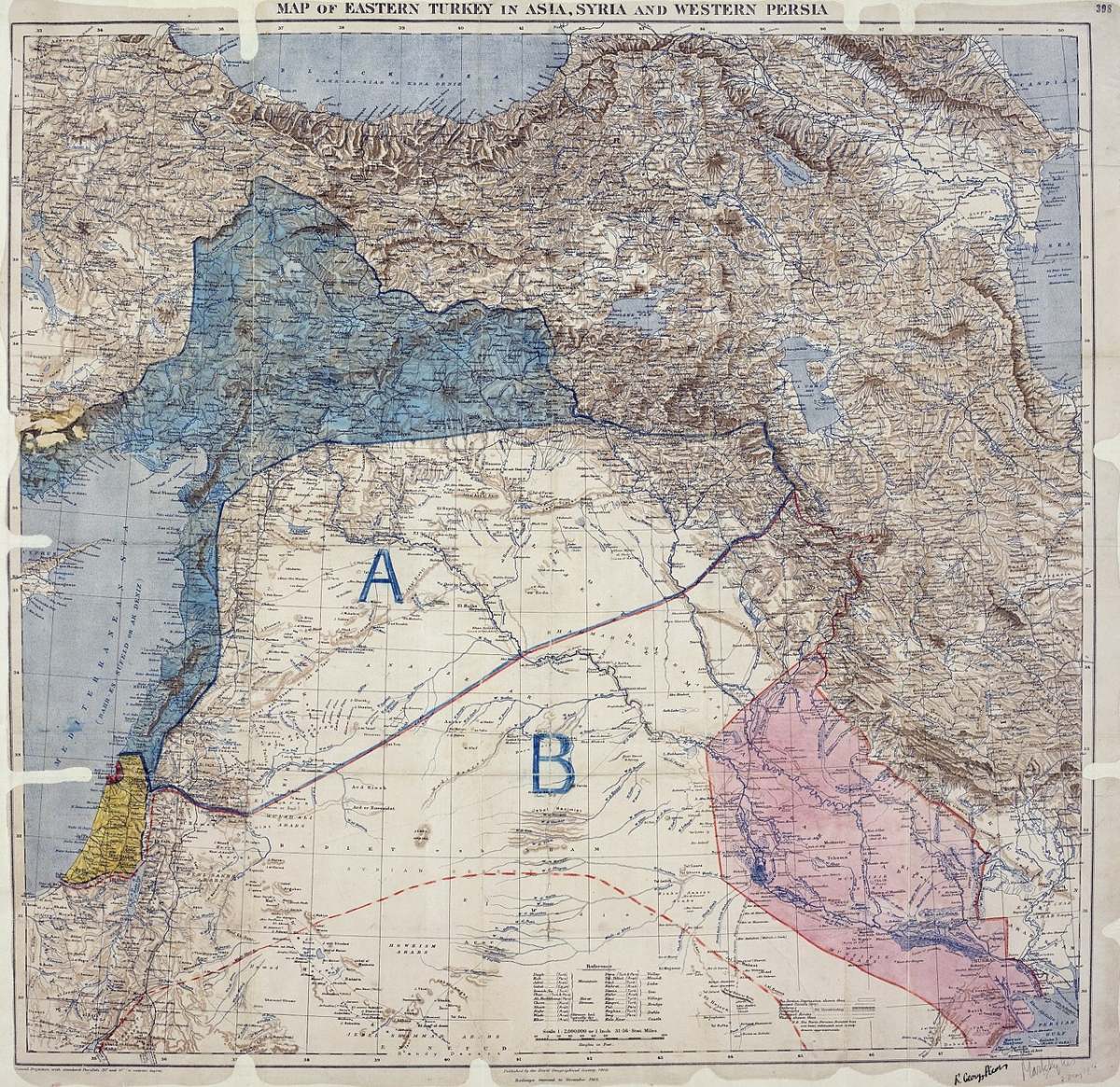
The abject dissolution of the decrepit Ottoman Empire by the result of World War I (1914- 1918) gave birth to a number of nation states that had never existed until they did. Syria, whose northern boundary is entirely shared with Turkey, is a case in study.
However, while the Arab- speaking localities in the newly contrived state were conquered at the points of British bayonets, the control of Kurdish north was gained by coercive diplomacy, days after the hatched had been buried.
Throughout much of the long duration of the Ottoman Empire, Syria was for the most part a subject vassal of Ottoman Turks. The well-known axiom that every state owes its existence to the very same causes that created it bears witness to Syria to the full extent.
The Great War saw the political demise of four world- subduing powers; the Hohenzollerns, the Habsburgs, the Romanovs, and the Ottomans, who failed the greatest global test, and disappeared leaving anarchy in their wakes. But the most successful amongst them all was that of the Ottomans, who clung to a living tradition that kept growing.
In March 1918, the Central Powers had nearly attained victory, but by late September, however, defense lines; Gaza in the East and Hindenburg in the West, were finally pierced. At this juncture, Otto Liman von Sanders, Commander of the combined elite force, Yildrim Army, gave instructions for a full headlong retreat to the terrestrial paradise of Islam; Damascus.
Yet brutality inflicted on Army IV and their families in Tafas (Sep. 27), where some 800 Turks were killed, and the setting on fire of two trains full of sick and wounded in Qadam (Sep. 30), and the savagery inside the Turkish Hospital in the city, all sealed the fate of Ottomans in the race for Damascus.
The fall of Damascus introduced grave effects on the power and moral of the Turks. On October 7, the whole of Ottoman Cabinet resigned. On October 12, Marshal Izzet Pasha was requested to form a new government. He was to be Grand Vizier and War Minister in the new Cabinet. The Turks still hoped that the Allies would grant an armistice to the Central Powers on the principles of President Wilson’s Fourteen Points.
Thereupon, on October 21, Mustafa Kemal Pasha, second in command to Sanders, decided to take the matter into his own hands. He sent a telegram which contained a proposition that Faisal, son of Hussein, had made to the Governor of Syria, Tahsin Bey, back in January 1918, to the effect that an armistice be concluded, according to which Turkey was to recognize Syrian independence with a viceroy be installed on behalf of the Sultan. At the time, the government in Constantinople, deeming victory was at hand, nipped the idea in the bud.
However, three weeks after the takeover of Damascus, British forces approached the ancient city of Aleppo. On October 23, General Henry MacAndrew, who was too weak to storm the city, determined to bluff the Turk into surrender. To this end, he sent Captain Robert Macintyre with a flag of truce into Aleppo to demand the capitulation of the city.
The Turks took this officer through their defenses, apparently in order to show him that the position was a strong one, which it was not. Macintyre was handed a reply. ‘The Commander of the Turkish garrison of Aleppo does not find it necessary to answer your note,’ it read.
Two days later, Bedouins of Sharif Nasir entered the city. Fighting spilled into Aleppo’s streets. Mustafa Kemal personally led Ottoman soldiers as they fought off the attackers from house to house. A part of the armed inhabitants took part in the fighting on the side of the Bedouins. In the night of 26, the Turks withdrew from Aleppo in high dudgeon.
The main bodies pulled back to a position in the north to block the Alexandretta Road. Mustafa Kemal spent his last hours of his acquaintance with Aleppo on Lady Hill – later Sheikh Maqsoud.
If Damascus has been the focus and centre of political life, Aleppo was the Empire’s Achilles’ heel. Under the Ottomans, and before Syria became a Mandated Territory, Aleppo included much of what is now southern Turkey as well as what is now northern Syria.
Now, the Turks were going to drew a ‘border with Turkish bayonets.’ On October 26, Ottoman forces inflicted a crushing defeat on the British. The place was immortalized by a memorial known to posterity quite symbolically as Qebir Ingilizi – the Grave of the English.
Quite coincidently, that same day, a Turkish delegation comprising Hussein Rauf Bey, the Minister of Marine, Ali Sadullah Bey, a high- profile officer, Rashad Hikmat Bey, Secretary- General at Foreign Affairs Ministry, had arrived in the harbor of Mudros. Rauf had clear instructions not to return without peace.
The Armistice of Mudros was signed late in the night of October 30, three days to a day since Anwer Bey, Minister of War, in league with German admiral, Wilhelm Souchon, had dragged the empire to the war. When guns fell silent, the Turks were almost in full control of territories extending uninterrupted from the Mediterranean up to River Tigris.
British officer, Charles Townshend, the messenger who bore the Turkish request for an armistice to the Allies, claims the Turks could have resisted British forces for fully five months, or perhaps longer. Yet time was ticking; Bulgaria had surrendered, and Germany had collapsed.
Of consequence, and in conformity with Article 19 of the Armistice that Germans officers quit Turkey within a month, Sanders turned over the command of troops to Mustafa Kemal. This last act of Sanders took place in Adana, hours before the armistice came into effect, on October 31.
Presumably, the war was over. In reality, it was not. In the night of November 1, the War Office in London sent unexpected orders to occupy the “Strategical Points” deemed necessary in line with Article Seven. Mustafa Kemal pleaded ignorance of the terms which called for demobilization.
Kemal, realizing it was not possible to come to terms with British, reported the situation to Izzet Pasha. However, when he was notified (November 6) that British forces would occupy Alexandretta, he rescinded orders. He was, therefore, stripped of his command and recalled to the Ministry of War, having his Yildrim Group disbanded. Two days later, Izzet himself was fired.
Nihad Pasha, who replaced Mustafa Kemal carried out the terms of the armistice to the letter. In less than two months, Dortyol, Tarsus, Ceyhan, Adana, Bahce, Islahiye, Hassa, Mamure, Osmaniye, Mersin, and Missis were taken by the French in December. The British occupied Aintab, Killis, Marash, Birecik, Urfa, Ras al-Ain, and Hasaka, but not Nusaybin, nor Cizre.
In the summer of 1919, while the world leaders were haggling over the Treaty of Versailles with the daunting task how to sternly punish Germany, truculent and stiff- necked Kemal was in Anatolia embarking on the hard sell of an idea to an audience ill with the emotion of the moment. Mustafa Kemal filled the air with the memory of Oghuz and Osman, and drummed up for the nation’s support in the defense of the homeland.
From nearly out of scratch, Mustafa Kemal would develop an idea into an ideal with the ultimate goal to expel invading forces and regain territories lost to the British under the nebulous terms of the armistice, which were now ceded to the French. His idea would be known to posterity as Misak- I Milli; the National Pact.
The idea probably arose from the axiom that when the armistice was signed, those territories which were now included in the pact were held at the point of Ottoman bayonets.
In March 1919, the Whitehall, conceding to repeated French requests, told the Quai d’Orsay that it definitely had nothing to do with Syria. Yet, it was not until September 15, 1919, when the British officially agreed to evacuate Syria, and to let the French occupy Cilicia and the localities located to the west of the Sykes-Picot line.
The replacement of British troops by French ones served a major blow to Arab aspirations. The prospects of Turkish- Syrian cooperation arose ironically on the strength of British withdrawal from Cilicia and northern Syria. The Anglo- French Syrian Agreement is a game changer so far as the National Pact is applied.
It is characteristic that the loss of Syria to the French consequent on the British resignation, not less than the renunciation by the latter of the war- time pledges made to Arabs, was a blow that awakened a dormant beast.
The Arabs had always viewed British forces as an ally of the Sharifian ones. The French were not concealing their aim in Syria. They have arrived to stay. In December 1918, France’s Foreign Affairs Minister, Stephen Pichon, had announced that French rights in Syria and Cilicia were based on historic tradition, upon agreements and contracts preceding the war, and upon the aspirations of the inhabitants.
The Syrian nationalists, who equally had every good reason to treat the British pledges with suspicion, and having been now abandoned to the mercy of France, found themselves engaged in the same struggle against the French, whom the Turks (their quite recent enemy) were already fighting.
Equally enough, in 1919, the Ottomans were after the disastrous defeat inflicted on them by the Allies, thrown into a most critical moment of their history. Kemal welded a shell- shocked nation by persuasion into a tremendous and irresistible force. For a moment, Arab Nationalists, in pursuance of a much sought- after ally, aligned with Turkish Nationalists. The sense of grievance, and the sense of bitterness was directed against the French; the common enemy.
Valiant efforts exerted by ex- Ottoman officers seemingly yielded fruits. On June 16, 1919, a Turkish- Syrian agreement was finalized apparently through the good offices of Essad Bey, the former Mutasarrif of Karak. It was purportedly signed by Faisal and Mustafa Kemal, and exchanged in two copies in Aleppo. The agreement aimed at a political compromise and military cooperation.
At this time, a sentiment gained ground and was shared by large classes of Syrians, many of whom called for a return to Ottoman rule. That was not a return to the status quo ante bellum, at any rate. Likewise, in Turkey, there arose a certain sentiment to restore political relations with Syria based on a sort of confederative or federative type of governance.
In December, Shakir Ni’met, who was at the head of Arab resistance in Aleppo, called Mustafa Kemal for close military cooperation. Strategically, Mustafa Kemal thought that the tactic of cooperating with the Arabs was likely to force the French to compromise. He was right.
Ni’met, a former Ottoman officer, proposed cooperations with Turkish nationalists for the sake of expelling foreigners. He also maintained that if he were successful in repulsing the French invasion, Arab nationalists in Syria would join the nationalist movement in Turkey to repulse the infidels.
The presence in Anatolia since 1918 of Sheikh Ahmed Sharif al-Senusi, who had fought the Italians in Libya, the French in Chad, and the British in Egypt, played into the hands of Mustafa Kemal, and helped mend the fence and repair the damage.
The Arab nationalists embellished their dream with all sorts of justifications. Among the Arabs, a new circulation found its way to the air that the Hashemites unfurled the banner of revolt not against the Ottoman state, but rather against the ruthless methods of Committee of Union and Progress (CUP), which, as an instrument of Turkish nationalism, tried to exclude and Turkicize Arabs.
This may give the historical justification to that fact that National Pact had not excluded territories outside the Armistice line, nor had the Turkish Government declared Arab localities to be outside the national boundaries.
The Turkish Parliament did not fail to pass the expansionist six- point document in 1920, which would loom large in Turkish politics in the decades to come.
Cautiously though, Turkish arms began to siphon into Syrian Nationalists, who were requested in exchange to help the Turks by resisting French troops, destroying bridges and disrupting transportation and communication lines in the north of the country.
The Sharifian- Kemalist cooperation culminated in the secret agreement for military cooperation, which was signed in the village of Kafar Janeh, on July 3, 1920. The Syrian signatory was Faisal’s Defense Minister, Yusuf Azma Pasha, head of Damascus patriots.
Yet the French invasion of Syria, and the flight of Faisal in the very same month, ground all the prospects of such a cooperation to a halt, and put it to a permanent stop. A cloud of suspicion filled the air.
Paris, in order to negotiate with Ankara was to scrap the unratified Treaty of Sevres. By the terms of Ankara Treaty 1921, France would cede to Turkey large swathes of territories which were considered a year earlier to be included in a much- protracted Kurdish state as defined in the Sevres Treaty of August 1920.
Most importantly, the 1921 treaty had given Alexandretta a status. Perturbed by fears that Bolshevism might press into Turkey, Paris was generous in making concessions to Ankara. This time, Nusaybin and Cizre were ceded. For his part, Mustafa Kemal had to put his once Syrian allies under the bus. Turkey’s annexation of Alexandretta in 1939, saw Damascus and Ankara on quite adversarial sides.
Henceforth, many Syrians feared the obtaining of Hatay was a stepping stone to further land grabs. Soon, their fear would become real. In 1950s, Turkish nationalists suggested Aleppo was to be restored to “motherland.” Turkey’s hostile position drifted Syria to the Russian orbit. This posture provided Ankara with an excuse to tighten the screws on Damascus. In 1957, Turkish armed forces were deployed to the border.
Against the backdrop of the Baghdad Pact in 1955, Syria had signed a mutual defense agreement with Egypt that same year. The pact was given effect when Jamal Abdel Nasser, no less hegemonic than the Turks, sent troops to the coastal city of Latakia in September 1957. Informed sources circulated that further troops could be deployed to the border with Turkey. Moscow warned Ankara against any Syrian adventure. Washington on account of the foiled Operation Straggle 1956, nixed the plan, but not the idea.
Syria in its eternal habit of been merely a blind receptacle for influences, ideas, and ideologies coming in from outside, presented itself to Nasser a year later. They formed the United Arab Republic. North and east Syria, bore the brunt of Nasserite “reforms.”
With the accession of the Baathists in 1963, Syria which embodied Arab Nationalism, assumed the role of a Pan- Arabist FOB against the forces which tried to disrupt it; Nationalist Turks. There has always existed a suspicion among Syrian nationalists that as Turkey grew stronger it would stretch its tentacles southward.
Throughout 1980s and 1990s, with variances though, water issues, Islamists and Kurds (particularly Kurdistan Workers’ Party), casted more clouds over the horizon. President Hafez Assad, who arrogated to himself the title of the ‘builder of modern Syria (partly he was), checked the Turks in. Assad molded Syria into a breakwater that rendered impossible the achievement of Turkish Nationalist aspirations in the area.
However, two years before his death, Turkey, in October 1998, deployed troops to the border threatening to rattle into Damascus within 48- hours unless Assad expels PKK’s leader, Abdullah Ocalan. Ankara had in 1992, and again in 1996, made similar threats, but with the passage of time, it quieted down.
Yet unlike previous times when Assad’s intransigence used to wreck the Turk’s intemperance, Ankara has this time massed troops, and a propaganda was employed. For a while, Assad walked a delicate line, and even considered military option. However, while Assad’s generals dissuaded him not to take the adventure, his Foreign Affairs Minister, Farouq al-Sharaa, disclosed a grim reality.
In his memoirs, Assad’s long- standing friend and top diplomat reveals that he told the president that military action could awaken the giant within (Muslim Brothers), with huge unforeseen, unintended and unwanted consequences that is difficult to predict.
It was this weakness that compelled Assad to acquiesce in subjection to a well- defined enemy, who regarded Syrians as inherently inferior. On the surface, the Adana Agreement, signed on October 20, eased tensions. The all- security deal was, to all intents and purposes, a Turkish victory in every arena.
Article One ended the physical presence of Ocalan in Syria. Strategically, by Annex III Syria implicitly ceded the Province of Hatay; Alexandretta. It turned out that the question of Ocalan was only a pretext for wider geopolitical gains.
That the pact was signed eleven days after Ocalan had left Syria, bears witness to such a claim. To know that the Agreement was signed on the very same day on which the Ankara Agreement had in 1921 been signed is also telling.
Just like Hatay, the deal helped perpetuate bitterness and suspicion between Ankara and Damacus. Yet differently, there was this time a common enemy (the Kurds), which alleviated its bitterness.
The death of Assad was a black swan event in that it laid the cornerstone of a new era between the two neighboring countries. For Ankara, Assad’s death was a blessing in disguise. Quite ironically, while the father kept the Turkish bear out of Syria’s vineyard, it was the hectoring naivety of the son that let the bear in unrestrained.
In the decade preceding the war, Turkey penetrated deep into all arenas of Syrian life. Suffice to say that in 2009 alone, some 50 agreements, protocols, and MOUs were signed. Aleppo was opened wide to Erdogan. The U.S.- led invasion of Iraq in 2003, and the ensued gains made by the Kurds, made Ankara and Damascus closer. Yet, a friend of yesterday would become an enemy of today.
It was during the Syrian crisis (2011- 2024) that Ankara played a most disruptive role in Syria as the country descend into a brutal sectarian civil war. The destructive involvement of the Turkish state, Turkish intelligence services and Erdogan and his family members in aiding and abetting the Islamist- leaning opposition since the very peep of the crisis is an undeniable sheer physical fact.
Invoking Adana’s Agreement Annex IV, which stipulates that failure by the Syrian side to take security duties stated in the agreement gives Turkey the right to take all necessary measures within 5 km deep into Syrian territory, Turkish Armed Forces, as of 2016, mounted three cross- border offensives into Kurdish localities beneath its southern borders.
Two months after Ankara’s first incursion, Turkish President, Recep Tayyip Erdogan, said: “Should we fully comprehend the National Pact, we can realize what responsibility we have in Syria, and in Iraq. We will be both at the table and in the field. We are currently holding the diplomatic negotiations on one hand, and making our preparations for the field, on the other.”
In late 2024, as the collapse of Assad was looming, Turkey’s right- wing nationalist coalition partner, Devlet Bahceli, in an evocative reference to the National Pact, said: “Aleppo is etched into the soul of every Turk and Muslim.”
The abrupt termination of the Assad reign in December 2024, brought further decline and destruction to the country, and saw Ankara in full possession of Syria. Syria has become by all appearances a Turkish political and military salient in the heart of the Middle East.
The astounding remarks made recently by Erdogan that Turkey’s security does not begin from Hatay, but rather from Aleppo, Damascus and Beirut, all tend to give substance to such a hypothesis. After a century- long interregnum, Syria has returned to the Turkish, or rather more precisely, Ottoman fold.