


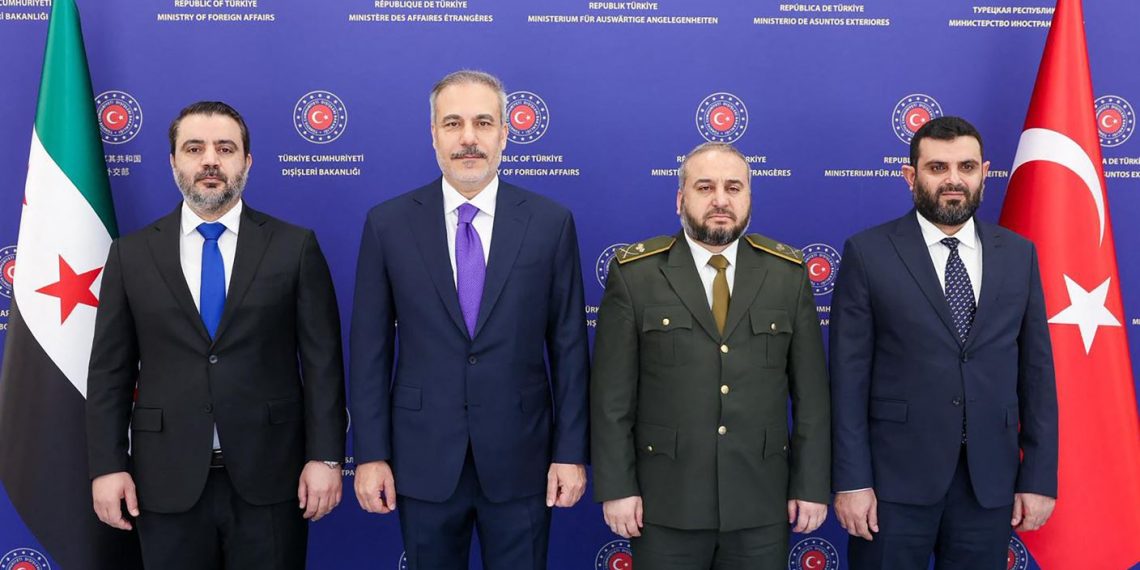
The surprise visit of Asaad al-Shaibani, Foreign Minister of the Syrian Transitional Authority, to the Turkish capital Ankara came amid numerous rapid developments—all related to Syria and the recent events there. Ankara hastily summoned al-Shaibani, and to make the visit appear more like a long-planned “working visit,” both Defense Minister Murhaf Abu Qasra and Intelligence Chief Ibrahim Salameh packed their bags to accompany him. Abu Qasra met with Turkish Defense Minister Yaşar Güler and hastily signed an agreement on “military training and advisory services.” This agreement was clearly rushed and offers no new strategic advancement, given Israel’s continued veto on any Turkish military presence or expansion inside Syria.
What was striking about this visit were the statements made by Turkish Foreign Minister Hakan Fidan, who attacked the Syrian Democratic Forces (SDF) and accused them of stalling in implementing the terms of the March 10 agreement, signed by General Mazloum Abdi, commander of the SDF, and interim president Ahmed al-Sharaa on March 10, 2025, in Damascus. Fidan’s remarks also included incitement against the Autonomous Administration and the SDF, despite a meeting held hours earlier in Damascus between a delegation representing the Autonomous Administration in northeastern Syria, headed by Ilham Ahmed, and the transitional government, headed by al-Shaibani himself. That meeting was described as “very positive.” However, Fidan’s statements, which included phrases such as “We know your intentions” and “We are not naive and we know what is going on,” demonstrated that he was still acting in the role of intelligence chief—a position he held for 13 years—and prevented the continuation of the atmosphere of relief that had prevailed after the Damascus meeting between Ilham Ahmed and Asaad al-Shaibani.
The Turkish stance and escalation followed the “Unity of the Position of the Components of North and East Syria” conference, held by the Autonomous Administration and attended by community figures from northeastern Syria. Participating remotely were Syrian Druze Sheikh Hikmat al-Hajri and Syrian Alawite Sheikh Ghazal Ghazal. Turkey pressured Damascus to reject the conference’s outcomes, which unanimously affirmed Syria’s unity—its land and people—and called for a participatory and decentralized democratic system. Consequently, the authorities in Damascus issued a statement condemning the conference, and media outlets funded by Turkey and Qatar began attacking the conference and inciting against the Autonomous Administration and the SDF. Politically, the authorities escalated tensions and announced their boycott of a planned meeting in Paris between the Autonomous Administration and the transitional government. This decision was welcomed by Turkey, which does not want any influential players on the Syrian scene capable of influencing the government and thereby limiting its own role and influence.
The transitional government remains shaken by the repercussions of massacres committed by factions affiliated with the General Security and other “rogue” groups led by figures close to the former regime and the Iranian Revolutionary Guard, calling themselves “the tribes.” These massacres targeted the Druze community in the southern province of Sweida and resulted in nearly 2,000 civilian deaths, as well as hundreds of fighters affiliated with the transitional authority. The massacres ended only after Israeli strikes on the General Staff building and the Republican Palace in Damascus. Direct Israeli military intervention created a new reality in Syria and gave Tel Aviv a presence, acknowledged by the transitional authority through contacts and meetings held between its officials and Israeli counterparts, with American participation. These culminated in a “disengagement” agreement between regime militias and the Druze resistance in Sweida. Moreover, there is talk of a gradually emerging plan to open a crossing linking Sweida with Israel, aimed at transporting food and relief supplies to the besieged province.
All these developments have created confusion and turmoil within the transitional authority in Damascus, which has translated into increased intransigence toward northeastern Syria and the SDF, as well as threats of force through military escalation—attacking SDF positions in Deir Hafer in the Aleppo countryside and villages in the Deir Al-Zor countryside, in addition to launching drones over the Kurdish neighborhoods of Sheikh Maqsoud and Ashrafieh in Aleppo city.
Turkey knows that the transitional authority in Damascus is in an extremely difficult position following the massacres it committed in the coastal region and Sweida, as well as the issuance of a United Nations report condemning the authority and accusing it of responsibility for the massacres in the coastal region, which the report described as bordering on “war crimes against humanity.” Another report issued by the Pentagon accurately described the infiltration of jihadists within Syrian military and security structures. Turkey also knows that the Israeli presence in southern Syria has become a reality, in addition to Tel Aviv’s firm adherence to the red lines it drew for Turkey, prohibiting any Turkish approach to the Syrian interior (Israel destroyed military facilities that Ankara sought to rehabilitate at Hama Military Airport and the T4 base near Homs in April 2025). Furthermore, the reality that emerged in Sweida after the recent massacres is one of clear decentralization, which will inevitably be reflected in northern and eastern Syria—and perhaps other parts of Syria—that will adhere to a decentralized model, given the authority’s failure in most security and economic areas. From this perspective, Ankara believes that most Syrian files are slipping from its grasp, and other actors are emerging who are stronger than it economically and militarily.
Turkey has not condemned the transitional authority’s atrocities in the coastal region, Damascus, and Sweida, nor the daily human rights violations throughout Syria. It approaches Syria with a security mindset, viewing it as a sphere of influence and control, governed by an authority Ankara insists must be subordinate to it. Ankara clings to the narrative that it was responsible for bringing this authority to power in Damascus.
Within this narrow and dangerous mindset, Ankara insists on combating the Kurds, the Autonomous Administration, and the Syrian Democratic Forces, rejecting all forms of decentralization and constitutional recognition of Syria’s diverse components and particularities. Despite an ongoing dialogue process within Turkey between the state and the Kurdish movement—including the establishment of a parliamentary committee called the “Committee for National Solidarity, Brotherhood, and Democracy,” and talk of a “new phase” and a “thousand-year brotherhood between Kurds and Turks”—the government and its diplomatic chief, Hakan Fidan, persist in excluding the Kurds in Syria and blocking Damascus from accepting decentralization or recognizing the Syrian Democratic Forces as an official structure within the new Syrian army, similar to other factions fully integrated into the authority’s framework under new names.
The Turkish approach regarding Syria remains unchanged. With a foreign minister who still assumes the role of intelligence chief overseeing covert operations and the “underground” arena, and who opposes the peace process with the Kurds inside Turkey, it seems Turkey’s stance toward the Kurds, the Autonomous Administration, the Syrian Democratic Forces, and thus the emergence of a decentralized democratic Syria, will see no progress. Turkey will continue to reject any breakthrough, insisting on building a centralized, unitary state ruled by a faction loyal to Ankara, or a province governed by a governor loyal to the sultanate—according to the Turkish imagination and the favored approach of Turkish media.
Within this context, the vocabulary of Turkish political discourse regarding the “new Syria” remains unchanged: rejection of decentralization, incitement of Arabs and Kurds against each other, collusion with the authority over the coastal region and Sweida, and competition over what it considers the Syrian “pie” with Israel, Arab countries, and other regional and international powers opposed to the Turkish imperial and colonial presence in the Levant.