

In recent days, Syrian cities have witnessed gatherings where “protesters” attacked the Syrian Democratic Forces (SDF). Despite the meager participation in these gatherings, which did not reach dozens of participants at their maximum, the events reveal the presence of two key issues.
The first issue is the participation of individuals associated with and close to the authority, including media figures from the inner circle, coupled with media incitement from the supportive platforms financed by the authority. This suggests that the demonstrations were directed by the authority.
The second issue is the attempt to undermine the content of the agreements between the Interim Government and the SDF by chanting slogans that reject the principle of partnership affirmed in those agreements.
These attempts at ethnic mobilization and polarization came after continuous meetings between the SDF and Damascus. According to the Interim Government’s Foreign Minister, Asaad al-Shaibani, five meetings took place last month. The SDF team described the recent meetings as generally positive and buildable, and similarly, the US representative, Thomas Brack, affirmed that the “situation is moving in the right direction.”
However, no expression has emerged from the Damascus authority indicating the achievement of new understandings, especially concerning the technical issues disclosed by the SDF, such as the formation of three military teams and affiliated brigades. Moreover, Al-Shaibani stated that there were “no practical steps” towards implementing the March 10 agreement, meaning that the recent meetings did not represent any practical steps that could be built upon.
The ongoing incitement against the SDF, and specifically against the March 10 agreement, highlights the multiplicity of the authority’s rhetoric. The authority presents itself to the American side and the international community as fully committed to the agreement’s terms, while simultaneously inciting its supporters against the SDF and the agreement itself, accusing the latter of procrastination without specifying where this “procrastination” lies. All this occurs within a state of arbitrariness and disarray in its security and governmental conduct and its insistence on a policy of closed doors toward Syrians of all components and political orientations.
It is to the SDF’s credit that it has not been drawn into parallel inflammatory rhetoric, nor has it called upon its supporters and advocates—especially abroad, given their effectiveness and ability to mobilize and advocate—to denounce the authority, its behavior, and its recent past in committing massacres.
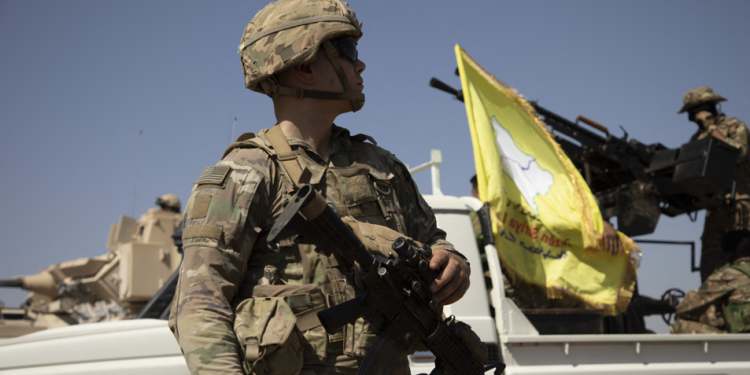
This kind of discipline can be described as a calm reading of the regional circumstances related to the Kurdish-Turkish peace process and the impact of escalation in Syria on peace advocates’ activities within Turkey. This also takes into account the nature of the US position sponsoring the negotiation process. The United States is convinced of the SDF’s commitment to fulfilling its obligations towards Damascus, especially since the draft of the latest agreement on forming SDF-affiliated teams to deploy in its areas of control is an idea that appeals to Washington. Furthermore, Washington supports the idea of forming a “Joint Security Chamber” to combat ISIS. The formation of this chamber would officially entrust counter-terrorism operations to both parties, which means consolidating the SDF’s presence in the military and security landscape throughout Syria. Washington’s interest in such cooperation might represent an opportunity to de-escalate tensions and prevent a relapse of the fragile peace between Damascus and the SDF.
However, the major question revolves around the ability of the al-Sharaa authority (the Interim Government) to perform a reverse integration, meaning operating under the supervision of the international coalition and the SDF and benefiting from their long experience in the path of counter-terrorism. Furthermore, the statements of the duo (al-Sharaa and al-Shaibani) regarding their ability to fight ISIS do not seem convincing to the United States. Their speeches directed at the West about previous confrontations with the organization are unconvincing and lack any evidence of credibility.
Interim President Ahmed al-Sharaa is scheduled to visit the White House this month. One of the files to be focused on is the announcement of Damascus joining the international coalition to fight ISIS. This is an issue that appears embarrassing for an authority coming from a jihadist background that was competing with ISIS for status and influence until recently. Such an accession might lead to internal splits, as an authority that appeared weak and indecisive in handling the French Camp file, and accepted the mediation of Uzbek and Turkestan jihadists, cannot manage the ISIS file, nor can it win over foreign jihadist groups to its side when declaring war on ISIS. Therefore, the closest scenario is that Damascus will join the international coalition without fulfilling its commitments or working seriously against ISIS and extremist groups or those listed on terrorism lists.
During the Riyadh meeting on May 14th, US President Donald Trump presented al-Sharaa with a brief list of demands, including “taking responsibility” for the detention centers holding ISIS elements in northeastern Syria and assisting the United States in preventing the organization’s return. Yet, from that meeting until now, al-Sharaa has not taken any step that expresses his desire to assume his responsibilities. The reason behind this may be his insistence on handling the file alone without the participation of the SDF. Washington’s leniency and welcoming of al-Sharaa’s authority’s integration into the international community and the lifting of some sanctions do not, by any means, imply leniency in the path of combating ISIS and installing Al-Sharaa as the sole official responsible for this file, in which the alliance between Washington and the SDF has achieved cumulative successes.
Formally, Damascus will present itself to international public opinion from now on as a party fighting terrorism, which is one of the many ironies of the Syrian scene. However, at the same time, it will be reluctant to seriously engage in this project due to an internal defect within the authority itself, as it cannot function as an apparatus fighting extremism while simultaneously nourishing it within army barracks, foreign fighter camps, inside some mosques, and through spreading its own ideas within moderate Sunni communities, targeting the new generations.
Despite this, the Damascus authority will repeat what al-Sharaa said when he offered his services in the counter-terrorism path via an American television station and subsequently called for dispensing with the SDF. However, offering services requires cooperation with US agencies, the Pentagon, and the SDF, as cooperation with Washington does not mean writing off the SDF for an unreliable partner who has not yet offered any evidence in the field of counter-extremism.
It seems that Washington’s experiment to draw al-Sharaa away from his jihadist clique will not be without obstacles, if not outright unsuccessful. This is because it is closely analogous to Washington’s previous policy when it sought to offer inducements to Bashar al-Assad to change his regime’s behavior and sever its ties with the Iranian axis, and was lenient with him in the path of Syrian-Arab normalization, only to be ultimately shocked by the deep-rooted alliances within the Assad regime’s house.
There is an easy way to discover al-Sharaa’s seriousness in the field of combating ISIS: his ability to reach an understanding with the SDF above all else, and not inciting against it through means that are not without vulgarity, threatening it, inciting against it, and calling for the annulment of the March 10 agreement. From a practical perspective, al-Sharaa will not be able to present himself as a substitute for the SDF, as the final say in this path will remain with the American agencies, the Pentagon, and the supervisors on the ground within the international coalition forces.