


In examining the record of ‘Hay’at Tahrir al-Sham’ regime’s actions in Syria during the past nine months, one encounters—whether as a foreign observer or an ordinary Syrian citizen—an extensive “portfolio” of massacres and mass killings based on sectarian identity, raids of abduction and enslavement, frenzied episodes of looting and burning, and assaults on sacred symbols of Syrian communities (such as shaving the mustaches and beards of elders, desecrating shrines and mausoleums, etc.).
This record did not result from arbitrary, unrestrained waves of revenge, nor from isolated incidents of “security breakdown” here or there. Rather, it came as a collectively planned campaign, following months of massive accumulation of incitement, agitation, and mobilization narratives adopted by the official discourse of ‘Hay’at Tahrir al-Sham’ authority, with full support, backing, and promotion from Arab media outlets aligned with the “faction-state,” marketing it as the much-awaited “new Syria.”
From the very first moments of the coastal clashes, which later escalated – through the calls for “general mobilization” issued by the ruling armed group – into massacres and sectarian identity-based killings, the shape and method of the authority’s response to any armed movement, uprising, or local discontent became clear.
That method relied on extending punishment and generalizing it, so that it encompassed everyone, after producing the maximum possible degree of localized sectarian division. Revenge thus became a form of “collective disciplining” of a Syrian community, for which the authority did not take long to invent a charge. The punishment was collective: the right to life was stripped from civilians who had committed no crime, except belonging to the sect meant to be disciplined and being present in a geographic area that witnessed fighting between two warring sides—one that lost power and sought to regain it by using civilians as shields, and another that wanted to hold on to it, even if this meant exterminations and seas of blood.
The authority’s choice during the coastal events was clear: excessive violence on its part, coupled with sectarian and regional incitement at its highest levels, which, through “general mobilization,” turned into executions, looting, plunder, rape, and enslavement—many aspects of which have been documented.
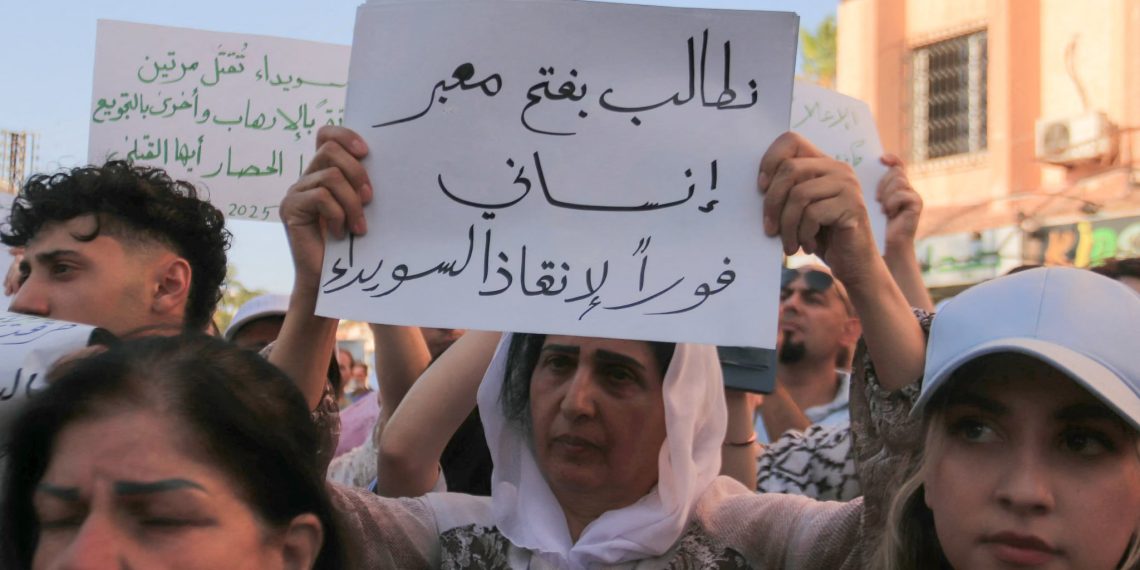
The “disciplining of the coast” and “retribution against the Alawites” campaign had not yet ended before the authorities launched an attack on Sweida, on two fronts: one led directly by themselves as a jihadist faction seasoned in wars of militias and geographies, and another newly created by their military mind and utilized—the “tribal” front.
The world saw the war of the faction calling itself the state against part of the Syrian people, and the extent of “managing brutality” it resorted to in slaughtering Syrian Druze civilians and burning village after village. Because this faction is foreign and alien to Syria, it did not respect taboos or national sensitivities, nor did it recall history or understand its meanings: killing, desecration, and burning of Syrian symbols, such as the statue of Sultan Pasha al-Atrash, while they mocked and played around. The faction practiced what it mastered and understood: killing, burning, looting—just for amusement and pleasure (such as the scene of their criminals killing the Syrian citizen Monir al-Rajmeh, who was shouting: “I am Syrian, my brother!”).
A major split occurred, and Syrian national unity was torn apart by this foreign, appointed faction. Now, this faction is trying to cover up this massacre by hiding behind strategies and tricks such as “visual identity,” celebrations and the “Damascus International Festival,” “Influencers Conference,” and other forms of symbolic distortion, falsification, and distortion of truth—tactics they mastered (with the help and sponsorship of the Arab media) since their coup to take “the Shami throne” from Bashar al-Assad and his circle.
Currently, this faction is busy normalizing the situation and calming massacres as if nothing happened. They try to erase the traces of bloodshed, to leave the scene of the crime, and to escape responsibility by blaming the “mobilization” and “popular uprising” elements, even distancing themselves from the faction and its factions, by offering scapegoats here and there, and talking about “unsupervised elements” within the faction—those who did not follow the higher commands, driven by their lust for blood and reckless disregard for human lives, filming their crimes with personal phones, or those caught on cameras in guesthouses and shops committing murders, looting, and burning. Additionally, the faction’s institutions have also moved the field commander overseeing the attack on Sweida, Ahmed Dallati, to another position. There are also talks about intentions to “sacrifice some tribal leaders” if the situation escalates further, especially with international reactions, sanctions, and calls for accountability for those who issued the orders for killings, looting, and destruction.
But what is certain after what happened in the coast, Sweida, and the ongoing violations, including abductions, demolitions, and ethnic cleansing aimed at displacement, is that what occurred is not merely a reflection of the faction’s mentality, which its leaders or politicians are trying to rid themselves of, or to cleanse the jihadist cells seeking to establish a pure Sharia emirate. Rather, it is meant to become a fixed, systemic approach—disguised with institutional laws and decrees issued and passed by the faction in the name of the state. There are efforts to reinforce the idea that the faction is the state, and that the interim president is the permanent and eternal president. His appointment of many members of the “People’s Assembly” and his chairmanship of the Supreme Judicial Council, and his supervision over all state institutions and branches, are presented as routine measures necessary for “the delicate exceptional circumstances the country is going through” and “to preserve the unity of the country in this critical phase.” To entrench this narrative and succeed in transforming the faction into a state, a media apparatus—both local and Arab—has been tasked with spreading these false narratives, manipulating minds, and playing on sectarian and national sensitivities, similar to what the “Baath” parties in Syria and Iraq did, but with an even greater dose of accusations and falsification, disregarding social sensitivities and the necessities of social peace.
Current efforts are aimed at getting rid of the legacy of blood, overcoming the national catastrophe and leaping over the resulting fissures, and activating more rituals, decrees, and “state” ceremonies — welcoming a delegation, striking a deal here, issuing a presidential decree and holding an election there — while the process of implanting the faction within the body of the state is carried out peacefully, even if that state in practice becomes an empty, deformed structure with no national sentiment, no loyalty, no parties, no democracy, not to mention parts of its territory being occupied and its sovereignty violated, and components of its people threatened in their lives, honor, and property.