

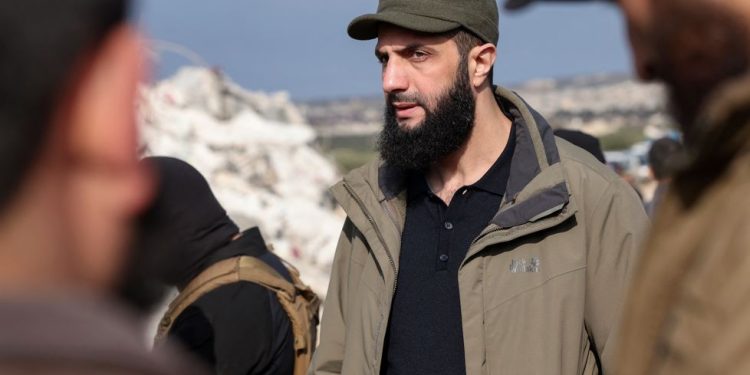
It is impossible to pinpoint an exact date for the start of Ahmed al-Sharaa’s pivotal transformation from a theoretical enemy of the West to an alleged “ally,” as is being rumored in the media of the new Syrian authority. This issue remains subject to speculation, as the trajectory of the transformations he underwent before taking power reflects an ability to move from one camp to another, if not to shift from one approach to another, while retaining the same old tools. Perhaps this very issue of “transformations” drew the attention of Western observers and decision-making circles in London and Washington.
This article examines the initial shifts that rocked al-Jolani, his ability to develop survival techniques, his learning from the Afghan experience, and his subsequent continued transformation to meet the desires of the United States. However, these transformations did not mean abandoning the past or discarding the image of the former Jihadi; Al-Sharaa himself stated earlier this month that he is proud of his history and is not ashamed of any historical phase he went through. Perhaps he believes that the “success story” being marketed in the West begins with the biography of a Jihadi who fought US forces in Iraq, then positioned himself in the ranks of local Jihad, which he himself helped to nativize and make less connected to global Jihad, ultimately leading to his seizure of power and his desire to retain it.
This article does not cover the full history of Ahmed al-Sharaa as much as it attempts to monitor the transformations and estimate the outcomes according to an ascending graph line, beginning with the split from the Islamic State of Iraq (ISI), leading to the renaming of the al- Nusra Front, and culminating in the adoption of the Afghan experience, particularly the key year of 2016, initiating communication with Washington and London, engaging in the “qualification” process, and then attempting to adapt to American demands. For the necessity of periodization, it was essential to write the two names according to each stage (Abu Muhammad al-Jolani and Ahmed al-Sharaa), as is customary in historical, political, and sociological writings that change the names of individuals according to who they were and what they later transformed into. This means that writing the name “al-Jolani” carries no value judgment.
The Initial Transformations
Abu Muhammad al-Jolani/Ahmed al-Sharaa’s capacity for transformation and deep shifting of loyalties became evident when he first decided to disassociate the al- Nusra Front (Jabhat al-Nusra) from Al-Qaeda and subsequently form “Jabhat Fatah al-Sham.” He justified this as a response to the desire of “the people of the Levant to push away the pretexts of the international community.” Before that, his ability to disassociate himself from Abu Bakr al-Baghdadi and defy his obedience came months after al-Jolani arrived in Al-Hasakah in August 2011 to establish the Syrian wing of the Islamic State of Iraq (ISI) alongside six others, including Anas Khattab (Abu Ahmed Hudud), Abu Maria al-Qahtani (al-Jolani’s deputy), and Iyad al-Tubasi (Abu Julaybib), who would later break away from al- Nusra to form a short-lived, loyalist Al-Qaeda organization named “Hurras al-Din.”
During his long clash with the Islamic State of Iraq (ISIS) and the loss of eastern territories, particularly Deir ez-Zor, Al-Qaeda leader Ayman al-Zawahiri sided with and bolstered Abu Muhammad’s position amidst al-Baghdadi’s pursuit of the latter. The support reached the extent of secretly sending no fewer than twenty senior Al-Qaeda leaders to Syria. These leaders arrived from Afghanistan, Pakistan, Yemen, Saudi Arabia, and Europe, all for the sake of “enhancing the credibility” of al- Nusra amidst the growing presence of ISIS. Al-Jolani’s importance can be inferred by looking at the list of names that came to Syria, especially Ahmed Salama Mabrouk (Abu Faraj al-Masri), who had been involved in Jihad since the seventies, traveling between Egypt, Afghanistan, Yemen, Sudan, the Caucasus, and Azerbaijan. The significance of this man was partially revealed when the Central Intelligence Agency (CIA) seized his personal computer, leading to him being described as “Al-Qaeda’s Rosetta Stone.” Furthermore, the support included repeated statements by Ayman al-Zawahiri and other regular endorsements of al-Jolani’s position, such as those made by figures like Abu Mundhir al-Shinqiti (author of the letter “They Want to ISIS-ify Jihad”), Abu Muhammad al-Tahawi (who wavered in his criticism of ISIS), Abu Zahra al-Zubaidi, and others.
Al-Jolani rejected the repeated messages from al-Baghdadi demanding that he pledge allegiance and obedience to the Islamic State of Iraq (ISI), the most important of which was the letter sent on February 8, 2013. The refusal came 36 hours later, along with a series of orders sent by al-Zawahiri demanding that al-Baghdadi and his Syrian spokesman Taha Sobhi Falaha (Abu Muhammad al-Adnani) leave Syria and return to Iraq. However, all this was fruitless, and a clash seemed inevitable, which materialized by the end of 2013. To this end, al-Zawahiri sharpened all the energy of the “International Al-Qaeda Coalition”—including leaders and ideologues—to support al-Jolani’s cause against the bullying and horizontal expansion of ISIS. From a realistic perspective, the conflict can be viewed as a clash between the “elite” faction represented by Al-Qaeda and the Islamic State of Iraq (ISI) as the more radical current, prone to breaking away from al-Zawahiri himself, which ultimately happened. That is, the conflict went beyond al-Jolani to something deeper: preserving Al-Qaeda from erosion and schisms.
Al-Jolani survived the ISIS pursuits, but he remained a target to the extent that al-Baghdadi had to send his deputy, Hajji Bakr, nicknamed “Silent Knight,” to Syria to deal with the prolonged defiance using the organization’s known methods and sending loyalists to spy on al-Jolani. Bakr was killed without the elements of the “Free Syrian Army” who killed him knowing his importance, in January 2014 in Tal Rifaat. Perhaps if Bakr (a former Iraqi intelligence officer skilled in building organizational hierarchies and cells) had been able to work in the Aleppo and Idlib countryside and get closer to the strongholds of the new Front, he might have achieved progress whose impact on the overall Jihadi scene in Syria cannot be estimated.
Al-Jolani’s defiance of al-Baghdadi’s line and authority represented the first transformation that contributed to changing his destiny, although the fundamental ideological differences during the period of schism and subsequent clash were not clear, and the distinction between the two organizations seemed difficult given the similarity of their practices and rhetoric. Indeed, Nusra itself elevated the importance of fighting the “pragmatic” trend within the organization. Charles Lister believes that “as the al- Nusra Front’s identity as an Al-Qaeda affiliate was gradually revealed, its leadership figures became more willing to publicly advocate for Islamic Sharia and chastise anyone with ties to the West, while pragmatists such as Abu Maria al-Qahtani and Saleh al-Hamawi were relatively marginalized… This public leadership shift and increasing radicalization were most clearly manifested in Idlib.” Furthermore, al-Jolani’s ultimate goal, according to an allegedly leaked audio message, was to establish “Islamic Emirates” in Syria.
Within the first stage, which included the disengagement, survival from ISIS, and securing the exclusive support of Al-Qaeda, there was a tendency for al-Jolani to win the Syrians’ favor, seek popular support, and subsequently move to the stage of nativizing Jihad, forging closer ties with Syrian Salafist groups, and “displacing powerful military blocs such as Ahrar al-Sham and the Nour al-Din al-Zenki Movement.” However, the price of this transformation was not easy; the relationship with Al-Qaeda soured and eventually ended with the Front’s declaration of disassociation, which prompted al-Zawahiri, in an audio recording, to reject the “breaking of the pledge,” considering the “secret pledge of allegiance by al- Nusra” to be one of the “fatal errors.” He emphasized that “the pledge between Al-Qaeda and all who pledge allegiance to it is a binding contract whose breach is forbidden and must be fulfilled.” Furthermore, al-Zawahiri began speaking of an injustice suffered by “brothers adhering to the pledge, and the matter reached the point of fighting and arrest,” while media outlets circulated al-Zawahiri’s intention to task Hamza bin Laden with establishing an Al-Qaeda branch in Syria.
After five years, Abu Muhammad al-Jolani chose to consider the allegiance to Al-Qaeda a formality after benefiting from it in confronting ISIS’s dominance over the Jihadi scene. In this, he intersects with Abu Musab al-Zarqawi, who kept his pledge to Osama bin Laden formal, or one could say he made his Iraqi organization largely decentralized. However, al-Jolani, unlike al-Zarqawi, went to the extreme, skillfully choosing the right moment for his disassociation, which was the relative decline of the ISIS threat under the continuous strikes of the international coalition and the Syrian Democratic Forces (SDF), leading to its preoccupation with protecting its strongholds, which made his disassociation less costly, despite ISIS’s attempts to expand in the Hama countryside. Added to the basket of factors that pushed al-Jolani to disassociate from the idea of global Jihad was the international coalition placing foreign Jihadis, especially “Khorasan Group,” on its target list, similar to ISIS. The role of the “International Union of Muslim Scholars” also appeared, as it criticized in April 2014 al-Nusra Group’s declaration of allegiance to Al-Qaeda leader Ayman al-Zawahiri and called on it “to return to the ranks of the Free Syrian Army.” This suggested a hidden agenda in the call for disassociating from Al-Qaeda, as the International Union, headquartered in Doha, was connected to what was being prepared in the international arena regarding Al-Qaeda’s presence in Syria. It may have been one of the parties advising al- Nusra on this path, which seemed compulsory: either disassociate from Al-Qaeda, or fade away as ISIS did.
There is another equally important aspect, which we will elaborate on later, that contributed to al-Jolani’s transition to the idea of nativizing Jihad and organizationally moving away from Al-Qaeda: the realization of the influence of anti-Assad Syrian opposition and their supporting regional powers in pressuring the West to differentiate between ISIS and al- Nusra/Al-Qaeda, both of which Washington had placed in the same basket.
Thus, al-Jolani’s transformations: the coup against ISIS, followed by the disassociation from Al-Qaeda, passed with great difficulty, to begin a third phase of transformations in facing new local opponents and actors who were less militarily, organizationally, and ideologically capable than the opponents of yesterday.
Local Jihad as a Survival Technique
After disassociating from Al-Qaeda on July 28, 2016, al-Jolani faced internal rebellions and splits within the Front. Dealing with the internal turmoil required a mixture of communication with the angry factions and dialogue sessions named “Reconciliation is Better” (al-Sulh Khayr), culminating in the neutralization of some defectors and the arrest of others after describing them as “heads of sedition,” such as Sami al-Oraydi, Iyad al-Tubasi, and Abu Hammam al-Suri. The task of stopping Al-Qaeda loyalists from abstaining from working with the Front and preventing fighters from joining ISIS was arduous and required diverse tactics. The subsequent challenge was to confront the formation of the Al-Qaeda loyalist “Hurras al-Din” by a group of those who had been previously arrested and released. This challenge was not difficult, as the Front, which had become Hayat Tahrir al-Sham (HTS), succeeded in expanding its base by bringing together, alongside Fatah al-Sham, several factions such as the Nour al-Din al-Zenki Movement, Jabhat Ansar al-Din, Jaish al-Sunna, and Liwa al-Haq.
From a pragmatic perspective, Nusra turned to strengthening the idea of local Jihad (nativizing Jihad), but it kept the tools of global Jihad, foreign Jihadis, and the hardline rhetoric intact. It began expanding its areas of influence and getting closer to social incubators by focusing on internal affairs and providing services, as was done in Deir ez-Zor before it slipped out of its control, and in Aleppo, where the focus was on securing food supplies and fuel.
In a way, the visual identity (visual brand) of al- Nusra, such as the “Dome of the Rock,” would disappear, and al-Jolani would stop issuing condemnations of the West and Turkey after years of describing what was happening in Syria as “an integral part of a global conflict” in which al- Nusra presented itself as a component in a long “historical battle” between imperialism and the Islamic world. HTS carried out intellectual and tactical procedures among individuals belonging particularly to the circle of Al-Qaeda and its affiliates. To reinforce its pragmatic position, HTS issued a statement in June 2018 titled “Jihad and Legitimate Politics between Constants and Variables,” in which it used the phrase “considered interests” (al-masalih al-mu’tabara) for the first time. The HTS accepted the outcomes of the Sochi Agreement in 2018 and thanked Turkey after the Russian-Turkish agreement on March 8. Thus, HTS narrowed the circle of condemnations and began supporting projects to stabilize the lines of engagement and reduce escalation to focus more on protecting its experience and continuing internal expansion at the expense of the worn-out opposition factions.
However, before these shifts in rhetoric and practice, al- Nusra seemed indebted to the Syrian opposition, supported by Turkey and Qatar, for its opposition to the US designation of the al- Nusra Front as a terrorist organization. During the Friends of Syria Conference held on December 12, 2012, in Marrakech, Morocco, with the participation of 120 countries, the pivotal point of contention appeared to be the al- Nusra Front, as the Muslim Brotherhood, the Free Syrian Army, and the National Coalition for Syrian Revolutionary and Opposition Forces objected to the US classification of the al- Nusra Front as a “terrorist organization.” To consolidate its position rejecting the American classification aimed at drawing a line between the anti-Assad opposition and Al-Qaeda, the opposition supported by Qatar and Turkey demonstrated two days after the Marrakech conference under the banner of “Friday of We Are All Jabhat al-Nusra.” This frantic solidarity came as a shock to the Obama administration and its Western partners, as that opposition paid no heed to the bloody nature of al- Nusra’s attacks, which began on January 23, 2011, with an attack on Syrian intelligence headquarters in Kafr Souseh, relying on suicide bombers and explosive devices in populated areas. Al- Nusra’s initial attacks reminded the United States of what happened in Iraq during the bloody decade following the fall of Saddam Hussein’s regime. Moreover, al- Nusra’s rhetoric after the Kafr Souseh operation seemed very clear, as the Front called in a video clip for the “ultimate implementation of Islamic Sharia as a system of rule.”
Unlike ISIS, which sought to destroy its local rivals, al- Nusra established tactical alliances and interconnected relationships with some similar factions in the general approach advocating for the implementation of Sharia. However, al- Nusra’s dominance within the “revolutionary” scene led some to question the usefulness of such an alliance. In a study written by Hamza al-Mustafa (the current Syrian Information Minister), scathing criticisms were directed at the groups dealing with al- Nusra Front, accusing them of short sightedness when they turned a blind eye “to its activity and practices, and sometimes when they tried to integrate it into the revolution, or confront its critics. Some revolutionary forces dealt with the issue of Jihadi movements with opportunism and pragmatism… which led to the increasing penetration and influence of these movements on the ground.”
The fact is that the alignment between the regionally sponsored Syrian opposition and al- Nusra secured a shield for the latter against Western criticism, placing al- Nusra in a different position from ISIS. To maintain this position and the long path that began in Marrakech, al-Jolani succeeded in presenting himself as a component of the revolution despite remaining linked to Al-Qaeda, and benefited from the interactions that took place in Astana since 2017, with his areas of influence becoming part of the de-escalation efforts worked on by the Turks and Russians. Everything that transpired during the phase of regional Syrian normalization of al- Nusra, then HTS, carried with it a paradox that reflected the fragile pragmatism and opportunism shown by the opposition forces defending al- Nusra, which lost their positions and perished with the fall of the regime. This was in contrast to the costly pragmatism chosen by al-Jolani, but which placed him in the circle of Western interest, similar to the Taliban with whom Washington negotiated in Doha. Russia, Iran, and the Assad regime believed that the presence of HTS at the heart of the armed scene on the opposition side was a means to curb the aspirations for change sought by Washington; however, the opposite and unexpected is what ultimately materialized.
Afghanistan and Syria: Contextual Intersection
Before the fall of the Assad regime and the arrival of the newcomers to the People’s Palace, marathon negotiations took place in Doha between the United States and the Taliban movement. Donald Trump seemed serious about withdrawing his forces from Afghanistan and signed an agreement in February 2020 after secret negotiations had begun in July 2018. Joe Biden completed what was agreed upon, leading to the US withdrawal in August 2021, the collapse of Ashraf Ghani’s government, and the ultimate accession of the Taliban to power.
Negotiations were not easy for the movement, and they entailed internal disagreements. A UN report discussed internal divisions on three levels: a division between the military and political commissions, a division between pro- and anti-Al-Qaeda Taliban factions over the issue of cutting ties with the transnational armed group, and a third division between members of the political office in Qatar, split into moderates and hardliners.
What is important here is that the negotiation process and its success served as a factor of inspiration for Jihadi movements. In Syria, HTS celebrated what it described as the Taliban’s victory, and similarly, the Uzbek Imam Bukhari Battalion congratulated the movement. However, the factor of inspiration in the HTS experience was represented by communicating with Westerners and accepting the principle of negotiation. When Mullah Akhtar Mohammad Mansour took the leadership of the movement, he allowed direct negotiations to begin between the former Afghan government and the Taliban. The two parties to the conflict sat near the Pakistani capital, Islamabad, in 2016, with American and Chinese participation. However, the assassination of Mansour on May 21, 2016, in a US drone strike near the Pakistani-Iranian border, stopped everything. The issue of negotiating with Washington was not easy for the Taliban, and naturally, communicating with Western journalists and intelligence agencies was not easy for HTS. In the example of both the Taliban and HTS, it is noticeable that the year 2016 was pivotal in the biographies of both groups, as it represented the real beginning of the possibility for both groups to shake off the influence of Al-Qaeda. In contrast, former US Ambassador to Damascus, Robert Ford, confirmed that Al-Sharaa’s qualification came “as the culmination of a long process that began since Al-Sharaa announced in 2016 the separation of his organization from Al-Qaeda.” This path seems to have become clearer after the successful Doha negotiations between the Taliban and Washington, making Ford’s talk of three meetings he had with Al-Sharaa in 2023, after being invited by a British non-governmental organization, acceptable. However, it cannot be asserted that the qualification took place only during those three sessions, as there must have been earlier meetings and others that took place afterward in which Ford did not participate.
Therefore, it can be said that the Taliban’s transformations, and the transition from rejecting negotiations with the Afghan government and then with the United States—or what could be called “political nihilism”—to the pragmatism generated by the idea of accepting communication with the United States, contributed as an additional factor in placing HTS and Al-Sharaa in their current position later on.
Can the Transformation Continue?
Less than ten days after the fall of the Assad regime, a US diplomatic mission arrived in Damascus and conducted a series of contacts that effectively began with Assad’s fall on December 8. The US Assistant Secretary of State for Near Eastern Affairs, Barbara Leaf, met with Syrian groups, including the new administration. Antony Blinken, Secretary of State for the Biden administration, said that what he heard from HTS was “a positive thing.” The Biden administration saw the “carrot” that could be offered to the newcomers to the People’s Palace as removing the HTS name from terrorism lists. However, the issue went far beyond that with Trump’s arrival at the White House.
Washington’s interaction with the “Deterrence of Aggression” operation suggested that what was happening was part of a plan that required the final elimination of the Iranian presence in Syria in a way that would push Benjamin Netanyahu’s government to reduce the scope of its regional war. Netanyahu, meanwhile, repeatedly claimed that they were the ones who brought down the Assad regime. From a causal point of view, the Israeli war on Iranian proxies in the region contributed to weakening the Assad regime. The intensive strikes on the leadership of the Revolutionary Guard and Hezbollah in Syria and the prevention of the intervention of Shiite militias to support Assad’s forces since the battle for Aleppo were akin to the “Midas touch” needed by the Deterrence of Aggression forces.
Victory appeared to have many fathers. Trump attributed the responsibility for getting rid of Assad to Erdogan in a manner that suggested Turkey played a role in reneging on the Astana and Sochi agreements concluded with the Russians. The transitional president, Ahmed al-Sharaa, gave a role to Russia in the process of overthrowing the regime by speaking of communication during the Deterrence of Aggression battle. Trump also attributed the primary role to the Saudi Crown Prince, and to some extent to Qatar and Turkey, in the matter of giving the new authority a chance to govern.
During the first meeting held in Riyadh last May, Trump intensified his demands, but with an excess of pragmatism and a lack of sensitivity towards Syrians and their right to political participation, as he asked Al-Sharaa for some exotic demands, such as joining the normalization agreements with Israel. That is, he asked the person who previously used the Dome of the Rock as a visual sign for his group and told his fighters in 2018, “With this spirit… we will not only reach Damascus, but we will be in Jerusalem, God willing.” Trump added to his concise list of demands helping the United States prevent the return of ISIS and “assuming responsibility” for the ISIS detention centers in northeastern Syria. These same demands were repeated in the Washington meeting on November 10. In this way, these demands are the “easy-to-abstain” requirements that Al-Sharaa’s authority can neither accept nor reject.
Damascus did not raise the issue of joining the international coalition to fight ISIS; rather, the announcement of joining was made by the US Embassy to Syria. The Syrian authority wanted the matter to pass without internal troubles and ideological splits. However, key figures in the authority expressed their opposition to such alignment with the coalition forces and, to some extent, with the Syrian Democratic Forces (SDF), the coalition’s partner. For example, the most prominent Jihadi figure, Abdullah al-Muhaysini, said that “the agreement is political.” Similarly, Justice Minister Mazhar al-Wais said that “the nature of the proposed dealing today, in reality, takes the form of security and informational coordination and cooperation, not an open military alliance in the traditional legitimate or political sense.” In the same vein, Information Minister Hamza al-Mustafa said in a post on the “X” platform that the agreement is political and does not yet include any military components. Such statements may be an expression of differences in legitimate visions or an attempt to absorb the anger of those who reject any fighting among “brothers of the methodology” and consequently minimize the nature of the commitments imposed by joining the coalition and Operation Inherent Resolve. However, whatever the case, the multiplicity of visions expresses the ability of the authority’s pillars to export their disagreements to public opinion in the form of comments and justifications without any definitive clarification from the head of the authority.
In any case, it appears that a new round of transformations will be initiated by Al-Sharaa regarding the fight against the trio: ISIS, Al-Qaeda, and foreign fighters. This means that the issue of nativizing Jihad by containing foreign Jihadis may cause deep problems within the authority itself, as happened in 2016 with the disassociation from Al-Qaeda. However, some viewpoints suggest the possibility that fighting ISIS could become a reason to “allow the foreign fighters who are fighting alongside the government—especially after their inclusion in Division 84, most of whom are foreign fighters—to be pushed into the next war.” However, the realization of such a scenario—extinguishing fire with fire—would lead the international coalition forces to refuse to work with the Syrian authority that puts foreign fighters at the heart of such confrontations.
Al-Sharaa’s mission seems impossible if he tries to follow the Idlib tactics to get rid of ISIS and Al-Qaeda, and the pressure of foreign fighters and their presence in the ranks of his forces, as his experience with the rebellion of Omar Omsen and the Verdun camp (“French camp”) near Harem in northwestern Syria showed. Furthermore, the need for foreign fighters has not yet ended, as they may be reused to eliminate his potential opponents, as happened during the massacres of the coast and Sweida. Moreover, Washington, which seems optimistic, at least for the moment, about this path—whose realization, far from optimism, requires a professional army with a national doctrine—otherwise, the issue of Damascus joining the international coalition will become closer to a cosmetic operation worked on by “public relations” offices and will have no effects in the arena of confronting ISIS, Al-Qaeda, and those described by Security Council Resolution 2799, issued last November 6, as “foreign terrorists.”