


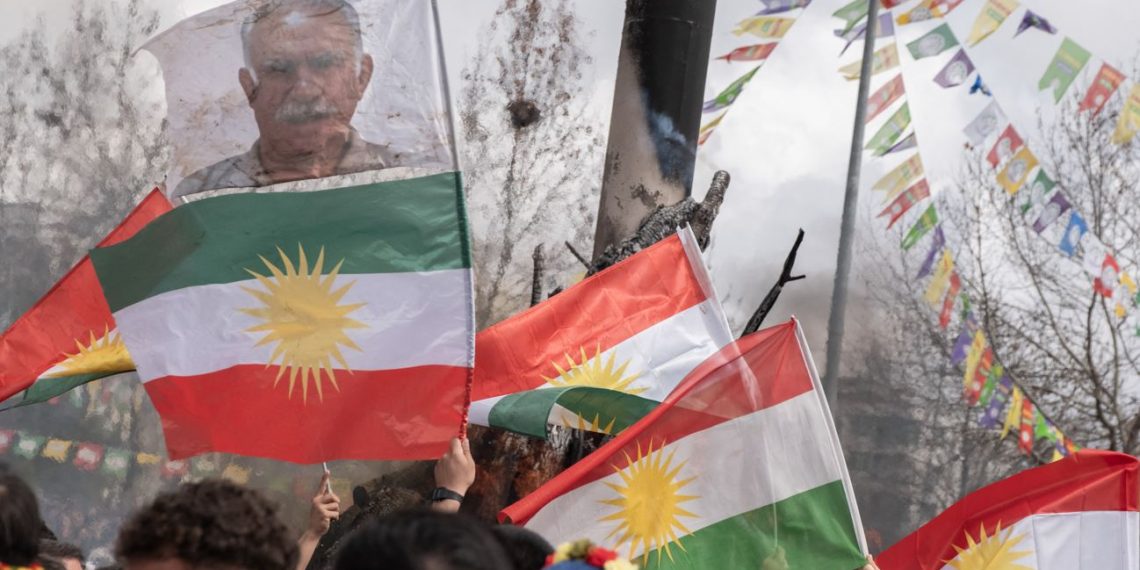
Marking the one-year anniversary of the Kurdistan Workers’ Party (PKK) announcing its self-dissolution and ending the armed struggle phase—which took place during the party’s 12th Congress held in the Kurdistan mountains from May 5 to 7, 2025—leaders Mustafa Karasu and Sozdar Avesta held a press conference on May 5, 2026. The conference aimed to discuss the developments of this phase and answer journalists’ questions regarding the progress of the dialogue and negotiation process between the PKK leader, Abdullah Öcalan, on one hand, and the Turkish state, represented by the two ruling coalition parties: the Justice and Development Party (AKP) and the Nationalist Movement Party (MHP), on the other. The two leaders detailed the steps taken by the PKK since the date of its historic 12th Congress, such as the weapon-burning ceremonies, the withdrawal of a group of fighters from Turkey, its continuous declaration of commitment to the peace and negotiation process, and its consideration of its leader, Abdullah Öcalan, as the sole representative and interlocutor for the Kurdish side—who is thus capable of leading this phase, negotiating with the Turkish state, and setting Kurdish priorities.
Leaders Karasu and Avesta also criticized the sluggishness of the Turkish government regarding the implementation of the resolutions issued by the “National Solidarity, Brotherhood, and Democracy” committee. Although these resolutions did not touch the core of the Kurdish issue and failed to provide fundamental, radical clauses for its solution according to the Kurdish leaders, the Kurdish side accepted them as an initial framework to pave the way for the “Peace and Democratic Society” phase. This was meant to initiate the transfer of the entire file to the legislative and executive authorities to bring about the required legal and constitutional changes, followed by implementing reforms on the ground through which the Kurdish identity would be recognized, along with the acknowledgement of the cultural, linguistic, and administrative rights of the Kurds in the Kurdistan provinces and across Turkey. The two leaders also pointed to the Turkish government’s stalling in conducting a new assessment of Öcalan’s legal status. They reaffirmed the Kurdish side’s firm position on the necessity of releasing Öcalan from Imrali Island prison, where he has been detained since 1999, after removing all legal obstacles to that end.
They demanded allowing political, social, and media activities to communicate with him, and permitting the formation of an auxiliary team to process the ideas and proposals issued by Öcalan to oversee the “Peace and Democratic Society” phase, thereby contributing to consolidating a permanent solution, ending all problems, and opening a new page in the relations between the Kurdish people and the Turkish state (1).
Devlet Bahçeli, leader of the Nationalist Movement Party (MHP) and a close ally of Turkish President Recep Tayyip Erdoğan, who played a primary role in initiating the talks between the Kurds and the Turkish state, had made statements on May 4, 2026, before his party’s parliamentary bloc regarding Öcalan’s legal status. He called for granting him “an official role to help advance the peace process and end a decades-long conflict.” On May 8, Erdoğan commented on Bahçeli’s remarks, stating that there would be no backsliding on the steps taken so far, noting that the “People’s Alliance,” which includes his party and Bahçeli’s party, is “the guarantee for the success of this phase.” Sources noted that Bahçeli’s proposal came following accusations by Kurdish lawmakers charging the government with sluggishness in advancing the peace process between the Turkish state and the Kurdish side (2).
Cengiz Çandar, a member of parliament for the Peoples’ Equality and Democracy Party (DEM) and a well-known journalist, welcomed Bahçeli’s statements. He said that Bahçeli’s recent remarks regarding Öcalan’s legal status and his emphasis on the government’s need to take qualitative steps to advance the peace process and the democratic solution could be historic and decisive. He explained that without Bahçeli’s presence, the solution and negotiation process would not have launched in the first place, clarifying that it is imperative to establish and define legal mechanisms supervised by the competent bodies and authorities in the government to institutionalize the process officially.
He pointed out that Öcalan’s legal status is a crucial point that the Kurdish side cannot bypass, calling on the government to implement the decisions and recommendations related to the “Right to Hope” law, which allows for the release of prisoners sentenced to aggravated life imprisonment who have served the statutory term of 25 years. Çandar also demanded that the AKP-MHP coalition government involve the concerned parties and all human rights and political activities in the ongoing preparations to draft a “law for the upcoming phase,” or to bring the “draft of the special law” to light after agreeing upon it. He noted that the Kurdish issue is a major, pivotal issue that is a century old, and it is natural for temporary obstacles to emerge; however, the core is the legalization of the phase and the endeavor to have it adopted by the state and its institutions, so that the legal status of the fighters, political prisoners, and forced exiles becomes clear. He added that the passage of these required legal amendments and reforms must take place in parliament before the legislative recess at the beginning of June 2026 (3).
The Peoples’ Equality and Democracy Party (DEM) announced in an official statement that it has called on citizens in all regions and provinces of Kurdistan and Turkey to hold demonstrations supporting peace and a democratic solution, to condemn the state of stagnation, and to urge the Turkish government to accelerate the execution of legal and constitutional reforms to bring the process to its conclusions and achieve a permanent solution. This is scheduled for May 16, 2026, under the slogan “A Step for Peace.” The party’s statement mentioned that the solution and peace process has not witnessed any progress for 18 months, and that the government has not taken any tangible steps toward bringing about legal and constitutional reforms. The party stated that the demands will center on 4 points: First, clarifying the legal status of the leader of the Kurdistan Workers’ Party, Abdullah Öcalan. Second, the immediate release of sick political prisoners and accelerating the settlement of the status of the remaining political prisoners. Third, issuing laws that enhance public freedoms and amending current laws to serve the process of solution and brotherhood. Fourth, ending the system of seizing municipalities and appointing “administrative trustees” (4).
The negotiation and dialogue phase between the Turkish state and the Kurdistan Workers’ Party had begun with a prelude and groundwork laid by Devlet Bahçeli, leader of the MHP and Erdoğan’s ally, when Bahçeli deliberately shook hands with members of the DEM Party bloc on October 1, 2024, following a long period of hostility, accusations of treason, and fiery statements in which he used to call for banning the party and arresting its MPs under charges such as “terrorism,” “seeking secession,” and “threatening the unity of the country.” On October 22, 2024, in a speech before his party’s bloc, Bahçeli launched his call to Öcalan to come to parliament and deliver a speech before the DEM Party bloc, announcing the dissolution of the PKK and the abandonment of armed action against Turkey, hinting at legal reforms including the application of the “Right to Hope” law which guarantees Öcalan’s release. On October 23, 2024, during MP Ömer Öcalan’s visit to Imrali Island prison to meet his uncle, the Kurdish leader responded positively to Bahçeli’s call.
He pledged to do everything in his power to put an end to the armed conflict between the PKK and the Turkish state and to seek the appropriate ground to solve the Kurdish issue, pointing to the necessity for the state to step into the path of the solution by establishing a parliamentary committee to propose a package of legal and constitutional reforms that pave the way for recognizing Kurdish identity and culture, guarantee administrative rights, and resolve the files of fighters, political prisoners, and forced exiles. Öcalan also warned the Turkish state against continuing to gamble on violence, stating that if the Turkish state persists in its policy of denial and cultural assimilation against the Kurds and bets on more war and military resolution, it will begin to decay and shrink within Anatolia—meaning it will exit the geography of Kurdistan—but only after the entire region “from Baghdad to Damascus, and from Damascus to Mosul, and from Mosul to Erbil” is subjected to dozens of wars similar to what Gaza witnessed, meaning the occurrence of horrific massacres after which Turkey would fracture and partition.
On February 27, 2025, Öcalan announced the “Peace and Democratic Solution” initiative to resolve the Kurdish issue in Turkey, moving from “armed struggle” to the phase of “political struggle” within an atmosphere of “peace,” and within the framework of official programs and reforms to secure and solidify the “democratic solution.” In the initiative, he explained the circumstances under which the PKK was founded as a response to the Turkish state’s policy of denying Kurdish rights and identity. He also focused on the thousand-year-old historical relations between the Kurdish and Turkish peoples, stating that they stood together in a voluntary union to face the forces of hegemony, and stressed that respecting identities, freedom of thought, and organization for all components is only possible in the presence of a democratic society. Öcalan also called on the PKK to hold its congress, announce the end of the armed struggle phase, and dissolve itself. Öcalan clarified in the text of the initiative that achieving a democratic society is the foundation for accepting the Kurdish identity and lifting all restrictions imposed on the manifestations of this identity. He added that the phase of consolidating a democratic society is uniquely capable of ending a hundred years of official denial policies against the Kurds and placing the historical relationship between Kurds and Turks in a new context and path, independent of the exclusionary interpretation of the Republic, and away from the axioms of oppression and persecution pursued by the current monolithic Republic. Öcalan went on to argue that the language of peace, democracy, the renunciation of denial policies, and respect for identities and freedom of thought and organization is the only path capable of ushering the Republic, strong and fortified, into the second century of its existence (5).
Responding to its leader’s call and the “Peace and Democratic Solution” initiative he put forward, the Kurdistan Workers’ Party held its 12th Congress from May 5 to 7, 2025, deciding to dissolve itself and end the armed struggle phase. In its final communique, the PKK explained “the previous phase that drove the Kurds in Turkey to adopt the option of taking up arms and confronting the state’s policy of denial and cultural assimilation, and countering the authority’s continuous betting on oppression and the military-security approach.” The statement also explained “the international circumstances at the time,” speaking about “socialism and national liberation movements that bore arms in response to the tyranny and oppression of totalitarian military regimes.” On July 11, 2025, a group consisting of 30 female and male fighters from the military wing of the PKK carried out a symbolic ceremony in which they burned their personal weapons, executing the instructions of their leader Öcalan and demonstrating their commitment to the peace and democratic solution process.
On October 26, 2025, in a press conference in the Kurdistan mountains, PKK leader Sabri Ok announced the withdrawal of the party’s first military units from inside Turkey as a new gesture of goodwill. On the official side, the parliament announced the establishment of the “National Solidarity, Brotherhood, and Democracy” committee on August 5, 2025, comprising 51 MPs from the blocs represented in the Turkish parliament. The DEM Party bloc, which is the third-largest bloc in the Turkish parliament, rejected the endeavors of some Turkish parties and figures to name the committee by another title—namely, the “Turkey Without Terrorism” committee—insisting that the true spirit of the process called for by Devlet Bahçeli on October 22, 2024, must be represented, which Öcalan responded to, mapping out its benchmarks and engineering it in an initiative under the name “Peace and Democratic Society” launched on February 27, 2025. Accordingly, the name of the parliamentary committee (The National Solidarity, Brotherhood, and Democracy Committee) harmonized completely with the name of the initiative launched by Öcalan (6).
The committee held a total of 137 meetings and consultations with figures, actors, and institutions to delve into the required reforms and the legal and constitutional changes planned to recognize the identity and rights of the Kurds in the country. It also held a meeting with Öcalan on November 24, 2025, presenting him with a summary of its work. On February 18, 2026, the committee issued its extensive 60-page report on the Kurdish issue and the possibility of a democratic solution, which it titled “The Historical Roots of Turkish-Kurdish Brotherhood,” passed by a majority of 47 deputies, against the objection of two deputies and the abstention of another. The report included, in its main outlines, a set of reforms that the state will undertake to resolve the Kurdish issue and open the way for “Peace and a Democratic Solution.”
These steps are:
First: Disarmament and Legal Guarantees: The report calls for issuing a special, temporary law for the post-disarmament phase of the PKK, ensuring the reintegration of militants into society and providing legal immunity for individuals participating in the dialogue process.
Second: Judicial Reforms: The implementation of rulings by the European Court of Human Rights and the Constitutional Court was emphasized. It also proposed a review of the Penal Code, particularly regarding the release of sick and elderly prisoners, and distinguishing between political criticism and the crime of terrorism.
Third: Local Administrations: The report proposes making changes to the municipality system, stipulating that if a mayor is dismissed, the municipal council has the right to elect their replacement instead of appointing a trustee (kayyum).
Fourth: The Brotherhood Law: The report depicts the history of Turks and Kurds as a “shared destiny,” calling for transcending the language of violence and building a new civil constitution (7).
The peace process between the Kurdish movement and the Turkish state is experiencing a state of stagnation and “frustration,” weeks after lawyers or members of Öcalan’s family have been unable to obtain permission to visit Imrali Island. This is compounded by the Turkish authorities’ rejection of numerous other requests to visit Öcalan, including the request submitted by the “Mothers for Peace” association on May 8, 2026. This brings to mind the scene that began at the start of 2024 and continued until the announcement of the recent peace and democratic solution phase, during which the Turkish authorities rejected dozens of requests to visit Öcalan in Imrali, including requests submitted by human rights, social figures, and organizations—the first of which was on December 22, 2024, submitted by the “Lawyers for Freedom” association, which includes 1,300 members (8).
A state of optimism had emerged, particularly after Öcalan’s initiative on February 27, 2025, which constituted a pivotal turning point in the trajectory of the Kurdish issue in Turkey in terms of ending the armed struggle and calling on the PKK to dissolve itself, followed by the party’s interaction with the call in its 12th Congress between May 5 and 7, 2025. Following that was the televised message in which Öcalan appeared in his first public audio and video appearance since his abduction in 1999, presenting assessments that represent the summary of the reviews he has been conducting for long years—whether regarding the path of the PKK, the reality of the Kurdish people inside and outside Turkey, or the successive changes inside Turkey and across the region.
A massive dynamic appeared on the Turkish political scene, turning into an official “peace phase” after it was endorsed by the main parliamentary blocs, leading to the approved formation of a special parliamentary committee launched under the name the “National Solidarity, Brotherhood, and Democracy” committee on August 5, 2025. This committee conducted hundreds of meetings with political, social, cultural, and human rights figures, as well as labor, doctors’, and lawyers’ unions, and a wide spectrum of civil society associations and organizations. It met with Öcalan and officials in the Turkish state, and subsequently issued its report in the first quarter of the current year 2026, which bore the name “The Historical Roots of Turkish-Kurdish Brotherhood,” and included recommendations for the government to carry out constitutional and legal reforms capable of opening a new page in the relationship between the Kurds and the Turkish state.
Three months have now passed since the “National Solidarity, Brotherhood, and Democracy” committee issued its report, thereby placing the ball in the court of the Turkish government, which is supposed to work on translating the clauses mentioned in the committee’s report into constitutional and legal reforms and amendments to be voted on in parliament.
This would make them enacted and open the way for the “Democratic Society,” where Kurds can practice politics with their identity and manage their regions with broad administrative powers, after the state amends its laws and lifts restrictions on Kurdish identity and culture in the country. No tangible field movement has taken place for over 3 months. A state of stagnation is being witnessed in the “peace phase” despite Bahçeli’s recent statements and Erdoğan’s assertions that “the phase is ongoing, and there will be no backsliding.”
There are those who link this state of stagnation to recent developments in the region and the US-Israeli war on the Iranian regime. Some say that the Turkish government is preoccupied with the war and monitoring its repercussions and developments, and has therefore temporarily turned away from handling the Kurdish file and following up on the peace process and dialogue with the Kurds. Other opinions speak of a deliberate delay and “intentional slowdown,” particularly on Erdoğan’s part, for domestic calculations and balances related to the elections and the nature of future alliances to contest them. Erdoğan is reportedly demanding that the DEM Party indirectly join the “People’s Alliance” and consequently vote for him in any upcoming elections before executing any legal reforms to lift restrictions on the Kurds or implementing the “Right to Hope” law under which Öcalan would be released from prison. Proponents of this view rely on the fact that no meeting has taken place with Öcalan for more than a month and a half, linking this measure to pressure from the government and the ruling party on the Kurdish side.
Furthermore, sources speak of a Turkish request directed to the PKK to disarm and surrender its weapons before the government proceeds to issue any laws concerning the Kurds or releasing Öcalan and thousands of political prisoners—foremost among them Selahattin Demirtaş and Figen Yüksekdağ, the former co-chairs of the Peoples’ Democratic Party (HDP), who have been detained since 2016 and sentenced to 42 years and 30 years respectively. These sources indicate the Turkish government’s refusal to release them, and thus its direct responsibility for the politicized, intentional delay of the Court of Appeals session for two full years to look into the appeals submitted by them and other politicians in the lawsuit known in Turkey as the “Kobani case,” until “concessions” are extracted from the Kurds.
Considering the major changes in the region since October 7, 2023, the Israeli-US attacks on Iran in the summer of 2025 and spring of 2026, the domestic political balances in Turkey, the declining popularity of the ruling party and its partner, the power struggle with the Republican People’s Party (CHP), the decline of the Turkish economy, and the emergence of livelihood crises, the Turkish state is the party most in need of reaching a kind of internal calm to strengthen “national cohesion” in the face of any external threat, cool down the “Kurdish front,” and secure support from the third-largest party in the country in any upcoming elections—should a comprehensive understanding be reached with the Kurds and compliance given to the demands of Öcalan and the Kurdish movement. Consequently, the time factor is in favor of the Kurdish side, not the Turkish government, which finds itself, domestically and externally, in a poor position and under great pressures and obligations—some resulting from the legacy of long years of neglect, arrogance, and monopolization of power, and others resulting from rapid regional developments that have demonstrated the extent of Turkey’s helplessness, weakness, and lack of influence in its surroundings and the region as a whole.
References:
Leadership of the Apoist Movement: The Status of Leader Apo Must Be Clarified and Legal Steps Taken. Firat News Agency (ANF) Website. Publication Date: May 5, 2026.
An ally of Erdoğan calls for granting a jailed Kurdish leader an official role. Reuters News Agency website. Publication date: May 5, 2026.
The Key to the Process is Status and Legal Adjustment.” Firat News Agency (ANF) Website. Publication Date: May 9, 2026.
https://kurmanci.anf-news.com/
DEM Party Takes to the Fields for the Resolution Process. Rudaw TV Website. Publication Date: May 9, 2026. https://www.rudaw.net/
Content of the “Call for Peace and Democratic Society.” Official DEM Party Website.
Tariq Hamo: Öcalan.. The Democratic Society and the End of “Monolithic Turkey”! Kurdish Center for Studies. Publication date: November 12, 2025.
A Year Since the Call for “Peace”.. The Kurdish Issue from the Gallows Platform to the Parliament Lobby. Turkish Studies Unit at the Kurdish Center for Studies. Publication date: March 18, 2026.
Yilmaz Yilmaz: Justice Ministry Fails to Respond to Applications. Azadiya Welat News Website, May 8, 2026. https://azadyawelat.com/