


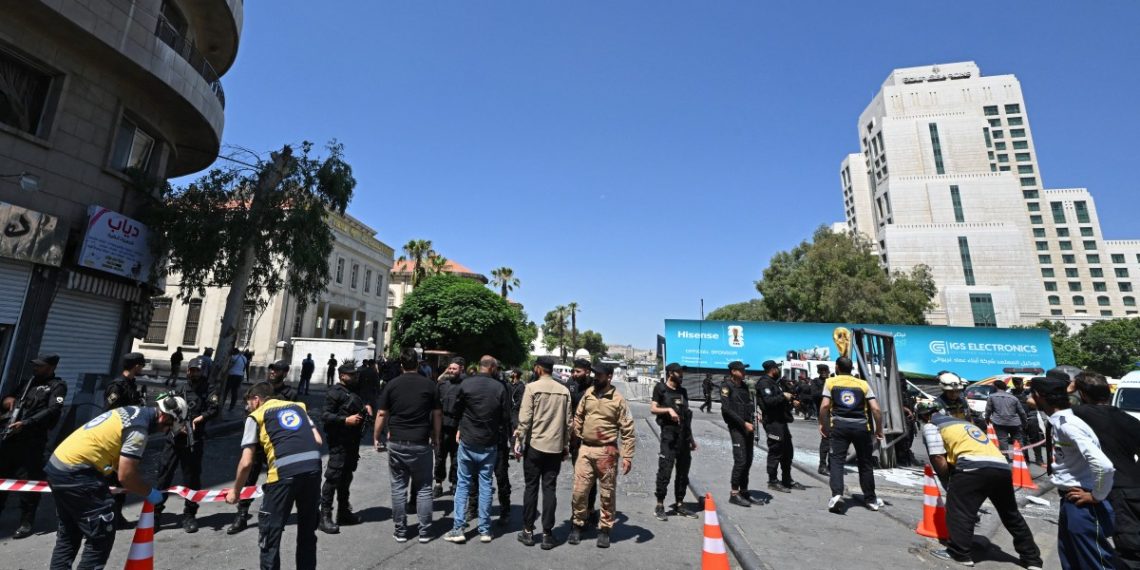
Not far from the residence of French President Emmanuel Macron in Damascus, two explosive devices detonated, with no group claiming responsibility for the blasts. While the French President was en route to the People’s Palace, the Élysée reported that the President did not hear the sound of the explosions. In turn, the transitional Syrian President, Ahmed al-Sharaa, hailed Macron’s “courage” and his determination to complete his itinerary, which is dedicated to economic relations between his country and Syria.
The occurrence of the explosion shortly before the convening of the NATO summit in Ankara, and during the first visit by a French president since 2009, leaves questions that may open the door to a range of possibilities regarding the nature of the party behind the incident. On the other hand, however, it provides answers regarding the reality of the new authority’s security infrastructure and the potential existence of loopholes and breaches that could shake the confidence of Western and Arab nations in the trajectory and viability of investing in Syria.
Excluding the External Factor
There is nothing to confirm the hypothesis that external parties stand behind the bombing incident. While analysts close to the authority point to Israel as being behind what occurred, such an accusation harbors a malicious character or a simplistic approach that preempts investigations and seeks to cover up the security failure, just as it aims to divert attention from the existence of gaps and recurring flaws within the security apparatus.
Similarly, there is a view pointing to Turkey, suggesting it is unwilling to see France compete with it over investment opportunities and a presence on the Syrian coast. Such a view/accusation overlooks the fact that Ankara has an interest in the banking facilities that Paris might contribute to, in order to facilitate the work of the Turks themselves inside Syria. Added to this is Paris’s contribution to securing a European depth for Syria, which is preferred by Ankara over imposing a European isolation on the Syrian administration. Most importantly, there is no evidence that France is competing with Turkey for influence and strategic projects within “Useful Syria.” Furthermore, Ankara can exercise its direct influence on Damascus instead of resorting to indirect means and sending veiled messages that damage the reputation of its Syrian ally.
Just as the exclusion of Israel and Turkey can be assumed, the same applies to Iran, as it is not unlikely that there is an Iranian reading that sees it as not in its interest to cast doubt on the security competence of the authority in Syria. If suspicions are linked to the possibility of Damascus engaging in tightening the screws on Hezbollah directly or indirectly, Tehran does not act on the basis of suspicions to turn them into proactive policies centered on dragging Syria into a scenario of bombings, car bombs, and improvised explosive devices (IEDs) like what happened in post-Saddam Hussein Iraq. This is while noting that the relationship between Tehran and Damascus, though not at its best, is not in such a state of clash and deterioration; it is, therefore, a relationship subject to a delicate balance that might be best expressed by what Ahmed al-Sharaa said last April during his participation in a panel discussion at the Royal Institute of International Affairs (Chatham House), stating that Syria will remain outside the conflict between Iran and the United States. Perhaps the Iranians see, in return, that they will not be dragged into a conflict with a Syrian authority bearing sectarian features that cannot be underestimated, always on the principle of Tehran’s unwillingness to “multiply” its enemies.
What About the Inside?
Among the flaws of any political analysis concerning the conditions of the new authority is that we know a great deal about its “friends,” while we miss a lot regarding the knowledge of its enemies. In this sense, expecting the Damascus bombings to be the result of a chronic security flaw—manifested in the inability to know the individuals within the security apparatus, especially those who infiltrated it from adversarial currents like ISIS or Hurras al-Din, or even some disgruntled figures from within the authority itself who are dissatisfied with the approach of cooperation and “alliance” that Damascus displays toward Western capitals, accusing it of “dependency” on the West—is plausible. Perhaps the moment of the French President’s presence in Damascus represented the appropriate time to deliver bloody messages similar to the methods of jihadist groups elsewhere, when they used to remind everyone through car bombs and explosive devices that they are still present on the ground.
It is impossible to link all previous incidents to a single party, including an “operative” within the security forces killing two American soldiers in Palmyra at the end of 2025, followed by the penultimate bombing in a cafe opposite the Justice Palace in Damascus a few days ago, and other operations, some of which were claimed by ISIS while responsibility for others remained unannounced. The question remains: is there a specific entity standing behind all these events, or are we facing a basket of adversaries, as was the case in an Iraq divided into violent currents: Al-Qaeda, the “Naqshbandis,” and Baathists? Most likely, all violent acts are an expression of a multiplicity of dispositions, but their rotation around the objective of thwarting the authority or bending it to accept their conditions does not necessarily represent a unity of goals, including what was carried out by the “remnants” of the former regime.
It is unlikely that the French jihadists led by Omar Omsen, who is responsible for the “Ghuraba Camp” near Harem, played a role in disrupting the French President’s visit to Syria. This is because the only clash that occurred between the French jihadists and government security forces in October 2025 ended in a reconciliation mediated by Uzbek mujahideen, and the relationship between the two sides has seen no tensions since then, especially since France has not raised the demand for them to the level of an urgent requirement that Damascus must fulfill; rather, it turned a blind eye to their presence in their camps. The Syrian containment of these jihadists has constituted an ideal case for Paris, which senses no danger in keeping them in the Harem “ghetto.”
The two bombing incidents in Damascus may pass without revealing who stands behind them, especially if they were carried out by infiltrated elements, or by those holding an opposing ideology that rejects Damascus’s behavior and its Western openness. In any case, the truth will be subject either to obliteration or to being reframed in a manner that serves the authority’s narrative. This is because embarrassing the authority regarding its security capabilities and its capacity to control the situation, particularly in the capital, is the most important message that those responsible for the two bombings wanted to deliver on the day following the French President’s visit to Damascus and the flocking of NATO leaders to Turkey, where the alliance meeting is being held. Perhaps the nature of the two bombings, which did not target sensitive security assets, influential internal figures, or foreign guests, makes the nature of the event purely a message.
Has Paris Been Affected by What Occurred?
The French President dealt with the situation with boldness and without amplifying the explosion incident. In French calculations, there are dealings with countries, and within countries, that have witnessed difficult security events. However, Paris, unlike other European nations, engaged in working with their governments, as seen in France’s relationship with Iran at the onset of the unrest that swept Tehran following the fall of the regime of Mohammad Reza Shah, and Saddam Hussein’s Iraq in the period between 1991–2003, as well as in post-Gaddafi Libya, in numerous African countries, and now in Syria.
French pragmatism is not naked in the way it is with the Trump administration, where everything is almost laid bare in terms devoid of elusive French politeness. France has always succeeded in choosing sub-headings that reflect the “spirit” and ideals of the Republic, such as justice, equality, inclusive governance, transitional government, democracy, and public freedoms. Former French President Nicolas Sarkozy had previously visited Damascus in 2008—that is, three years after the assassination of Lebanese Prime Minister Rafik Hariri, at a time when France was supporting the path of holding those responsible for Hariri’s killing accountable through the Special Tribunal for Lebanon established in 2007—an action that brought widespread criticism to Paris following the visit, to which it paid little attention.
During the first visit by European foreign ministers who came together to Damascus in early January 2025, French Foreign Minister Jean-Noël Barrot, alongside his German counterpart Annalena Baerbock, presented a basket of demands in exchange for dealing with al-Sharaa. Among these was the commitment to a comprehensive and peaceful transition of power, societal reconciliation, and guaranteeing the rights of women, minorities, and the Kurds. This was incorporated in similar phrasing during the Paris Conference to Support the Transition in Syria in February 2025, attended by 20 countries, and the same was emphasized by Macron while receiving al-Sharaa at the Élysée during the first visit made by his Syrian guest to a Western nation.
With Macron’s recent visit, the economic forum, and the signing of agreements and contracts, Paris does not seem committed to the initial lines it attempted to draw regarding its relationship with the new Syrian government. This is because economic attractions, the search for alternative energy routes, and a presence on the eastern coast of the Mediterranean represent a flexible means to have a say inside Syria, in a manner that also reflects on the situation in Lebanon as well as the Syrian-Israeli “peace” file. On the other hand, a policy of marginalizing the Syrian authority represents a French departure from playing its roles in the Eastern Mediterranean, something France has realized in more than one country that witnessed security collapses or civil wars.
In conclusion, it appears that the message of the bombing and the implications of its timing did not affect the core of the French visit to the People’s Palace, especially since the visit, headlined by the conclusion and signing of economic agreements, does not conflict with regional and international policies; rather, it may garner the required acceptance. This means that the relationship between Damascus and Paris has become clearer, where the demand for judicial and security reform and the safeguarding of French interests take precedence over the initial conditions that spoke of a comprehensive and peaceful transitional phase for authority and an inclusive government that accommodates all Syrian groups.