


The interim Syrian President, Ahmed al-Sharaa, stated in remarks to journalists that a security agreement with Israel is a “necessity” and would serve as a “prelude to the conclusion of further agreements.” Meanwhile, the interim government—represented by Foreign Minister Asaad al-Shaibani—concluded an agreement dubbed a “roadmap” with both Jordan (Foreign Minister Ayman Safadi) and the United States (Ambassador Tom Barrack). Barrack, in a post on his X account, described it as “not only charting a path for recovery, but one that future generations of Syrians can follow as they build a homeland rooted in equality of rights and responsibilities.”
Regardless of the interim government’s engagement with foreign actors on what is fundamentally an internal Syrian issue—and its attempt to impose “fundamental solutions” that purport to be a “path for future generations,” as Barrack claimed—the deliberate exclusion of the people of Suwayda and their administrative and military representatives cannot go unremarked. Their absence from the meeting that produced this “roadmap” makes clear that the underlying problem remains unresolved. So long as the authority continues to ignore Suwayda’s political will and opts, as it habitually does, to bypass national consensus and political participation with local actors—choosing instead to negotiate with foreign powers and hand over sovereignty—it renders these efforts illegitimate. As if to confirm this dynamic, the Jordanian Foreign Minister explicitly noted that the roadmap also guarantees “Israel’s security.”
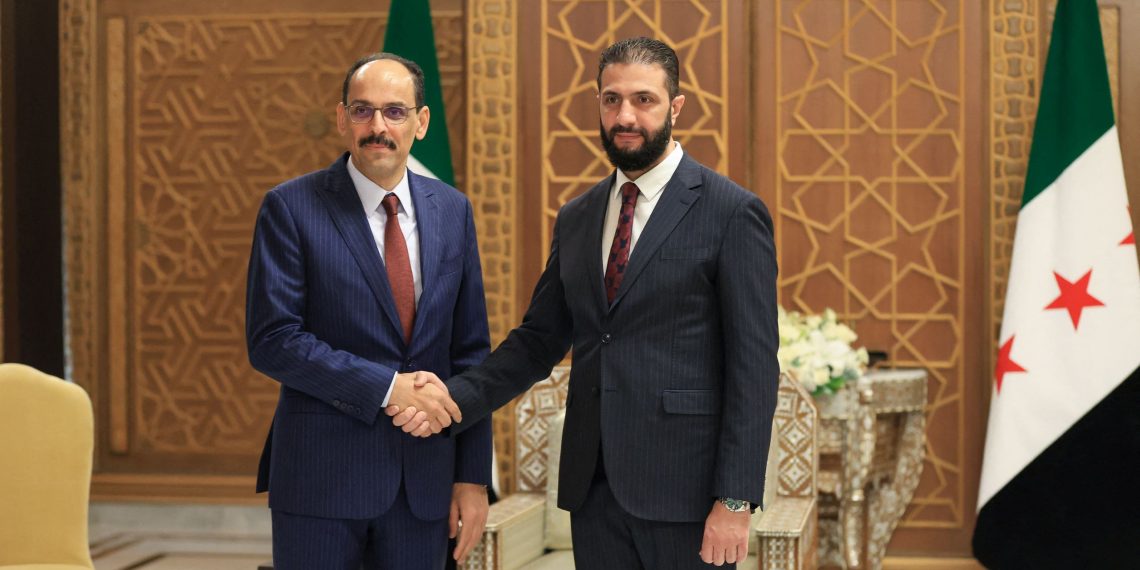
Amid the flurry of political maneuvering in Damascus, talk of a “security agreement” with Israel, and the crafting of a “roadmap” concerning Suwayda, Ankara—determined to remain at the heart of developments and secure the largest share of the “Syrian cake”—swiftly dispatched its intelligence chief, Ibrahim Kalin, to Damascus to meet with al-Sharaa. According to Turkish media, the meeting addressed “regional developments, the fight against ISIS, and the refugee file.” Kalin had previously visited Damascus in May, where he engaged with authorities on the March 10 agreement between the Syrian Democratic Forces (SDF) and the interim government. Ankara is exerting pressure to prevent Damascus from recognizing a decentralized model for northern and eastern Syria, or from accepting the integration of the SDF as a unified, independent structure within a reformed Syrian army. Turkey also seeks to influence the nature of the upcoming “security agreement” with Israel, ensuring that any peace or normalization efforts do not occur behind its back. In essence, Turkey wants a regime that remains within its sphere of control, follows its script, and respects the “red lines” drawn by the Sublime Porte—one that recognizes both its own limits and Turkey’s centrality.
The authority of Hay’at Tahrir al-Sham (HTS) is acutely aware of the scale of the struggle over Syria, and of the power wielded by regional actors—particularly Israel, which drew its red lines from the very first hours of HTS and its allies’ arrival in Damascus. Israel destroyed Syria’s heavy weaponry, expanded its military and intelligence footprint in the south, and placed limits on Turkish influence by targeting and dismantling bases Ankara had begun to develop.
From here, Syrian Authoruties (HTS), versed in the “jurisprudence of war” and the strategic principles of “patience and waiting,” “prohibition of aggression,” and “empowerment,” appears intent on de-escalating, weathering the storm, and ensuring its own survival amid the clash of powerful actors on Syrian soil. There is a clear willingness to accommodate foreign influence, to surrender national sovereignty, and to cede parts of Syria to Turkey and Israel alike—all in the interest of retaining power. The aim is to convert this “functional role” and mutual accommodation with external actors into a system of reciprocal services, bolstering the faction’s grip on power and deflecting attention from the massacres and violations it has committed—and continues to commit—against the Syrian people. This approach is driven by narrow factional interests, not national ones. It rests on the belief that foreign backers are the sole guarantors of continued rule, thus negating the need for democracy, national consensus, or power-sharing with other forces. In other words, the faction seeks to evolve into a functional oligarchy that bows to external demands while remaining rigidly opposed to internal calls for democracy and the peaceful transfer of power.
One of the main reasons driving the authorities to depend on foreign powers and play all sides—just as we have seen over the past few months—is their desire to tighten their grip on all aspects of the country and not relinquish control of the state (their state). This is evident in their rejection of decentralization and recognition of Syria’s diversity and societal specificities, as well as their refusal to lift bans on national political forces and parties. The authorities aim to establish a subordinate, highly centralized state, governed by a minister appointed through fake quotas, along with a subordinate cleric or supervisor who is linked to the top of the pyramid and to whom they owe complete loyalty. There is a clear obsession within this faction to rule the country with a rigid, centralized authority, suppressing all wills emerging from the regions and components. And in order to escape the horrific crimes they have committed, they are willing to abandon land and sovereignty, and to distribute the country among this axis or that, each according to their strength, brutality, and the extent of harm they can inflict.