


Many people, including journalists and media figures close to the Damascus authority, and Arabs who belong to the axis supporting this authority (which whitewashes all its policies and moves and skillfully conceals all its violations against the Syrian people), are competing to heap praise on the policy and diplomacy of the interim President Ahmed al-Sharaa. They describe how he is cleverly proceeding to “zero out” his country’s problems and open channels with regional and international powers that were hostile to him and he to them just a year ago, practicing pragmatism to its fullest extent.
To bolster their narratives aimed at justifying the transformations of al-Sharaa and his authority, these individuals invoke stories and narratives from the Islamic heritage, usually starting with the Quranic verse: “But if they incline to peace, you also incline to it and rely upon Allah. Indeed, it is He who is the Hearing, the Knowing,” and listing the necessities of the “empowerment phase” according to the principle of “averting harm/corruption” (Dar’ al-Mafasid). This is in addition to resorting to the “original principles” of political science in the West and how to manage and protect the state by bending to the storm and submitting to overwhelming powers, to ward off their evils and prevent their dangers, among other well-known Machiavellian principles in politics, or what was historically known as “the science of governance principles”!
This groundwork was laid for the new phase following the overthrow of Bashar al-Assad’s regime by “Hay’at Tahrir al-Sham” (HTS) and its replacement in the “Victory Conference.” Theorizing about these transformations has become part of the new state institutions’ work, supervised by the ministries of foreign affairs, information, and culture, with the arsenal of arguments and justifications constantly being reinforced by new references from local and global heritage. This occurred during al-Sharaa’s visits to Arab capitals, which he had previously sometimes accused of apostasy and deviation from the faith, and at other times of subservience to the nation’s enemies and the forces of arrogance. This was when he was the head of the “Idlib Emirate” and appeared among his soldiers wearing a black turban, coupled with his nom de guerre “Abu Mohammad al-Jolani”. The pace of theorizing and justification intensified with al-Sharaa’s visits to France and New York, reaching its peak with his visit to his organization’s archenemy: the Russian Federation!
The visit to Moscow and the meeting with President Vladimir Putin showed al-Sharaa’s determination to move all his authority’s former opponents—or those who might turn into opponents in the future due to damage to their interests from the recent shift or fear of other powers seizing their areas of influence—out of the “enemy” category and into the “friend” category. He dangled a set of incentives and inducements, starting with prioritizing them in reconstruction projects, investment, and the renewal of the oil sector, and not ending with maintaining the military presence, but rather consolidating it if that becomes a priority for this “friend.”
During the Moscow visit, al-Sharaa focused on the “depth of historical ties” between Damascus and Russia, on the “bilateral relations and common interests linking the two countries, and respecting all past agreements.” This means that the Russian presence will remain strong in Syria, and will not be limited to the Hmeimim airbase and the naval base in Tartus (which may expand in the future, or Moscow may be granted other military bases). Instead, relations will strengthen into something akin to a strategic alliance, given the Damascus authority’s adherence to all “previous agreements” signed by the Assad regimes (father and son) since the so-called “Correctional Movement” in 1970.
Defenders of al-Sharaa’s policy of “opening up” to Russia say that one of its facets is due to Moscow’s “advanced position” regarding the “Deterrence of Aggression” operation that ended Assad’s rule. They claim there was an old understanding between Russia and “Hay’at Tahrir al-Sham” that led Moscow to refrain from providing military support to Bashar al-Assad’s regime against the advance of the “Deterrence of Aggression” factions. This granted the attacking factions a significant opportunity to advance without fear of the bombs and missiles of the Russian Air Force, which had brutally attacked thousands of armed men and Syrian civilians opposing the rule of Moscow’s former ally, since the Kremlin’s military intervention in Syria in the autumn of 2015, transforming it into a key and decisive player in the Syrian political and military scene. For its part, al-Sharaa’s authority protected Russian interests and “controlled” the Syrian street angry at Russian support for the Assad regime. Russian embassies, consulates, or cultural centers were not subjected to any attack, while the Russian military presence on the coast was suppressed on both the media and political levels.
Furthermore, the prominent Russian presence in the warm Syrian waters, and Moscow’s long hand on the coast, will give al-Sharaa’s authority a feeling of comfort and security. Russia will fill the vacuum and relieve the authority of some of the burden by contributing to calming matters. Naturally, it will undertake not to support those the authority describes as “remnants,” and to refrain in the future from assisting any armed movement that may emerge within the Alawite community, which was subjected to massacres last March and is currently exposed to systematic persecution and tightening. Moreover, the Russian presence, according to Damascus, will create a kind of balance with the American role, and will cover at least one geographical area, imposing a kind of “security” and a touch of “neutrality,” thereby protecting it from the ambitions of allies like Turkey and others. In another calculation, this also means protecting it from future Israeli attacks.
The authority appears to genuinely have a comprehensive vision for “zeroing out problems” with all regional and international actors, including those that intervened and became directly involved in the Syrian crisis and whose military support, whether for the regime or the armed opposition, contributed to prolonging the Syrian bleeding, or those who practically occupy areas of Syrian geography, such as Israel and Turkey. All of this is to consolidate its rule and establish the pillars of the (factional) state it is striving to establish now.
There are no radical solutions implemented according to international law or UN resolutions regarding the Israeli and Turkish occupations of Syrian territories, nor are there agreements based on national interest, such as obtaining an apology from Russia for its role in the Syrian civil war, and demanding compensation for the families that the Russian military machine destroyed and scattered. The authority does not take the interests of the Syrian people or the safety and sovereignty of its homeland into account when dealing with foreign parties. Instead, it proceeds from its own interest: that these relations (or, more accurately: concessions) in their new format contribute to consolidating its rule (the rule of the faction) and presenting itself to the outside world as an entity capable of preserving the interests of those it agrees with. It grants them all the privileges they desire from Syria, with a quick, centralized, individual decision, and without the need for mechanisms imposed by democratically elected institutions, such as the People’s Assembly (Parliament), and in the complete absence of opposition and critical media, with the authority confiscating political life and banning established national parties.
It is a mindset and methodology of “The Foreign First,” in the fever of the authority’s efforts to arrange the cards and impose new equations through which it can succeed in shaping a reality that is solely in its favor. A reality that imposes the authority on the Syrian people, blocks the roads for Syrians and national forces and parties who reject this authority, leaving them all alone, exposed, facing a functional authority that organizes its position through concession to foreign parties and satisfying one party or another, each with a different style and method, and always by granting each party a piece of the “Syrian cake,” so that it can then focus on the internal front, marginalizing the forces opposing its rule and persecuting all those striving to build Syria as a state of law and institutions with a decentralized, democratic format.
Anyone looking at the rule of the “Hay’at Tahrir al-Sham” authority over the past ten months will find only the disasters it has brought upon the Syrian people: from the massacres on the coast against the Syrian Alawite component to the clashes in Damascus and the attacks on Suwayda against the Syrian Druze component, leading to the threat (and empowerment by the Turkish military machine) against the Kurds and the Autonomous Administration in northeastern Syria.
Now, the authority is moving to satisfy all parties at the expense of the Syrian people and homeland, practicing tolerance and “transcendence” at the expense of Syrians, and calling it pragmatism and political “cunning.” It is trying to “bring the Levantines and Moroccans together” as the Egyptian proverb goes, and is betting on creating consensus between countries whose interests conflict across the entire region, not just in Syria. Hence, it finds no difficulty in claiming to create consensus and reconciliation between Israel and Turkey, the United States and Russia, and Qatar and Saudi Arabia on Syrian soil!
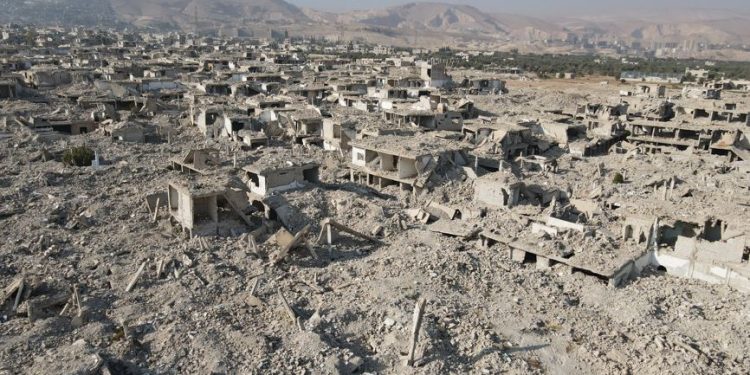
For its part, the media chorus (Pharaoh’s sorcerers) continues to invent justifications and rationales for this authority, and continues to cover up its concessions to foreign parties, just as it covered up its violations against Syrians internally. It goes on praising and glorifying the “necessary authority” busy “zeroing out problems” with the outside world, to build the coveted “Singapore model.” A model that Ahmad al-Sharaa recently discovered he is light-years away from achieving, especially since reconstruction, meaning reaching “Syria 2011″—the Syria before the outbreak of the civil war—requires $600 to $900 billion!