
In a short story by the great Russian writer, Anton Chekhov, a simple fisherman is brought before the court on a charge that might seem trivial at first glance: stealing a bolt from a railway track to use as a weight for his fishing line. The man, in his apparent innocence, does not grasp the gravity of his action. He stands before the judge, defending himself and his village with a logic that seems reasonable from his perspective: “We make sinkers out of the nuts, and there’s nothing better; they’re heavy and they have a hole.”
When the judge warns him that his action could cause the train to derail and innocent people to perish, the fisherman replies with absolute confidence: “God forbid! Do you think we are evil infidels? We understand, and that’s why we don’t unscrew all the nuts; we always leave some.”
This literary scene, despite its apparent simplicity, carries within it a philosophical and social depth that transcends the boundaries of the text to become a mirror reflecting many contemporary phenomena.
Chekhov’s story reveals a deeper conflict between two different logics: the logic of immediate individual need, and the logic of public interest and collective responsibility. The fisherman sees the nut merely as a useful piece of metal for his personal need, while the judge understands that it is part of a larger system, and its removal could lead to catastrophe.
This contrast in vision—this difference in perceiving interest and responsibility—is tragically rooted in the contemporary Syrian landscape. When we contemplate the ongoing discussions about the Syrian crisis, we find that each party speaks as if living in a completely different reality from the other.
Opinions vary and perspectives diverge regarding the Syrian scene in a way that is simultaneously astonishing and alarming. Upon scrutinizing these views, one might imagine that each party is talking about an entirely different issue. Even when the subject is specific and clear, we find a sharp divergence in vision that resists reconciliation, mediation, adaptation, or adjustment!
This discrepancy is not merely a difference of viewpoints, as is natural and expected in any healthy society; rather, it is a radical contradiction in understanding the very nature of the problem, in determining the priorities for a solution, and even in defining the concept of homeland and citizenship, and the concept of Syria and the Syrian phenomenon today.
A state of chronic separation and acute divergence prevails in the Syrian landscape. The parties do not meet on a shared “ground,” nor do they share a single “sky,” nor are they shaded by the “roof of the homeland” that political speeches have long celebrated.
Today, Syrians are also living in temporal parallelism: some are still in the past, some are in the present defending “their state,” and others are searching for safety and a loaf of bread. Three different dates for “one people,” as if the train is moving and the passengers are looking out of windows that overlook widely separated eras. This geographical and psychological distance between the interlocutors is reflected in their perceptions, priorities, and intentions, making dialogue a kind of “pursuit of the impossible,” even assuming good intentions and sincere will from some parties.
The most that is happening today on the Syrian arena is a form of dialogue or deliberation on the “public affair,” but it is a dialogue of a special kind: one that widens the gap instead of narrowing it, turning natural difference into a profound dispute, and even a raging conflict, not only on the ground but also in the skies.
Dialogue no longer links two shores; instead, it has become a bridge built only from one side. The other party sees it as a hangman’s noose presented with a diplomatic smile, leading them to intensify the cutting of what remains of the ropes of trust, so that they never have to cross it one day.
This alarming shift from the logic of constructive dialogue to the reality of destructive conflict, governed by narrow purposes and factional interests, reminds us of the fisherman in Chekhov’s story, who speaks using the collective pronoun “we” while serving his personal interest, unaware that his action could lead to a catastrophe that affects everyone.
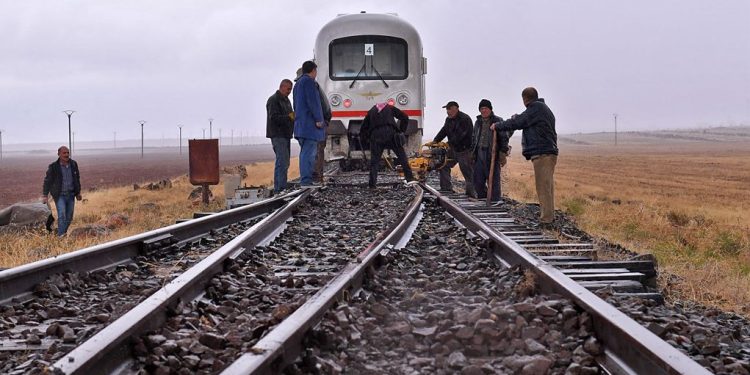
In this context charged with tension and division, we find ourselves facing a terrifying scenario: some parties, in their pursuit of short-term goals, seek to undo the “last bolt” on the Syrian train tracks, disregarding the catastrophic consequences that may result.
These individuals, exactly like Chekhov’s fisherman, justify their actions with narrow and shortsighted logic, believing they “understand” what they are doing and that they are leaving “some bolts” to ensure the train’s safety. But the bitter truth is that every bolt undone brings the country one step closer to the abyss, to the possibility of the train completely derailing and shattering.
The more alarming fact is that some of us no longer even want the train to stay on the track. Undoing the bolts has become a goal in itself, not for better fishing, but because revenge has become more precious than survival. At this moment, the Chekhovian fisherman ceases to be an innocent ignorant and becomes a conscious criminal. The irony is that the one who shouts the loudest today, “We do not want partition,” is the same one who has spent the past years building psychological walls, zones of influence, separate narratives, and conflicting stakes that cannot be gathered into one homeland.
The lesson learned from Chekhov’s story, and its painful projection onto the Syrian reality, is that partial solutions and narrow interests, no matter how logical and justified they may seem from the perspective of their proponents, can lead to collective catastrophes whose magnitude or consequences cannot be predicted.
And just as the bolt does not feel that it is part of a train until it falls, many Syrians no longer feel they are part of a homeland. The homeland has become for them merely a background for a selfie, a childhood memory, or a reason for hatred. When this feeling disappears, undoing the bolts is no longer a crime, but merely cleaning up a place we no longer want.
The worst part is that we have started talking about Syria in the past tense: it “was” a country, we “were” a people. The future has disappeared from our lexicon, and only the heavy present remains: a moment where we continue to undo a new bolt to postpone the admission that the train stopped long ago.
Salvation from this predicament requires a fundamental redefinition of the concept of “national interest,” “rising above factional interests,” and “searching for genuine common denominators” that can form a solid basis for a serious and constructive national dialogue. And I do not know: do these words still hold any meaning in the Syrian phenomenon today?!
Perhaps there will not be a last bolt at all. Perhaps the train will gradually collapse, cars falling one after another, while the passengers inside each car applaud because the cars of others fell first. In the end, no one will be left to hold anyone accountable, because no one will remain to be held accountable. Only a long silence, and a final metallic sound echoing in the valley: the sound of a small nut falling onto a stone, heard by no one.
Every day that passes without real dialogue and fundamental solutions is another day we get closer to the moment when we might find ourselves facing a last bolt, and a final decision between wisdom and catastrophe.