


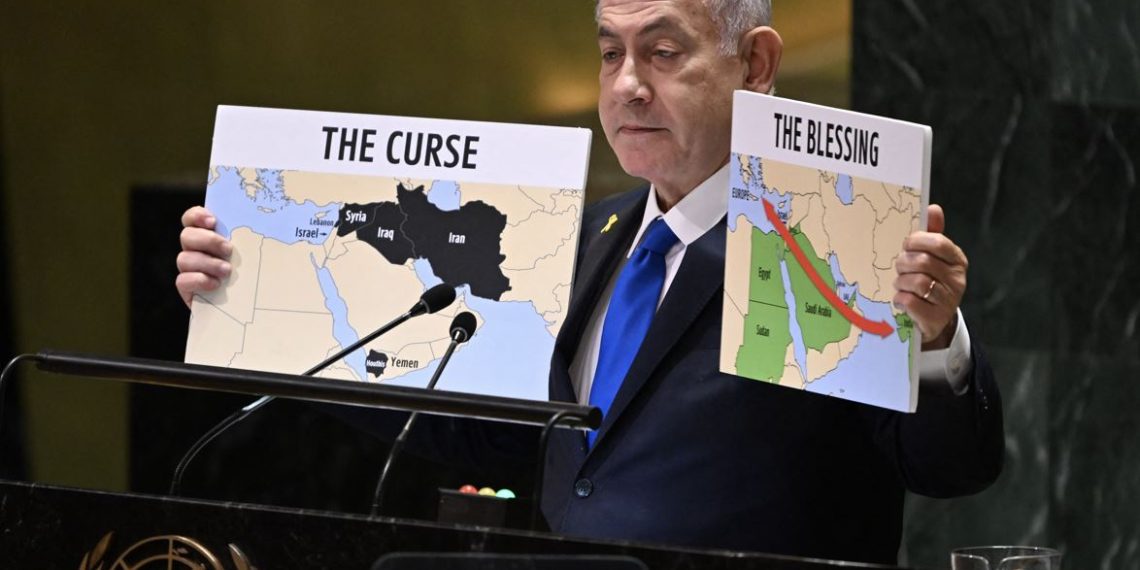
On Friday, June 13, 2025, Israel launched a series of simultaneous surprise attacks on multiple levels, targeting Iranian military and nuclear capabilities and infrastructure in a comprehensive and coordinated operation titled “Rising Lion.” On the first day of the assault, 200 warplanes, including advanced F-35 fighters, carried out precision strikes that disabled missile systems, platforms, air defense batteries, and airfields, significantly reducing the operational capacity of these Iranian strategic assets. Over the course of these 12 days, Israel also destroyed numerous military and industrial targets, inflicted substantial damage on Iranian nuclear reactors, and assassinated top commanders in the Iranian Army and Revolutionary Guard, as well as several scientists involved in the nuclear program.
The Penetration and Erosion of Red Lines
In addition to the widespread destruction inflicted by the Israeli war machine on Iran’s nuclear program and strategic weapons infrastructure, Israeli intelligence succeeded in assassinating senior leaders from the top echelons of the Iranian military, Revolutionary Guard Corps, and intelligence services. Notably, they targeted Mohammad Bagheri, Chairman of the Joint Chiefs of Staff of the Armed Forces; Hossein Salami, Commander of the Revolutionary Guard; Amir Ali Hajizadeh, Commander of the Guard’s Aerospace Force responsible for drones and missile capabilities; Gholam Ali Rashid, Commander of the Khatam al-Anbia Headquarters; and Mehdi Nemati, Deputy Director of the Intelligence Service of the Iranian Police Command. Meanwhile, Iranian President Masoud Pezeshkian, who was attending a meeting of the Supreme National Security Council, and Ali Shamkhani, the political advisor to the Supreme Leader, were wounded in two separate attacks based on precise intelligence.
Israeli agencies and cells embedded within Iran also carried out targeted assassinations of a group of scientists overseeing the nuclear program, most notably Mohammad Mehdi Tehranchi, responsible for developing explosive systems for nuclear warheads; Seyyed Sedighi Saber, a scientist specializing in uranium enrichment and warhead development; Ithar Tabatabai, a nuclear engineer; Fereydoun Abbasi, the former head of the Atomic Energy Organization of Iran; and Ahmad Reza Zolfaghari, a nuclear engineer.
Iran named its response to the Israeli attack “True Promise 3,” a continuation of “True Promise 1,” which Iran executed through missile and drone strikes against Israel on April 13, 2024, in response to the Israeli airstrike on the Iranian consulate building in Damascus at the beginning of the same month. That strike resulted in the deaths of Brigadier General Mohammad Reza Zahedi and his aide, Brigadier General Hadi Haj Rahimi, along with five military advisors— all of whom were senior figures in the Quds Force of the Iranian Revolutionary Guard.
“True Promise 2,” also carried out via missile and drone strikes, occurred in early October 2024, in response to Israel’s assassination of Ismail Haniyeh, a prominent leader of Hamas, at the end of July 2024 during his visit to Tehran for the President’s inauguration. Moreover, Iran’s attack was also a retaliation for Israel’s assassination of Hassan Nasrallah, Secretary-General of Hezbollah, in late September 2024. Resulting in the deaths of senior Hezbollah leaders and Abbas Nilforoushan, deputy commander of operations for the Iranian Revolutionary Guard Corps (1).
The war officially ended on June 24, 2025, when U.S. President Donald Trump announced a ceasefire between Iran and Israel. This came after U.S. intervention on behalf of Israel, including the bombing of the Natanz, Isfahan, and Fordow nuclear reactors on June 22, in an operation dubbed “Midnight Hammer.” The attack involved advanced Northrop B-2 Spirit stealth bombers and their 30,000-pound GBU-57 bunker-buster bombs. U.S. submarines also launched 30 Tomahawk missiles. Iran responded by bombing the U.S. Al Udeid base in Qatar, following prior notification to both Washington and Doha regarding the timing and scale of the strike.
Israel succeeded in inflicting significant damage to Iran’s nuclear program and destroying missile platforms. Iran’s ballistic missiles and Russian-made air defense systems—known as the S-300P—were targeted, with Israel claiming to have destroyed all four systems Iran possessed, thereby gaining control of Iranian skies, where dozens of Israeli warplanes patrol around the clock. Iran launched a total of 500 missiles at Israel (out of an estimated 3,000 in its arsenal, according to American sources), with 25 penetrating Israeli air defenses (David’s Sling, Iron Dome, Patriot, and the U.S.-made Thar system), causing damage to military, security, medical, residential, research, and energy facilities. Additionally, Iran launched 1,000 drones, none of which reached their targets inside Israeli territory.
Iran had planned to bombard Israel with over 1,000 missiles, but Israel’s successful interception of Iranian drones and missiles—through the destruction of missile capabilities, supply chains, and command centers—paralyzed approximately 40% of fixed and mobile missile launchers, destroyed 70% of air defense batteries, and bombed missile storage facilities, preventing Iran from launching successive, intense barrages of various missile types and effects (2).
Netanyahu and Trump: Misleading and Surprising
Iran was clearly misled before Israel launched its massive, devastating attack. The objective was to catch the Iranian leadership completely off guard, paralyzing it and crippling its ability to respond. Both Israel and the United States employed misleading and deceptive tactics to give the impression that they had no intention of initiating any military operation against Iran, and that the prevailing approach in both countries was to favor a political solution and continue negotiations.
- Israeli media focused on reports of “disagreements” between the Israeli government and the US administration, highlighting diverging views regarding the Gaza war, which was intended to be the main issue occupying Israel at the time.
- The Israeli government exploited the crisis arising from demands for the conscription of ultra-Orthodox Jews, as well as threats by parties supporting this group to withdraw from the government and dissolve the Knesset, portraying it as a major crisis that distracted the entire country from Iran’s nuclear program.
- The Israeli media was flooded with news emphasizing that the government was preoccupied with the war on Hamas and the hostages. The cabinet meeting held on June 12 to vote on launching the attack was promoted as focused solely on hostage negotiations, and ministers had been informed in advance that the agenda would be centered on efforts to release the hostages held in Gaza.
- The Israeli government announced on June 12 that Minister of Strategic Affairs Ron Dermer and Mossad Chief David Barnea would travel to Washington, D.C., the following day (i.e., June 13, the day of the attack) to meet with US envoy Steve Witkoff in preparation for the sixth round of US-Iranian nuclear negotiations, scheduled to take place in Muscat, Oman, on June 15. Washington had notified Omani authorities beforehand of the need to arrange and secure conditions for the sixth negotiation session with Iran, just three days before the full-scale Israeli attack.
- US President Donald Trump himself engaged in deception when he claimed to oppose an Israeli military operation against Iran, arguing that such an attack would undermine negotiations. In a tweet from April 2025, Trump gave the Iranian regime a 60-day deadline to reach an agreement. That deadline expired on June 12, and on June 13—the 61st day—the large-scale Israeli attack was launched.
It is evident that Trump and a close circle of his advisors were informed in advance of the timing and scope of Israel’s attack on Iran. Netanyahu admitted in his speech following the attack on June 13 that they had informed the Trump administration beforehand and that he told Trump, “Surprise is the secret to success.” Trump also described the Israeli attack to ABC on the morning of June 13 as, “The Israeli attack was excellent. We gave them an opportunity, and they didn’t take advantage. They were hit hard. Very hard.” In a tweet on Truth Social, Trump stated: “Iran’s leaders had no idea what was coming. They are all dead now. Iran must make a deal before it’s all over.” Netanyahu and Trump orchestrated a deception campaign against Iran, misleading the Iranian regime into believing that America (and subsequently Israel) was relying on negotiations to persuade Tehran to abandon its nuclear program, and that no attack was imminent (3).
Zamir’s Doctrine and October 7
In May 2022, while serving as a visiting scholar at the Washington Institute for Near East Policy, General Eyal Zamir (the current Chief of Staff of the Israeli Defense Forces) authored an extensive 75-page study titled “Countering Iran’s Regional Strategy: A Comprehensive Long-Term Plan.” The study examined Iran’s rising role in the Middle East and the threat posed by the Tehran regime to Israel—both directly through its nuclear and advanced weapons programs, and indirectly via its sponsorship of armed militias loyal to it across several countries. Zamir’s analysis focused on the effects of Iranian power and its gradual development, accompanied by a significant and expanding influence and role in the region. The regime of the “Guardianship of the Jurist” has become a major and influential regional player, whose role cannot be overlooked, nor can the repercussions stemming from its power and dominance over entire countries.
In the study, Zamir outlined his vision for restraining Iran—a strategic threat to Israel and the West. He viewed Iran’s past capabilities in development and rehabilitation within a project aimed at expanding and consolidating its influence, and transforming into a regional superpower, as a distinct and independent threat. Therefore, he argued, this is a front that must be addressed through a comprehensive grand plan (including Israel, the United States, and its European allies), encompassing multiple aspects and fields— all aimed at destroying Iran’s military capabilities. Such measures include surprise strikes utilizing maximum force and lethality, along with targeted assassinations of key leaders and strategic planners— with the goal of removing Iran from the threat it poses to Israel’s security and existence.
Zamir considered the existence of the Iranian regime, with its expansionist mentality and military project, to be a genuine structural threat to Israel—not merely a regime seeking to strengthen its influence for regional gains but one that employs traditional anti-Israel rhetoric to garner support among Arabs and Muslims (4).
Following the October 7, 2023 attack led by Hamas, which resulted in the death of approximately 1,200 Israeli civilians and soldiers, wounded 7,500, and kidnapped 251 others, Israel experienced a seismic shock. This was the second mass atrocity against Jews after the Holocaust perpetrated by the Nazi regime in Germany. Considering accusations that Iran incited Hamas to launch the attack, Israeli decision-makers revisited Zamir’s study, which has since become a doctrine for both defensive and offensive operations against Iran and its regional proxies. As Israel began its retaliatory actions— including a large-scale military operation in Gaza targeting Hamas, Hezbollah in Lebanon, and the Houthis in Yemen— secret preparations and plans were set in motion, based on Zamir’s doctrine, to carry out major, devastating strikes aimed at Iran’s military capabilities, which Tehran regards as the “head of the octopus” controlling its proxies and arms in the region.
According to the Hebrew-language website (walla.co.il), the Israeli military decided at the end of November 2024 to launch a large operation against Iran’s military infrastructure. The objective is to destroy Iran’s nuclear program, strategic missile platforms, key facilities, and infrastructure, as well as to eliminate top military leaders and Iranian nuclear scientists. An analysis published last June indicated that the Israeli military leadership convened for ten hours, including senior officials from the Military Intelligence Directorate (Aman) and the Air Force (120 officers), to devise a plan to attack Iran and identify the primary targets— notably nuclear reactors, the air defense system, missile storage sites, launch pads, and drone systems. The plan also includes the assassination of military commanders and scientists involved in Iran’s nuclear efforts. The cell responsible for planning the attack on Iran reconvened in February 2025, and by early March, the attack plan was finalized with targets set. Shlomi Bender, head of Military Intelligence, was quoted as saying that the 1,500-kilometer distance between Israel and Iran would be erased, as Israeli aircraft squadrons would be able to fly freely into Iranian airspace, which must be fully secure (5).
Iranian Containment and Israel’s Initiative
Iran’s strategy, based on long-term containment and reliance on proxies and arms to execute targeted, controlled strikes against Israel—aimed at achieving regional gains and consolidating influence—has failed. Iran did not grasp the radical shifts that occurred in Israel’s deterrence strategy after the October 7 attack. It continued to depend on controlling escalation, oscillating between threats of force and activating military proxies in the region, while also returning to negotiations and dialogue, and expressing willingness to compromise on its nuclear program. All these efforts were driven by the hope of containing or influencing Israeli change.
Tehran’s assessments concluded that Israel was preoccupied with the confrontations in Gaza and under domestic pressure regarding the release of hostages held by Hamas. In this context, Israel was reluctant to pursue a full-scale regional war. Moreover, internal political balances and the nature of alliances among Israeli political blocs limited Prime Minister Netanyahu’s capacity and scope to launch a large military offensive against Iran and its nuclear ambitions.
Meanwhile, Israel implemented its new strategy of massive destruction and total war across all intelligence, media, and military domains. The goal was to paralyze the Iranian regime, create maximum terror, confusion, and dispersion among its leadership, and destroy its deterrent and influencing capabilities—such as its missile systems and air defense network.
The plan to dismantle the Iranian regime, assassinate its senior military leadership, and destroy its military capabilities had been in development for years, renewed and intensified following October 7. The renewed Israeli objective focused on destroying Iran’s entire military infrastructure—particularly nuclear reactors, missile systems, and air defense. It also aimed to eliminate top-tier political and military leaders and target influential Iranian scientists and nuclear experts.
The initial wave of airstrikes, involving around 200 aircraft during the first “stormy” sortie, combined targeted assassinations, covert operations, intelligence infiltration, and jamming. These operations included attacks by secret cells and bases on military installations, missile depots, and launch sites, all aimed at disabling and removing these assets from the confrontation equation.
Israel sought to generate a storm that would sweep across Iran, inflicting massive destruction across all military sectors—provided that the impact was strategic enough to dismantle Iran’s military achievements, which Tehran had invested billions of dollars and years of effort in building and developing. The objective was to crush the backbone of Iran’s military establishment and eliminate its scientific and research elite.
The strikes of destruction, sabotage, and liquidation covered all geographic regions and all domains of Iranian power. These operations were both horizontal and vertical, with no regard for red lines. Although Israel refrained from overtly overthrowing the Iranian regime or destroying Iran as a unified state—leaving that decision to the Iranian people and opposition—it employed the most lethal means available, destroying infrastructure deemed potentially usable for military purposes and setting fire to facilities supporting Iran’s war economy.
It was evident that Israel aimed to demonstrate its strength by allowing its warplanes unrestricted freedom of movement within Iran’s secure skies—where dozens of aircraft bombed and destroyed targets continuously. By disabling Iran’s air defense system—either through sabotage, targeted drone strikes, or surprise attacks—Israel ensured the freedom of its aircraft to operate without fear of retaliation. From there, a campaign of carpet bombing across Iran’s vast territory was launched, aiming to sabotage and dismantle all the regime’s military achievements and capabilities—destroying years of nuclear reactor construction, military modernization, and the foundations of deterrence and offensive power.
Anatolia and the Promised Land
On the other side, signs of a Turkish-Israeli confrontation began to emerge following Israel’s war against Hamas in the Gaza Strip, which resulted in the deaths of tens of thousands of civilians, internal displacement, and a crippling blockade. Turkey sought to lead the “Islamic Rejection Front” against Israel, but its primary concern was its fear of the looming Israeli project of change. This was evident as Israel engaged in confrontations on multiple fronts—Gaza, Lebanon, Syria, Iran, and Yemen—and as discussions persisted about redrawing regional maps and shaping a “New Middle East.” Turkey perceived the manifestations of Israeli power, which were demonstrated through strikes against Hamas, the invasion of Gaza, devastating blows to Hezbollah and the assassination of its leaders, the destruction of the former Syrian regime’s army, the weakening of the Houthis, and ultimately, a broad attack on Iran—including efforts to sabotage its nuclear program and eliminate top military and Revolutionary Guard leaders. Ankara felt that Israeli fire was closing in, raising an urgent question: What if Israel launched an attack against Turkey with its military strength?
Turkey, governed by an Islamist-nationalist alliance and aspiring for regional leadership and the consolidation of its “Century of Turkey,” has in recent years announced expansionist projects to secure its influence and presence across the region and the world (such as Neo-Ottomanism, Blue Homeland, and the National Pact). It is now on the brink of a clash with Israel, which is led by a right-wing government that believes that brute force and military strength are the only languages of communication in a region full of anti-Israel sentiments and angry supporters. Israel has openly declared that its future strategy is to prevent the emergence of any military force capable of threatening the Jewish state, emphasizing the need to “redraw the maps” and reshape the region to ensure Tel Aviv’s continued dominance and uniqueness.
The Israeli strikes in April 2025 on land and air bases inside Syria, which Turkey had planned to rehabilitate and position itself within a cooperation framework with the new Syrian government, served as a clear message and reminder of Israel’s red lines. Turkey also observed with astonishment the details of Israel’s attack on Iran, witnessing the extent of Israel’s air superiority and intelligence capabilities. Questions arose among decision-makers in Ankara: What if a “scenario” was being planned against Turkey? Could there be a secretly operating “intelligence army” underground, waiting for orders to launch an Israeli attack on Turkey? What would prevent Israel from doing so? (6)
In January 2025, an Israeli report was issued by a committee called the “Security Budget and Force Buildup Inspection Committee,” known as the Nagel Committee, named after its chairman, Jacob Nagel, a former head of the National Security Council. The report recommended that the Israeli government prepare for a potential war with Turkey, focusing on the threats posed by Israeli influence in Syria and the alliance between Ankara and the new Syrian government. Although the report highlighted Syria as a source of danger—potentially turning into a confrontation arena between Turkey and Israel—Israeli concerns actually extend beyond Syria. They are rooted in Turkish ambitions across the entire region, military interventions in Syria and elsewhere, and Turkey’s pursuit of large-scale expansionist projects, including building militias and adopting a religious and sectarian discourse that incites against Israel. Because of these concerns, the Nagel Committee listed Turkey as one of the primary threats to Israel, pointing to potential conflict zones that Israel might face in the foreseeable future. After a comprehensive assessment of Israel’s security situation, the balance of power and influence, and the nature of regional alliances, the committee proposed increasing the Israeli military budget to approximately $4.1 billion annually—aimed at modernizing Israel’s military capabilities and expanding its intelligence and electronic warfare fields—so that the Israeli Defense Forces would always maintain superiority and leadership (7).
The Period Following the Hamas Operation on October 7, 2023, and the Israeli Attack on Gaza
After the Hamas operation on October 7, 2023, and Israel’s subsequent attack on the Gaza Strip—followed by the expansion of the war to include Hezbollah and the Houthis in Yemen, and later Iran and Syria—a media war erupted between Turkey and Israel. Each side accused the other of posing a threat and preparing for an expansionist war against it. The most vocal was Devlet Bahçeli, leader of the Nationalist Movement Party and partner of Turkish President Recep Tayyip Erdoğan, who threatened Israel days after its attack on Gaza with Turkish military intervention to stop it. Bahçeli tweeted multiple times, warning Israel: “If a ceasefire agreement is not reached and the aggression continues, Turkey must intervene and do everything in its power to protect Gaza and the legacy of the Ottoman Empire—the legacy of our ancestors.”
Meanwhile, Erdoğan described Israeli Prime Minister Benjamin Netanyahu as a “war criminal,” stating that Israel had killed 60 journalists covering the Gaza tragedy and accusing it of committing war crimes by cutting off electricity, water, and food to civilians (8).
Overall, three major developments have deepened hostility between Turkey and Israel, escalating tensions to the brink of war and confrontation:
- The Israeli war in Gaza against Hamas in response to the October 7, 2024, attack prompted Turkey to assume the role of leader of the Islamic world, considering Gaza part of the “Ottoman legacy.” Consequently, Turkey issued threats of military intervention (Bahçeli), accused Israel of war crimes, and called Netanyahu a terrorist (Erdoğan). Turkey also rejected Israel’s military operation against Hezbollah in Lebanon and expressed fears of Israeli expansion and occupation of Lebanon—approaching the Turkish border “just two and a half hours away by car,” according to Erdoğan. He further stated, “The Israeli invasion is right next to us, and the place the Israeli government will target within the illusion of the Promised Land after Palestine and Lebanon is our homeland.” (9)
- Israel’s destruction of the former Syrian regime’s army through hundreds of concentrated airstrikes hours and days after the fall of Bashar al-Assad’s regime and the arrival of Hayat Tahrir al-Sham (HTS) in Damascus on December 8, 2024. Israel announced its doctrine for a “New Syria,” declaring the 1974 disengagement agreement between Tel Aviv and Damascus null and void, and asserting direct control over the buffer zone. It penetrated large parts of southern Syria, declaring the three southern governorates—Quneitra, Daraa, and Sweida—as areas of influence where the Syrian government is prohibited from transferring heavy weapons or deploying large numbers of soldiers. This was accompanied by Israeli security penetration, establishing surveillance cells and advanced spy platforms in these regions. Subsequently, in April 2025, Israel bombed Hama Military Airport and the T4 base near Homs to prevent Turkey from establishing bases there. An Israeli Foreign Ministry official was quoted as saying that Israel would not allow Ahmed al-Sharaa to bring “hostile forces” into Syria—referring to Turkey (10).
- The large-scale Israeli strike on Iran on June 13, 2015, which demonstrated Israel’s significant and advanced military capabilities—striking Iran’s nuclear program, destroying sophisticated weapons, crippling the Iranian regime, and eliminating senior military and Revolutionary Guard leaders. Some voices in Turkey claimed that this attack was merely an Israeli “rehearsal” aimed at targeting Turkey and destroying its army. Ankara condemned the Israeli attacks on Iran, with Erdoğan calling them “terrorist acts” and expressing solidarity with Iran. The attack revealed Israel’s military strength through swift, surprise strikes—whether in destruction, sabotage, or assassination—that disabled Iran’s capabilities and kept its skies open and safe for dozens of Israeli warplanes. It was evident that this attack was part of a new strategy (the Israeli founding doctrine), aimed at imposing regional hegemony through overwhelming force and military might, with the goal of effecting change, restructuring the region, and establishing new balances (11).
As a result of Turkey’s assessment of the extent of the Israeli state’s heavy-handed use of force—particularly in Gaza and Lebanon—and the agreement of the ruling right-wing coalition in Israel to intervene in the region and impose new regional balances, Devlet Bahçeli, leader of the Nationalist Movement Party and partner of Turkish President Recep Tayyip Erdoğan, proposed a initiative to the Kurdish movement in Turkey in October 2024. He called on the Kurdish movement to lay down its arms and engage in negotiations and dialogue to resolve all outstanding issues and strengthen the internal unity of Turkey. This initiative received a positive response from the Kurdish movement and its leader, Abdullah Öcalan, on February 27, 2025. At Öcalan’s request, the Kurdistan Workers’ Party (PKK) announced its dissolution and renunciation of armed struggle during its 12th congress in May 2025. Meanwhile, the Turkish government established a parliamentary committee (with strong participation from the Peoples’ Democratic Party—DEM, the third-largest bloc in parliament) tasked with discussing legal and constitutional reforms, aimed at creating a foundation and opening prospects for recognizing Kurdish identity and cultural rights within Turkey.
Bahçeli’s initiative predated the fall of Bashar al-Assad’s regime, the Israeli destruction of the former Syrian army, and the Israeli attack on Iran.
Turkey recognizes that Hamas’s attack on October 7 was a major turning point in the history of Israel and the region, creating a new strategic outlook for the Jewish state. It also understands that the ruling right-wing coalition in Tel Aviv will not hesitate to confront any country militarily—even Turkey—if it perceives it as a threat to Israel’s security. It has become increasingly clear that Israel, which operates in the vicinity and surroundings of Turkey and talks openly about changing the regional map, poses a growing threat.
Following the emergence of the features of Israel’s military response in Gaza and Lebanon—responses that proved to be destructive and eradicatory—Turkey, within just a year, reconsidered many issues. It opened a dialogue with the Kurdish movement and sought to “turn a new page” with the former Syrian regime. Erdoğan repeatedly invited Bashar al-Assad for a personal meeting and reconciliation, all in the hope of “cooling down” the Syrian front. Meanwhile, he pursued a policy of de-escalation with the Trump administration, aiming to achieve gains such as ending U.S. sanctions on Turkey, reintegrating Turkey into the F-35 program, and boosting economic relations and trade volume.
Thus, the Turkish strategy appeared to focus on resolving internal and external issues before tensions between Ankara and Tel Aviv escalate into a direct confrontation or clash.
Conclusion:
First: After the October 7, 2023 attack, Israel decided to rely on lethal force aimed at destruction and eradication, based on its military and technological superiority, and its ability to surprise and strike in multiple locations and on multiple fronts. This approach undermined the old rules of engagement, which had allowed its main adversary, Iran, to expand and consolidate its influence through armed parties and militias.
Second: Israel’s objective became the destruction of armed movements (Palestinian Hamas and Lebanese Hezbollah) confronting the Jewish state at close range. This involved assassinating their leaders and cadres and dismantling their armed units. The reliance was on air and ground attacks, as well as disruption, sabotage, and espionage operations carried out by agents who provided intelligence that led to the assassination of dozens of prominent leaders. Additionally, Israel reoccupied territories and expanded its presence there after eliminating the structures and infrastructure of these armed groups.
Third: The Israeli attack on Iran (the “Octopus Head”) came after a campaign of deception and misinformation by Tel Aviv and Washington, along with promises of negotiations and deadlines, until preparations for the major airstrike were complete. This indicates a high level of coordination between the Israeli government and the US administration, and an American understanding of Israel’s new deterrence doctrine.
Fourth: The military operation against Iran was massive and unexpected, revealing a significant breach in sensitive institutions within the Iranian regime. In addition to destroying a large portion of Iran’s military and removing strategic weapons from the battlefield, many Iranian military leaders and nuclear scientists/experts were assassinated.
Fifth: The Israeli attack on Iran appeared comprehensive and marked the beginning of a new phase that emerged after October 7 — one characterized by the absence of red lines, with Israel targeting all centers and leadership to forcibly subjugate the enemy to Israeli terms. Israel moved from “shadow war” to open confrontation, directly attacking Tehran and its core, having already weakened the strength and effectiveness of Iran’s allied militias over 18 months of ongoing hostilities.
Sixth: Turkey observed with concern the Israeli establishment after October 7, from the declaration of war in Gaza, to the attack on Hezbollah, the destruction of its infrastructure, and the assassination of its leaders. Turkey, intoxicated by its power under Islamist and nationalist leadership and speaking of expansionist projects like “Neo-Ottomanism,” saw a trend toward Israel’s efforts to redraw the maps of the Middle East. This concern was reinforced after the fall of the Syrian regime, Israel’s destruction of its army, its expansion into the Golan Heights and the buffer zone, the declaration of southern Syria as a security zone free of heavy weapons, and the attack on bases inside Syria that Ankara had planned to use. The greatest threat perceived by Ankara was the Israeli attack on Iran, as it saw Tehran’s capabilities crumbling under Israeli military might.
Seventh: Turkey’s fear of the new Israeli doctrine (establishment/change) and the potential for conflict between the two countries prompted Ankara to address internal issues it had previously refused to resolve peacefully, such as the Kurdish issue. Dialogue took place with the Kurdish movement and its leader, Ocalan, which led to the Kurdistan Workers’ Party (PKK) announcing its dissolution and renouncing armed struggle, in exchange for constitutional and legal reforms that would end the denial of Kurdish identity and cultural rights in Turkey. This new approach might also influence Turkey’s policies toward Syrian Kurds, as Ankara revisits its previous hostility toward them.
References:
- Al Jazeera Net. “The True Promise: A series of military operations launched by Iran against Israel.” Published on June 14, 2025. (Link)
- Trends Research & Advisory. “Lessons Learned from the Israeli-Iranian War.” Published on June 28, 2025. (Link)
- Future Center for Advanced Research and Studies. Al-Sayyid, Muhammad Mahmoud. “The Secret Keeper: How Israel Deceived Iran with Its Surprise Attack.” Published on June 14, 2025. (Link)
- Al Jazeera Net. Al-Minshawi, Muhammad. “How Will the Israeli Chief of Staff Confront the Iranian Shadow Army?” Published on June 19, 2025. (Link)
- Al-Araby Al-Jadeed. Zaidani, Naif. “Red Wedding: Israel’s Plan to Assassinate Senior Iranian Leaders.” Published on June 18, 2025. (Link)
- Erem News. “The Power Struggle Between Turkey and Israel Escalates After the Iran War.” Published on July 4, 2025. (Link)
- Com. Muhtar, Gandhi. “The Nagel Committee for Enemy-Making: The Turkish Threat Is Greater Than the Iranian Threat.” Published on April 16, 2025.(link)
- Al Jazeera. Darwish, Ahmed. “Turkey’s Position on the Al-Aqsa Flood: Shocking Inaction or Support as Much as Possible?” Published on December 24, 2023.(link)
- Quds Press. “Erdogan Sounds the Alarm: Israel Approaching Our Borders.” Published on October 1, 2024. (Link).
- BBC Arabic. Williamson, Lucy. “Israeli Strikes in Syria Pose a Challenge to Turkey.” Published on April 5, 2025.(link)
- Strategic Forum. Lotfy, Youssef. “Changing the Rules of the Game: The Iranian-Israeli Conflict from a Supergame Theory Perspective.” Published on June 14, 2025.(link)