
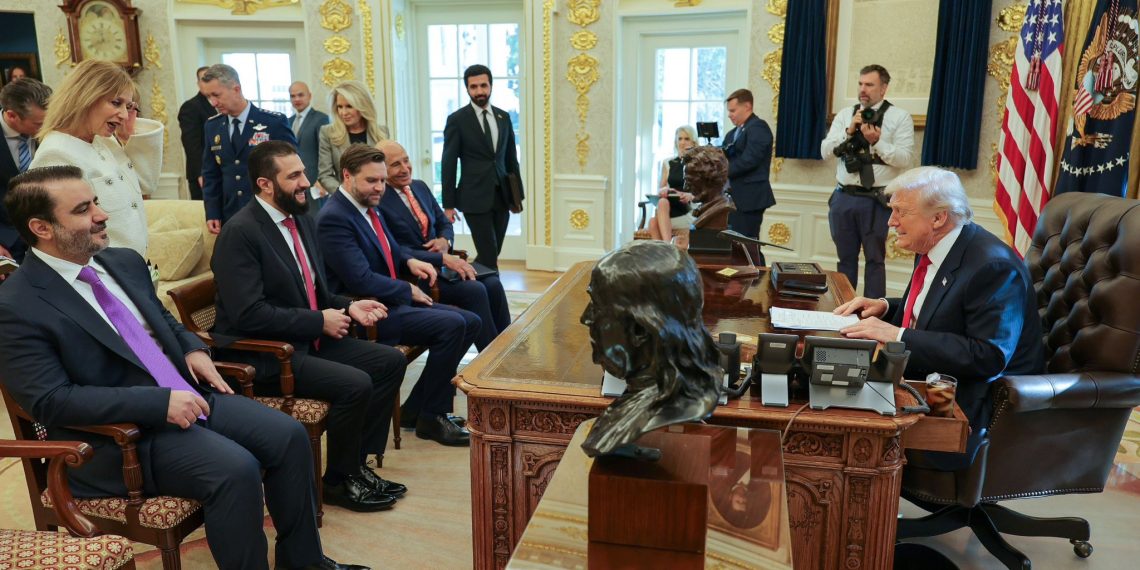
The visit of the interim Syrian President, Ahmed al-Sharaa, to the American capital, Washington D.C., represents a major political shift in the transformations of the Middle East. It is considered a culmination of an American policy based on appeasing regional parties to support the new authority in Damascus, with a speed that is so rapid that the U.S. Administration is looking for ways to bypass Congress’s Caesar Act sanctions legislation. This is remarkable in the context of the new form of file management in the White House.
In this paper, we present an initial reading of the outcomes of the visit, based on what has been announced, and the future paths of American supervision over Syria and Syria’s transition into the American orbit.
Therefore, regardless of the direct results and what gains Al-Sharaa will reap, the meeting reflects the biggest shift in Damascus’s geopolitical positioning in seventy years, when it practically became part of the Soviet and Eastern orbit.
First: Joining the Global Coalition as a Political Signal
During the visit, the United States announced that Syria has joined the Global Coalition to Defeat ISIS, becoming the 90th member of this coalition. A senior U.S. official told The Wall Street Journal: “Syria will become the 90th member of the Defeat ISIS Coalition, partnering with the United States in eliminating the remnants of the organization and stopping the flow of foreign fighters… It will be allowed to resume the operation of its embassy in Washington to enhance coordination in counter-terrorism, security, and economy.”
With this announcement, Damascus has moved from being a country subject to U.S. sanctions to a political and security partner in the Western coalition system.
Despite the celebratory nature of the announcement, a U.S. official confirmed to The Wall Street Journal that “the precise terms of Syria’s role in the coalition are still under discussion,” describing the announcement as a “political signal” that will later evolve into broader intelligence and military cooperation against ISIS.
This statement clarifies that Syria’s joining the Coalition in its first phase is more symbolic than operational, but it opens the door to redefining the American presence in the country under a new umbrella.
The newspaper also quoted another official as saying: “There will be no change in the size of the American military presence in Syria,” meaning the United States maintains its field presence under the Coalition’s cover until the arrangements for the integration between Damascus and the Syrian Democratic Forces (SDF) are finalized.
It remains that joining the Global Coalition opens the door to internal conflict within the factions and wings of the authority, a confrontation that is almost guaranteed in light of the successive fatwas (religious edicts) from the authority’s clerics, and how entering the coalition does not mean “loyalty to the infidels” according to their terminology.
Second: U.S. Supervision of the Agreement between SDF and Damascus
At the conclusion of Al-Sharaa’s visit to Washington, the Syrian Foreign Ministry statement listed the discussions’ focus on implementing the March 10th agreement as a primary agenda item discussed with the American side, even though the Syrian side avoids presenting a neutral formula for this file in its statements and uses a unilateral formula demanding the dismantling of the Syrian Democratic Forces (SDF). Therefore, the agreement’s path is expected to see progress in the coming days, and Damascus will bear the political cost of non-agreement, given that the SDF has confirmed in numerous briefings that it keeps the Coalition and the American side fully informed of developments regarding the talks.
The Washington Post quoted American sources as saying that the United States has a strong interest in supporting Al-Sharaa, partly because this support may allow the withdrawal of U.S. troops still stationed in Syria as part of the anti-ISIS Coalition. It is known that Damascus’s joining the Coalition requires the announcement of a final agreement with the SDF and finding an acceptable and logical formula for the integration of the two parties, not from one side alone.
However, the military capability of Damascus’s forces is limited, as its troops lack discipline and organization, still relying on militia-like structures, according to an assessment published by the Soufan Center. Furthermore, some factions within the army—including thousands of foreign fighters—still cling to jihadi beliefs and may not be committed to fighting ISIS. The slow progress of talks between Damascus and the SDF will also play a negative role in integrating the Damascus government into the Global Coalition.
The American role is not understood merely as mediation, but as direct supervision over the construction of the new Syrian security structure, whereby the country is militarily reunified within a Washington-sponsored balance of power system, guaranteeing the SDF a degree of decentralization within the army. Thus, the United States is attempting to transform its military presence into long-term institutional influence by integrating its allies into the official structure of the Syrian state.
Third: Suspension of Sanctions
During the visit, the Trump administration announced the extension of the suspension of sanctions imposed on Syria under the “Caesar Act” for an additional six months, after they had been frozen since his first meeting with Al-Sharaa in Saudi Arabia in the middle of the year.
However, the most stringent sanctions on Damascus remain in place and cannot be fully lifted without Congressional approval. Al-Sharaa’s direct goal in Washington was to push for their complete removal, while urging Trump to pressure Israel to stop its attacks on Syria and withdraw its forces from the south of the country. But the outcome was only the extension of the suspension. Despite this, it is considered a gain for the Damascus authority, because during the past six months, which it was supposedly under American scrutiny to meet the conditions for the extension, Damascus forces committed the Sweida massacre, and the Druze region remains under siege. Nevertheless, Trump ordered the extension of the sanctions suspension.
Despite the Trump administration’s suspension of the Caesar Act, the threat of potential reimposition of sanctions acts as a deterrent to American companies seeking to do business in Syria, according to The Washington Post.
In conclusion, this decision is noteworthy because the Sweida massacre, which resulted in hundreds of deaths, did not prevent Washington from proceeding with the extension, indicating that strategic considerations trumped the human rights dimension and even the list of American conditions. Furthermore, the White House has begun hinting at the cancellation of the law itself, and any conditions tied to this step will be formalistic to politically cover the decision, not to actually regulate Damascus’s behavior at the present time.
Fourth: The American Domestic Dimension
The openness toward Damascus was not without internal repercussions in Washington. Republican Representative Marjorie Taylor Greene criticized President Trump for receiving Al-Sharaa, calling on him to focus on American domestic issues, to which Trump responded by saying that Greene “lost her way.”
This debate reflects that the openness toward Syria might become a political liability for Trump within the Republican Party, especially amid the rise of the populist current that rejects engagement in Middle East files. On the eve of Al-Sharaa’s visit to Washington, more than 100 senior Christian clerics in America sent a letter to Trump urging him to pressure Al-Sharaa to stop the massacres against minorities and protect Christians.
Therefore, the White House will have to balance this openness with pressure from the conservative current that fears the “partnership with Al-Sharaa” could turn into a new political or financial quagmire, or a cover for massacres that pro-Damascus forces might commit.
Fifth: The American Bet… Between Prize and Risk
From Washington’s perspective, Syria under Ahmed al-Sharaa represents a strategic prize and a rare opportunity to re-engineer the balance in the Levant. But at the same time, it is an adventure fraught with risks in a highly volatile regional environment. At a time when Lebanon is sinking into accelerating political and economic collapse, and Iraq remains an open arena for Iran-aligned militias, the U.S. Administration sees Damascus as the only possible pillar for rebuilding relative stability in the Levant. However, it is known that there are financial considerations and economic partnerships between Trump’s team and his family with regional governments that support the Syrian President, and the influence of this factor on shaping U.S. policies toward Syria is not unlikely to be significant.
This position was clearly summarized by Joshua Landis, Director of the Center for Middle East Studies at the University of Oklahoma, in a statement to CNN, saying: “The United States is taking a huge gamble on Ahmed al-Sharaa and Syria.”
Conclusion
The outcome of the visit confirms that Syria has not just entered the phase of American supervision, but has transformed into a component within the system of the Global Coalition and regional security. Its joining the Coalition, even if politically, the suspension of sanctions, and the commencement of the SDF integration process under the supervision of the U.S. Central Command, are all signals of gradual integration into the American orbit, but with a new element which is imposing the cost of non-agreement on Damascus. That is, the most dangerous element will be the obstruction of the agreement with the SDF. Accordingly, completing the integration phase will be the authority’s winning card, especially since it will include, in a broader vision, guarantees for the protection of minorities from any massacres or violations.
However, in return, the internal debate in Washington and the possibility of Syria turning into a political burden on Trump remain factors that may impose limits on this openness, making the American-Syrian path a hostage to the balance between real politik and the climate of internal division in the United States.