

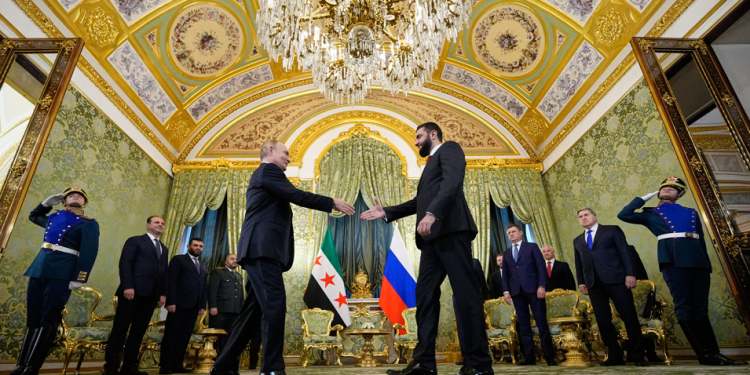
The regime’s supporters surrounded the visit of interim president Ahmed al-Sharaa to Moscow with a great deal of vulgar propaganda; some of it related to the handover of Bashar al-Assad, and others talking about bringing the Russian army to northeastern Syria to limit the influence of the Syrian Democratic Forces (SDF). However, the nature and essence of the visit do not warrant burdening it with all these expectations.
From a simple practical perspective, the Damascus regime, burdened by internal problems and its bankrupt government, is not in a position to negotiate with Moscow on anything that would be in its favor, especially the issue of handing over al-Assad. Russian officials have previously shown clear hostility in responding to journalists regarding the demand for Bashar al-Assad’s handover, stating that Assad and his family, according to Russian diplomatic protocol, have been granted humanitarian asylum, and the matter is concluded. Moreover, the issue of handover is linked to the prestige and “image” of the Russian state, which is represented by providing safe haven for its former allies. This highly sensitive matter is part of the image of Putin’s Russia, which cannot be overly pragmatic to the point of handover or even negotiating on this issue. Furthermore, to whom would the handover be made? To the armed group that overthrew Russia’s man in Syria! The success of such an assumption would mean that Russia was defeated in Syria twice, at a time when Moscow is trying to claim that it was defeated only once, and that al-Sharaa’s attempt to knock on the Kremlin’s doors and bring them back to Syria merely reduces the level of that defeat to a temporary “tactical retreat.”
If we consider the second interpretation, which suggests that one of the visit’s objectives was to enlist Russian support in curbing the influence of the Syrian Democratic Forces (SDF), we must acknowledge the long-standing coexistence between Russian forces and the SDF over the past decade, characterized by peaceful relations, some understandings, and virtually zero direct confrontation between the two sides. This is despite statements from the Russian Foreign Ministry that incited the opposition, the regime, and Turkey against the Kurds and their project of regional self-governance, which it labeled as an American-backed mini-state or a “separatist project.” How, then, can al-Sharaa succeed in this endeavor, where al-Assad himself failed despite his privileged position and historical cooperation with Moscow?
Beyond the rhetoric of regime supporters, the visit implicitly reveals al-Sharaa’s desire to secure Russian support for any draft resolution that would help legitimize his authority internationally. The Syrians’ experience with the Russian veto necessitates a degree of humility and deference to Moscow’s presence in the Security Council. Perhaps this appeasement strategy also requires a visit to and consultation with China, especially since the issue of Uyghur fighters and the Turkestan enclave in Syria is hindering efforts to reassure Beijing. In this regard, Damascus may take some security measures to limit the activities of the Uyghurs, including the detention and prosecution of Turkistani fighters, as a down payment.
Furthermore, the visit included al-Sharaa’s commitment to previous agreements between Moscow and Damascus and an emphasis on the “historical ties between Russia and Syria.” This phrase encompasses the connections and relationships that flourished under the Assad regime during the Syrian war. Al-Sharaa also brought with him a proposal to renew the agreement regarding the Tartus and Hmeimim bases. The latter has long been the base that supported Assad’s forces and contained the advance of the armed opposition and Hayat Tahrir al-Sham, and from it, airstrikes were launched against cities and towns outside of Assad’s control. Al-Sharaa’s visit implicitly conveys an additional message that can be summarized as follows: We defeated al-Assad, not Russia, or we defeated a part of Russia in Syria.
There is a significant obstacle regarding the armament process that al-Sharaa faces in the context of building a new army. The Turkish weapons and advanced communication equipment that were secretly introduced were openly destroyed by the Israeli Air Force. In contrast, the United States and Europe refuse to arm Al-Sharaa’s army, which is composed of Hayat Tahrir al-Sham and factions loyal to Turkey, while the declared desire to arm the army and acquire Russian air defense systems to put an end to Israel’s absolute control over Syrian airspace seems somewhat wishful thinking.
The question of the viability of being supplied with Russian weapons warrants further investigation. The advanced Russian air defense network in Syria did not prevent Israeli operations targeting the Iranian Revolutionary Guard and the Assad regime. Furthermore, could Russia really supply a factional army following a Jihadist line with weapons that would enhance its regional position? And for what purpose would Moscow provide these weapons? To deter Israel? These are rhetorical questions that seem realistic and imply their own answers. Based on past experiences, Russian defenses have consistently stood down when its strategic ally, Iran, was being attacked. Is al-Sharaa and his authority more important than Iran in the Russian perspective? That seems unlikely. We should also remember that Benjamin Netanyahu, at the moment of Russia’s entry into the Syrian war in 2015, welcomed what he called “the new neighbor” and the Russian role that would relieve him of the burden of confronting Iranian aggression on Syrian territory. In fact, the assumption of Russia’s return to the Syrian arena would be met with further approval from Netanyahu, who sees its return, especially to the coast, as a barrier against Turkish ambitions to expand along the Mediterranean shores. This is in addition to another assumption: that a stronger Russian presence on the coast could secure a network of client/sectarian groups rallying around the Russian forces upon their return, making the idea of a “Coastal Region,” with Russian support, a potential counterpart to the American-protected East Euphrates region and the Israeli-protected Suwayda region.
Concluding arms deals requires three factors: industrial capacity on the part of the supplier, which is impossible for Russia given its protracted and open-ended war with Ukraine. One of the problems the Russians faced in the days leading up to Assad’s fall was a shortage of weapons, with reports even indicating that Russian aircraft lacked the necessary ordnance to stop the advance of the “Deterrence of Aggression” fighters. Furthermore, the second factor, financial liquidity in the hands of the Damascus authority, is also absent, preventing it from purchasing and paying for weapons, even if we assume that Damascus were to become a strategic ally of Moscow. The third factor is the necessity for the “allies” to have a degree of ideological understanding or congruence. Can Russian experts and trainers work with a “quasi-army” governed by extremist religious doctrines that contradict the national doctrine of the Russian army, and subsequently work with an army whose high-ranking officers have not undergone any training courses in Russia, but rather come from a Jihadist background hostile to Russia itself? The lack of “chemistry” between the trainers and the trainees is one of the issues that cannot be underestimated.
It seems that al-Sharaa’s authority has not yet grasped the reality that the new Syria is destined to remain devoid of strategic weapons—neither Eastern nor Western weapons, then. An Israeli commentator sarcastically wrote after the destruction of Syria’s weapons stockpiles shortly after Assad’s departure: “Let them start with rifles.” For Hayat Tahrir al-Sham, the world has been generous, as the sanctions against it have been partially lifted and the programs offering rewards for bringing its leaders to justice have been suspended. However, this generosity stops short of providing weapons, as the argument goes: why do you need weapons when you have pledged to maintain good relations with all your neighbors, without exception or caveat? If the armament is intended for new rounds of civil war, the world will not encourage such costly recklessness. The future of the Syrian armed forces cannot be anything other than a combination of police agencies, border guards, coast guards, and counter-terrorism forces. Realistically, this option seems beneficial for Syria’s future, as a mechanized army equipped with strategic weapons is a threat to its neighbors and, more importantly, undermines the project of internal peace.
There is another issue related to the nature of the future Syrian army: sarcastic remarks have been made about militaristic states like Pakistan, describing them as “an army that grew a state, not a state that established an army.” Here, the world cannot accept the idea that a faction should develop an army, and then that army should develop a state.
It is highly probable that Russia’s presence, even if at Syria’s behest, will only serve Russia’s interests. Here, one must ask: Which international or regional powers suggested that al-Sharaa visit Moscow? Such a visit, should it materialize, will not serve the slightest interest of al-Sharaa’s authority; rather, it will reinforce the new dynamic of the international and regional power-sharing game, especially since Syria is far too weak to enter the “Game of Nations” or to coexist with the conflicting interests of influential countries.
In a way, the visit to Moscow seems to be nothing more than a presidential escape from domestic problems and national obligations. Al- Assad has previously tried this approach, resorting to foreign allies in order to subdue opponents and block any internal political process.