


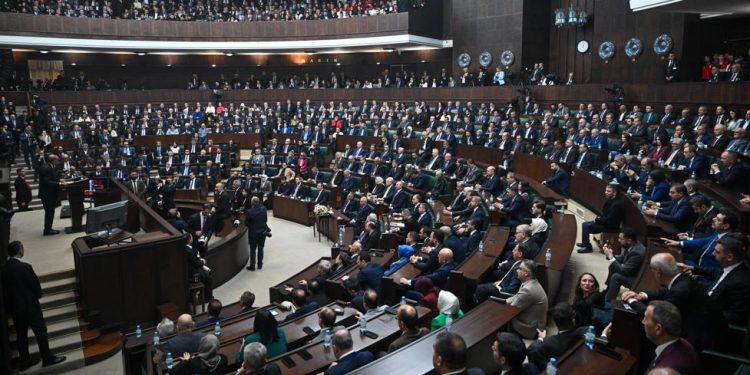
The “National Solidarity, Brotherhood, and Democracy Commission,” mandated to follow up on the legal framework for the peace process, held a pivotal meeting last Friday, emerging with a historic decision: to proceed to Imrali to meet with the leader of the Kurdistan Workers’ Party (PKK), Abdullah Öcalan, after 33 out of 51 members representing 11 parties voted in favor, while 11 deputies from the Republican People’s Party (CHP) chose to boycott the session. This decision was not merely an item on the parliamentary agenda; it was a new, foundational moment that surpasses the second threshold in the peace process and opens the door to an unprecedented political phase in Turkey.
This development comes shortly after the leader of the Nationalist Movement Party (MHP), Devlet Bahçeli, broke one of the most deeply entrenched taboos in Turkish political discourse. In his speech before his party’s parliamentary group a few days earlier, he reiterated that if the parliamentary committee stalled in going to Imrali Island, Öcalan’s place of detention, he would go there himself, accompanied by three of his friends, and using his own means. This statement resonated throughout Ankara’s corridors and was considered a step that crossed a new threshold in the complex process of peace, especially at a sensitive moment for the country, a full year after the process began.
Bahçeli, as the political heir to the Turkish nationalist movement and one of the most prominent voices embodying the concept of the state as a sovereign act, recognizes that he now occupies a pivotal position in the peace process alongside Öcalan. His recent statements reflect that he is not moving within narrow partisan calculations, unlike the CHP and a portion of the Justice and Development Party (AKP), but rather stems from a vision that considers itself an extension of a historical chain based on the idea of “the survival of the Turkish nation,” especially amid the profound transformations the region is witnessing.
In defense of this “spirit,” as he expresses it, and in light of a complex geopolitical reality threatening the structure of the state in the Middle East, Bahçeli invokes the saying of the prominent nationalist thinker, Ziya Gökalp: “He who does not love the Kurd is not a Turk, and he who does not love the Turk is not a Kurd.” He also recalls what Gökalp affirmed in his famous article, “Turks and Kurds” (1922), when he stressed that the National Pact defines the existence of two nations, the Turks and the Kurds, within a single national framework based on indivisible unity, a shared motherland, and the rejection of any Kurd or Turk remaining outside this unity.
These sayings intersect remarkably with Öcalan’s vision, which calls for ending the armed struggle, opening the way for peace and democracy, and repairing a thousand-year-old brotherhood. From this perspective, Bahçeli’s position seems akin to a retrieval of the “spirit of historical reconciliation,” and a readiness to sit alongside his historical adversary, Öcalan, at one table if that is a condition for formulating a long-term and viable political settlement.
Moreover, this shift did not come from a vacuum; it was preceded by an integrated path of steps taken by the PKK, starting with the withdrawal of its forces from areas within Turkey’s eastern borders, and proceeding to their withdrawal from the lines of engagement in the “Zap” region on the border of the Iraqi Kurdistan region. With these developments on the ground, the ball seemed to be in the Turkish state’s court to complete the reciprocal process, especially after the formation of a parliamentary legal committee charged with moving the file from the domain of security and military conflict to the realm of legal and political solutions, within the framework of what Öcalan describes as “democratic integration.”
Accordingly, Bahçeli had believed for months that the state should move without hesitation, with swift and clear steps, to ensure the completion of the process on solid legal and institutional foundations. In his view, any hesitation or slowness in taking decisive action could return the peace process to square one and open the door to a new setback that would dissipate the rare opportunities for a solution that have accumulated.
Although the Committee held about 17 sessions before the last meeting, it has not yet submitted its legal proposals to Parliament. Conversely, some leaks indicated a position of reluctance within state institutions, especially what is attributed to the AKP and the CHP, regarding granting the Committee permission to go to Imrali, a step the Kurdish side considered essential to guarantee the continuation of the process. Indeed, Öcalan himself insisted on the necessity of this visit, seeing it as a crucial anchor point for the serious and effective continuation of the process.
The Symbolism of the Decision
The step of the parliamentary committee heading to Imrali Island acquires importance that goes beyond merely holding an additional hearing. The completion of this visit would be the first of its kind since the start of secret and public communications between the Turkish state and the PKK in 1993. It would grant the peace process its official legal framework, moving it out of the circle of narrow security initiatives to the level of institutional and constitutional recognition, thereby bolstering the process’s legitimacy and establishing it on clear constitutional bases.
In this sense, this step first means that the Committee’s presence in Imrali consolidates Öcalan’s position as the primary negotiator in the process, making the continuation of his isolation in its current form a matter of sensitive legal and political dimensions. According to international standards followed in negotiation processes, a negotiator must enjoy a minimum level of freedom and movement, opening the door for serious discussions about granting him the right to hope after 27 years of captivity, or enacting legislation that allows for a review of his legal status.
Second, the Kurdish side, according to statements by Parliamentarian Pervin Buldan, indicates that Öcalan is awaiting this visit to present his vision on the roots of the conflict, viewing himself as a central party in shaping its historical structure, and to emphasize the need to move the conflict from the arenas of confrontation to the ground of peace and democratic transformation, in his capacity as the chief negotiator for the Kurdish side.
Third, Öcalan believes that the Committee’s mission should not be confined to security aspects, or merely to procedures for integrating PKK fighters, releasing political prisoners, or bringing back exiles. These, in his view, are just elements within a broader path. He stresses the necessity for the Committee to address three fundamental legislative packages that represent the constitutional basis for any permanent settlement: the Law of Democratic Society, the Law of Local Administration, and the Law of the Constitutional State. These packages are not just negotiating points; they form a framework for rebuilding the relationship between the state and society, thereby promoting pluralism and ending decades of conflict.
Bahçeli’s Insistence and the Dual State
Concurrently, Bahçeli’s insistence on the Committee going to Imrali has prompted a series of interpretations. One group of observers sees his position as a response to hesitation within the AKP regarding this step, despite acknowledging its importance. Some readings suggest an unannounced tension between Bahçeli and Erdoğan; the former appears closer to the logic of “state interest” in its sovereign and institutional sense, while the latter, according to this analysis, prioritizes his party’s interest and its power calculations.
Proponents of this view cite the case of Selahattin Demirtaş; despite the European Court of Human Rights’ decision calling for his release, the slowness in ruling on his case persists, which is viewed as a symbol of the contradictions in the official approach and the lack of trust between the parties, especially since Bahçeli emphasized his release as a politicized issue.
Another, deeper interpretation emerges, suggesting that Turkey is witnessing a structural division between the Normative State (legal) and the Prerogative State, a concept Öcalan invoked from the political scientist Ernst Fraenkel in his book, The Dual State (1941). The Normative State is one that operates according to law and customary institutional procedures, while the Prerogative State is based on exceptional decisions rooted in the influence of security apparatuses, similar to what prevailed during the Nazi era.
Based on this, Bahçeli emerges as one of the few voices calling for adherence to the law in the Imrali file and the peace process, at a time when the Prerogative State operates with a logic that contradicts this direction. This tension became evident when Bahçeli announced that he was ready to go to Imrali himself, in a move that seemed like a symbolic challenge to the parallel authority within the state. This scene is not new; at the beginning of the peace process, Öcalan spoke of a conflict within the state between a legal, normative wing and an extra-legal, prerogative wing, affirming his alignment with the Normative State.
The most notable surprise, however, was the stance of the Republican People’s Party (CHP), which boycotted the voting session despite its tacit and unannounced alliance with the Peoples’ Equality and Democracy Party (DEM Party) in recent years. The motivations for this stance appear to stem from the party’s fear of a reaction from its solid nationalist base, along with its reliance on capitalizing on Kurdish votes to serve its power ambitions. There are also reported concerns within the party’s political circles that Öcalan may be pushing for the formation of an independent democratic bloc in the next phase, moving the Kurds from the position of a “swing vote” to that of a strategic actor on the periphery of nationalists and Islamists. With this position, the reality of the calculations governing the CHP was exposed, and most Kurdish actors saw that it committed a grave strategic error that would carry a heavy political cost.
In conclusion, all eyes are now on Imrali, and it can be said that the peace process has effectively entered a point of no return, having surpassed the second threshold. Öcalan has borne the cost of calling for disarmament and moving forward with the settlement path alone, confirming his full commitment, as Bahçeli himself describes it, to opening the way for permanent peace.
In Öcalan’s words, the road to peace is not a single station but a long path of removing mines, building bridges, and crossing thresholds one after the other. With the parliamentary committee’s decision, a chapter spanning about 150 years of exile and execution that pursued most Kurdish leaders has been closed. For the first time, the Kurdish leadership is transforming from a position of pursuit, exclusion, and imprisonment to the position of a legitimate interlocutor with whom the Parliament and the Turkish state are negotiating within a legal and institutional framework. The mere occurrence of this transformation is, in itself, a decisive historical moment, revealing that the process has entered a new phase in which the rules of the entire political game are changing.