


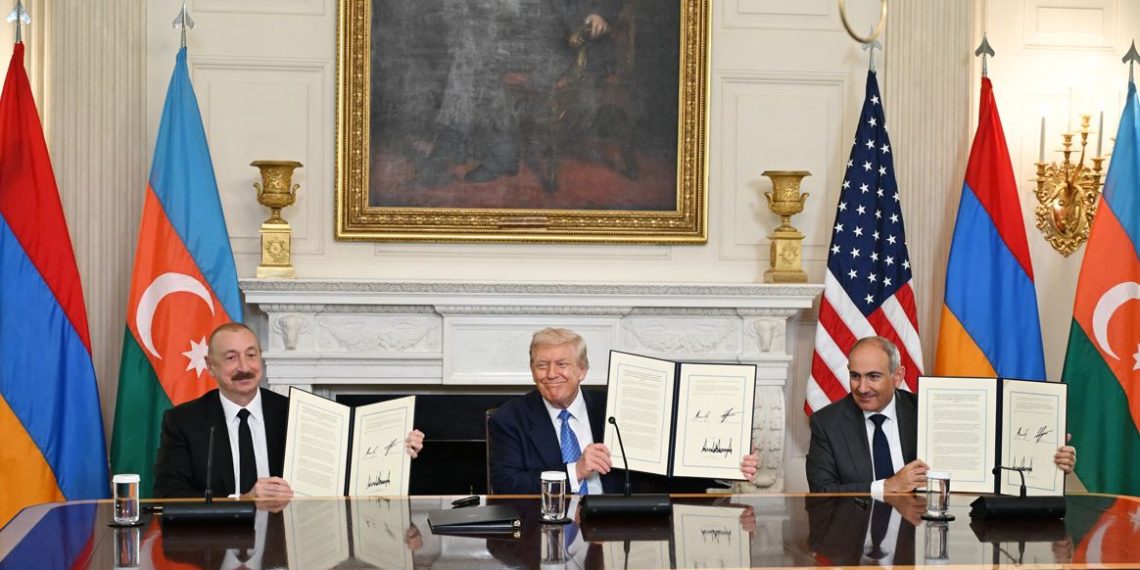
Within four days, significant developments occurred in Beirut (August 5), with the Lebanese government deciding to restrict the possession of weapons by the Lebanese army throughout the territory of Lebanon, with a timeframe not exceeding the end of the year. At dawn on Friday, August 8, the Israeli government decided to “impose control over Gaza City and the surrounding camps,” something Tel Aviv had avoided since the start of the war on Hamas following the October 7, 2023 attack. Later that evening, Washington time, an agreement was concluded at the White House under the auspices of President Donald Trump to end the conflict, which has resulted in three wars and began in the 1990s between the Republics of Azerbaijan and Armenia. The agreement aimed to initiate normalization between the two countries after recognizing their “territorial integrity” and establishing the “Trump Road for International Peace and Prosperity,” allowing the free passage of goods and people. This route connects Azerbaijan and the Nakhchivan enclave, which is separated from Azerbaijan by 32 kilometers of Armenian territory and borders Turkey. A 99-year lease for the route will be granted to a consortium of American companies, and it will include highways, railways, and pipelines for oil and gas (The Guardian: “Iran and Russia Lose Out on US Deal with Azerbaijan and Armenia,” August 9, 2025).
In all three cases, the main theme is the “filling of the Iranian power vacuum.” This follows Iran’s defeat in Lebanon and Gaza, and then its defeat in the June 2025 war. This involves disarming Hezbollah in Lebanon, completing the process of eliminating Hamas’s military and political influence, and establishing an American-controlled geographic barrier between Iran and the South Caucasus region, separating Tehran from Armenia, its only regional ally. This barrier also includes Azerbaijan, an American ally whose relations with the US, Israel, and Turkey complicate Tehran’s rulers and form a geographic barrier between Russia and Iran.
However, in Trump’s first success in ending wars—rather than merely halting them as recently occurred between India and Pakistan—there is more at stake than just the strike on Iran. What Armenian Prime Minister Nikol Pashinyan feared was that this would close the door to Yerevan’s relations with the Western U.S.-European bloc (when he hesitated and refused to allow Russian forces to guard the corridor, called Zangezur, as a compromise offered by Putin between Baku and Yerevan after the 2020 war, a solution also acceptable to Iran). This obstacle was overcome in the Washington agreement, when Armenia, through what transpired at the White House, moved away from an alliance with the Kremlin that had begun with its independence from the Soviet Union in 1991, and shifted into the American orbit.
This Trumpian success also marks the beginning of American control over the Eurasian route connecting China and Europe. Before the Ukraine war, this route passed through Russia and Ukraine. After the 2022 Ukraine war, the US shifted to using the “intermediate corridor,” which extends from China to the Kazakh coast on the Caspian Sea, then via ferries carrying trains and trucks to the Azerbaijani coast, and from there through Georgia and Turkey. This corridor is now planned to pass through the “Trump Route” to Turkey and then to Europe. It is 2,000 kilometers shorter than the Cino-Russian border route, which became unviable after the Ukraine conflict. The importance of this corridor for China increased after the disruption of the Red Sea route following Houthi attacks on ships in the month after October 7. It is also faster, less expensive, and safer than the maritime route.
Now, after the August 8, 2025 agreement, Washington has gained control of this Eurasian route. Those who engineered this deal seem to be convinced by Zbigniew Brzezinski’s 1997 statement that “Eurasia is the chessboard on which the ongoing battle for global political leadership is fought… Eurasia is the center of the world, and whoever controls Eurasia controls the world… But at the same time, it is important that no Eurasian challenger emerges capable of dominating Eurasia and thus challenging the United States” (“The Grand Chessboard,” Al-Ahliya Publishing and Distribution, Jordan, Amman, 1999, pp. 12-13).
With this agreement, and following the death of the old Sino-Russian Eurasian route after the outbreak of the Ukrainian war, Washington has taken control of China’s route to Europe, blocking Russia from Iran, and erasing the route of China’s Belt and Road initiative launched in 2013 via Pakistan, Iran, Turkey, and Europe, as well as the Cino-Russian-Ukrainian-European route. It is essential to reflect deeply on the Russian narrative that claims Washington provoked the unrest in Ukraine in 2014—just one year after China proposed its Belt and Road project. It is also necessary to consider linking the Belt and Road to the US insistence on blocking the Middle Eastern route for this Chinese project through the Iranian barrier, exemplified by the 2015 Obama-Khamenei agreement on the Iranian nuclear issue.
Than, one must consider the apparent zero-sum nature of the plans between Obama and Khamenei, as the opposite occurred when Iran’s rapprochement with Russia and China solidified between 2018 and 2023, and as the cooperation between Moscow and Beijing increased before and after the 2022 Ukrainian war.
If we decode the Washington-Azerbaijan-Armenia agreement, we see that it is connected to the “Trump Road,” which, at no more than 32 kilometers long, physically links the Turkic world—”extending from the Aegean Sea to Chinese Turkestan,” as Turkish President Turgut Özal described in 1993. This aligns with the vision of Turkish nationalist, Turkic-oriented Turanists. It is no coincidence that in fall 2024, with signs of the decline of Iran’s regional power beginning to appear, the initiative to establish a “New Turkey” was launched by the leader of the Nationalist Movement Party (MHP), which has Turanist tendencies, and with Erdoğan’s approval. This move is directed towards Abdullah Öcalan, leader of the Kurdistan Workers’ Party (PKK).
Subsequently, we saw US cooperation with Turkey in the overthrow of Bashar al-Assad, a dual blow to Iran and Russia. Now, we observe a US-Turkish partnership aimed at establishing a Turkic world by overcoming its fragmentation through the “Trump Road.” Most likely, and for this reason, there is American insistence on a settlement between Erdoğan, Bahçeli, and Öcalan, as well as a parallel agreement between the SDF (Syrian Democratic Forces) and the new Syrian government. For the Americans, the Turkish world—considered essential against China, Russia, and Iran—cannot be realized without resolving the Kurdish issue in Turkey and its Syrian neighborhood, and without the emergence of a “New Turkey.”
However, this geopolitical position of the Turkish world will lead to a central role for the new Turkey within the Middle Eastern regional landscape. It is likely that the Israeli-Turkish and also the Saudi-Turkish conflicts over (and in) Syria after December 8, 2024, aim — from Tel Aviv and Riyadh — to curb Turkey’s growing power, which is driven by U.S. support for Turkish policies in the Caucasus and Central Asia, as well as largely by the understandings between Trump and Erdogan regarding post-Bashar Assad Syria. This has led to a U.S.-Turkish rapprochement that has been absent since 2013.
It is likely that Washington will consider the interests of its three allies—Ankara, Tel Aviv, and Riyadh—in the new Syrian configuration. The recent Israeli interest in southern Syria may stem from US-Turkish tendencies for the “Indian Corridor” project to pass through the Syrian-Turkish route to Europe, replacing the previous sea route established in 2023, which connected the Indian and Omani coasts, then passing through the Emirates, Saudi Arabia, and Jordan toward the Israeli coast. From there, oil and gas pipelines run under the sea, and goods are transported by ships from Haifa to Europe along this route via highways and railways, and vice versa.
In summary: We now see how weakened Putin will be in the upcoming Alaska summit, following the Syrian strike on Russian forces on December 8, 2024, and the American strike on August 8, 2025, via the Azerbaijan-Armenia agreement. Furthermore, Khamenei’s current situation—marked by successive losses in Gaza, Lebanon, the South Caucasus, and anticipated setbacks in Iraq and Yemen—resembles the regional losses faced by Egyptian President Gamal Abdel Nasser after the June 1967 defeat, when his ally Abdullah al-Sallal fell in Sanaa, and his ally in Aden, Abdullah al-Asnaj, was unable to succeed the British after their withdrawal from southern Yemen. These losses were managed by Marxists within the local branch of the Arab nationalist movement, and in 1968, his Iraqi ally Abdul Rahman Arif fell, replaced by Baathist rivals.