

No book addressing the Kurdish question or any Kurdish matter related to international policies is without mention of the Lausanne Treaty, signed on July 24, 1923. Few studies, countless in number, go beyond the “prevailing narrative” regarding this treaty, which is viewed as the culmination of emerging Turkish diplomacy led by a negotiating team headed by Ismet Pasha (Inonu).
The “prevailing narrative” about Lausanne has deeply etched itself into modern Kurdish political consciousness. It is seen as a sudden and treacherous development by the Turkish side in their shared relations. Moreover, the dominant British narrative portrays how the British delegation head, Lord Cuzon, embarrassed his Turkish counterpart during negotiations when he asked about the Kurds, and how Esmat’s claim that there was no difference between Kurds and Turks was an unacceptable lie. But, in reality, there is no dominant Kurdish narrative of the “environment surrounding the Lausanne Treaty.” What was happening before the signing or during the negotiations?
In 1918, U.S. President Woodrow Wilson proposed his Fourteen Points, which became an international program for many national movements in the Middle East. In modern Kurdish history, written during and after World War II, Kurds began romantically repeating ideas about Wilson’s liberating principles. The paradox is that the Kurdish leadership class at the time of Wilson’s principles unanimously opposed them. The twelfth principle stated:
“Guaranteeing the sovereignty of the Turkish parts of the Ottoman Empire, and granting other nationalities under Ottoman rule the right to self-determination and opportunities for independent development.”
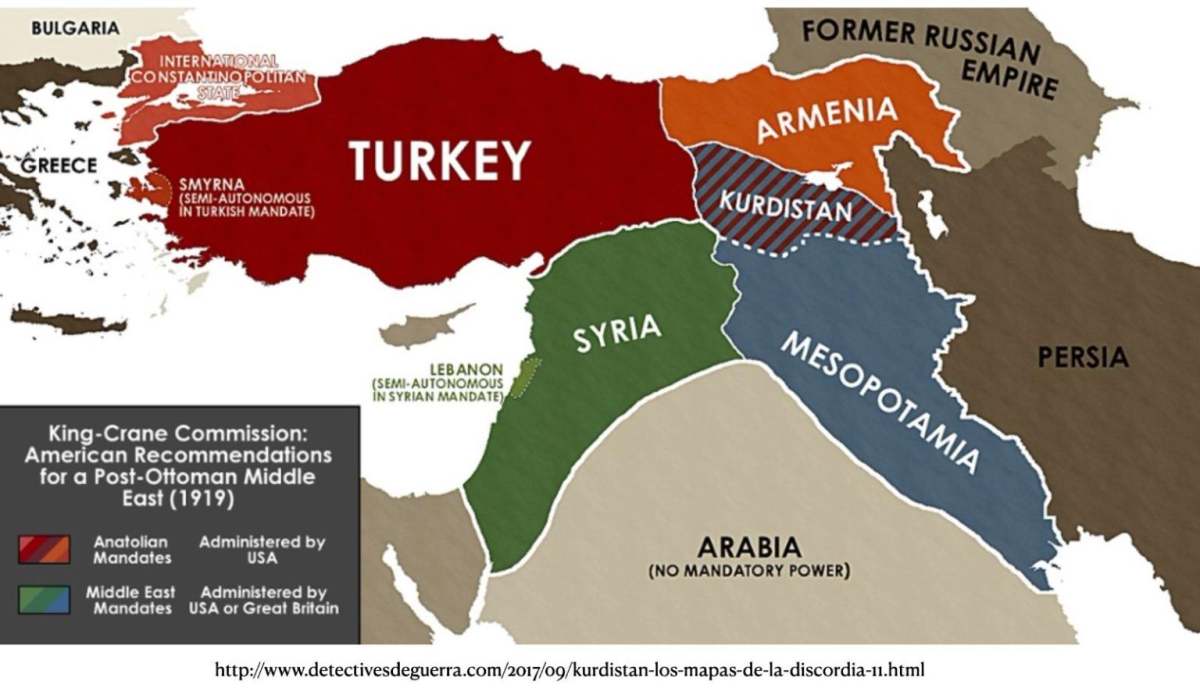
Arab forces benefited from Wilson’s principles to free themselves from Ottoman control. The Kurdish nationalist movement also adopted this principle to build an independent state similar to the Arabs. However, the Kurdish position was fragmented regarding these principles, with the most support coming from the family of Bedirhan (see Jordi Gorgas – The Kurdish-Turkish Movement in Exile – pp. 21, 22). These principles laid the groundwork for the Sèvres Treaty map, which we will mention later. The majority of the Kurdish population, wary of Wilson’s principles, relied on American diplomatic moves to apply the twelfth principle, which was entirely focused on establishing an Armenian state comprising six provinces considered part of Kurdistan by the Kurds.
The Armenian genocide in 1915 led the Kurds in the subsequent phase to avoid re-engaging in debates about the Armenian issue. This concealment resulted in a limited understanding among current Kurdish generations of how Lausanne passed without armed Kurdish opposition or why they lacked enthusiasm for the Sèvres Treaty of 1920, which outlined Kurdish borders. More specifically, without understanding the Armenian issue, Kurdish history from the Ottoman reforms of 1839 to the Lausanne Treaty of 1923 remains incomplete and incomprehensible. Therefore, most traditional Kurdish writers, unintentionally, resort to self-criticism, claiming that the Kurdish people and their leaders were ignorant and easily deceived by Turkish promises. Such conclusions, depicting Kurdish losses, foster a false and empty national consciousness deprived of lessons from historical experience. The Armenian issue was a bomb detonated in the hands of the Kurdish, and everything that followed must be re-read in light of this explosion, which both Kurds and Armenians contributed to, by failing to prioritize a shared settlement of land and sovereignty over the land that bears two names: Armenia and Kurdistan.
In the fall of 1913, Kurdish prince Abdul Razaq Bedirhan sent a message to the Kurds warning of a broad international plan forcing the Ottoman state to cede large parts of its lands in North Africa and Anatolia after its crushing defeat in the Balkan Wars. At that time, the prevailing view was that the great powers had laid the foundations for establishing an Armenian state within the borders of the six provinces where Kurds made up about 80% of the population, according to Bedirhan’s message. Abdul Razaq Bedirhan noted that “if the Ottoman government refuses to relinquish Kurdish lands, it will lose Constantinople and Asia Minor” (Haukur Taher Tawfik – The Kurds and the Armenian Question – pp. 758, 760).
During that period, between the coup of the Union and Progress and the declaration of the Turkish Republic, the cavalry forces (known as the Hamidiye Brigades) were the largest armed Kurdish force. Kurdish leaders worked hard to thwart the Ottoman government’s attempts, which were close to Armenians between 1908 and 1911, to disarm these forces. Abdul Razaq Bedirhan pointed out that these efforts were not aimed at rogue tribal cavalry units, as often portrayed in modern Kurdish history, but he warned against “disarming the Kurds” (Haukur Taher Tawfik – p. 761).
Discussions about tensions between Kurds and Armenians were scattered under various factors, but the outcome was tragic and brutal against Armenians. During Bediuzzaman Said Nursi’s debates with tribes in Van, fears arose among the common people about Armenian domination of Kurdistan, possibly with European backing. Nursi quoted several excerpts from these concerns and his responses in the “Messages of Light” collection, most notably in the volume titled “Refinement of Islam.”
Nursi warned, before this period of tribal conflicts, against disbanding the Kurdish cavalry forces. He wrote an article published in the “Shura-yi Millet” newspaper on November 19, 1908, criticizing the government’s decision to close the tribal schools from which most Kurdish officers in the Ottoman army and the Hamidiye Brigades graduated. He likened the tribal school to a “window” that had been closed and the Hamidiye Brigades to a door. He warned that closing the school would undermine Kurdish loyalty and devotion to the state, questioning what would happen if the doors were sealed—i.e., if the brigades were disbanded.
Thus, the “prevailing Kurdish narrative” about the history of Kurdish liberation includes unknown and confused pages, such as the hesitation to admit that Kurds worked with all their might to thwart what is called Wilson’s liberating principles. Therefore, it is necessary to raise provocative questions for research and intellectual challenge: Is there a hidden settlement in the Lausanne Treaty between Kurds and Turks? Did the Turkish team exceed the bounds of understanding and use the treaty as a sword over the Kurds’ necks? Would it have been better to establish “Little Kurdistan” in the areas of the Bedirhan family and relinquish the six provinces (Van, Bitlis, Erzerum, Sivas, Kharbūt, and Diyarbakır) to Greater Armenia? What truly happened from the 1908 constitutional coup until the end of the War of Independence in 1922? Would it have been possible for Turkish leaders to give up Kurdistan to the Kurds after committing the worst crime of the era—the Armenian genocide—through official, documented communications by Talat Pasha and the Union and Progress leaders? Did the European model of establishing modern nation-states set the stage for reciprocal massacres in the collapsing Ottoman East?
In a 1913 article titled “Pen Before Sword,” Saleh Bedirhan wrote in the magazine “Roji Kurd” that the Kurdish people are now like a deaf and mute person who has suffered greatly but cannot express it or seek help.
In any case, what we will present in these pages is a broader story of Lausanne beyond the prevailing narrative. Where should we start to understand what happened in Lausanne, which legally ended the Kurdish people? Should we begin with the Sèvres Treaty, which preceded it by three years? Or should we go back to World War I and the joint resistance against the fierce Russian attack and the clashes with the Armenian Dashnak forces?
The reality is that Lausanne is a chapter in a long story that began a thousand years ago, and that chapter remains open. Similar episodes occurred over the past thousand years in Kurdish-Turkish relations.
Therefore, Lausanne cannot be reduced to a legal treaty between the crumbling Ottoman state and European countries; it is the result of a thousand years of complex, turbulent, and neighboring relations among three peoples: Kurds, Turks, and Armenians. Without completing the picture of the Armenian element, it is impossible to fully understand this treaty from a Kurdish perspective, because to this day, the young Kurdish generation questions how their ancestors were easily deceived by these blatantly foolish clauses. And when they raise this legitimate question without receiving an answer, they have pushed aside the Armenian element in the equation. Consequently, Lausanne becomes incomprehensible to them. Is this enough to grasp the treaty and find answers to pressing questions? Not at all. It is necessary to go further back, to Sèvres three years earlier. Or even further back to World War I and the resistance against the Russian invasion, and clashes with Armenian forces.
The story’s roots go even further, back to the 1853-1856 Crimean War. Should the story start here? Or even earlier—at the 1839 Tanzimat edict?
The question of where to begin takes us deeper into history, and each proposed starting point shifts the narrative. Therefore, it is better to go back to the beginning—back to 1042, when the Kurds first saw men on horseback at the gates of their capital, Mahfaraqin. It is said that those men were Turks, marking the first encounter and clash between the two peoples in the depths of Kurdish lands.