


It is no coincidence that Devlet Bahçeli, leader of Turkey’s Nationalist Movement Party (MHP), launched his initiative on October 22, 2024, when he invited PKK leader Abdullah Öcalan to “speak in the Turkish Parliament to end the armed struggle and dissolve the Kurdish worker party PKK.” On that day, with the BRICS summit taking place in Kazan, Russia, Turkey’s dance between the White House and the Kremlin, which began on August 9, 2016, with the summit between the Russian and Turkish presidents, came to an end. This was when Turkey’s application to join BRICS was rejected. This was made clear three weeks earlier in Russian Foreign Minister Sergey Lavrov’s statement: “BRICS is an entity composed of countries with a shared vision. Membership also requires adopting a stance that diverges from the European position on Ukraine” (Zaman Arabic, September 30). Notably, Iran joined the Russians in rejecting Turkey’s application.
Here, hours after Bahçeli’s announcement, Turkish President Recep Tayyip Erdoğan endorsed the initiative. The surprise was the initiator himself, a member of a Pan-Turkic nationalist party with extreme chauvinistic positions toward the Kurds and connections to the military establishment and the deep state. Erdoğan’s quick endorsement, however, indicated both the seriousness of the proposal and that it was the result of a major internal reassessment within the Turkish state.
Looking back, the end of Turkey’s “Eastward Turn” policy on that day in Kazan represented a new expression of Turkey’s crisis in international relations. Since its foundation in 1923, modern Turkey has played a functional role aligned with Britain against the Bolsheviks. Its neutrality was purchased from London and Paris in the second half of the 1930s as World War II loomed, followed by its functional role in NATO from the early 1950s against the Soviets, and in the attempt to establish a “Middle Eastern NATO” through the Baghdad Pact in 1955.
With the end of the Cold War, marked by the White House’s victory over the Kremlin in 1989, Turkey experienced a loss of its traditional functional role in international relations. President Turgut Özal, shortly before his death in 1993, argued that “Turkey belongs to a Turkic world extending from the Aegean Sea to Chinese Turkestan,” in an attempt to secure Ankara’s role with Washington in organizing a geopolitical area resulting from the Soviet Union’s collapse. This region served as a geographical barrier between the Americans’ old adversary, Moscow, and a latent, economically rising adversary they were beginning to perceive in China.
Then came Islamist Prime Minister Necmettin Erbakan in 1996 and 1997, who proposed a southward shift toward Iran, Iraq, and Syria, before the military staged a coup on February 28, 1997, with American approval. After him, Erdoğan and his party came to power in 2002, presenting to the Americans—who were shocked by the September 11, 2001 attacks—the argument that “Hassan al-Banna’s disciples are best equipped to confront al-Qaeda, bin Laden, and Zawahiri.” This Erdoğanist approach was supported by the Americans through their domestic backing against their old allies within the Turkish military establishment.
Erdoğan then became the contractor and intermediary who provided American cover for the Islamists’ rise to power in Tunisia and Egypt in 2011 and 2012, and their participation in Libya and Yemen. Washington’s withdrawal of support for the Islamists, along with its backing of the July 3, 2013, coup in Egypt, marked the beginning of tensions in Turkish-American relations. This tension only ended in Damascus on December 8, 2024, when Washington sponsored the Islamists’ rise to power in partnership with Ankara. This was a blow to Moscow and Tehran and can be described as a retaliatory strike launched by Erdoğan in response to the Russian-Iranian strike in Kazan a month and a half earlier. Just as Cairo 2013 marked the beginning of Erdoğan’s tension with the Americans, his later cooperation with them in post-Bashar al-Assad Syria recalls his alignment during the period 2002-2013.
Here, it is likely that Bahçeli’s initiative draws profound lessons—not only from the crisis of Turkey’s loss of its traditional functional role in international relations that began in 1991, but also from the structural crisis of the Turkish state since its founding in 1923 by British Foreign Secretary Lord Curzon. At that time, the external functional role of the Turkish state provided international protection and economic gains, which served to mask or mitigate the internal fragility of the Lausanne Treaty state.
When the internal situation was exploding, as in 1925, 1930, 1937-1938, and 1984-2024, the outside world hastened to prevent collapse or fragmentation. Even when Erdoğan appeased the Americans in Libya against the Russians—who support General Khalifa Haftar in the East—and when he appeased the Russians in Syria from 2016-2020, which angered the Americans, this double game did little to benefit him. Then, while he was close to the Russians and Iranians in Syria, he found himself at odds with them in the Azerbaijani-Armenian conflict from 2020-2023.
Perhaps one of the many motives behind Bahçeli’s initiative, along with Erdoğan’s, was the fear of Iranian power vacuums in the region after the defeat of Tehran’s allies in Gaza and Lebanon in the fall of 2024, and the potential Turkish costs if this vacuum is filled without Ankara’s involvement—especially in Syria. This is likely the reason for Ankara’s haste, alongside Washington, to craft an operation to oust Bashar al-Assad between November 27 and December 8. Erdoğan knew this was a betrayal of his partners in Astana and Sochi, Vladimir Putin and Ali Khamenei, and a painful blow to them. However, it was deemed necessary by Washington to end the Iranian axis and weaken Russia ahead of negotiations regarding Ukraine.
Yet, the deeper explanation for Bahçeli’s initiative is that Turkey, externally floating and unanchored, is no longer effective as long as its internal fragility remains unaddressed. The cure for Turkey’s internal pain lies in healing its greatest ailment: that it is a republic founded ideologically on an exclusionary, eradicating nationalism within a multi-ethnic society.
It is remarkable that this comes from the leader of a Turkish nationalist Turanist party and the leader of an Islamist party, and that their initiative is directed toward a leader imprisoned on an isolated island. He is the leader of a party that combined Marxism with Kurdish nationalism. In his new century, he developed the theory of the “democratic nation,” which advocates for a homeland without a fixed national identity, where citizens enjoy political freedom and equality, while their ethnicities, religions, and sects live in freedom and cultural, ritual, and linguistic pluralism.
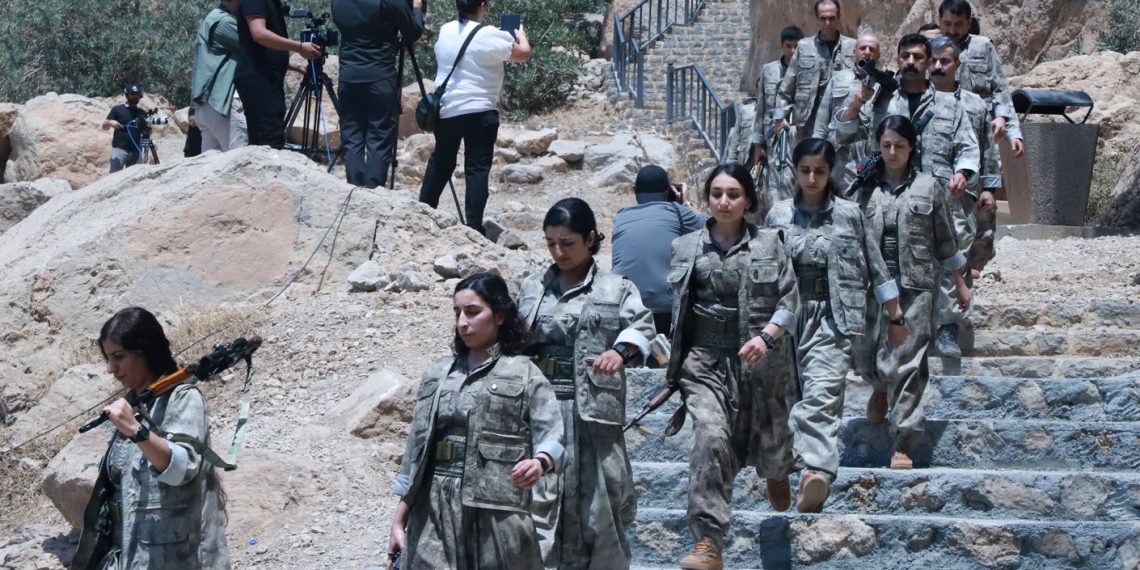
These three figures are at odds with Kemalism. Will they come to an agreement, especially after Mr. Öcalan gave positive signals regarding the Bahçeli-Erdoğan initiative on February 27? Subsequently, the Kurdistan Workers’ Party (PKK) responded positively at its 12th congress last May. Cemil Bayik, co-chair of the Executive Council of the Kurdistan Communities Union (KCK), announced the pursuit of “resolving the Kurdish issue through political and legal channels” (Hawar News Agency, May 18), after the party congress agreed to “dissolve the organization’s structure and end the armed struggle.”