

In 1936, Leon Trotsky published his book, “The Revolution Betrayed: A Criticism of the Stalinist Experiment” to diagnose the situation in the Soviet Union under Stalin. Trotsky argued that a “new ruling stratum sought to dispense with the old principles and control the masses, and looked for a guaranteed rule in its domestic affairs. Stalin, who was a second-rank figure in the revolution, emerged as the unchallenged chief of the Thermidorian bureaucracy and the first Thermidorian” (The Revolution Betrayed, Dar Al Talia, Beirut 1968, p. 100). He further added: “The bureaucracy triumphed not only over the Left Opposition (led by Trotsky against Stalin after Lenin’s death in 1924) but also over the Bolshevik Party and over Lenin’s program… The heavy rear guard proved to be heavier than the head of the revolution. These are the explanations of the Soviet Thermidor” (p. 101).
Who studies the history of the Russian Marxist movement will observe a focus, since its beginnings, among its key figures (Lenin, Martov, Trotsky, Bukharin, etc.) on the experience of the French Revolution of 1789 and its aftermath. Even the disagreements between the Bolshevik Lenin and the Menshevik Martov during the 1903 party split involved the French yardstick. They agreed that the goal of the Russian Revolution was democratic, not socialist (clear in Lenin’s 1905 book: Two Tactics of Social-Democracy in the Democratic Revolution, though Lenin changed his view in 1917, adopting the slogan of socialist revolution in the “April Theses”). The dispute lay in Lenin’s view that the Russian bourgeoisie was incapable of achieving the goals of the 1789 bourgeois-democratic revolution, and that Marxists and the working-class party would lead the revolution to achieve those goals. Martov, conversely, advocated for supporting the bourgeoisie against Tsardom, the aristocracy, and the church in realizing the democratic revolution.
Here, both the Bolsheviks and the Mensheviks agreed that the Jacobins, under Robespierre, during their peak period (June 2, 1793 – July 27, 1794), represented the revolutionary purity and the left of the French Revolution. They viewed the overthrow of the Jacobins on July 27, 1794 (the 9th of Thermidor according to the French Revolutionary Calendar) as a deviation from the revolutionary line of July 14, 1789, a shift towards a “deviational” course that ended the revolution. The Thermidorians, who ruled by controlling the National Convention (which later dissolved itself and delegated its powers to the Directory on November 2, 1795), represented a shift away from the “correct line.” However, they neither returned to the old monarchical system nor fully adhered to the revolutionary path. Their opposition came from the Left (the remnants of the Jacobins and the communistic egalitarian tendency led by Babeuf) and the royalist Right, which sought to restore the monarchy. This created chaos and turmoil under the Thermidorian rule until the officer Napoleon Bonaparte overthrew the Thermidorian Directory in the Coup of 18 Brumaire/November 9, 1799, seizing sole military power.
Trotsky offered an analysis of the Thermidorians’ victory over the Jacobins: “The fatigue of the masses and the decay of the cadres in the eighteenth century helped the Thermidorians triumph over the Jacobins. A deep historical analytical study of the matter subsequently demonstrated that the Jacobins’ base rested on the lower strata of the petty bourgeoisie surging with the overwhelming wave. It was natural that the eighteenth-century revolution, which was responsive to the development of the forces of production, would push the big bourgeoisie into power. The Thermidorian movement was merely a link in this inevitable development” (p. 111).
He then provided a social interpretation of the “Stalinist Thermidor”: “The present state of production is incapable of guaranteeing necessities for all, but it permits giving great privileges to a minority and uses inequality as a stimulus for the majority… Thus the Soviet Thermidor appears clearly to us. Poverty and ignorance return in a new form represented by a chief who threatens with a strong stick, while the bureaucracy, which was commonplace in the past, has transformed itself from the servant of society into its mistress” (p. 116).
A study of the Thermidorians in France notes their moderation following the previous revolutionary phase, their distance from dogmatic rigidity and extremism. This moderation was evident in their attempts to soften the Jacobins’ radicalism and extremism against religion and the church, and to ease the state’s grip on the economy that the Jacobins had imposed on prices and the property of the wealthy. They also ended the Reign of Terror and the power of the guillotine wielded by Robespierre. Yet, they satisfied neither the royalists nor the remnants of the Jacobins and the egalitarians who found broad social ground during the economic crisis of 1795-1796. Since the Thermidorians did not yield to those on their right or left, they sought salvation from the internal crisis in foreign wars. This produced an overblown military force that led to the Bonapartist overthrow, after Napoleon Bonaparte emerged as the “savior” from the chaos of the Right and Left fighting under a centrist rule that could no longer maintain power.
However, unlike the French case, it can be argued that Stalin’s fate was not like that of the Thermidorians, even though Trotsky’s book warned him of a potential Bonapartist situation that could emerge in Moscow and overthrow his “Thermidorian rule.” This led Stalin to quickly arrest and execute Marshal of the Soviet Union Mikhail Tukhachevsky in May 1937.
If Stalin was a centrist in the Bolshevik Party leadership struggles of 1924–1929 between the Left (Trotsky), who wanted a strict policy toward the peasants, and the Right (Bukharin), who desired flexibility and the allowance of a free commodity economy, he would not have isolated Trotsky in alliance with Bukharin, nor would he have, after eliminating and isolating Bukharin from the Politburo in 1929, implemented the Left Opposition’s program of forced agricultural collectivization (Kolkhoz) and compelled millions of peasants to settle in cities to become industrial workers.
He was a centrist in the factional struggles but an extremist in the economic program. He might be considered a Thermidorian for abandoning the global revolutionary spirit advocated by Trotsky in his theory of “Permanent Revolution” in favor of the theory of “Socialism in One Country.” This move was viewed by Trotsky, as well as the rulers of England, France, and Germany (who feared waves of European revolutions following the Russian Revolution), as Stalin’s abandonment of the revolutionary drive and the “export of revolution.” This pleased right-wing rulers in the West and angered the Trotskyist revolutionaries.
Undoubtedly, the Stalin of the 1930s did not resemble Lenin and his policies during 1917–1922. However, didn’t Stalin’s pragmatism, which made him “Thermidorian” (and more accurately, a realistic observer of the balance of power and interest), as evident in his 1939 pact with Hitler to avert the danger of German military focus on the East instead of the West, resemble Lenin’s pragmatism in the Treaty of Brest-Litovsk in March 1918, when he ceded vast areas of Ukraine to the Germans and their advancing army in exchange for preserving Bolshevik power? And didn’t the Stalin who appeared moderate toward the domestic front and the outside world (London and Washington) when he needed them in his war with Hitler from 1941 to 1945 appear as a leftist extremist after the Cold War erupted in 1947 with the American-European West?
Trotsky’s theory of Stalin’s Thermidorian nature remains a subject of debate. The interesting point is that a declassified CIA report, released under the US Freedom of Information Act, assessing the 20th Congress of the Soviet Communist Party (February 1956), where Khrushchev delivered his report against the cult of personality surrounding Stalin, included this question: “Will the process of de-Stalinization lead to a Thermidorian situation or to a Napoleonic military dictatorship?”
Furthermore, Stalinists still view the era of Nikita Khrushchev’s leadership (1953–1964) as a Thermidorian deviationfrom the “correct line” represented by Stalin (Lenin’s successor). This view is echoed by Maoists regarding the line of Deng Xiaoping since 1978, who led the Chinese Communist Party to preside over the largest capitalist transformation witnessed by humanity since the Industrial Revolution in 18th-century Britain, regarding it as a deviation or displacement from the revolutionary line of Mao Zedong, who imprisoned Deng Xiaoping during the Cultural Revolution (1966–1969).
Thermidorianism in the Syrian Context
In January 2021, a study was published by the European University Institute, supported by the European Commission and funded by the European Union budget, conducted by Jérôme Drevon and Patrick Héni, entitled: How Global Jihad Is Being Domesticated and Where It Is Leading: The Case of Hay’at Tahrir al-Sham, the former al-Qaeda affiliate in Syria.
The study argues that “the transformations in Hay’at Tahrir al-Sham suggest a commitment to establishing a Thermidorian state… which implies a regression from a political entity’s (or person’s) revolutionary dynamic, which involves a radical break not sought to take power but to retain it” (p. 25). It states that “the political context in Idlib is Thermidorian in more than one respect, such as the disenchantment with the revolutionary utopia amid an undefined cessation of armed conflict (after the March 5, 2020 agreement between Putin and Erdoğan to fix the lines of fighting in Idlib province), and the renunciation of utopia in governance methods, coupled with reliance on external factors, alongside the search for compromises at difficult moments of action” (p. 25). It concludes that “Abu Mohammad al-Jolani, according to this view, holds a Thermidorian perspective, in that the (revolutionary Islamic leader) is in a position where he cannot achieve his goals through revolutionary action alone, but through external factors, which pushes him toward a ‘wait and see’ policy that reflects a principle of flexibility and reliance on external powers” (p. 28).
Through this Thermidorian view of Hay’at Tahrir al-Sham’s (HTS) situation in Idlib after March 5, 2020, the study considers the organization a “light-version Salafist” (p. 32). It suggests that the “Thermidorian transformation of HTS has provided an opportunity to solve the very problem from which it emerged as a former extremist jihadist organization” (p. 31). From this perspective, “Idlib can be considered a new model for the deprogramming of the radical and global agendas of Salafi Jihadism” (p. 27), and that “HTS appears to be the only one capable of developing and implementing a military counter-jihad strategy against remnants of Al-Qaeda and ISIS networks”(p. 31).
The study implies that this new Western perspective on an organization belonging to the Salafi-Jihadist current stems from a functional utility desired by the West, European, according to the text’s source, and certainly American : “The only way to defeat global jihad is to rely on local forces” (p. 31), rather than “on remote strikes” (p. 31), such as drone attacks, or through a “failed” “counter-terrorism strategy” (p. 32). The study recalls and notes that HTS’s attack and elimination of the Hurras al-Din organization in the summer of 2020 (members of Jabhat al-Nusra who refused to break ties with Al-Qaeda in 2016) created a situation that “resulted from HTS’s quest for dominance and deprived Al-Qaeda of any substantial presence on Syrian soil for the first time in nine years” (p. 1).
Ultimately, the study reaches the conclusion: “Hay’at Tahrir al-Sham, in pursuing its objectives, effectively suits Western interests from various angles” (p. 31), based on the premise that “the ability to negotiate and create political deals is a practical solution with organizations that Western countries cannot eliminate, and the Taliban exemplifies this case” (p. 32). The United States had signed an agreement with the Taliban on February 29, 2020, in Doha, and then the US turned a blind eye to the Taliban’s takeover of the Afghan capital, Kabul, on August 15, 2021, despite having fought them since 2001.
Frankly, the author of these lines, despite having cited the 2021 study from the European University Institute in his own study, “The Syrian Armed Islamic Opposition,” published by the Kurdish Center for Studies on May 8, 2024, to interpret the situation of Western American-European acceptability of Hay’at Tahrir al-Sham’s role in Idlib, wishes to admit that he is now re-utilizing the mentioned study to attempt to interpret the reasons, or some of the reasons, for the Western American-European acceptability of HTS’s situation in Damascus after December 8, 2024.
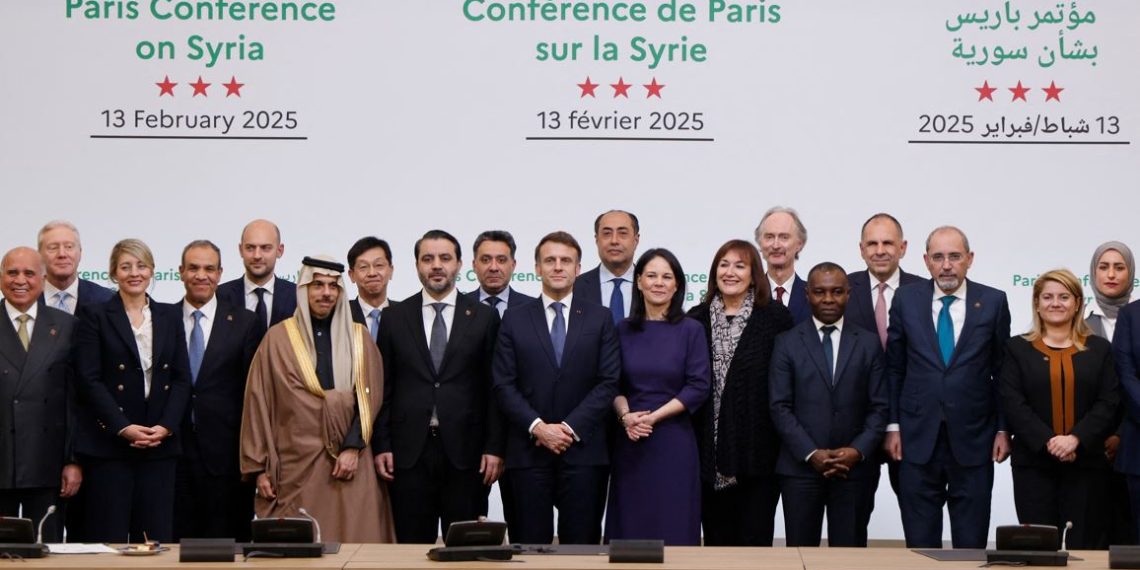
This matter remains perplexing to the majority of Syrians—whether opposition, loyalist, or gray toward the new Syrian authority—as well as to regional and international parties. The author does not seek to provide an answer or answers but, through this text, aims to approach the reasons for this acceptability and, fundamentally, to present or pose an open question to interpret or attempt to interpret what transpired on December 8, 2024, which is a pivotal and perhaps the most significant event since April 17, 1946.
The author does not intend to study the extent to which the West’s view of the new Syrian authority aligns with the facts or contradicts them (as Henry Kissinger says: “There are no permanent friends or enemies, only permanent interests”), but to confine the study to an approach that feels for the reasons behind that view within the policy-making circles of the United States–United Kingdom–European Union triangle—a view that clearly reflects acceptability for the new Syrian authority one year into its tenure in Damascus.