


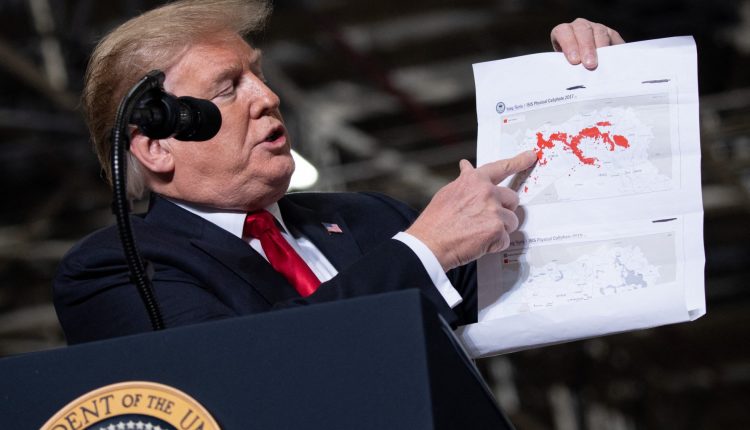
The Kurds of Rojava followed the hectic presidential race to the White House of 2024. On November 4, they received with great anxiety the long- expected yet unwelcome hour when it struck. On that day, Donald Trump made a stunning comeback from his loss to Joe Biden in 2020, carving a decisive victory to a second term in the Oval House.
In Rojava, the Kurdish enclave in Syria’s northeast region, Trump had been notoriously associated with Operation Spring Peace mounted by Turkish Armed Forces and its Syrian mercenaries in Sere Kaniye (Ras al-Ain) and Gire Spi (Tal Abyad), during Trump’s first term back in 2019. Yet the sequel to the drama was still to be fully played out.
Elsewhere, quite not unrelatedly, a month later, by the result of a two- week long blitzkrieg, the long- time regime of Bashar Assad was made a history. Quite sarcastically, the successor to secular Assad was an unrepentant Jihadist.
Abu Mohamed al-Jolani, chief of al-Qaeda’s branch in Syria, Jabhat al-Nusra, which had, by a Jihadist tradition, changed its name to Hayat Tahrir al-Sham, himself now assumed a new name; Ahmed al-Sharaa, allegedly his real name.
From the get-go, Trump attributed Syria’s mind- blowing occurrence to his Turkish counterpart, Recep Tayyip Erdogan, who, by an “unfriendly takeover without a lot of lives being lost,” had emerged as the main beneficiary of Assad’s deposition.
The President-elect, who plainly said that Turkey holds the key to the future of Syria, alluded likewise to Erdogan’s imperial past aspirations in the country, saying “they have wanted it for thousands of years.”
When Trump assumed power, one of the first decisions to take regarding the Syrian issue, was to appoint Thomas Barrack, his Ambassador to Turkey, as his Special Envoy to Syria, in the main to bring Kurds and al-Sharaa together. Yet, Barrack, would openly embrace al-Sharaa’s.
Trump’s words, not unprophetically, have come true. This takeover by Turkey of Syria comes at the expense of gains and sacrifices made by Syrian Kurds, who, up to recently were the United State’s most reliable allies in the war against the Islamic State in Syria and Iraq (ISIS).
Pro- Turk to the bone, Barrack naturally holds grudges against the Kurds and their ambition in autonomy. Trump’s man to Syria, a businessman rather than a diplomat, has from the inception buried his head in Rojava’s sand, surpassing the average ostrich in the practice.
To cut short a long story, the Kurds in January the last have lost large swathes of territories they had held in Tabqa, Deir Ezzor, and Raqqa which they had liberated from ISIS at the points of their bayonets back in 2016- 2019.
Not only this, Syrian Government forces and its extremist (local and foreign) allied groups have committed war crimes and crimes against humanity against Kurdish civilians in every locality previously held by Kurdish- led Syrian Democratic Forces (SDF).
However, while the Kurds were seen again friendless and left to their own devices, their just cause, unity, unprecedented global solidarity, and threats posed against their very existence in Syria seem to have garnered support.
Recently, Western voices and calls to the effect that the Kurds ought to be protected emerge to be heard and are notedly in the ascendant. On top of these calls perch Senator Lindsey Graham, the Chair of the Senate Appropriation Subcommittee, which oversees foreign aid and State Department.
On January 29, Graham, along with Senator Richard Blumenthal (of the Democratic Party) introduced a legislation (Save the Kurds Act), mainly to impose bone-breaking measures on the Jihadist-leaning government of Ahmed al-Sharaa, in case it recommences attacks on the Kurds, and demands al-Sharaa’ s HTS be re-designated as FTO.
The influential Republican Senator, who sponsors the bill, believes the proposed bill receives a strong bipartisan support that could carry it into effect on the ground.
While the Kurds have reached a new deal (actually the fourth) to integrate into the interim government, they still face mounting pressure from the central government and pro- Turkish militias, amid ongoing sieges and waves of displacement linked to Syrian forces.
Yet, while the bill is expected to be discussed in fine details in the coming days, and hopefully will be passed, the move in itself is symbolic since it is reminiscent of the one that had failed to pass in 1919- 1920. This by all appearances puts more pressure on the Senate.
Historically speaking, Save the Kurds Act brings to memory the century- long rejected proposal President Woodrow Wilson had in 1919 lodged to the Congress, asking for a potential American mandate over Armenia and Kurdistan.
To bring the story to light, let us go back in history to the days when weapons had fallen silent, curtailing presumably the bloody scenes of World War One 1914-1918, and setting assumedly the stage for a “peaceful” political settlement that has never brought peace to the Middle East.
In the Paris Peace Conference, 1919-1920, British Prime Minister, David Lloyd George, had Mohamed Sharif Pasha represent the Kurdish claims. The former Ottoman diplomat, not letting the chance slip, rose to the occasion par excellence.
Sharif Pasha introduced himself as the Kurdish delegate to the conferees in Paris, and had the Kurdish cause submitted a pamphlet detailing Kurdish historic and territorial claims to Kurdistan. The first, it must be said, in modern history.
In the very same vein, and since Great Britain had no clear vision for Kurdistan, Lloyd George had, via his persuasive eloquence, convinced the U.S. President Woodrow Wilson, best known for his Fourteen Points of self- determination, to have a mandate over Armenia and Kurdistan.
To put the idea into performance, General James Harbord was sent on a mission to Armenia and Kurdistan, to assess the situation first hand. In June, Wilson left Paris to propagate for his ideal. Yet sadly enough, his health was rapidly deteriorating.
While the fate of Kurdistan was still undecided, the British with all certainty, had no interest in the land of the Kurds. In September 1919, the Syrian Agreement was signed hereby the British were to hand to the French all Syrian territories they had conquered during the war.
By that time, Wilson was back home. He spent the summer touring the country by rail to convince the nation that the Treaty of Versailles should be ratified by the Congress, and that the United States should join the League of Nations.
To do him justice, the ailing American president met success in inducing people in a number of states to his ideal. However, he had a formidable and bitter political enemy whom he could not induce to his view. Such an opponent would upset the applecart.
While Wilson was in the Versailles Palace, Henry Cabot Lodge, the Senate’s Foreign Relations Committee Chairman, and majority leader, and like- minded senators were not marking time. They had full time to lobby against the treaty. In official circles, Lodge was influential.
Unwaveringly, Lodge opposed Wilson’s proposal that his country join the League of Nations. Further still, he was of the opinion that Germany must be utterly crushed and a harsh political settlement must be imposed. Conversely, Wilson was more lenient on Germany. This added, to all intents and purposes, more fuel to the fire.
While Wilson was in the French capital, Lodge had succeeded in pitting American political and diplomatic circles against the President. The unsuccessful foreign policy of the United States played into the hands of the Senate’s Foreign Relations Committee Chairman.
Back home, the gravely ill president, while touring the country, suffered his fourth and the most severe ischemic stroke on October 2. The tour ended abruptly. The stroke would leave Wilson bedridden until retirement, in 1921. The idea as a whole seemed to have been vanished.
A month later, not unexpectedly, the Congress vetoed the Versailles Agreement, and thus rejected the League of Nations Covenant (November 19). Great expectations were reduced now to forlorn hopes. Wilson was not to give up.
Upon rejection, Sharif Pasha and Bughos Nubar, the Armenian chief negotiator in the conference, to possibly bridge any potential gap that might occur, were made to sign a more conciliatory agreement the following day.
Thereupon, a joint Kurdo-Armenian statement of peaceful cooperation, where they asked the conference to establish a joint mandate over both Armenia and Kurdistan was issued.
It was stated in the agreement that a united Armenia and an independent Kurdistan should be established under the same mandatory power; that the drawing of the Kurdistan- Armenia border was left to the decision of the peace conference; that both states would respect minority rights.
In the United States, the Wilson-Lodge rivalry took a more personal dimension when Lodge, harboring deep- seated festering grudges (dating to 1916) against the president, made numerous reservations and proposed likewise amendments to the treaty.
Steadfast from his part, Wilson, who disliked Lodge, and had decided against inviting him to the peace conference, refused to introduce any changes. None of them acquiesced.
However, while the personal dimension of the story cannot be ignored, the mutual personal animosity was further fueled by ideological differences; Wilson was a progressive Democrat and Lodge a conservative Republican. Yet the story has another dimension.
We need to know why Lodge was so adamant to rally against Wilson’s proposal. To the American audience, Lodge’s concerns about open- ended commitments to the League of Nations, were broadly somewhat sound.
In a broader sense, Lodge’s fears were justifiable. The Senate’s strongest man based his fears on Article X of the League’s Covenant that it could commit U.S. to foreign intervention without the consent of Congress. These fears were not baseless.
Elsewhere, the ill- judged Russian adventure of Archangel, which had futilely claimed some 200 American lives, had tarnished irreparably Wilson’s image and casted thick shadows over the Wilsonian foreign policy.
Consequently, Major General, William Graves, commander of the American Expeditionary Force-Siberia, issued orders on Saint Sylvester’s Day for the troops to concentrate at their ROs. On January 5, 1920, he would finally receive the official orders to withdraw.
The Chief-of-Staff, Peyton March, described the mission as little more than “a military crime”. The American failure in Siberia, which was basically recommended by the president himself, shifted the foreign policy.
This, added to the failure of the American Expeditionary Force, North Russia, with its tragic end still alive in the American collective memory, all diminished any prospects of an American military mission in Kurdistan and Armenia.
These military failures, among previous ones, and the fact that America was not engaged in war against Turkey, all played into the hands of Henry Lodge. No compromise was reached.
Not giving up, the president, without slight consideration paid to Lodge’s changes, submitted the Covenant to the Senate for the second time, but it failed to obtain the two-thirds vote needed for approval.
Much to the disadvantage of Kurds and Armenians, on June 1, 1920, the pro-Wilson and pro-Lodge senators could not square the circle, and the request was in the result put to the second and final rejection (52 to 23 votes).
On the ground, the veto practically nipped the prospects of a Kurdish state in the bud, and gave a death blow to the fledgling First Armenian Republic (1918-1920).
Nonetheless, articles 62 and 64 of the Treaty of Sevres (August 10, 1920) made the Kurdish state a probability of the future, if the Kurds within a year were successful in formulating an ideal for their long- sought and much- wanted state.
Now, with Great Britain barely disinterested, and with the U.S. rejecting a much- wanted mandate, no foreign power could take such a mandate over Armenia and Kurdistan. For a moment, Italy was thought of as a mandatory power.
Militarily, such a bid would have necessitated deploying troops on the ground. It was an adventure that Rome could not navigate.
Sadly enough, one month after Sevres (September 1920), encouraged in the chief by the Congress rejection, Turkish Armed Forces advanced on the Armenian semi- autonomous areas. Their de facto autonomy was brutally terminated.
Relatedly, at the end of 1920, French diplomats told their British counterparts Paris was floating the idea to retreat from Cilicia, and come to terms with Kemalist Turks leaving thousands of Armenians and Kurds to their own devices. Such a change of heart consigned in all actuality the idea of Northern Kurdistan to the grave.
In 1920, the chaotic political situation at home, and the catastrophic missions abroad precluded the U.S. to furnish troops to the former lands of the Caliphate.
Today, a century+ 6 years into the Wilson-Lodge divergence, which lies at the foundation of the Congress rejection of an eastern Mandate, and which, more or less, deprived the Kurds of a state of their own, the United States in particular, has a moral obligation towards the Kurds in northeast Syria.
Yet, unlike the Russian adventures, the U.S. have already troops employed on the ground in Syria. Kurdish dearly sacrifices during the long- years of the Syrian conflict, and the egalitarian autonomy they have established ought to be preserved and recognized.
In the historical perspective, the United States had in no moral obligation towards the Kurds to fulfil in 1920. Today, in every aspect, it has. It ought to be fulfilled. That to avert a Kurdish genocide.