

At the dawn of the twentieth century, the term “Wilsonian Moment” prevailed, emerging strongly in the Western press across Paris, London, Rome, and Washington. Following the end of World War I, U.S. President Woodrow Wilson established his Fourteen Points, reflecting American visions for the post-war world. Wilson’s vision was distilled into his famous principle of the “right of peoples to self-determination.” At the time, the political movements of peoples emerging from the wombs of empires defeated in the Great War—the Ottoman Empire, the Austro-Hungarian Empire, and an exhausted Tsarist Russia—called for their right to self-determination. Under the influence of this slogan, independence movements and national identity tendencies grew, continuing until their influence waned and receded shortly after under pressure from European imperialists and within the United States itself at the hands of Republican Theodore Roosevelt, as these powers realized that Wilson’s visionary principles would signal the sunset of imperialism.
In the meantime, many conflict zones around the world are witnessing a “Trumpian Moment,” which appeared in the second phase of Trump’s governance through his favorite slogan: “Peace Through Strength.” Many states, and sub-state actors, have either succumbed to this Trumpian principle or invoked it to end their problems with neighbors. As Trump achieved successes in the field of settlements and deals, the White House’s appetite grew to impose further peace deals—regardless of the strategic goal of creating a less divided world that blocks the Russian and Chinese roles in supporting U.S. adversaries and exhausting America with a fragmented and turbulent world that delays the U.S. focus on the primary strategic conflict with China.
In August, Trump stated that he had “succeeded in ending seven conflicts” that harbored costly and perhaps sustainable wars: the conflict between Israel and Iran, Azerbaijan and Armenia, Egypt and Ethiopia, Serbia and Kosovo, India and Pakistan, Thailand and Cambodia, and the DR Congo and Rwanda. The list extends to a promise of intervention to end the civil war in Sudan, addressing the Western Sahara file by approving autonomy for the Sahrawis, and conversely, we see success in halting the Israeli war in Gaza and a diligent effort to end the Russian war in Ukraine via the 28-point plan.
The Middle East represents the epicenter of tension that Washington has been unable to extinguish through policies of appeasement, direct military intervention, or even the formula of postponing and delaying clashes. After October 7, 2023, it seemed that Washington must proceed on the path of sustainable peace within the Middle East and, to a lesser extent, peace between central states and sub-state groups and peoples. Here, the Israeli-Palestinian “conflict” comes to the fore, while another chronic conflict between the Kurds and the Turkish state remains obscured. This raises questions about the American role in the Kurdish-Turkish peace process, and where Washington and its interests stand in this trajectory.
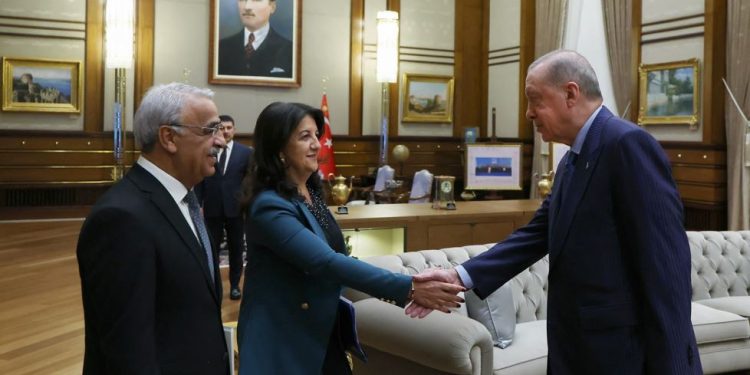
Washington welcomed the call by PKK founder Abdullah Öcalan to lay down arms, but it did not elaborate on the procedural steps or positive statements emanating from the trio: Öcalan, Erdoğan, and Bahçeli. Washington’s deliberate avoidance of appearing in the Kurdish-Turkish peace file opens the door to questions regarding the secret behind its lack of enthusiasm for resolving this thorny issue, which affects the lives and futures of some one hundred million Turks and Kurds in Turkey and its Kurdish surroundings. Thus, American “coolness” leaves behind questions that must be contemplated.
In 2006, a year after the launch of talks between the PKK and the Turkish government in Oslo under British auspices, the United States welcomed the talks, stating that “the Kurdish issue cannot be resolved by military means.” At that time, Turkey was uncomfortable with the idea of Norwegian mediation and similarly uneasy with the parallel track undertaken by the Henri Dunant Centre (HD) in Geneva, despite the center’s participation in dialogue and mediation initiatives in more than 25 countries. According to Turkish journalist Cengiz Çandar in his book (Turkey’s Mission Impossible: War and Peace with the Kurds), the “silent support” from influential international circles was “highly significant.” Turkey’s hesitation regarding third-party participation seems rooted in its perception of the Kurdish issue as a purely “Turkish problem” in the face of foreign pressure groups; Turkey, per Çandar, is concerned about the “foreign fingers” that have stirred unrest since the founding of the Republic in the 1920s.
Turkey cannot be an exception to the “Trumpian Moment.” The Kurdish issue in the Middle East represents a sustainable flashpoint whose resolution necessitates sitting at the negotiating table, offering mutual concessions (rational concessions), reforming exclusionary unilateral constitutions, and integrating Kurds and their linguistic and cultural rights into the new state system. This would subsequently require a reconsideration of the weathered “Establishment” of nation-states built on the ruins of the Ottoman Empire’s final defeat and on the rules enacted in Lausanne in 1923.
Evidence can be found of communication between the United States and the PKK during two phases. The first was after the fall of Saddam Hussein’s regime in 2003, as Washington sought to avoid a clash with the party’s fighters in Iraqi Kurdistan to keep the focus on the U.S. mission within Arab Iraq, thereby making Kurdistan a primary zone of stability. The second phase came with the start of jihadist activity shortly after the Arab Spring wave. Therefore, mediating Kurdish parties acknowledge forms of communication built on the divergence of Turkish-American viewpoints. Ankara was comfortable with the expansion of jihadist groups, unlike the United States, which saw strengthening Kurdish forces in Iraq and Syria as an opportunity to form an objective alliance to confront jihadists. Ankara’s intransigence in assisting Washington during the wave of confronting Al-Qaeda and ISIS in Iraq and Syria played a role in increasing the need for partnership with Kurdish armed forces.
With the war on ISIS, Washington began “rediscovering” Kurdish actors. Specifically with the Battle of Kobane, Barack Obama took steps that surprised everyone by providing military support to the YPG and YPJ, a support that grew into a partnership starting with the founding of the Syrian Democratic Forces (SDF) in 2015. Washington knew it was cooperating with a new ally that constantly provoked Turkey, while the Turks were waiting for the moment ISIS would topple the nascent Autonomous Administration experiment. The American-Turkish contradiction was one of the reasons that pushed the Kurdish presence forward.
Obama’s Middle East policy paved the way for American engagement without reservations with Kurdish currents, including the PKK and supporters of Öcalan’s ideas. However, Trump in his first presidency appeared hesitant and preferred “isolationism” as a break from American “interventionism.” Consequently, the Kurds paid a heavy price for Trump’s ideas based on withdrawing from Syria and replacing the local authority with Turkish authority in Ras al-Ayn/Sere Kaniye and Tel Abyad. Had it not been for the intervention of certain elements of the American Deep State, Trump would have moved toward a full withdrawal in favor of Turkish and Russian replacement east of the Euphrates.
However, Trump in his second phase—burdened by three files: the Russo-Ukrainian war, the Israeli war on the “Axis of Resistance” after October 7, and the fall of the Bashar al-Assad regime—wanted to interact with these files more optimally. His interaction meant a decline in Turkey’s international and regional fortunes and a rise in Tel Aviv’s standing in the region. Thus, Turkey sensed the “Israeli danger” for the first time. This “danger,” expressed by the Turkish government and state on numerous occasions, formed the driving force and the appropriate moment to address the Kurdish issue and return to negotiations with Imrali.
In this manner, Washington’s alignment with Tel Aviv pushed Ankara toward recalculating the trinity of: Role, Influence, and Importance. This recalculation provided an opportunity for the Turkish state (the State, not just the government) to assess its chances of surviving recession within Turkey. For this reason, the Kurdish-Turkish peace process came in harmony with the Trumpian Moment and the establishment of peace throughout the Middle East, even if Trump did not publicly declare the necessity of reaching a solution to end the armed conflict in Turkey.
There are economic benefits that require Turkey to change its traditional policies toward the Kurds and their demographic positioning. Transforming Anatolia into a corridor and transit zone for energy lines from the Turkic world (Azerbaijan and Turkestan), the Arabian Gulf, Iraq, and the Kurdistan Region to Europe will contribute to reducing Russian influence globally. For Turkey to become part of the American soft war on Russia, it must close the files that raise fears over the future of alternative energy lines.
Here, the Kurdish geography becomes of significant importance to the United States. Ultimately, there is a Trumpian Moment whose effects may persist even after Trump leaves the White House. It is likely that Kurdish and Turkish politicians have successfully captured this moment. While Turkey rejects Trump’s logic of “Peace Through Strength,” it realizes that reaching an understanding and agreement with Imrali and the PKK, and subsequently with the SDF, will help Turkey maintain its regional role and influence—all while deeply appreciating the United States’ lack of involvement in the internal peace file, as Washington prefers to leave it as an internal Turkish mission that preserves the state’s “prestige” before extremist and chauvinistic Turkish currents.