


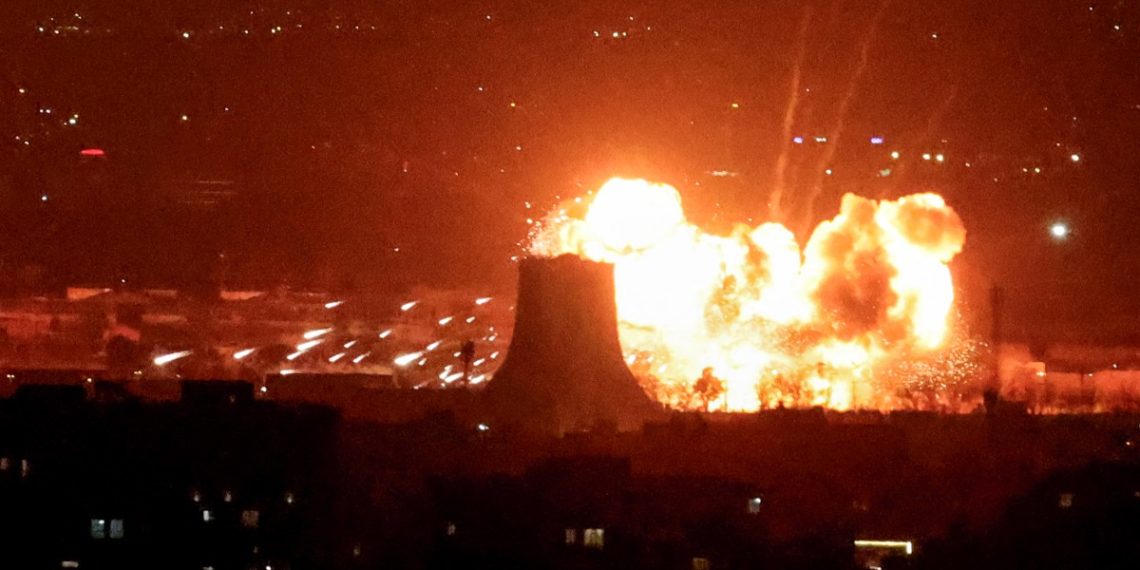
On the Sunday preceding the war of February 28, 2026, Israeli Prime Minister Benjamin Netanyahu stated: “We seek to create a comprehensive system—specifically a hexagonal formation of alliances within and around the region. This includes India, Arab and African nations, Mediterranean states (Greece and Cyprus), and Asian nations. Without delving into specifics, the goal is to establish an axis of nations against radical axes—namely the Shiite axis, which we have struck with extreme force, and the Sunni axis that is currently manifesting and taking shape.”
One cannot avoid the temptation to link these remarks to the events in Tehran six days later, when Israeli aircraft—acting on American intelligence—launched a strike that killed the Iranian Supreme Leader, Ali Khamenei. It is evident that Netanyahu intended for his statement to prepare the Israeli public for a new regional landscape following a war which, according to post-conflict leaks, was scheduled during his final meeting with President Donald Trump on February 11, after allowing a window for negotiations with the Iranians.
According to leaks in the Israeli press, the three unnamed countries in Netanyahu’s “Hexagon” are the UAE, Ethiopia, and Azerbaijan. Furthermore, his reference to the emerging “Sunni Axis” points to the joint Saudi-Pakistani defense agreement signed last September, which provides a Pakistani nuclear umbrella for the Saudis. This was followed by a rapprochement with both countries by Turkey and Egypt, suggesting the formation of a “Quartet” standing in opposition to Israel’s alliance with the Hexagon (1+6).
Netanyahu’s rhetoric signals the expected sunset of the Iranian axis and the rise of a “Sunni Quartet” that, as facts suggest, is confined to these four nations. Indeed, this “Quartet” finds itself in direct confrontation with the “1+7” (Israel and the Hexagon) across several theaters: Southern Yemen (Saudi Arabia vs. the UAE), Northern Somalia (Saudi Arabia, Egypt, and Turkey vs. Ethiopia, the UAE, and Israel), the Grand Ethiopian Renaissance Dam (Egypt vs. Ethiopia), and Sudan (Egypt, Saudi Arabia, and Turkey vs. the UAE and Ethiopia). This friction extends to Cyprus (Turkey vs. Cyprus and Greece), Syria (Turkish-Israeli competition over the post-Assad era), and Kashmir (India vs. Pakistan). Meanwhile, Azerbaijan has leaned closer to Israel regarding Iran than its ally Turkey, which favored a negotiated settlement. In Eastern Libya, the Egyptian-Saudi-Turkish rapprochement has translated into efforts to distance Field Marshal Khalifa Haftar from Abu Dhabi in favor of a settlement with the Turkish-aligned Western Libyan government—a shift perhaps underscored by the assassination of Saif al-Islam Gaddafi to remove obstacles to that reconciliation. Observers of the weeks leading up to the February 28 war note how Pakistan, Saudi Arabia, Turkey, and Egypt collaborated to urge Trump toward a diplomatic solution with Khamenei, while Tel Aviv pushed for the opposite.
Returning to the recent war, logic dictates that it was an inevitable progression of the “October 7, 2023 Wars.” In Netanyahu’s view, striking Iranian proxies in Gaza (2023-2025) and Lebanon (2024) was insufficient; his priority since the early weeks of the Hamas attack was “striking the head of the snake,” a move previously blocked by former President Joe Biden. Similarly, in the early months of his term, Trump hesitated to launch a full-scale war against Iran, permitting the Israelis only a limited engagement last year which he personally terminated on its twelfth day. However, during the current week-long conflict, Trump and Netanyahu appear united in making this a decisive turning point in the struggle with Tehran. While they agree on the three core Iranian files (the nuclear program, ballistic missiles, and regional containment), they differ on the endgame: Trump seeks “regime behavioral change and internal containment,” while Netanyahu seeks the total collapse of the Mulle regime.
The February 28 war will likely mirror the British campaign against Egypt’s Muhammad Ali Pasha in 1840 or the 1967 war against Gamal Abdel Nasser. The latter was an Israeli war fought by proxy for the United States; both were intended to contain and weaken regional leaders who had become “Great Regional Powers” and disrupted the status quo established by dominant international forces (London in 1840, Washington in 1967). The goal was to diminish their regional influence and confine them within their borders, paving the way for their regimes to produce successors who would adapt to the prevailing international will. Notably, the opening salvo of the February 28 war targeted the Iranian leadership directly—a fate Muhammad Ali and Nasser did not face. It seems the calculations of Trump and Netanyahu converged on removing Khamenei after he remained untouched in last year’s twelve-day war. Trump likely believes this will “facilitate behavioral change,” while Netanyahu views it as “accelerating the disintegration and fall of the Iranian regime.”
In summary: all indicators point to the waning of Iranian power across the Middle East. Last autumn, the Saudi-Pakistani agreement was viewed as a reaction to an Israeli strike on a Gulf capital, with Riyadh seeking a deterrent against similar scenarios. Subsequently, the alignment of Turkey and Egypt with Riyadh and Islamabad signaled the formation of an axis bracing for dramatic developments, with Iran clearly being the focal point. Netanyahu’s vision for the “Hexagon” serves the “day after” Khamenei, primarily as an attempt by Israel and its six allies to fill the expected Iranian power vacuum and position themselves against the “Quartet.”
The primary question remains: What is Washington’s stance toward the “Quartet” versus the “1+6”? Furthermore, if Iran responds by striking Gulf states—something Khamenei avoided during the twelve-day war—how will that impact the composition and map of both the “Quartet” and the “1+6”?